 Iranco Magazine Team
Processing chain, physicochemical specs, ISIRI 3623, bulk packaging, regional markets and wholesale procurement checklist
Export guide · Instant coffee · Wholesale
Iranian instant coffee: wholesale buying & export guide
Processing chain, spray/agglomerated/freeze-dried comparison, ISIRI 3623, MAP nitrogen bulk packs, Russia & Iraq markets, HS 21011100 and importer checklist — Iranco Magazine.
Instant coffee demand across the Middle East, Central Asia and the EAEU is rising for industrial powder, agglomerated and freeze-dried grades with transparent COA and MAP packing. Iran’s 5,000 t+ processing base, land borders and OEM lines make it a regional supplier to Iraq, Afghanistan, the CIS and Armenia.
This guide targets traders, procurement managers and beverage R&D teams — covering the production ecosystem, technical tables, target markets, competition, customs, industrial uses, pricing and twelve control points before remittance.
Import success hinges on grade fit (mix versus premium jar), locked ISIRI 3623 specs in the contract annex and a sealed retain sample.
1. Production ecosystem and industrial capacity (~5,000 t)
Iran’s instant coffee sector grew from green Robusta imports (Vietnam, Brazil, Uganda) and press extraction, evaporation and spray-drying lines, with agglomeration and freeze-drying added in recent years. Nameplate capacity at active plants in Tehran, Alborz, Qazvin and the north exceeds 5,000 t/year; a large share feeds domestic coffee mix and HoReCa, with the balance exported bulk or as OEM.
The chain starts at green bean import (HS 090111), industrial roast, grind, hot-water/steam extraction, concentrate to 30–45 °Brix, drying and MAP nitrogen or retail filling. Three cost pillars — energy, green bean FOB and polymer packs — set FOB margin per grade.
Iran’s Eurasian crossroads position, Caspian ports (Anzali, Nowshahr) and busy borders with Iraq and Afghanistan shorten lead times versus Southeast Asia for neighbouring markets. Iranian producers specialise in Arabic, Russian and English OEM labels and caffeine tuning for regional mix lines.
2. Processing and spray-dried vs agglomerated vs freeze-dried
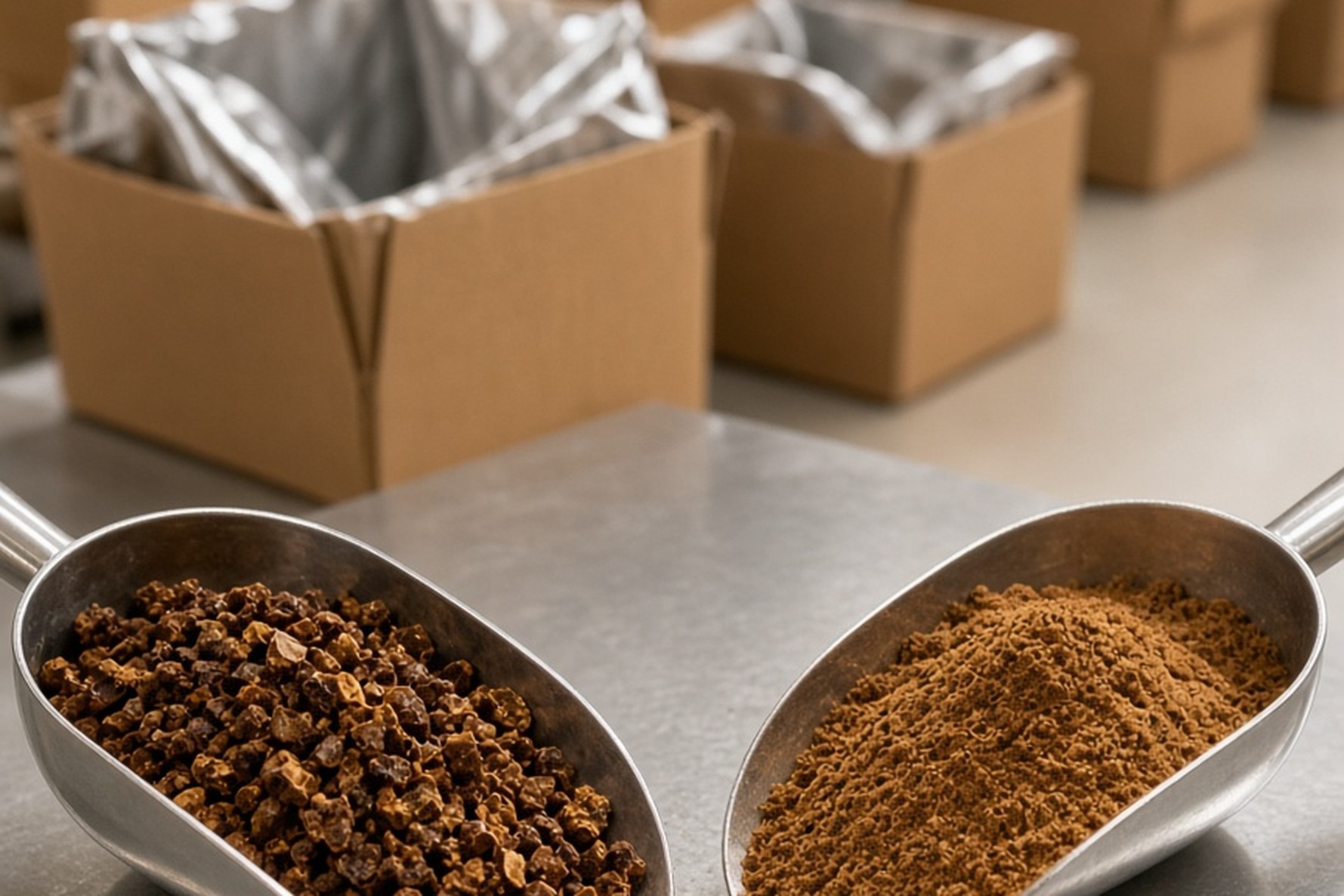
Instant coffee extraction uses 85–95°C water under controlled time and pressure; fines are removed, extract concentrated then dried. Spray-drying at 180–220°C yields fine powder at 0.20–0.35 g/cm³ bulk density — the economic base for bulk exports to Iraq and 3-in-1 lines.
Agglomeration wets spray powder surfaces and builds 0.5–3 mm granules with <15 s solubility — better jar appearance than classic powder. Freeze-drying freezes extract, sublimates ice under vacuum and preserves aroma in golden crystals at 2.5–4× spray-dry cost — core exports to Russia, Kazakhstan and Armenia.
| Method | Process temp. | Solubility | Aroma | Relative cost | Export use |
|---|---|---|---|---|---|
| Spray-dried (classic) | 180–220°C | Good | Moderate | Low | Coffee mix, bulk HoReCa |
| Agglomerated | Steam + surface moisture | Excellent (<15 s) | Better than spray | Medium | Retail jars, Iraq |
| Freeze-dried (gold) | Freeze −40°C then sublimation | Excellent | Best | High | Russia, Armenia, premium |
3. Physicochemical specs and in-line QC
Bulk contracts must fix moisture, bulk density, particle size, solubility at 80°C, caffeine, acid-insoluble ash and TPC numerically. Moisture above 4% drives caking in MAP bags and fat separation in warm stores.
Aroma recovery on advanced lines strips volatiles before drying and returns them to finished powder — a visible difference in Russian market acceptance between aroma-tower plants and basic lines.
A retain sample from each 10–25 t batch with accredited COA is the baseline for destination customs and quality disputes.
4. National standard ISIRI 3623 and lab protocol
ISIRI 3623 is the national reference for plain instant coffee (no sugar or creamer) and sets moisture, ash, caffeine, heavy metals and labelling. Official export requires health approval and COA meeting this standard or tighter buyer specs.
For the EAEU, Iranian COA plus EAC conformity, Russian labels and sometimes producer registration on the importer list are required. Ochratoxin A caps at 10 µg/kg are common on Russia/EAEU contracts.
Sensory evaluation should confirm no burnt odour, abnormal mineral salt taste or excessive woody notes (poor roast or chicory adulteration).
| Index | Method | Limit / target | Commercial importance |
|---|---|---|---|
| Moisture | Lab oven | Max 4% | Caking, micro |
| Total ash | Incineration | Max 12% | Mineral impurity |
| Acid-insoluble ash | ISIRI 1253 | Max 0.1% | Sand and soil |
| Caffeine | HPLC | 1.5–3.5% (by grade) | Roast / Robusta differentiation |
| TPC | Plate count | ≤10,000 cfu/g | Bulk hygiene |
| Coliforms | Count | <10 cfu/g | Destination clearance |
| Salmonella | 25 g | Negative | Strict markets |
| Ochratoxin A | HPLC/ELISA | ≤10 µg/kg | Russia and EU |
5. Sensory evaluation, adulteration and authenticity
Common fraud includes chicory, maltodextrin, roasted barley or weak extract powder. Sudden rises in acid-insoluble ash, caffeine below claimed 100% Robusta roast, and slow solubility are red flags.
Particle microscopy, FT-IR at advanced labs, and COA versus retain sample matching are recommended before payment.
For freeze-dried grade, crystal uniformity and ≥95% particles above 8 mesh are premium appearance criteria.
6. Export markets and destination rules
Russia and the EAEU are the largest dollar potential with demand for agglomerated and freeze-dried grades; Caspian sea and northern rail beat long European detours. Iraq takes the highest tonnage of spray powder for local mix plants and OEM sachets.
Central Asia (Kazakhstan, Uzbekistan, Turkmenistan) feeds beverage and biscuit lines with 10–25 kg industrial packs. Afghanistan and Armenia are border markets with repeat orders, less global brand focus but sharp price competition.
| Market | Dominant grade | Channel | Docs / rules | Iran advantage |
|---|---|---|---|---|
| Russia / EAEU | Agglomerated & freeze-dried | Caspian sea, northern rail | EAC, CT-3, Russian | Preferential tariff, freeze-dried |
| Iraq | Spray & agglomerated powder | Land border | Arabic, halal | Fast transit, price |
| Central Asia | Industrial powder | Rail and road | CT-1, RU/EN | Local-label OEM |
| Afghanistan | Classic powder | Dogharoun, Mahiroud | Dari/English | Sweet mix volumes |
| Armenia | Freeze-dried & agglomerated | Land border | EAEU neighbour | Gold for retail |
7. Iran’s regional competitive position
Versus Vietnam and Indonesia, Iran lacks global scale but wins on distance to Iraq and Afghanistan, OEM flexibility and FCA border delivery. Turkey is stronger on brand and EU access but reports higher industrial powder cost.
Matching grade to market (spray for mix, agglomerated for jars, freeze-dried for premium) avoids margin loss from over-specification.
| Origin | Strength | Weakness | Target market |
|---|---|---|---|
| Iran | Land borders, OEM, energy | Green bean import reliance | Iraq, Afghanistan, CIS |
| Vietnam | Robusta scale, price | Distance to Iraq | Global, Russia by sea |
| Indonesia | Earthy aroma, cost | Lead time | ASEAN, Gulf |
| Turkey | Branding, near EU | Higher price | Europe, Gulf |
8. Bulk MAP nitrogen packaging and logistics
Three-layer PET/ALU/PE bags with nitrogen flush and <2% residual O₂ give 18–24 months shelf life for spray and agglomerated powder at 15–25°C. Freeze-dried product often ships in drums with desiccant and PE liner due to moisture sensitivity.
Five-ply master cartons, stretch-wrapped pallets and optional silica in sea containers are advised for humid southern ports. Common bulk weights are 10, 25 and 50 kg; contracts should state ±0.5% net weight tolerance.
| Layer / item | Spec | Role |
|---|---|---|
| Three-layer bag | PET/ALU/PE 12+9+70 µm | O₂ and moisture barrier |
| Headspace gas | N₂ ≥99.5%, residual O₂ <2% | Oxidation and aroma |
| Bulk weight | 10, 25, 50 kg | Coffee-mix lines |
| Metal drum | 25–50 kg + liner | Sensitive freeze-dried |
| Pallet | Five-ply carton, stretch | Sea/rail export |
9. HS codes, customs and drawback
Plain instant coffee powder is declared under HS 21011100; preparations with sugar or creamer fall under 21011200 — misclassification causes wrong duty and clearance stops.
Iranian customs drawback (Article 66) can refund part of import duty on green beans or extract when re-exported as finished product; import licence numbers must appear on the export declaration.
Typical documents: invoice, packing list, health certificate, COO, COA, bill of lading; EAEU adds CT-3 and Declaraция.
- 21011100: Extracts and plain instant coffee powder.
- 21011200: Coffee-based preparations (mix and sweetened compounds).
- Record green bean import licences for drawback on re-export.
10. Downstream industrial applications
Most bulk volume goes to coffee mix, RTD drinks, confectionery, biscuits and coffee ice cream. Each use differs in bulk density, liquor colour and caffeine sensitivity — align with buyer R&D before locking formula.
| Segment | Input form | Key parameter | Supply note |
|---|---|---|---|
| 3-in-1 coffee mix | Spray-dried powder | Bulk density 0.25–0.4 g/cm³ | Solubility <20 s |
| RTD beverages | Concentrated extract | Stable aroma | Caffeine COA |
| Chocolate & biscuits | 1–5% powder | Colour and bitterness | Acid-insoluble ash |
| Sports supplements | Standardised caffeine | HPLC | GMP if required |
| Coffee ice cream | Freeze-dried powder | Cold solubility | Uniform granules |
| Retail OEM | Agglomerated | Granule appearance | Destination label |
11. Pricing drivers and proforma structure
FOB price reflects green bean CIF, extraction yield, drying type (×1 spray, ×1.15–1.25 agglomerated, ×2.5–4 freeze-dried), MAP pack cost, volume tiers (5, 10, 20 t) and agreed FX.
Payment is often 30% deposit after contract and 70% before loading, or LC at sight for new buyers. Third-party inspection and extra ochratoxin testing should be explicit in the RFQ.
- Robusta green bean CIF and Vietnam FOB volatility.
- Drying multiplier: spray, agglomerated, freeze-dried.
- MAP bag and pallet cost; volume tiers 5/10/20 t.
- Extra ochratoxin testing and third-party inspection.
12. Risk, insurance and shipment control
Main risks: green bean price swings, destination customs delay, COA disputes and moisture damage in transit. All-risks insurance at 110% is advised for CIF/CIP.
For Russia, monitor secondary sanctions and payment routes (rial/dirham/rouble) with destination banks and brokers. Iranco matches buyer technical specs to plants with ISIRI 3623 capability and MAP bulk packing.
13. Twelve-point importer checklist
Before order and payment, fix the following in contract and RFQ:
- Define grade: spray-dried, agglomerated or freeze-dried with numeric solubility.
- Max moisture 4% per ISIRI 3623 (tighter for freeze-dried if needed).
- HPLC caffeine and Robusta/Arabica claim.
- Acid-insoluble ash ≤0.1%.
- TPC, coliforms and Salmonella per ISIRI 3623 and destination.
- Ochratoxin A ≤10 µg/kg for Russia/EAEU.
- Bulk density and particle size for buyer filling line.
- MAP pack: nitrogen, residual O₂, bulk weight 10/25/50 kg.
- Correct HS 21011100 versus 21011200.
- Retain sample, batch code and accredited COA.
- Incoterm (FOB/FCA/CIF) and 110% insurance.
- EAC/CT-3/halal documents for destination market.
14. RFQ data for an accurate proforma
Send the following for a transparent FOB/CIF quote:
- Grade and application (mix, jar, RTD, biscuit).
- Total volume and delivery schedule (single or monthly).
- Caffeine band and drying type.
- Bulk weight and pack type (MAP bag or drum).
- OEM or neutral label and destination language.
- Port/border delivery and Incoterm.
- Extra micro and ochratoxin panel.
- Payment terms and pre-shipment inspection need.
Submit the same parameters on Iranco so matching suppliers can quote.
15. Export instant coffee supply through Iranco
Iranco is Iran’s specialised food-export platform, routing bulk instant coffee RFQs by grade, ISIRI 3623, MAP packing and destination (Iraq, EAEU, Central Asia) to COA-ready plants.
The flow covers sample match, lab sign-off, border or Caspian loading and customs documents. Register specs and volume for proforma and OEM options.
16. Summary
Iranian instant coffee at ~5,000 t capacity, three drying grades and border access is a practical choice for regional importers. Success keys: numeric ISIRI 3623 contracts, nitrogen MAP, correct HS codes, grade fit and adulteration control.
A twelve-point checklist and clear RFQ reduce customs holds and quality disputes — secure stable supply via Iranco.
Frequently asked questions
How do spray-dried, agglomerated and freeze-dried differ for bulk buying?
Spray-dried is lowest cost with good solubility for mix; agglomerated granules dissolve faster for jars; freeze-dried offers best aroma at 2.5–4× cost for Russia/Armenia premium.
What does ISIRI 3623 require?
Moisture, ash, caffeine, micro, metals and labelling — COA must match the contract annex.
Difference between 21011100 and 21011200?
21011100 is plain instant powder/extract; 21011200 covers preparations with sugar or creamer — tariff errors stop clearance.
What shelf life does nitrogen MAP bulk give?
With O₂ below 2%, typically 18–24 months for spray and agglomerated powder at 15–25°C.
Documents for export to Russia?
COA, health cert, EAC, Russian label, CT-3 and often producer registration; ochratoxin ≤10 µg/kg.
How to detect adulteration?
Rising acid-insoluble ash, low caffeine, slow solubility and microscopy/FT-IR versus retain sample.
Main bulk price drivers?
Green bean rate, drying type, volume, MAP pack and extra tests.
How to buy through Iranco?
Submit grade, volume and destination on contact/RFQ; sample, COA and FOB proforma follow.
Featured Products
Related Articles



