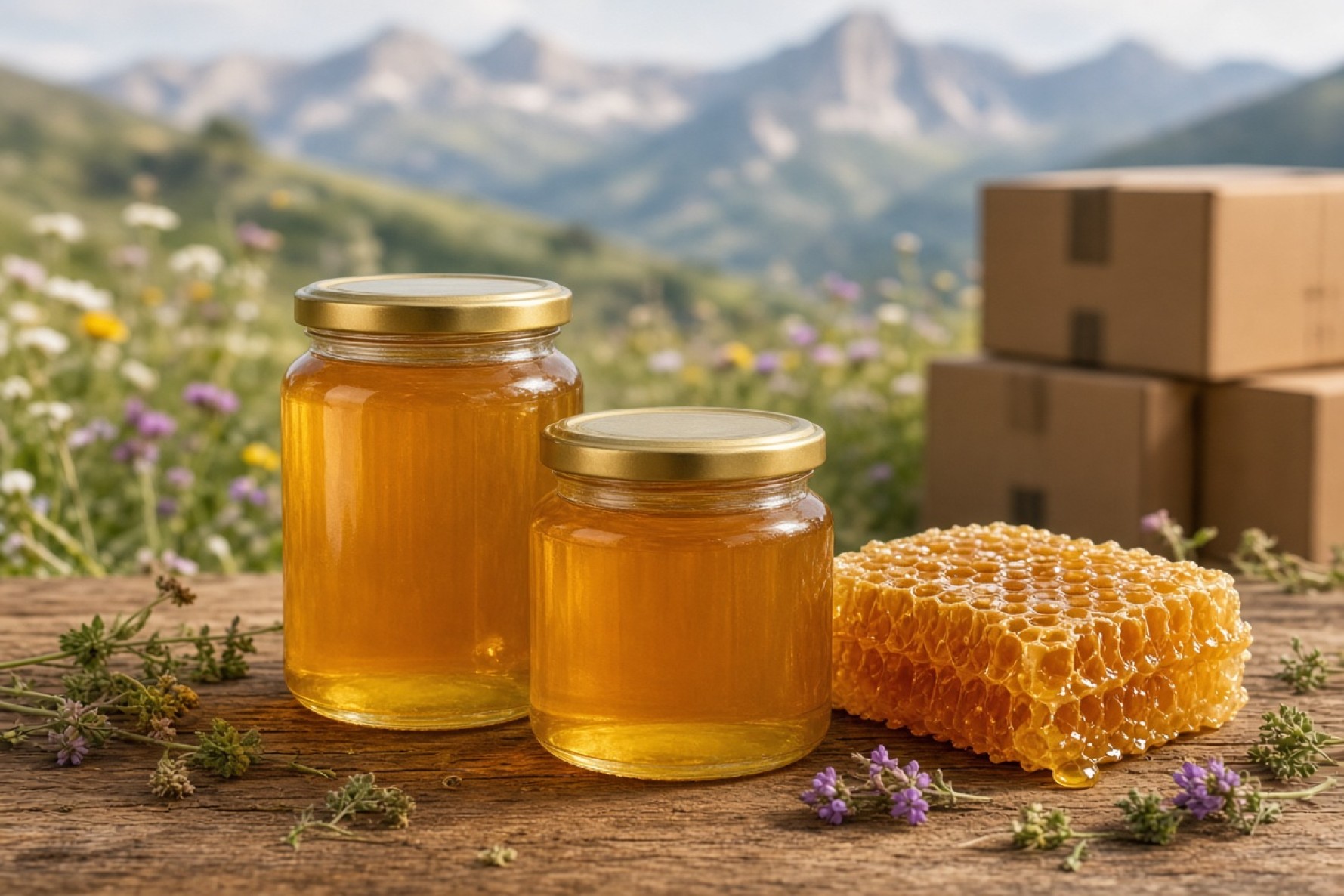
 Iranco Magazine Team
International markets, physicochemical specs, authenticity tests, contaminant control, packaging and logistics for commercial honey shipments
Export guide · Honey & beekeeping
Iran Honey Export: Target Markets, Quality Testing and Market Standards
A comprehensive guide to international markets, physicochemical specifications, authenticity testing, contaminant control, packaging requirements and logistics for commercial honey shipments.
This specialist guide is designed to empower exporters, importers, procurement managers and international traders with a clear roadmap of mandatory laboratory tests, regional standard differences, demand structure in key markets and transit-risk management for Iranian honey. Using the data in this report, buyers can validate quality, draft contracts and choose shipping methods with lower commercial risk.
With rare ecological diversity, 11 of 13 recognised world climates and a rich flora of more than 8,000 wild and medicinal plant species across the Zagros, Alborz and fertile plains, Iran is one of the largest beekeeping hubs in the Middle East and West Asia. Official annual natural honey output is recorded between 110,000 and 136,000 tonnes, placing Iran third worldwide after China and Turkey. Despite more than 11 million bee colonies, official annual exports fluctuate between only 5,000 and 10,000 tonnes — a gap rooted in packaging challenges, limited awareness of destination lab protocols and incomplete alignment with modern certification systems.
In today’s international markets, honey is no longer a simple traditional commodity; it is a functional product with precise biochemical specs, mandatory standard codes and botanical/pollen identity profiles. Professional buyers in the GCC, the Eurasian Economic Union and East Asia evaluate shipments against physicochemical COAs, heat-damage markers and veterinary/pesticide residues. Sustainable export success requires deep understanding of the differences between Iran National Standard No. 92, Codex Alimentarius and the Gulf technical standard (GSO 147).
1. Commercial and geographic position of honey production in Iran
The geographic spread of Iranian apiaries enables honeys with clearly distinct organoleptic profiles, colour, aroma and antioxidant properties. Northern Zagros and the north-west are traditional and industrial production hubs. West Azerbaijan, with annual output of more than 23,000–27,000 tonnes, ranks first nationally and, together with East Azerbaijan, Ardabil, Kurdistan, Lorestan and Isfahan, forms the core of mountain honeys with high diastase and optimal sucrose. Tropical and semi-tropical southern habitats in Fars, Khuzestan, Bushehr and Hormozgan are the exclusive base for Sidr (konar) honey — the most popular type on Arabian Peninsula markets.
Multi-stage harvest calendar
- Spring crop (Ordibehesht–Khordad / Apr–Jun): citrus and bitter-orange blossom honey in northern gardens (Mazandaran, Gilan) and southern Fars, plus rapeseed honey.
- Summer crop (Tir–Mordad / Jun–Aug): peak harvest of rich mountain honeys such as astragalus (gavan), thyme, multi-floral mountain and tragacanth at Zagros and Alborz altitudes.
- Autumn crop (Mehr–Aban / Sep–Nov): unique Sidr honey from southern pastures.
This sequential harvest cycle enables continuous year-round supply of fresh product for trading companies and exporters. Final value-added depends on precise nectar-source separation, elimination of unhealthy manual interventions and brand development aligned with target-market requirements.
2. Typology of Iranian export honeys by botanical origin
Iranian export honey is split by dominant nectar plant into monofloral and polyfloral grades. Accurate typology lets traders match each shipment to the right consumption market.
Sidr (konar) honey
Sidr honey from Ziziphus nectar is Iran’s most strategic Gulf export grade. It shows dark amber to ruby colour, high body, an intense sweet taste and a distinctive konar-fruit aroma. Its key physicochemical trait is a naturally high fructose-to-glucose ratio (above 1.3), which delays crystallisation for more than a year. It commands exclusive demand and premium pricing in the UAE, Qatar, Kuwait and Oman.
Astragalus (gavan) honey
Harvested from mountain astragalus shrubs on Zagros and central Alborz slopes. Colour ranges from light yellow to clear amber with a mild, widely accepted taste. It is the backbone of high-tonnage shipments to Iraq, Turkey and the Caucasus. With correct hive management, sucrose naturally stays below 2%.
Thyme honey
From wild foothill pastures covered with mountain thyme. Dark amber tending to red, a piercing aroma and a warm medicinal taste, rich in polyphenols and natural thymol — an excellent choice for European and East Asian functional markets.
Citrus and bitter-orange blossom honey
From hives placed in bitter-orange and orange orchards in Mazandaran and Fars. Clear, very light yellow colour with a mild acidic finish. Fresh citrus honey naturally has lower diastase activity and receives a technical exception under international standards. It tends to soft, creamy crystallisation.
Multi-floral mountain (chehel-giah) honey
Formed from a natural blend of wild mountain nectars in areas such as Sabalan, Arasbaran and Dena. It carries a wide mineral and flavonoid spectrum and, at competitive prices, suits broad food use in regional retail chains.
| Type | Origin | Colour (Pfund) | F/G ratio | Crystallisation | Priority markets |
|---|---|---|---|---|---|
| Sidr (konar) | Khuzestan, Fars, Bushehr, Hormozgan | Dark amber (85–114) | 1.3–1.55 | Very slow (+1 year) | UAE, Kuwait, Oman, Qatar, Saudi Arabia |
| Astragalus | Kurdistan, Lorestan, Isfahan, Hamedan | Light amber (30–50) | 1.05–1.18 | Medium (6–9 months) | Iraq, Armenia, Russia, Turkey |
| Thyme | Tehran, Alborz, Qazvin, Zanjan | Medium amber (50–85) | 1.10–1.22 | Medium (5–8 months) | China, Malaysia, Germany, UAE |
| Citrus | Mazandaran, Gilan, Fars | Light yellow (15–34) | 0.95–1.05 | Fast (2–3 months) | Iraq, Russia, Oman |
| Mountain multi-floral | West & East Azerbaijan, Ardabil | Amber to gold (40–70) | 1.05–1.15 | Medium (4–6 months) | Iraq, Kazakhstan, Kuwait |
3. Technical specs and physicochemical indicators buyers expect
Acceptance of commercial honey lots rests on an official certificate of analysis (COA). Before loading, buyers require full compliance with the laboratory parameters below.
- Sucrose: primary screen for artificial feeding; standards set a 5% ceiling, while premium contracts usually agree below 2–2.5%. Above 5% typically voids export certification at most entry points.
- Moisture: INSO 92 and GSO 147 allow max 20%; for cross-border trade, especially humid climates, keep moisture below 17.5–18% to prevent fermentation and bloated containers.
- Reducing sugars & F/G ratio: reducing sugars at least 60–65 g/100 g; fructose-to-glucose above 1.05 is preferred.
- Proline: minimum 180 mg/kg; premium Iranian mountain honeys usually show 300–600 mg/kg. Abnormally low values signal damaging heat or dilution.
| Parameter | Reference (INSO 92 / GSO 147) | Premium export agreed | Commercial importance |
|---|---|---|---|
| Sucrose | Max 5% | Max 2.5% | Nectar authenticity; no overfeeding |
| Moisture | Max 20% | Max 17–18% | Prevent fermentation |
| Reducing sugars | Min 60 g/100g | 65–72 g/100g | Natural honey identity |
| Fructose/glucose | Min 0.9 | 1.10–1.40 | Liquid-phase stability |
| Proline | Min 180 mg/kg | >250 mg/kg | Bee biological marker |
| Free acidity | Max 50 meq/kg | Max 35 meq/kg | Fermentation health & flavour |
| Electrical conductivity | Max 0.8 mS/cm | 0.2–0.7 mS/cm | Flower nectar vs honeydew |
4. Thermal, ageing and purity markers: HMF and diastase
Post-harvest monitoring focuses on two highly sensitive indicators: hydroxymethylfurfural (HMF) and diastase enzyme activity. These are the main customs audit criteria for freshness and absence of heat abuse.
HMF formation mechanism
HMF is a cyclic compound formed by dehydration of simple sugars (especially fructose) in the presence of honey’s natural organic acids. Fresh honey usually shows 0–5 mg/kg HMF. Increases come from intentional heating above safe thresholds or long storage at abnormal temperatures. INSO 92 and GCC technical rules set a 40 mg/kg ceiling; tropical-origin honeys may be allowed up to 80 mg/kg. Commercially, HMF at Iranian border exit should stay below 15–20 mg/kg because warm-season container transit can raise the value further.
Diastase activity
Diastase is a heat-sensitive enzyme secreted by the bee’s digestive system. Unheated natural honey should show at least 8 Schade units. Heating above 45°C lowers this number. Naturally low-diastase honeys (e.g. citrus) may be accepted at minimum 3 units if HMF stays below 15 mg/kg. Diastase below 8 combined with HMF above 40 signals severe heat damage.
Advanced authenticity methods
Detecting modern adulteration such as high-fructose corn syrup or hydrolysed rice syrup needs advanced chromatography and isotope methods. Accredited labs use stable isotope ratio mass spectrometry (EA-IRMS) to match honey carbon-13 with protein isolated from the same sample. Nuclear magnetic resonance (NMR) metabolite fingerprinting is also used at European and Gulf entry points.
5. Lab protocols: pesticide residues, antibiotics and heavy metals
Biological safety and absence of chemical contaminants are a red line for food clearance in international trade. Even trace veterinary drugs or heavy metals can trigger seizure and place the origin on quarantine alert lists.
- Chloramphenicol: absolute zero tolerance; detectable by LC-MS/MS below 0.1 μg/kg.
- Nitrofurans, dapsone, metronidazole: no permitted limit; any residue is a violation.
- Tetracyclines & sulphonamides: typical MRL 10–20 μg/kg; Eurasia and some EU retail channels often require non-detectable residues.
- Acaricides: amitraz, fluvalinate and coumaphos measured by GC-MS; progressive farms switch to oxalic and formic acids.
- Heavy metals & microbes: Codex lead max 0.1 and cadmium 0.05 mg/kg; mould/yeast count below 1,000 CFU/g (GSO 1016).
| Class | Substance | Limit | Method | Non-compliance impact |
|---|---|---|---|---|
| Banned antibiotic | Chloramphenicol | Zero (<0.1 μg/kg) | LC-MS/MS | Destruction & official fine |
| Therapeutic antibiotic | Tetracycline | <10 μg/kg | LC-MS/MS | Clearance stop |
| Acaricide | Amitraz | Max 200 μg/kg | GC-MS | Return to origin |
| Acaricide | Fluvalinate | Max 50 μg/kg | GC-MS / HPLC | Customs rejection |
| Heavy metal | Lead | Max 0.1 mg/kg | ICP-MS | No sanitary permit |
| Microbial | Yeast & mould | <1,000 CFU/g | Culture | Fermentation / spoilage risk |
6. Target export markets for Iranian honey
Structurally, Iran’s honey demand splits across several geographic regions with distinct buying patterns.
- Iraq: largest volume importer; Kurdistan prefers mountain/medicinal honeys while central and southern regions buy economical multi-floral and astragalus. International inspection COCs at border terminals are required.
- UAE: logistics and re-export hub; first-hand buyer of premium Sidr with sucrose below 1.5% and pollen authenticity; entry requires Dubai municipality registration plus ESMA/GSO rules.
- Oman, Qatar, Kuwait: premium markets for luxury glass packing; Kuwait posts the highest rates for monofloral medicinal honeys. Flawless Arabic labelling matters as much as biochemistry.
- China: destination for specialty and organic grades; China Customs registration and farm-to-plant traceability are mandatory.
- Eurasian Economic Union: FTA cuts tariff costs; Russia demands bulk industrial honey and retail jars with bold flavours, with strict residue controls.
| Market | Approx. volume share | Preferred nectar | Packaging | Border authority |
|---|---|---|---|---|
| Iraq | 40–50% | Astragalus, multi-floral, citrus | Glass, PET, plastic jars | COSQC |
| UAE | 15–25% | Luxury Sidr, thyme, bulk | Premium glass & drums | ESMA |
| Kuwait | 5–10% | Sidr with very low sucrose | Fancy glass & gift boxes | PAFN |
| Oman | 5–8% | Sidr, multi-floral mountain | 250–1000 g glass | Oman MoA / standards |
| Russia | 3–5% | Thyme, astragalus, industrial bulk | Metal drums & glass jars | Rosselkhoznadzor |
7. Gulf regional standard requirements (GSO 147)
GCC states apply harmonised technical rules under GSO 147. Food additives, invert sugar, synthetic flavours or preservatives are not allowed.
- Final moisture: max 20% by weight
- Apparent sucrose: max 5% (some special honeys up to 10%)
- Reducing sugars: min 60 g/100 g for blossom nectar honey
- Free acidity: max 50 meq/kg
- HMF: max 40 mg/kg (tropical up to 80)
Labelling (GSO 9)
- Mandatory Arabic (bilingual Arabic–English allowed)
- Exact product name stating “pure natural honey” plus botanical origin
- Exporter, packing plant, country of origin and local importer details
- Nutrition facts table and production/expiry dates with lot number
8. Technical frameworks for Eurasia and China
Eurasian technical regulation (TR CU 021/2011)
- Absolute ban on chloramphenicol, metronidazole and furazolidone
- Tetracycline threshold below 10 μg/kg
- Radiological safety tests (caesium-137 and strontium-90)
- Eurasian declaration of conformity via a legal representative in destination
China Customs protocol (GACC)
- Packing plants and mother apiaries approved by Iran’s veterinary authority with China registry codes
- Bilingual veterinary health certificate declaring freedom from WOAH-listed diseases
- Periodic sampling for organophosphates, heavy metals and synthetic sugars with two-year record retention
9. Export packaging standards and best practices
Honey is strongly hygroscopic. Packaging protects biochemical integrity and is the primary marketing tool at final destinations.
Industrial bulk
- Food-grade steel drums 290–300 kg with phenolic epoxy linings
- Food-grade HDPE pails 20–25 kg with sealable lids and gaskets; virgin polymer only
Retail packing
- Clear glass jars 250, 500 and 1,000 g with low optical refraction
- Twist-off metal lids with food-grade plastisol liners
- Clear squeeze PET bottles with silicone valves for table use
Palletising
Five-layer corrugated master cartons with high compression strength; 100×120 cm wooden pallets heat-treated under ISPM-15; edge protectors and thick stretch wrap for humid port conditions.
10. Logistics chain, transit heat management and supply risks
On land routes to Iraq from Ordibehesht to Aban, cargo-hold temperatures can exceed 55°C and raise HMF several-fold during 24–48 hour customs stops. In hot seasons, refrigerated containers set at 22–25°C are mandatory.
At sea, honey’s density (~1.42 kg/L) makes it weight-limited; a 20-ft container hits payload (~21–22 t net) before volume. Aluminium thermal liners or reefers block solar heat gain.
The critical crystallisation band is 12–15°C. Transit warehouses should hold 20–24°C with RH below 60%. If creamed honey is desired, controlled crystallisation must be done at the mother plant.
11. Cost structure and regional competition
Delivered honey cost covers raw material, industrial preparation and clarification below 40°C, packaging, pre-shipment inspection and certificates, plus logistics and customs. Very low price offers usually come with weaker quality parameters or invert syrups.
| Country | Core advantage | Limitation | Price level |
|---|---|---|---|
| Iran | Botanical diversity, high purity, premium Sidr | Weak unified branding & retail packing | Competitive vs quality |
| China | Huge tonnage, very low unit cost | Sugar-adulteration scepticism | Very cheap |
| Turkey | Strong branding & packaging | Reliance on specialty forest honeys | High / expensive |
| Yemen | Traditional Sidr prestige | Tiny volume & logistics instability | Extremely expensive |
Iranian Sidr, with a nectar profile close to Gulf and Yemeni locals, can capture luxury share at a lower cost base; Iran’s commercial edge should stay on natural nectar authenticity and therapeutic value — not price wars with Chinese industrial honey.
12. Industrial and pharmaceutical uses and special grades
- Pharma & supplements: thyme and Sidr as carriers in cough syrups and wound ointments; zero pesticide residue and spore-forming bacteria required.
- Confectionery & beverages: darker multi-floral with strong taste; colour stability, viscosity and no wax debris are plant QC priorities.
- Cosmetics: humectant for soaps and masks; clarity and high solubility come first.
13. Importer checklist before placing an order
- Define exact honey type and botanical origin (not the generic phrase “natural honey”).
- Set sucrose ceiling on the COA (max 2.5% or 5% by grade) via liquid chromatography.
- Lock moisture below 18% for humid destinations.
- Lock factory-gate HMF in Iran at max 15–20 mg/kg.
- Obtain certificates proving chloramphenicol and tetracyclines are fully negative.
- Approve label artwork preview in the destination language.
- Specify glass, lid and food-grade plastisol gasket structure.
- Define transit fleet conditions and heat monitoring in hot seasons.
- Verify veterinary health certificates from Iran’s official veterinary system.
- Agree weight/quality tolerances and border sampling dispute rules.
- Seal a retained sample before loading at a third-party reference lab.
- Set a firm production-to-loading timeline to avoid long customs dwell.
14. What information is needed for an accurate price?
- Honey type (pure Sidr, astragalus, thyme, mountain multi-floral)
- Target sucrose and moisture levels
- Destination HMF acceptance ceiling
- Filtration status (raw with natural sediment or clarified)
- Container type (300 kg drum, 25 kg pail, glass jar or squeeze bottle)
- Buyer-brand (OEM) needs and label languages
- Exact tonnage and number of 20-ft containers
- Incoterms and delivery point (EXW, FOB, CIF, etc.)
- Final discharge port or customs point
- Extra lab certificates (C-13, microbial, Gulf conformity)
Importers can send required specifications via Iranco so matching supply options are reviewed against the request.
15. Export supply of Iranian honey to buyer specifications
In cross-border natural honey deals, differences are not limited to raw cost. Variations in nectar quality, moisture, diastase, lid gaskets, master-carton strength and transit temperature control reshape deal profitability.
Iranco, as Iran’s food-industry sourcing platform, provides a coherent system for these requirements. International buyers can register supply requests with full physicochemical specs, nectar type, packing grade and discharge port. Iranco enables identification of credible processors, alignment of partner-lab tests, retained-sample coordination and oversight of customs and sanitary compliance.
Analytical summary
Cross-border honey trade rests on precise laboratory data, biological safety and quality stability. Iran’s third-ranked global production capacity of more than 120,000 tonnes per year opens broad potential in Gulf, Eurasian and East Asian markets. Commercial use of that advantage requires moving beyond bulk commodity sales, upgrading packaging and applying strict thermal and veterinary testing.
Full compliance with GSO 147, veterinary bans under TR CU 021/2011, continuous HMF and diastase monitoring, and temperature control in the logistics chain are the core pillars of investment security in this sector.
Frequently asked questions
What are the key GSO 147 requirements for honey entry into GCC countries?
Moisture max 20%, sucrose max 5% (under 2.5% for grade-one contracts), reducing sugars min 60%, free acidity max 50 meq/kg, HMF below 40 mg/kg, plus Arabic labelling with a nutrition table.
Why does HMF change during sea freight and how is it prevented?
HMF forms rapidly above 35°C; container skins can exceed 50°C in hot Gulf seasons. Prevention means loading with HMF under 15 at origin plus a reefer at 22°C or foil thermal liners.
How do Russia/Eurasia quality rules differ from Gulf markets?
Gulf markets focus most on nectar authenticity, monofloral Sidr, taste and HMF ceilings; Eurasia under TR CU 021/2011 concentrates on zero veterinary residues, radiological tests and heavy metals.
Which tests prove purity and absence of industrial syrups?
Beyond sucrose and reducing sugars, EA-IRMS for carbon-13 ratios, HPLC for rice-syrup oligosaccharides and NMR for botanical profiles are used.
How can Iranian export honey be sourced directly from credible plants?
Define type, sucrose level, container, Incoterm and volume; international buyers can send these specs via Iranco as a purchase request.
Why do some pure honeys crystallise quickly?
Crystallisation is natural in raw honey due to glucose supersaturation. Citrus honey with F/G below 1.05 sets in months; Sidr stays liquid over a year thanks to higher fructose.
What drives export honey pricing in international contracts?
Monofloral type (e.g. Sidr), lab sucrose level, residue testing, packaging material and contract tonnage are the core cost drivers.
Which documents are required for legal honey export from Iranian customs?
Commercial card, veterinary health certificate, qualitative conformity certificate from an authorised inspection firm, certificate of origin, commercial invoice and packing list.
Featured Products




Related Articles



