 Iranco Magazine Team
Value-chain analysis, international permits, destination sanitary rules and cold-chain quality technologies
Export Guide · Caviar & Fisheries
Iranian Caviar Exports: Target Markets, Legal Requirements, and Export Packaging
A comprehensive analysis of the value chain, guidance on international permits, destination-market sanitary rules, and cold-chain quality technologies. Iranian caviar, rooted in the biological authenticity of the Caspian watershed and modern farm infrastructure, holds a significant share of global luxury consumption markets.
International caviar trade is recognised as one of the most profitable and specialised segments of the global fisheries and luxury-food industries. Over recent decades, bans on commercial harvest of wild Caspian sturgeon, aimed at restoring natural stocks, shifted the economic structure and value chain from coastal capture to mechanised aquaculture farms. Iran, drawing on indigenous knowledge, expertise in artificial propagation, exceptional climatic conditions, and biological compatibility with flagship species, pioneered the deployment of sturgeon farming systems.
Because of its exceptionally high added value, caviar sits among perishable luxury goods; any lapse in quality control, cold chain, or legal documentation can cause irreparable commercial damage. Sustainable entry into tier-one markets such as the European Union, Gulf Cooperation Council countries, and East Asia depends on full command of CITES rules, veterinary sanitary codes, and impermeable packaging techniques. International caviar purchasing is profitable only when buyers can correctly analyse differences among biological species, sensory grades, health-audit requirements, and air-freight methods—and embed them in purchase contracts.
1. Structure of Iran’s farmed caviar industry and its place in international trade
Over the past two decades Iran’s caviar industry has undergone a fundamental shift from traditional harvest in northern waters to industrial production in concrete ponds, recirculating farms, and grow-out cages. More than 300 licensed farms in 22 provinces raise sturgeon; the Caspian coastal belt in Gilan and Mazandaran—close to seawater with natural temperature and salinity—and Fars Province, using freshwater and artesian wells, account for the largest share of national sturgeon meat and caviar output.
Production pathways, official statistics, and export share
Official customs and fisheries-agency statistics show annual formal exports of Iranian farmed caviar exceeding five tonnes. Beyond formal air-cargo channels, baggage and passenger exports up to each traveller’s legal allowance have also sustained product introduction and sales in tourist markets. More than 30 countries worldwide accept shipments of Iranian farmed caviar.
Geographic advantage and genetic differentiation
Iran’s competitive edge versus other producers rests on three pillars: genetic authenticity of native Caspian species, use of Caspian feeding waters at coastal facilities, and the traditional processing skill of specialist “caviar masters.” Rich flavour, minimal undesirable fat, and buttery aroma in Iranian caviar reflect scientific feeding regimes and farm water quality. Iranian Beluga sturgeon caviar retains top demand among leading restaurants and international hotels.
2. Species taxonomy and distinguishing traits of export-grade Iranian caviar
In specialist caviar trade, the biological species is the primary determinant of grain size, colour range, membrane texture, and flavour profile. Four main sturgeon species are bred and raised on Iranian farms.
| Commercial attribute | Beluga | Osietra | Sevruga | Baerii |
|---|---|---|---|---|
| Scientific species | Huso huso | A. persicus / gueldenstaedtii | Acipenser stellatus | Acipenser baerii |
| Grain diameter | 3.0–3.9 mm | 2.5–3.2 mm | 1.8–2.4 mm | 2.4–2.9 mm |
| Colour range | Light grey to silver | Dark olive to golden | Dark grey to glossy black | Dark brown to matte grey |
| Flavour profile | Pure buttery, creamy | Nutty and hazelnut-like | Bold, marine, and saline | Mild earthy, light nutty |
| Market position | Ultra-luxury, highest price | Premium restaurant | Popular in Eastern Europe | Most economical farmed grade |
Technical traits of Beluga
Caviar from Beluga sturgeon yields the largest grain size among all species. The fish requires at least 8 to 12 years of on-farm grow-out to reach sexual maturity and roe harvest. That long capital cycle limits supply and sustains high global prices.
Technical traits of Osietra and Baerii
Persian sturgeon (A. persicus) and Russian sturgeon produce amber and golden hues; stable nutty colour and flavour diversity make Osietra the favourite among professional chefs. Siberian sturgeon (A. baerii), with high tolerance to temperature swings and shorter maturity (3 to 5 years), balances price in export portfolios and meets much of the demand from luxury airlines and hospitality groups.
3. Commercial grading and physicochemical indices of caviar grains
Commercial caviar grading combines sensory criteria, physical dimensions, and laboratory tests. Iran’s national standard No. 186 and the international Codex Alimentarius standard CODEX STAN 291-2010 are the references for this quality separation.
Commercial grades of Beluga caviar
- Beluga Imperial Top: Very large grains over 3.3 mm diameter, uniform light grey colour, 100% spherical grading, no crushed grains, and no surface stickiness.
- Beluga Imperial: Grain diameter 3.0 to 3.3 mm, dark grey to smoky olive colour, more than 95% uniformity, and clear elastic membrane.
- Beluga Royal: Grain diameter 2.8 to 3.0 mm, darker grains, no structural breakage, suitable for general hotel and chain retail.
- Grade 1 and Grade 2: Products with size inconsistency or membrane breakage above 2%; lower commercial value.
| Test | Permitted range | Methodology | Control objective |
|---|---|---|---|
| Table salt (NaCl) | 3.0–3.8% by weight | Mohr / Volhard titration | Bacterial control without excess salinity |
| Total moisture | 50–58% by weight | Oven drying at 105°C | Dense texture and no weeping from grains |
| Total protein | 23–28% by weight | Kjeldahl micro-method | Natural grain maturation |
| Lipid (crude fat) | 10–16% by weight | Soxhlet extraction | Soft texture and flavour richness |
| Acidity index (pH) | 6.0–6.8 | Electrometric measurement | Early spoilage monitoring |
| Borate compounds (E284/E285) | 0% (prohibited) | Optical spectroscopy | EU regulatory compliance |
Safety standards and contaminant limits
Under European Commission Regulation 2023/915 and food-and-drug sanitary rules, export caviar must pass tests for heavy metals and veterinary drug residues. Maximum limits are lead (Pb) 0.3 mg/kg, cadmium (Cd) 0.05 mg/kg, and total mercury (Hg) 0.5 mg/kg. Exceeding these levels leads to detention and destruction at destination border inspection posts.
4. Customs coding and tariff separation of genuine caviar from substitutes
Completing the customs declaration in caviar export requires an accurate Harmonized System code (HS Code) aligned with international rules. Export and import regulations draw a clear line between real sturgeon caviar and its alternatives.
- Tariff code 16043100 (genuine caviar): Exclusively for unfertilised eggs of sturgeon (Acipenseriformes). Any shipment under this code is subject to CITES law and fisheries health certificates.
- Tariff code 16043200 (caviar substitute): Replacement products from trout, salmon, carp, lumpfish, or synthetic gelatin-based goods.
Accidental or deliberate use of code 16043200 instead of genuine caviar—because tins look similar—counts as regulatory breach, concealment of species, and customs violation in destination countries, exposing the shipment to quarantine and severe penalties.
5. International CITES requirements and the trade-permit regime
All sturgeon species are listed on CITES Appendix II to prevent illegal trade and extinction. International caviar trade is lawful only when aligned with the Conference of the Parties framework (Resolution Conf. 12.7).
Standard CITES label coding format
Every primary caviar container in international trade must carry a single-use, non-transferable label that is destroyed when opened. The label bears a continuous coded identifier with the structure below:
- Three-letter species code: HUS Beluga, PER Persian sturgeon, GUE Russian sturgeon, STE starry sturgeon, BAE Siberian sturgeon.
- Source code: Letter C for farmed production; letter W (wild) is prohibited in commercial trade.
- Exporting country code: IR for Iran.
- Harvest year: Four-digit packing year.
- Processing-unit code: Fisheries-agency identifier for the packing plant.
- Batch number: Internal company traceability code.
HUS/C/IR/2025/IR-014/L-0842
Absence of this label on even one tin in the shipment, or illegible parts of the code, renders the entire lot unlawful.
6. Sanitary standards, veterinary approvals, and export regulatory codes
Successful passage through border inspection and entry into official food distribution networks depends on sanitary and official documents issued by competent authorities.
EU veterinary approval (EC Code)
Caviar processing units in Iran that export directly to EU member states must obtain a dedicated supervisory code and sanitary approval after full facility audit by veterinary inspectors and confirmation by the European Commission. This code appears on all transport documents and product labels and signals strict EU hygiene standards in segregation lines, process water, personnel hygiene, and traceability systems.
| Certificate type | Issuing authority | Commercial use |
|---|---|---|
| CITES export permit | Iran Fisheries Organization | Proof of lawful farmed production under national quota |
| Veterinary health certificate | National Veterinary Organization | Microbial health and freedom from disease |
| Certificate of origin | Chamber of Commerce | Confirmation of production geography and tariff treatment |
| Certificate of analysis (COA) | Partner laboratories | Moisture, salt, protein, and contaminants |
| Halal certificate | Fisheries religious-supervision centres | Access to Islamic and Arab Gulf markets |
Hygiene principles for malossol caviar processing
Export caviar is processed by traditional malossol technique using ultra-pure iodine-free salt at less than 4% by weight. The method involves no severe heat treatment or chemical preservatives. Monitoring the production line for pathogens including Salmonella and Listeria monocytogenes is therefore critical. Microbiological tests must be run repeatedly on each production batch, with absence of these agents in 25 g samples formally recorded.
7. Export target-market analysis: demand preferences and sales channels
Consumption of Iranian caviar varies widely by market in pack size, popular grades, and usage patterns.
- Persian Gulf region: UAE and Qatar — focus on Imperial Beluga, luxury 30 to 100 g tins.
- European Union: Germany, France, Belgium — large malossol tins for repacking.
- East Asia: Japan, Singapore, Hong Kong — vacuum glass Osietra gold and Beluga.
- Emerging destinations: Switzerland and Brazil — rising demand for Beluga Royal and Baerii.
Persian Gulf markets
The UAE and Qatar are major regional buyers of Iranian caviar. Dubai acts as a distribution hub for luxury hotels and re-exports. Consumers prioritise Imperial Beluga with very large grains and light colour. Premium gift packs—carved or leather boxes with 50 and 100 g tins and mother-of-pearl spoons—are in high demand.
EU and East Asian markets
German and French importers often order large one- to two-kilogram malossol tins; after clearance, caviar is repacked under local brands in CITES-approved workshops. Natural taste, authentic Caspian sturgeon species, and absence of borax are key European red lines. Japan emphasises aesthetic grain indices, spherical stability, and colour uniformity; Japanese heavy-metal residue quarantine standards are among the strictest globally.
8. Competitive position of Iranian caviar versus major global players
| Country | Dominant species | Core advantage | Challenge | Iran strategy |
|---|---|---|---|---|
| Iran | Beluga, Persian sturgeon | Caspian authenticity, buttery taste, large grain | Air logistics and FX transfers | Focus on top tier without price war |
| China | Hybrid Beluga, Baerii | Huge volume and price undercutting | Lower perceived quality | Brand separation and pure Caspian lines |
| Italy | White sturgeon, Baerii | Mechanised technology, EU access | Energy cost and Beluga limits | Quality competition in Imperial Beluga |
| France | Baerii, Osietra | Michelin restaurant network | Limited farming resources | Bulk malossol supply for repacking |
China has captured a large share of economy caviar volume in recent years; nevertheless, authentic Iranian Beluga remains an irreplaceable luxury trade symbol. Professional buyers clearly distinguish the rich flavour of Caspian-shore farmed caviar from intensively farmed alternatives.
9. Primary and secondary packaging engineering: protecting texture from oxygen and temperature swings
Caviar is not severely pasteurised; lipid and protein stability depend directly on limiting air contact, preventing surface evaporation, and cushioning mechanical shock in transit.
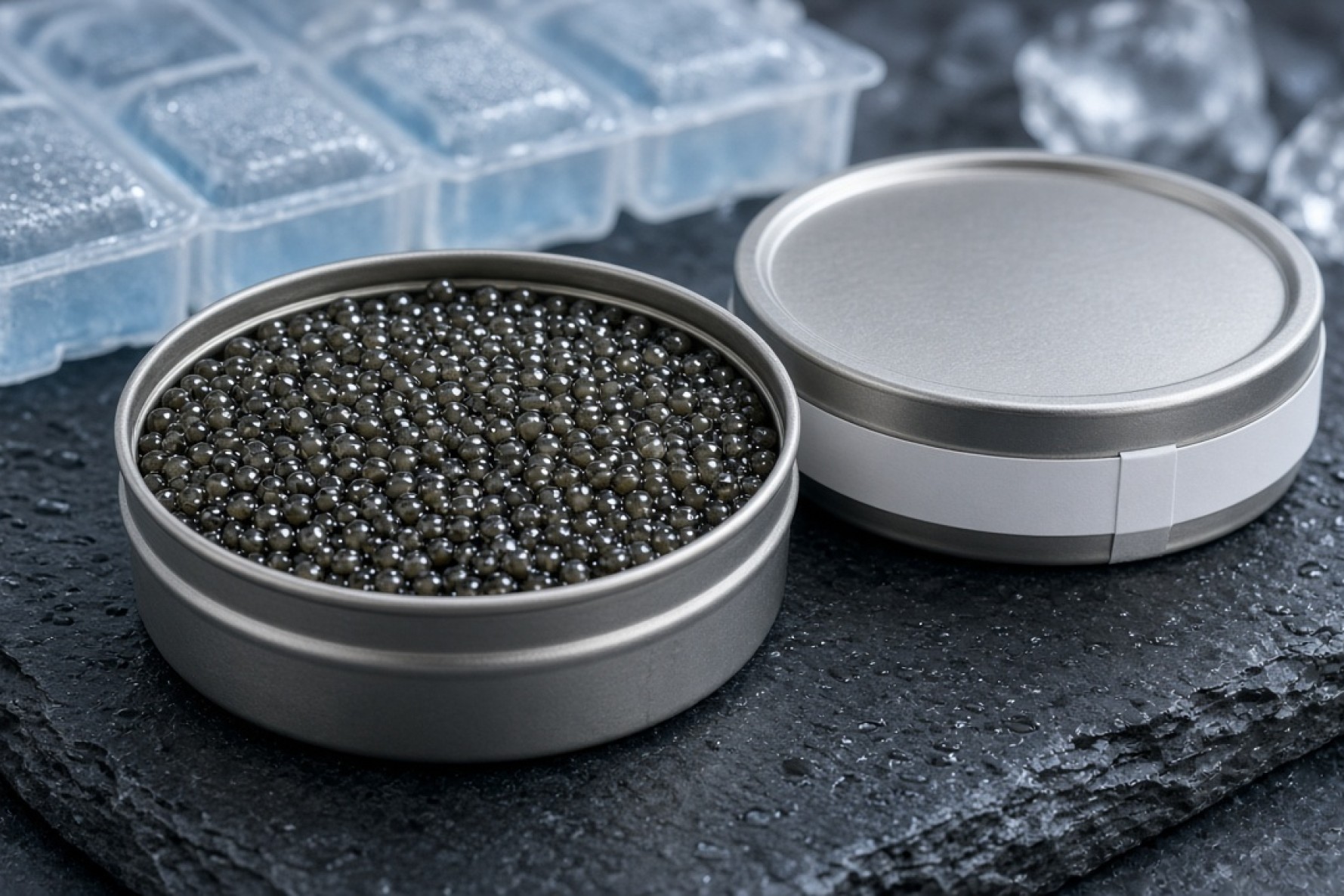
- Primary malossol metal tin or vacuum glass jar with CITES label
- Moisture-barrier plastic wrap to prevent condensate contact
- Placement in compact isothermal EPS carton (minimum 40 mm thickness)
- Frozen polymer gel packs around sides and lid
- USB digital temperature data logger at shipment centre
- Outer laminated heavy carton with air-freight warning marks
Primary packaging
- Traditional malossol tins: Tin-plated metal in 500, 1000, and 1800 g sizes; the lid gently vents excess pressure and a latex band on the seam blocks air while allowing physiological gas release.
- Vacuum metal tins: Aluminium 10 to 250 g with epoxy-phenolic lacquer without bisphenol (BPA-NI).
- Vacuum glass jars: Visible grain colour and size; require dark protective outer cartons.
Isothermal protection system
Ordinary ice must never be used; melting ice creates free water and severe temperature swings. Polymer cold gel packs instead maintain −2 to +2°C for up to 72 hours.
10. Cold-chain logistics and express air-transit protocols
Caviar’s freezing point, due to salt and soluble proteins, is below that of pure water—roughly −2.5 to −3°C. Freezing grains at −18°C forms large ice crystals, ruptures delicate membranes, and turns texture into worthless sticky mass.
Standard storage, loading, and transit temperature is exclusively −2 to +2°C. Swings even a few degrees above +4°C activate proteolytic enzymes and shorten malossol shelf life.
| Stage | Standard action | Risk if omitted |
|---|---|---|
| Pre-conditioning | Hold tins and gel packs at −2 to 0°C in cold store | Premature gel-pack thaw in flight |
| Airport handover | Refrigerated truck transfer to cold warehouse | Thermal shock on the ramp |
| Air carriage | Perishable air cargo code (PER) | Unintended freezing or hold warming |
| Destination clearance | Fast track with specialist fisheries customs broker | Gel-pack exhaustion and texture loss |
In export sales contracts, CPT or CIP terms are preferable to FOB because the exporter, by managing the flight path end to end, offsets origin-customs delay risk.
11. Importer checklist before placing an order
- Query destination-country CITES management authority and confirm an Import Permit can be issued.
- Verify the producer’s veterinary health code and EC code in destination systems.
- State exact scientific species (e.g. Huso huso) on proforma and airway bill.
- Define commercial grade and minimum grain diameter in writing, with breakage tolerance below 2%.
- Specify malossol processing (salt 3.0–3.8%) and a no-borate condition.
- Choose container type: bulk malossol 500/1000 g or retail 50 g metal.
- Obtain and approve draft COA including heavy metals and Salmonella/Listeria.
- Require temperature data logger and graphic file extraction on opening.
- Review destination labelling language and rules (halal, nutrition, expiry).
- Plan express clearance with a specialist fisheries customs broker at destination airport.
12. What information is needed for an accurate price quote?
Caviar pricing reflects physical, biological, and logistics factors combined. For a valid proforma, buyers should provide:
- Exact species: Beluga, Osietra, or Baerii
- Quality grade: Imperial Top, Imperial, Royal, or standard
- Minimum grain diameter and colour preference
- Container type and volume: bulk malossol or consumer retail (metal or glass)
- Factory or custom CITES labelling
- Total order volume (gross and net kilograms)
- Geographic destination and international delivery airport
- Preferred Incoterms (FOB Tehran or CPT/CIP)
- Extra diagnostic tests beyond routine standards
13. Direct sourcing of export caviar from Iran through Iranco
Buying Iranian caviar in international trade is never a simple commodity deal: biological species authenticity, true grain size, traditional malossol processing, and valid CITES documentation directly determine investment success. Iranco provides a specialised platform connecting international buyers with Iran’s most reputable licensed sturgeon farms and processing plants. Through this gateway, applicants can submit purchase requests specifying species, commercial grade, bulk or luxury packaging, and destination country.
To review supply terms and align shipment standards with your target market, register your purchase details—including grade, order volume, and destination airport—in the Iranco system for prompt technical follow-up.
Analytical summary
International trade in Iranian caviar requires full alignment of biological knowledge, legal compliance, and uninterrupted cold-chain management. The industry’s successful shift from wild capture to mechanised aquaculture enables planned sustainable production without dependence on natural fluctuations. For importers, durable competitive advantage forms when focus moves from raw price to verifying integrated CITES labels, strict contaminant limits under destination standards, and thermal systems stable at −2 to +2°C. Investment in top grades of Iranian Beluga (Imperial Beluga), with distinctive taste and visual appeal, secures lasting presence in global luxury distribution channels.
Frequently asked questions
What are the main factors in Beluga caviar grading?
Grain size over 3.2 mm diameter, light grey or silvery-smoky colour, full uniformity, intact membrane without rupture, and pure buttery flavour are the primary Imperial Beluga indicators.
Why is caviar trade impossible without CITES permits?
All sturgeon species are protected under CITES Appendix II. Commercial movement without export/import permits and single-use security labels is treated as international smuggling and leads to seizure.
What is the optimal storage and transport temperature for caviar?
The ideal range is −2 to +2°C. Freezing point is about −2.5 to −3°C; full freezing in a home freezer destroys grain texture, and temperatures above +4°C accelerate bacterial spoilage.
What distinguishes malossol processing?
Malossol uses pure salt below 4%, preserving natural grain flavour; absence of borax is essential for EU and Japan entry.
How do genuine caviar and substitutes differ for customs?
Genuine sturgeon caviar clears under tariff 16043100; substitutes are classified under 16043200 and are not subject to genuine-caviar rules or pricing.
How can we verify authenticity and quality grade?
Match tin codes to official CITES permits, review veterinary health certificates, check moisture and salt on the analysis sheet, and buy from units with official health codes through trusted channels such as Iranco.
What minimum order size justifies air-export cost?
Because CITES, veterinary certificate, and minimum air-waybill costs are largely fixed, orders above 5 kg usually achieve economic viability.
What is malossol shelf life in primary packaging?
Under factory seal and temperature held at −2 to +2°C, shelf life is 3 to 6 months. After opening, product should be consumed within 48 to 72 hours.
Featured Products

Related Articles



