 Iranco Magazine Team
Ecological position, production capacity and the geography of cold-water aquaculture in Iran
Sourcing Guide · Trout & Fisheries
Iran Rainbow Trout; Wholesale Buying, Sizing & Export Guide
Ecological setting, production capacity, and the geographic map of cold-water aquaculture in Iran — a practical guide for wholesale buyers, exporters, and fisheries supply-chain managers.
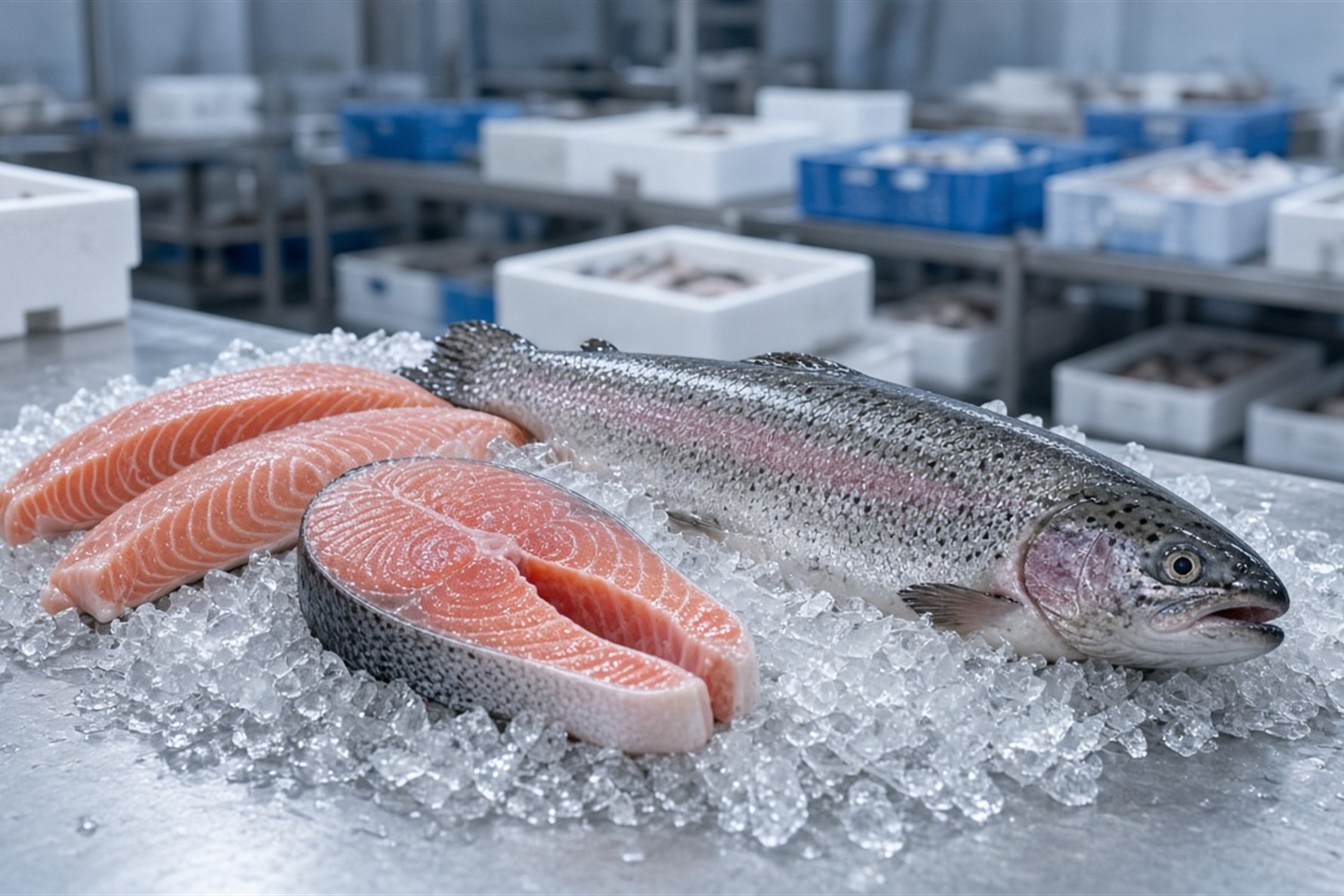
Rainbow trout, scientifically known as Oncorhynchus mykiss, is the central species of freshwater cold-water aquaculture on the Iranian plateau. Iran’s geography and geological relief — especially the Zagros and Alborz mountain belts — have created an exceptional hydrological setting for cold-water fish breeding and grow-out. Mountain catchments, karst springs with stable temperatures of 12–16°C, seasonal snowmelt, and oxygen-rich torrential rivers have enabled Iran to produce more than 150,000 tonnes of trout meat annually, accounting for roughly 17% of global production of this species. That harvest volume has established Iran among the world’s largest freshwater trout production hubs and the leading producer in the Middle East.
For wholesale buyers and exporters, knowing production hubs, farming systems, commercial weight grades, laboratory quality indicators, and destination-market requirements — from Russia and Eurasia to the Persian Gulf and Iraq — is essential to securing contracts and reducing shipment rejection risk. This guide maps an operational sourcing path for Iranian rainbow trout from farm to port and airport.
1. Geographic Map of Cold-Water Aquaculture in Iran
Farm development around sustainable water resources has shaped distinct production hubs across several provinces. Knowing these hubs is essential for logistics planning, harvest timing, and final shipment quality.
| Province / Region | Primary water source | Role in the chain | Commercial profile |
|---|---|---|---|
| Chaharmahal and Bakhtiari | Headwaters of the Karun and Zayandeh Rud | Leading hub by tonnage | Hundreds of farms; high volume for wholesale |
| Lorestan | Sezar and Kashkan | Second-largest national producer | Stable mountain hydrology |
| Mazandaran | Traditional raceways, RAS, Caspian cages | Large sizes and export salmon trout | Stronger muscle texture in cages |
| Alborz and greater Tehran | Proximity to air and road freight | Sorting and processing hub | Final packing and export trade |
Chaharmahal and Bakhtiari; the tonnage engine
With hundreds of farms along the headwaters of the Karun and Zayandeh Rud, Chaharmahal and Bakhtiari is recognized as Iran’s leading trout production hub by weight. Stable water temperature, suitable gradient for continuous concrete raceways, and access to industrial feed have made the province the primary volume source for domestic distribution and export.
Lorestan; second-largest producer
Lorestan ranks second, relying on the Sezar and Kashkan river basins. Wholesale buyers can use the region’s farm diversity to fill medium and household-standard grades — especially in seasons when Chaharmahal capacity is under pressure from export orders.
Mazandaran; large sizes and Caspian cages
Along the northern belt, Mazandaran simultaneously operates traditional concrete raceways, recirculating complexes, and cages in the Caspian Sea, making it the main hub for large-size fish and export salmon trout. Continuous swimming in large water bodies strengthens carcass muscle texture and improves flesh flavor — a key factor for the Russian market and sushi chains.
Alborz; preparation and export hub
Alborz province and the greater capital area, with proximity to air and road infrastructure and equipped sorting centers, industrial slaughterhouses, and processing plants, form the main hub for preparation, final packing, and export commercial handling. Many wholesale contracts are fulfilled from this hub with the processing plant’s veterinary approval code IR.
2. Four Standard Trout Farming Systems in Iran
Iranian trout production rests on four farming systems. System type directly affects stocking density, feed conversion ratio, muscle texture, and ultimately destination-market acceptance.
- Continuous concrete raceways (Raceway): The most common method, fed by gravity flow from rivers. Relatively low capital cost and familiar management for most farmers; suited to portion-size through medium commercial grades.
- Circular and octagonal ponds: Equipped with advanced aerators and liquid oxygen, they enable densities above 50 kg/m³. Better dissolved-oxygen control and growth uniformity stabilize sorting output.
- Recirculating aquaculture systems (RAS): Physical and biological filtration reduce water use and allow precise environmental control. Suited to water-scarce areas or orders with tight quality specifications.
- Floating cages (Cage): In reservoir lakes and along the Caspian; continuous swimming in large water bodies strengthens carcass muscle and improves flesh flavor — the preferred option for heavy industrial salmon trout.
Recent advances in balanced extruded feeds and fast-growing strains have markedly improved farm feed conversion ratios and opened the path to successful entry into global wholesale markets. Wholesale buyers should specify farming system and water source in the contract — especially for orders sensitive to flavor and texture.
3. Standard Weight Grading and Commercial Classification
In wholesale trade and international fisheries markets, carcass weight sets the base price, processing form, and final destination. Lack of weight uniformity in a shipment is treated as a quality-grade loss, because automatic filleting lines, factory packing lines, and even cooking protocols in food manufacturing are designed around homogeneous sizes. Industrial sorting units must therefore separate carcasses into standard classes with high precision.
| Commercial grade | Carcass weight range (g) | Supply form and commercial cut | Main use and target market |
|---|---|---|---|
| Portion / restaurant | 300–500 | Whole gutted, head-on, tail-on | Domestic restaurants, catering, hotels |
| Household standard | 500–800 | Gutted, head-off, tray pack | Retail chains, urban fine distribution |
| Medium commercial | 800–1200 | Gutted, skin-on fillet, steak | UAE, Oman, Qatar, Iraq |
| Large export | 1200–2000 | Gutted, head-off, butterfly fillet | Russia, Belarus, Kazakhstan |
| Heavy industrial salmon trout | 2000–3500+ | Skinless fillet, cold-smoked slices | Russian processing plants, sushi chains |
Portion / restaurant; 300–500 g
This grade is designed for single-serve restaurant plates and hotel buffets. Whole gutted carcasses with head and tail are used for whole cooking or quick grilling. On the domestic market, high turnover and competitive price matter more than deep orange color; however, weight uniformity of ±5% per carton is mandatory so industrial-kitchen cook times stay consistent.
Household standard; 500–800 g
The best-selling range in retail chains and urban fine distribution. Supply is typically gutted head-off in tray pack, MAP, or vacuum. Retail buyers emphasize glossy skin appearance, clear freeze date, and absence of bruising. This grade bridges household consumption and small hospitality orders.
Medium commercial and the Persian Gulf; 800 to about 1500 g
Markets in the UAE, Oman, Qatar, and Iraq mainly require 800–1200 g carcasses — and up to about 1500 g for luxury hotel orders — for gutted, skin-on fillet, and steak forms. Halal certification, GSO compliance, and bilingual labeling (English/Arabic where needed) are common requirements. Air-chilled routes for fresh-cold shipments and sea-frozen routes for high volume are both widely used.
Large export and salmon trout; 1.2 kg and above
Russia, Belarus, and Kazakhstan concentrate demand on 1.2–2 kg; processing plants and sushi chains want 2–3.5 kg and above for skinless fillet and cold-smoked slices. In this range, flesh color on the SalmoFan scale (target 28–31 for Russia), complete bloodline clearing, and IQF freezing determine acceptance or rejection.
4. Pigmentation Physiology and Salmonization; the SalmoFan Index
Rainbow trout flesh color depends on carotenoid deposition — especially dietary astaxanthin — in muscle tissue. In international trade, the standard SalmoFan card (approximate scores 20–34) is the visual benchmark. Domestic markets often accept lower scores; by contrast, Russian and Eurasian exports typically require a minimum of 26 and a target of 28–31.
| SalmoFan range | Approximate color | Suitable market | Sourcing note |
|---|---|---|---|
| 20–23 | Pale pink to cream | Domestic wholesale; some Iraq orders | Short pigmentation period; lower feed cost |
| 24–27 | Pink–orange | Persian Gulf; export retail | Balance of cost and visual acceptance |
| 28–31 | Deep orange (salmon trout) | Russia, Belarus, Kazakhstan | Common Eurasian contract target |
| 32–34 | Intense orange–red | Sushi; premium cold-smoked | High feed cost; long feeding period |
Commercial salmonization requires feeding plans weeks to months before harvest. Sudden withdrawal of pigment or feed-quality swings creates uneven color patches that become obvious at filleting. In export contracts, state the target SalmoFan score, measurement method (random sample from each pallet), and allowed deviation percentage explicitly.
5. Organoleptic Assessment; Texture, Skin, Eyes, and Gills
Before relying on laboratory certificates, sensory inspection at origin or loading can catch most quality deviations. Professional buyers check four axes at once.
- Muscle texture: Firm, with quick spring-back after finger pressure; soft or watery flesh signals delayed processing or cold-chain failure.
- Skin: Glossy, clear mucus, without widespread bruising or scale loss; dull, sticky skin warns of early spoilage.
- Eyes: Clear and bulging in fresh product; sunken, cloudy eyes on chilled carcasses indicate aging (less reliable on frozen).
- Gills: Bright red to pink in fresh fish; brown color or ammonia odor means immediate rejection.
- Odor: Fresh marine/freshwater aroma; muddy or geosmin odor is unacceptable in Eurasian export markets.
- Opened belly: Free of viscera residue and black bloodline; bile stains on fillet cause lot rejection.
6. Laboratory Quality Control; Premium Limits and Critical Ceilings
Wholesale acceptance depends on a lot certificate of analysis (COA) and compliance with contractual limits and destination regulations. The table below is a practical framework for buyers and QC units at plants holding an IR code.
| Parameter | Premium limit | Critical ceiling | Method |
|---|---|---|---|
| TVB-N | Less than 15 | Maximum 25 | Acid distillation |
| PV | Less than 2 | Maximum 5 | Titration |
| TVC | Less than 4 | Maximum 6 | Pour plate |
| Listeria | Negative | Not detected in 25 g | Selective culture |
| Salmonella | Negative | Negative in 25 g | Enrichment |
| Pb | Less than 0.05 | Maximum 0.2 | Atomic absorption |
| Cd | Less than 0.01 | Maximum 0.05 | Plasma |
Total volatile basic nitrogen (TVB-N) is a protein freshness index; peroxide value (PV) indicates the onset of lipid oxidation. Total viable count (TVC) is usually reported as log CFU/g. Listeria and Salmonella must be negative in 25 g; lead and cadmium are controlled to destination heavy-metal limits. Exceeding a critical ceiling means stopping loading and reviewing the cold chain or source.
7. Industrial Processing, IQF Freezing, and Export Packing
After harvest and bleeding, the industrial line performs gutting, kidney and bloodline clearing, washing, and rinsing. Delay between harvest and bleeding directly affects odor, color, and TVB-N. Export-qualified plants hold a veterinary approval code IR and a HACCP system.
IQF freezing and glaze
In wholesale export, each piece is frozen in an IQF tunnel (air temperature about −35 to −40°C) so pieces do not stick together. Immediately afterward, immersion or sterile-water spray forms a 5–10% ice glaze (maximum per contract, often up to 20%). Glaze percentage must be clear on the label and invoice; ambiguity is a common source of financial dispute per container. Destination cold-chain core temperature is typically ≤ −18°C.
EPS, vacuum, and MAP packing
| Pack type | Temperature / state | Primary use | Contract notes |
|---|---|---|---|
| EPS (polystyrene) + ice | 0 … +2°C | Fresh road haul; Iraq and local market | Fast transit; no re-freezing |
| Flat vacuum | ≤ −18°C | Frozen retail and wholesale | Film thickness; oxygen permeability |
| MAP | 0 … +4°C | Supermarket and hotel | CO₂/O₂ ratio; 8–10 day shelf life |
| Master carton + IQF | ≤ −18°C | Export container | Glaze %; net weight |
In MAP packing, the CO₂/O₂ gas mix slows aerobic bacteria and preserves flesh color. Vacuum reduces omega-3 lipid oxidation and suits frozen storage. Technology choice depends on time to consumption, distribution channel, and contractual glaze terms.
8. Veterinary IR Code, Russian Systems, and HS Codes
Trout exports to the Russian Federation and the Eurasian Economic Union require the origin plant to be listed on the approved Rosselkhoznadzor register and a veterinary health certificate to accompany the shipment. Electronic systems such as Cerberus and Mercury are used to track and register Russian import consignments; any mismatch among invoice, label, and certificate can stop clearance. The plant approval code on the label must match the destination registry.
| HS code | Product description | Commercial use |
|---|---|---|
| 0301.99.90 | Live | Broodstock transfer or limited live sales |
| 0302.11.00 | Fresh / chilled | Road and air chilled freight |
| 0303.14.00 | Frozen (carcass) | Export reefer container |
| 0304.42.00 | Fresh fillet | Hotel and premium retail |
| 0304.82.00 | Frozen fillet | Secondary processing and sushi |
| 0305.43.00 | Smoked | Value-added product |
- Core documents: veterinary health certificate, COA, commercial invoice, packing list, cargo insurance.
- Eurasia: compliance with TR EAEU 040/2016 and approved plant listing.
- Persian Gulf: Halal certificate and GSO requirements.
9. Export Target Markets
Russia and the Eurasian Economic Union (EAEU)
The highest-value destination for Iranian large trout and farmed salmon trout. Demand centers on 1.2 kg and above, SalmoFan 28–31 color, clean gutting, and freeze without temperature breaks. Belarus and Kazakhstan follow similar patterns and sometimes share transit routes. Key constraints include TVB-N, histamine, heavy metals, and zero antibiotic residues.
Gulf Cooperation Council (GCC) countries
The UAE, Qatar, Oman, and Saudi Arabia mainly buy medium commercial grades (800–1500 g) for restaurants and hotels. Sea freight to Jebel Ali in reefer containers and air freight for chilled MAP are common. Labels must clearly show expiry date and product specifications.
Iraq
A volume market preferring road haul of fresh or light-frozen product. Grades of 300–800 g and sometimes whole carcass are in demand. Delivery speed and competitive price matter more than high color scores; weight uniformity and packing hygiene still decide acceptance.
China
A potential market for frozen fillet and value-added products; requires compliance with Chinese aquatic import rules, plant registration, and a long sea cold chain. Successful entry usually involves trial samples, precise HS specifications, and a logistics partner experienced with reefer containers.
10. Cold-Chain Transport; Road, Sea, and Air
Mode choice depends on distance, product shelf life, cost, and destination sensitivity. A temperature data logger is recommended on every export shipment and is mandatory under many Russian and Gulf contracts.
| Mode | Target temperature | Typical time | Common destinations | Operational note |
|---|---|---|---|---|
| Road (refrigerated) | 0 … +2 or ≤ −18°C | 1–4 days | Iraq, domestic market, nearby borders | Control stops and door seals |
| Sea (reefer container) | −20 … −25°C | 10–25 days | Russia, Persian Gulf, China | Pre-cool container; data logger |
| Air | 0 … +4°C (chilled) | 12–36 hours | Dubai, Doha, Moscow (urgent) | High cost; suited to fresh MAP |
11. Pricing Drivers, Seasonal Cycles, and Incoterms
Final wholesale price per kilogram combines origin live or carcass price, processing and sorting cost, glaze percentage, packing, cold-chain logistics, insurance, duties, and trade margin. Ambiguity over weight basis (net without glaze versus gross with ice) is a source of multi-million disputes per container.
Seasonal cycles
Near the spawning season, flesh quality and fillet yield may change. Many export buyers prefer the autumn–winter window for heavy weights and salmon-trout color. In summer, heat stress on raceway farms and geosmin risk rise; harvest planning and pre-slaughter feed withdrawal become more important.
Contract terms and Incoterms
In export trade, the chosen Incoterms set the risk and cost boundary. Most common options are EXW processing plant, FOB origin port (e.g. Bandar Abbas), CFR / CIF destination port (e.g. Novorossiysk or Jebel Ali), and for some air orders CIP destination airport. Include insurance, minimum remaining shelf life at destination, and delivery of the data-logger chart in the contract.
- Price basis: net weight without glaze or live-weight equivalent — state explicitly.
- Grade tolerance: typically ±5%; allowed mix percentage separately.
- Glaze: target 5–10% with a reference measurement method.
- Payment: advance, letter of credit, or a mix matched to counterparty risk.
12. Six-Step Wholesale Buyer Checklist
- Define product and grade: Lock scientific name Oncorhynchus mykiss, supply form (gutted carcass, fillet, smoked), weight range, and the correct HS code.
- Select hub and farming system: Volume from Chaharmahal/Lorestan; heavy size and strong texture from Mazandaran/cages; packing and documents from the Alborz hub.
- Quality and color: Write target SalmoFan, TVB-N / PV / microbial limits, and organoleptic rejection criteria into the contract.
- Packing and cold chain: Specify IQF or chilled, glaze percentage, pack type (EPS, vacuum, MAP), and transport mode.
- Documents and registry: Plant IR code, health certificate, COA, Eurasian compliance (Cerberus / Mercury) or Halal/GSO for the Gulf.
- Commercial terms: Incoterms, weight basis, third-party inspection, insurance, grade-deviation penalties, and minimum shelf life at destination.
13. Conclusion
With production above 150,000 tonnes and about 17% of global rainbow trout (Oncorhynchus mykiss) output, Iran is the primary Middle East supply hub for this species. Successful wholesale buying means aligning production hub, weight grade, SalmoFan color, laboratory limits, and transport mode with destination requirements — from domestic restaurants to Russian and Gulf containers.
Iranco is a specialized platform connecting B2B buyers to qualified rainbow trout farms and processing units. For inquiries on grade, volume, export destination, and cold-chain terms, contact the Iranco trading team.
Featured Products


Related Articles



