 Iranco Magazine Team
Zagros–Alborz production geography, SalmoFan grading, IQF freezing and glazing, Russia and GCC markets, HS documents and reefer cold chain
Export Guide · Frozen Trout
Iran Frozen Trout: Wholesale Buying and Export Guide
A comprehensive guide for procurement managers, exporters, and distributors: Zagros and Alborz production geography, quality grading, freezing and glazing engineering, Russia, Eurasia and Gulf markets, trade documents, and the cold chain for frozen rainbow trout.
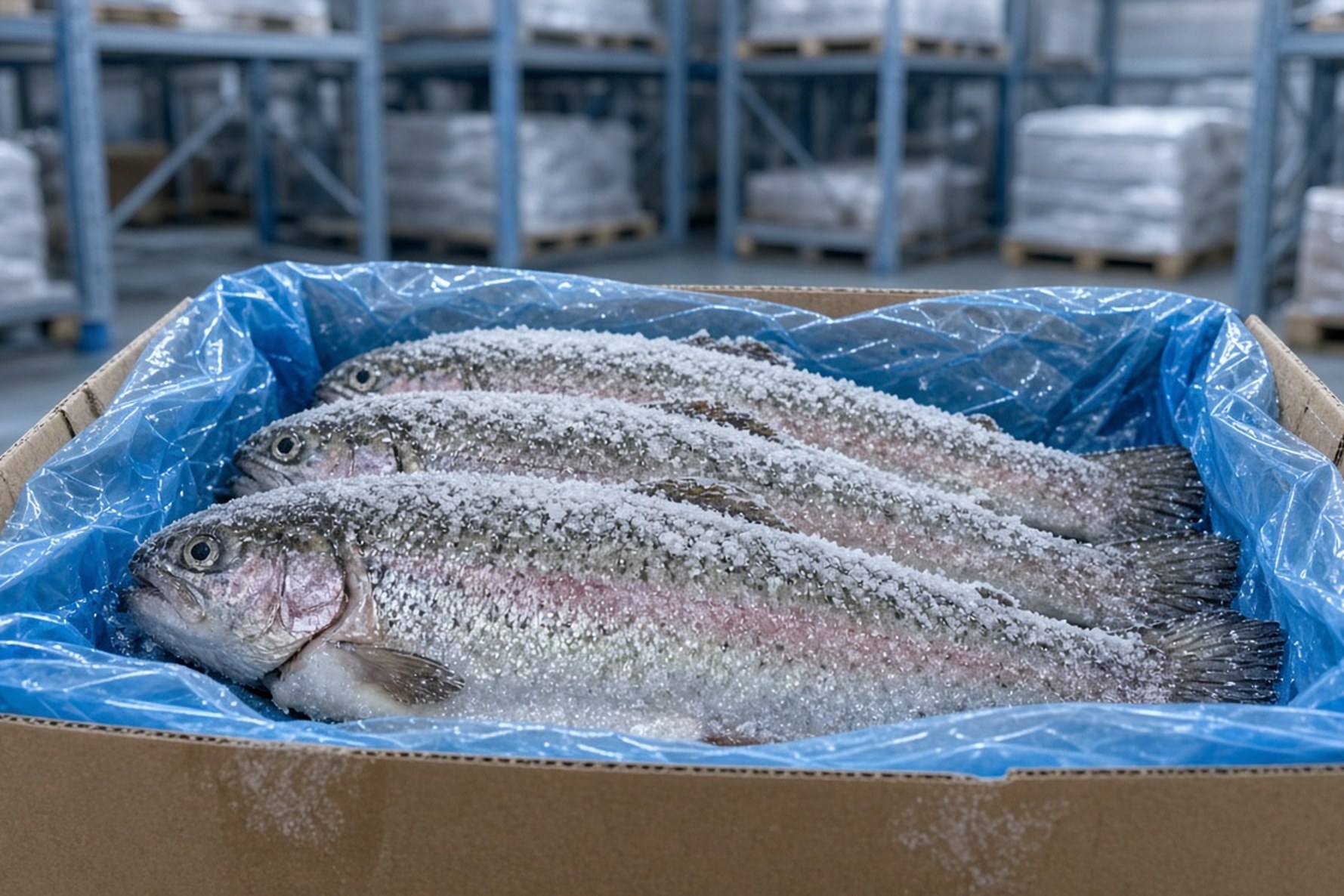
Iran is the world’s largest producer of freshwater rainbow trout. A dense network of cold-water farms on the slopes of the Zagros and Alborz has built annual capacity above 120,000 tonnes and a stable supply base for domestic and export markets. Frozen product — especially gutted fish and fillets — is now the core of international trade in Iranian trout to Russia, the Eurasian Economic Union (EAEU), and Gulf Cooperation Council countries.
Success in wholesale buying and export of this commodity requires precise knowledge of ecological capacity, laboratory quality indices, freezing and ice-glaze protocols, destination sanitary requirements, customs documents, and cold-chain logistics engineering. This guide sets out the technical and commercial dimensions of Iran’s frozen trout for B2B operators.
1. Ecological capacity and production geography
Rainbow trout (Oncorhynchus mykiss) is a cold-water species that grows best in oxygen-rich waters at an optimal temperature of 10 to 18°C. Iran’s mountain geography — especially the central and northern Zagros and the southern foothills of the Alborz — gives farmers abundant springs and rivers that underpin competitive meat quality and pigment uptake.
Lorestan
Lorestan province, with the Dez and Kashkan river systems and Zagros headwaters, is one of the classic trout-farming hubs. Farms in this region, thanks to stable water temperature and appropriate stocking density, produce carcasses with dense texture and strong acceptance in export markets.
Chaharmahal and Bakhtiari
Chaharmahal and Bakhtiari, as one of the leading production hubs, supplies a substantial share of national volume. High altitude, cold spring water, and processing infrastructure adjacent to farms have made this province a primary source of export frozen trout.
Mazandaran and Alborz
The Alborz foothills in Mazandaran and Alborz province offer closer access to northern ports and Caucasus corridors. This logistics advantage is strategically important for reefer shipments to Russia and Eurasia.
Fars, Kohgiluyeh and Boyer-Ahmad, Isfahan
The southern Zagros axis — Fars, Kohgiluyeh and Boyer-Ahmad, and Isfahan — completes the national supply basket. Altitude and water-quality diversity in these provinces enables production of different weight and colour grades for domestic and export markets.
| Province | Approx. annual production (tonnes) | Water source | Meat quality traits | Export market priority |
|---|---|---|---|---|
| Lorestan | 35,000–39,000 | Zagros springs and fast rivers (~700 farms) | Firm texture, high elasticity, controlled fat | Russia and Belarus |
| Chaharmahal and Bakhtiari | 24,000–36,000 | Natural springs and Karun headwaters | High muscle density; ideal feed conversion | Russia, UAE, Qatar |
| Mazandaran and Alborz basin | 15,000–25,000 | Alborz catchments and artesian wells | Suited to orange-flesh salmon trout | Russia, Armenia, Azerbaijan |
| Fars, Kohgiluyeh and others | 10,000–20,000 | Mountain springs and intensive farms | Medium size suited to household use | Kuwait, Oman, Iraq |
2. Specifications, grading, and quality indices
Commercial valuation of frozen trout is based on flesh colour, unit weight, organoleptic (Organoleptic) attributes, and laboratory results. The SalmoFan colour card is the standard export-market tool for scoring fillet colour; the 24 to 28 range is considered desirable in most Russia and Eurasia orders.
Common weight grades
- 250–400 g: Whole gutted fish; Arabic single-portion restaurants and household packs for Iraq and Oman.
- 400–800 g: Highest-demand retail size; gutted with head and tail; suited to blast freezing and the Persian Gulf market.
- 800–1200 g: Large salmon trout; home portioning and international restaurants.
- 1.2–2.5+ kg (Super Premium): Large carcass for filleting, smoking, and steaks in Moscow and St. Petersburg markets.
Organoleptic indices
Odour must be fresh and mildly marine; muddy, geosmin, or metallic odours are rejectable. Texture after thawing should be elastic without severe water loss (Drip Loss). Glossy skin surface, clear eyes (on headed carcasses), and absence of blood spots are visual acceptance criteria.
| Index | Super Premium | Grade A | Grade B (non-export) |
|---|---|---|---|
| Carcass weight range | 1.2–2.5+ kg | 500–1000 g | Below 400 g or non-uniform |
| SalmoFan | 26–28+ | 22–25 | < 20 (dull or white flesh) |
| TVB-N | < 22 mg/100g | 22–28 mg/100g | > 30 mg/100g |
| Histamine | < 50 mg/kg | 50–100 mg/kg | > 150 mg/kg |
| Drug residues | Zero (no malachite or chloramphenicol) | Absolute zero | Antibiotic traces present |
3. Processing, freezing, glazing, and packaging engineering
Final quality of frozen trout is the result of a controlled chain of operations from farm to cold store. Deviation at any link — especially delay between harvest and freezing — directly affects TVB-N, texture, and appearance after thawing.
Fasting and hypothermic stunning
Before harvest, a 24- to 72-hour fasting (Fasting) period reduces gut contents and lowers the microbial load after gutting. Hypothermic stun (Hypothermic Stun) with ice water suppresses animal stress and lactate build-up and preserves tissue quality.
Gutting and preparation
Bleeding, gutting, kidney bloodline cleaning, and final wash are the standard steps before freezing. Export product is usually offered as gutted (Gutted) or skin-on fillet; retained viscera or bile fails destination inspection.
Blast freezing and IQF
Tunnel or blast freezing (Blast Freezing) must bring the fish core below −18°C in the shortest time so that fine ice crystals form. IQF (Individual Quick Freezing) technology enables piece-by-piece separation at destination and is preferred for retail and mixed orders; block-frozen is common for high volume and lower cost.
Glazing 5–10%
Ice glaze (Glazing) with cold potable water creates a protective layer against oxidation and freezer burn. The standard export range is usually 5 to 10 percent of net weight; excess glaze is treated as weight fraud in destination audits and must be declared on the invoice and label.
Master carton versus vacuum
- Carton master carton with polyethylene liner: Suitable for block and bulk IQF; lower cost; requires humidity control and cold-store sealing.
- Vacuum or vacuum-skin packaging: Better visual shelf life; reduced oxidation; suited to fillet and premium retail.
- Labelling: Scientific name, net weight excluding glaze, production/expiry dates, plant IR code, and destination language are mandatory.
- Fasting and Stun: Lower stress and gut load.
- Gutting and wash: Hygienic preparation before freezing.
- Blast / IQF: Preserve texture with fine crystals.
- Glaze and Pack: Surface protection and contractual weight compliance.
4. Export markets
Three main demand blocks shape Iran’s frozen trout trade: Russia and the Eurasian Economic Union, GCC countries, and China. Each market has different plant-registration protocols, health documents, and product preferences.
Russia and Eurasia — Mercury system
Russia is the largest volume destination. The origin plant must be on the Rosselkhoznadzor approved list, and electronic shipment tracing is done through the Mercury system. Technical regulation TR EAEU 040/2016 sets limits for TVB-N, histamine, heavy metals, and veterinary drug residues. High colour grade and fully gutted product have the strongest acceptance.
Gulf Cooperation Council (GCC) countries
The UAE, Qatar, Oman, Saudi Arabia, and Bahrain control imports under GSO standards and halal requirements. The sea route to Jebel Ali with reefer containers is common. Bilingual labelling (English/Arabic) and clear declaration of expiry date and glaze percentage matter.
China — GACC registration
Entry to the China market requires registration of the processing unit in the CIFER system under GACC rules (Decrees 248 and 249). The 18-digit registration code must appear on packaging and health documents; without it, clearance at Chinese ports is not possible.
| Market | Key requirement | Product preference | Commercial note |
|---|---|---|---|
| Russia / EAEU | Mercury + Rosselkhoznadzor list | Gutted; SalmoFan 24–28 | High volume; strict laboratory checks |
| GCC | Halal + GSO standards | 200–500 g grades; IQF | Jebel Ali route; clear labelling |
| China | GACC / CIFER | Block and IQF; glaze control | Plant registration required before entry |
5. Sanitary requirements
Export processing units must hold a veterinary supervisory IR Code from the Iran Veterinary Organization and keep HACCP and GMP systems documented and operational. Buyer audits and destination inspections focus on these records and critical-control-point histories.
- TVB-N: Freshness index of total volatile base nitrogen; exceeding the destination limit leads to shipment rejection.
- Histamine: Rises under poor storage; inadequate bleeding and cold-chain breaks increase risk.
- Drug residues: Antibiotics and farm chemicals must be at zero or below the destination MRL; a withdrawal period before harvest is mandatory.
- PSI (pre-shipment inspection): In many export contracts, independent sampling and quality confirmation are done before container loading.
6. Trade documents
The common customs tariff code for frozen rainbow trout is HS 03031400. The standard export document set includes the veterinary health certificate, certificate of origin (Certificate of Origin), commercial invoice, packing list, and ocean or land bill of lading.
- Veterinary health certificate: Issued by the Iran Veterinary Organization; aligned with the destination template.
- CoO: Certificate of origin from the chamber of commerce or customs as required by the importing country.
- Invoice and Packing List: Net weight, gross weight, glaze percentage, carton count, and grade specifications.
- B/L or CMR: Ocean bill of lading or road consignment note stating reefer temperature.
Common Incoterms
In frozen trout trade, four terms are common:
- FOB: Delivery on board at the origin port; risk after loading sits with the buyer.
- CFR: Freight to destination port borne by the seller; insurance usually separate.
- CPT: Carriage to the agreed place; suited to Eurasian land corridors.
- DAP: Delivery at destination; seller retains full logistics control to the buyer’s warehouse door.
7. Cold-chain logistics
Holding core temperature at −18°C or lower from loading to discharge is the condition for quality survival. A 40-foot reefer container is the standard export volume unit; installing temperature data loggers (Data Logger) at several carton points is essential to prove cold-chain integrity in insurance disputes.
| Corridor | Approximate route | Target market | Operational note |
|---|---|---|---|
| Caspian | Northern ports → Russia / Kazakhstan ports | Russia and Eurasia | Shorter transit; seasonal capacity |
| Caucasus | Overland via northwest borders | Russia, Armenia, Georgia | Needs road reefer and temperature monitoring |
| Persian Gulf | Bandar Abbas / Bushehr → Jebel Ali and GCC ports | UAE, Qatar, Oman, Saudi Arabia | 40-ft ocean reefer; regular sailings |
| Far East | Southern ports → Shanghai / Ningbo | China | Long transit; GACC registration mandatory |
8. Economic analysis and risk
Export landed cost of frozen trout comprises several components: live or gutted purchase price from the farm, processing yield loss, freezing and glaze cost, packaging, laboratory and certificates, reefer freight, insurance, and working-capital financing. Clarity on the weight basis (net excluding glaze versus gross including ice glaze) is critical to avoid price disputes.
Cost components
- Raw material and gutting yield loss (typically 14–20% versus live).
- Freezing energy, glaze, and cold-store holding.
- Primary packaging, master carton, and palletising.
- Quality tests, health certificates, and pre-shipment inspection.
- Reefer container freight, terminal charges, and cargo insurance.
| Risk | Likely impact | Relative probability | Mitigation |
|---|---|---|---|
| Cold-chain break | Higher TVB-N; shipment rejection | Medium | Data logger; backup reefer; insurance |
| Drug residues | Seizure at destination border | Low to medium | Withdrawal period; pre-loading test |
| Glaze / weight dispute | Buyer financial claim | High | Declare percentage; witness weigh; PSI |
| Unregistered plant | No clearance (Russia / China) | Medium | Confirm approved list before contract |
| FX and freight volatility | Margin erosion | High | Short-term contracts; freight adjustment clause |
9. Summary
Iran’s frozen trout, built on Zagros and Alborz ecological capacity, annual production above 120,000 tonnes, and a processing network with IR codes, is one of the country’s most competitive seafood export items. Commercial success rests on locking colour and weight grade, controlling glaze at 5–10%, laboratory compliance with destination requirements, complete documentation (including HS 03031400), and uninterrupted cold-chain monitoring at −18°C.
Iranco is a specialised platform connecting wholesale buyers and exporters to qualified frozen-trout suppliers under clear contractual specifications. For volume, grade, destination, and Incoterm enquiries, contact the Iranco team.
Featured Products


Related Articles



