 Iranco Magazine Team
Real capacity for pistachios, dried fruit, saffron and processed Iranian foods in Germany — EU standards, lab control, labelling, packaging, customs and buyer selection
Export Guide · Germany · Food
Iran Food Exports to Germany: Standards and Market Opportunities for Iranian Products
Real capacity for pistachios, dried fruit, saffron and processed Iranian foods in Germany — EU standards, lab control, labelling, packaging, customs and buyer selection.
Germany is the EU’s largest national food market. In 2025 food accounted for about two thirds of German imports from Iran; shelled pistachios were the top line. This B2B guide covers specs, EU law, logistics and sourcing.
Introduction
Exporting Iranian food to Germany is not justified by geography alone. Germany applies the full EU legal stack: official controls, contaminants, MRLs and consumer labelling. Trade data show Iran has a real position in pistachios and high-value lines.
In 2025 Germany imported about €234.5M of goods from Iran; food was about €153.9M (65.6%). Shelled pistachios were roughly €78M — the largest food item.
Professional trade rests on three pillars: measurable specs, lot uniformity and lab documentation aligned with EU law.
1. Germany’s market position for Iranian food exports
Germany is a consumption hub and a redistribution point for nuts and food in Europe. Hamburg, Bremerhaven and Frankfurt airport are key entry nodes. Iran’s strongest position is in pistachios, then saffron and selected dried fruit.
Most German buyers source via specialist importers or industrial distributors. Direct listing in retail without consumer packaging and audit history is difficult; the practical B2B path is EU-ready sales to an importer.
2. Which Iranian foods have real opportunity in Germany?
Opportunity must be weighed against import data and regulatory difficulty.
| Product | HS | Iran position | Main barrier |
|---|---|---|---|
| Pistachios | 080251 / 080252 | €78M kernels 2025 | Aflatoxin, 50% checks |
| Saffron | 091020 | Leading supplier | Identity, moisture, MRL |
| Dates | 080410 | Visible share | Tunisia competition |
| Raisins & dried fruit | 080620 | Market presence | Mycotoxins, SO₂ |
| Processed foods | Various | Niche / industrial | Label, allergens |
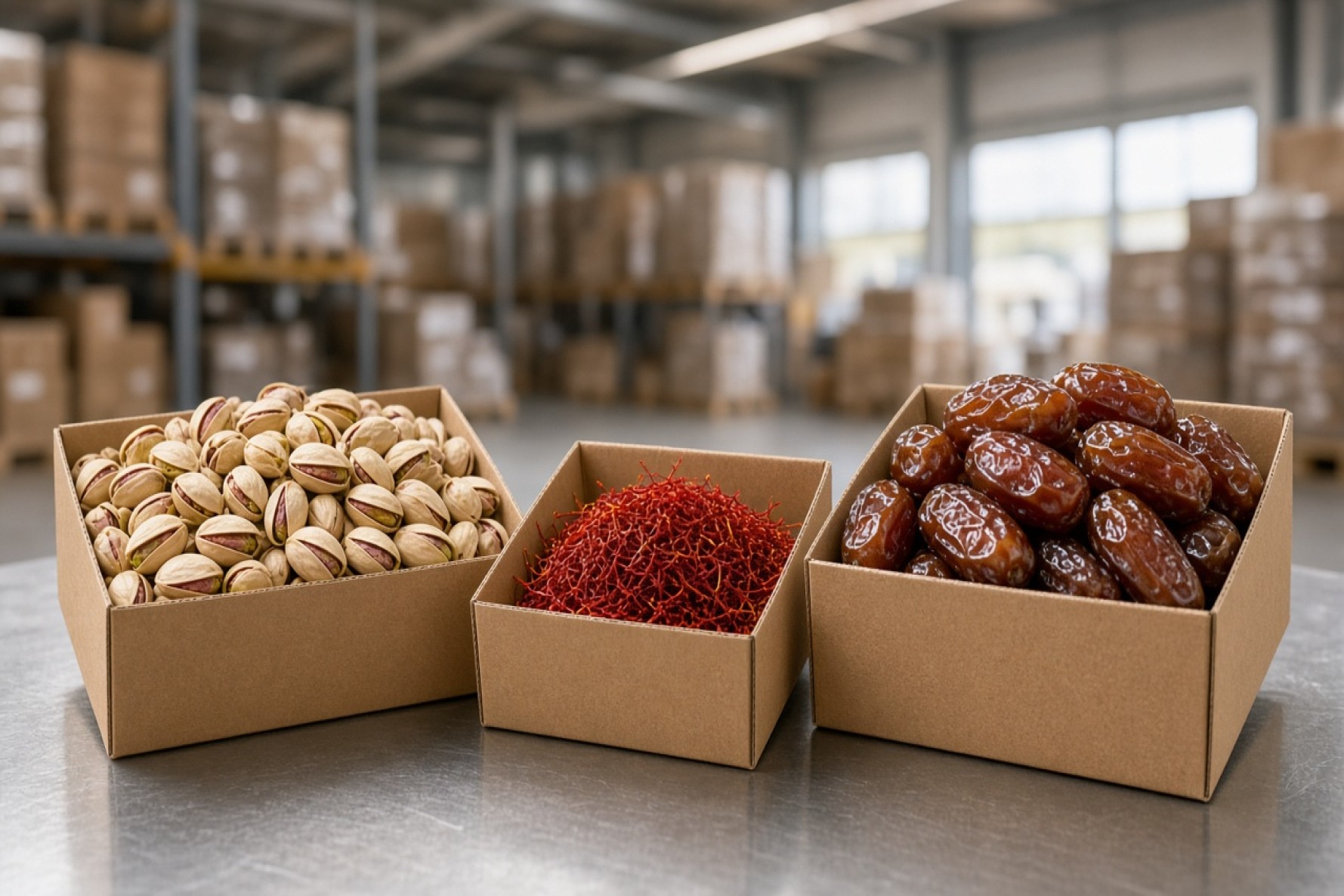
Pistachios
Sold in-shell for retail and as kernels for confectionery. Aflatoxin control and size/open-shell consistency separate accepted lots from border holds.
Saffron
High unit value and small shipments; purity, moisture and colouring strength drive price more than marketing grades.
Dates, raisins and dried fruit
Demand exists but competition from Tunisia, Turkey and others is strong. Grade, moisture, pack and landed cost matter.
Spices and high-value lines
Besides saffron, other spices can enter specialist import channels with stable specs and MRL documentation.
Processed foods
Sauces and industrial inputs work when formulation, allergens, German labelling and monthly capacity meet EU buyer expectations.
3. What specs must the German buyer define?
Terms like “export grade pistachios” or “premium saffron” are not contractually sufficient — parameters must be testable.
| Group | Parameters | Why |
|---|---|---|
| Pistachios | Size, open %, moisture, aflatoxin class | EU 2023/915 & grade |
| Saffron | Cut/style, moisture, colouring | Identity & price |
| Dates | Variety, moisture, defects, net weight | QC & label |
| Raisins & dried fruit | Color, capstem, foreign matter, SO₂ | Retail vs industrial |
| Dates, raisins and dried fruit | Moisture, size, mycotoxins | EU safety |
Attach a spec sheet to the contract; approved samples must link to the export lot.
4. EU regulations for food imports into Germany
Germany applies EU food law; the importer is responsible for compliance.
- EU 2017/625 — official controls at entry and on the market
- EU 852/2004 — food hygiene along the chain
- EU 2023/915 — aflatoxin limits (8/10 vs 12/15 µg/kg for pistachios)
- EU 2073/2005 — microbiological criteria (incl. ochratoxin A where relevant)
- EU 396/2005 — pesticide MRLs
- EU 1169/2011 — food information to consumers
| Use | B1 | Total |
|---|---|---|
| Final consumption / direct ingredient | 8 µg/kg | 10 µg/kg |
| Sorting or physical treatment before sale | 12 µg/kg | 15 µg/kg |
Define consumption vs processing tier before loading; changing use after a border rejection is not reliable.
5. Quality control and laboratory testing
ISO 22000 or HACCP helps but does not replace EU law. COA must match the export lot; sample after final sorting.
For saffron and dried fruit, plan moisture, metals and MRL tests as required by the buyer and product risk.
6. Labelling: EU 1169/2011 and German LMIDV
Retail sale to German consumers requires mandatory particulars in German under EU 1169/2011 and LMIDV. English alone is not enough for German retail.
- Product name, ingredients, emphasised allergens
- Net weight, dates, storage
- FBO name and address
- Country of origin, batch, nutrition table
Bulk B2B may use minimal labels, but the importer must apply full German retail labelling before shelf sale.
7. Export packaging for the German market
Packaging must match channel (bulk, retail, industry) and moisture control.
| Channel | Pack | Priority |
|---|---|---|
| German retail | Consumer unit + DE label | Shelf appeal, batch |
| Bulk importer | 25 kg bag with liner | Moisture, pallet |
| Food industry | Industrial pack | Unit cost, traceability |
| Air freight (saffron) | Sealed tins / cartons | Security, COA |
8. HS codes, EU 2019/1793 and 50% pistachio control
In-shell 08025100 and shelled 08025200 pistachios of Iranian origin face reinforced aflatoxin controls at 50% identity/physical check frequency under EU 2019/1793.
| Goods | HS | Entry note |
|---|---|---|
| Pistachios in shell | 08025100 | 50% check — IR origin |
| Shelled pistachios | 08025200 | 50% check — IR origin |
| Saffron | 091020 | High value; TRACES |
| Dates | 080410 | Label + QC |
Plan importer EORI, TRACES/CHED and a competent border entry point in advance.
9. Sanctions, payment and contract
Iran trade requires workable banking, transparent parties and compliance with EU/German restrictions. Define payment (LC, prepayment, escrow), border rejection costs, official sampling and force majeure in writing.
10. Logistics: sea, air and land
Routes may be direct to Germany or via another EU port.
- Sea: Hamburg / Bremerhaven — nuts, containers
- Air: Frankfurt — saffron, samples, urgent lots
- Land: Iran–Turkey–EU border — trucks, time and checks
- EU entry: Clear in NL/BE then haul to DE without duplicate duty
For pistachios, budget warehouse time and possible 50% official control in lead time.
11. Competition in Germany
| Product | Iran position | Rivals | Differentiation |
|---|---|---|---|
| Pistachios | Strong | USA, Turkey | COA, size |
| Saffron | Leading | Spain, Afghanistan | Lab identity |
| Dates | Present | Tunisia | Variety, landed cost |
| Raisins & dried fruit | Moderate | Turkey, Chile | Color, SO₂ |
In pistachios, mature markets shift competition to documented quality among Iranian suppliers.
12. Pricing factors
| Factor | Effect |
|---|---|
| Grade & defects | Direct on FOB |
| EU lab programme | QC cost |
| Pack & DE label | Retail SKU cost |
| Volume & Incoterms | Freight & border risk |
| 50% pistachio control | Delay & fees |
| Payment / banking | Compliance cost |
True price = product + QC + pack + freight + border control + inland DE logistics + working capital.
13. 20-point importer checklist
Before placing an order, fix these in writing:
- Exact product name, grade and form (raw, dried, consumer pack).
- HS code and split in-shell 08025100 vs shelled 08025200 for pistachios.
- Define final consumption vs sorting/processing (aflatoxin tier).
- Contractual B1 and total B1+B2+G1+G2 limits per EU 2023/915.
- Size, open shell %, moisture and defect limits for nuts and dried fruit.
- Saffron: style, moisture, purity; dates: variety, moisture, texture.
- Approved sample tied to the export lot before bulk production.
- Agreed lab, sampling plan (points, composite size).
- Mycotoxin, pesticide MRL (EC 396/2005) and metals if required.
- Review producer HACCP/ISO alongside mandatory EU compliance.
- German label text (LMIDV) and EU 1169/2011 nutrition table before print.
- Net weight, tolerance and food-contact packaging specification.
- Minimum remaining shelf life at arrival in Germany.
- Importer EORI, TRACES/CHED responsibility and border entry point.
- Budget time/cost for 50% pistachio checks under EU 2019/1793.
- Route design: sea Hamburg/Bremerhaven, air Frankfurt, land via Turkey.
- Payment terms, correspondent bank and sanctions compliance.
- Incoterms, insurance, border control costs and reinspection rules.
- Match invoice, COA, origin and transport docs to physical lot.
- Retain reference sample and written accept/reject criteria in contract.
What to send for an accurate quote
- Product name, grade and key technical specs
- Order volume, pack type and label (bulk or consumer)
- Aflatoxin tier and additional tests required
- German port/city, Incoterms and schedule
- Payment terms and documents expected by importer
Vague requests produce incomparable prices; a structured RFQ is the professional first step.
Sourcing Iranian food for Germany — Iranco
Iranco can receive structured RFQs to match Iranian producers and suppliers. State product spec, volume, tests, packaging, German destination and Incoterms from the start.
For pistachios, insist on lot traceability and COA tied to the shipment; for saffron, specify identity and moisture instead of vague “premium” labels.
Summary
Iranian food exports to Germany are a real flow (€153.9M food in 2025), led by pistachios. Success depends on EU compliance, German labelling, lab QC and reliable logistics more than raw FOB price.
Fix specs and aflatoxin class first, then compare landed cost. Exporters must guarantee batch traceability and proper sampling before any COA.
FAQ
Does Germany import food from Iran?
Yes. Federal statistics show about €234.5M of imports from Iran in 2025, of which food accounted for roughly €153.9M (65.6%). Shelled pistachios alone were about €78M — the largest single food line.
What is the best Iranian food product for Germany?
Pistachios have the strongest proven trade volume, followed by saffron and selected dried fruit. Success depends on EU compliance, not origin alone.
What are the aflatoxin limits for pistachios in Germany?
Germany applies EU Regulation 2023/915: 8 µg/kg B1 and 10 µg/kg total for ready-to-eat or direct ingredient use; 12 and 15 µg/kg if the lot is officially destined for sorting/physical treatment before final sale.
Is there special border control for Iranian pistachios?
Yes. EU 2019/1793 lists Iranian pistachios under reinforced aflatoxin controls with 50% frequency for identity and physical checks at 08025100 and 08025200.
Is an English label enough for Germany?
No. Food Information Regulation (EU) 1169/2011 applies, and German LMIDV requires German-language mandatory particulars for products sold to German consumers unless a specific exemption applies.
How does organic certification work with TRACES?
Organic products must comply with EU organic rules and TRACES registration/documentation for the supply chain; a certificate alone without a verified chain is not sufficient for EU organic placement.
How is export pricing to Germany calculated?
Compare landed cost: product spec, lab programme, packaging, freight, border control risk, duties (if any), inland DE logistics and payment/banking costs — not FOB price alone.
Are ISO and HACCP enough for the EU market?
They support due diligence but do not replace EU legal requirements: official controls (Reg. 2017/625), hygiene (852/2004), contaminants (2023/915, 2073/2005), MRLs (396/2005) and importer documentation.
How can I source Iranian food for Germany via Iranco?
Submit a structured RFQ with product spec, volume, tests, destination and Incoterms through Iranco; options from Iranian producers are matched on the same specification basis.
For food export advice to Germany and purchase requests from Iranian suppliers
Contact Irancoinfo@iranco.com · WhatsApp: +98 913 104 4182 · Telegram: @irancofood
Featured Products












Related Articles



