 Iranco Magazine Team
From product group and buyer selection to registration, Arabic labels, sanitary requirements, packaging, customs clearance and logistics routes into the UAE market
Export Guide · UAE
Iran Food Export to the UAE: Market Channels, Standards and Entry Routes
Retail and HORECA sales channels, exportable product groups, choosing a UAE buyer, product registration, Arabic labelling, halal, QC testing, HS tariffs, packaging and Jebel Ali / Khalifa shipping — from the Iranian exporter’s perspective.
Introduction — why the UAE matters for Iranian food export
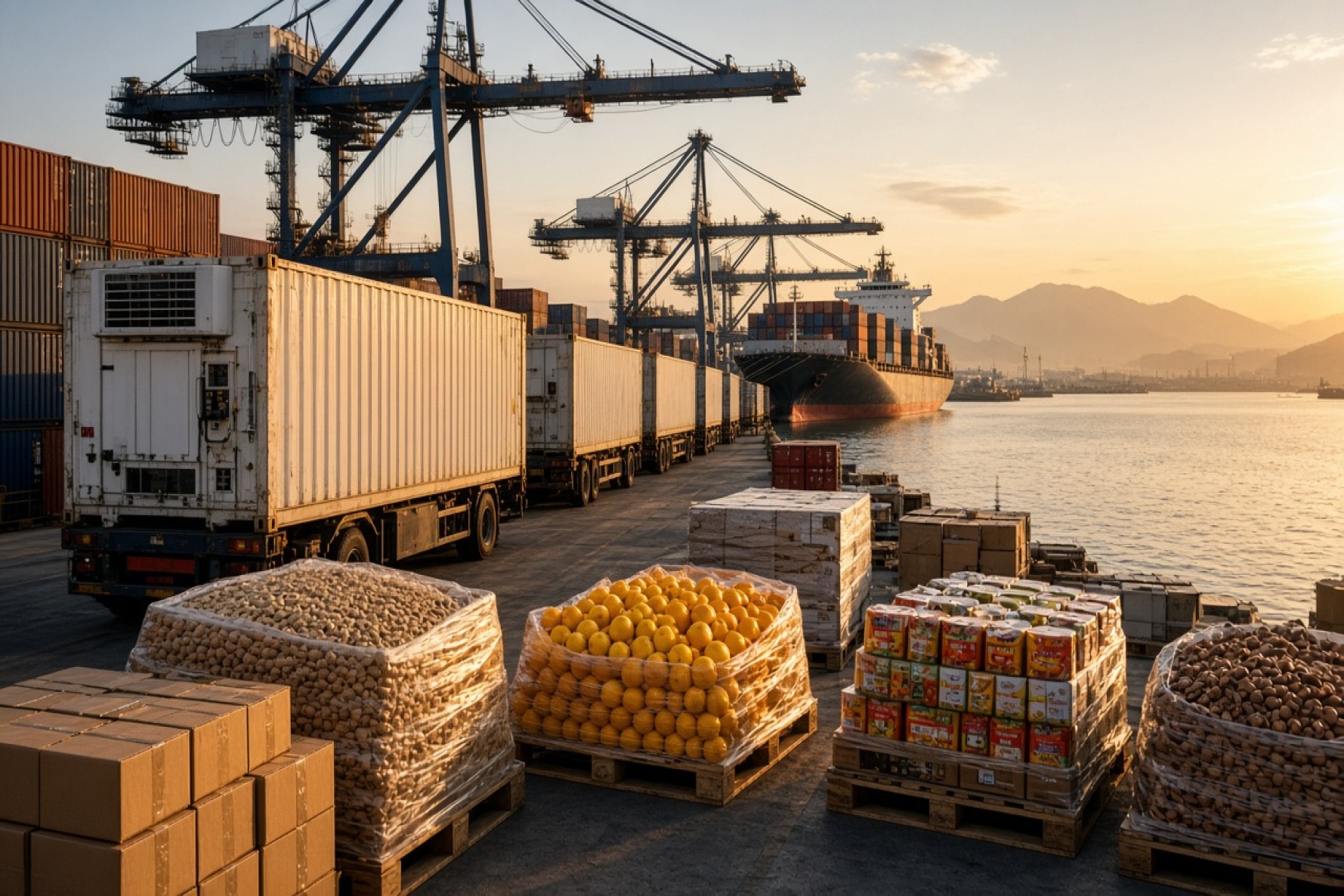
Proximity from southern Iranian ports to Jebel Ali and Khalifa shortens transit time, but export success is not “fast shipping” alone. A UAE importer accepts cargo when registration, Arabic labels, health documents, QC and packaging match the target sales channel. In 2024 data, UAE imports from Iran were about USD 174.85 million in fruit and nuts and USD 74.72 million in vegetables — a small share of total UAE food imports, but with room to grow when supply and compliance are stable.
This guide has ten practical sections: market channels, product groups, buyer selection, registration, labelling, halal, QC, HS and duty, packaging, routing and pricing. It closes with a 20-point exporter checklist, RFQ fields, FAQs and Iranco contact.
| Group | Approx. value |
|---|---|
| Fruit, nuts and related | $174.85M |
| Vegetables and edible roots | $74.72M |
| Dairy, eggs, honey | $29.72M |
| Seafood | $20.80M |
| Fruit and vegetable preparations | $18.37M |
1. UAE food sales channels — who does the exporter sell to?
Iranian exporters rarely sell to consumers directly; contracts are with UAE importers, distributors or B2B buyers who then supply one or more channels below.
| Channel | Market scale (est.) | Pack & label expectation |
|---|---|---|
| Retail | ~$18.1B | Consumer pack, GSO 9, registration, shelf design |
| HORECA | ~$18.8B | Bulk pack, spec stability, unit economics |
| Food processing | 570+ plants | Ingredients, COA, industrial pack |
| Re-export | Regional hub | Master cartons, COO, consolidation |
- Retail: Lulu, Carrefour, Spinneys, Al Meera — registered products and approved labels
- HORECA: hotels, airline catering, chain restaurants
- JAFZA & free zones: warehousing, repack, GCC distribution
2. Product groups — where is Iran competitive in the UAE basket?
Total UAE food imports are huge; exporters should pick groups with both demand and reliable Iranian supply quality.
| Group | UAE imports 2024 (sample) | Iran strengths |
|---|---|---|
| Fresh fruit & veg | ~$1.2B+ | Short route, seasonality, appearance |
| Nuts & dates | ~$927M+ | Pistachio, raisin, dates — tough competition |
| Fruit/veg preparations | — | Tomato paste, juice, canned |
| Dairy | ~$2B | Cold chain, certificates, halal |
| Spices & tea | — | Saffron, barberry, tea |
3. Choosing a UAE buyer — who to contract with
The right buyer is not only the highest price. Verify food import licence, clearance experience from Iran, warehouse at Jebel Ali or Khalifa, and alignment with your target channel.
| Buyer type | Advantage | Exporter risk |
|---|---|---|
| Registered retail importer | Stable volume, private label | Label registration delays |
| HORECA wholesaler | Repeat orders, bulk pack | Low tolerance for inconsistency |
| JAFZA trader | GCC re-export | Price pressure, strict docs |
| Processing plant | Long-term supply | Hard COA and specs |
- Confirm the buyer’s licence covers your food category
- Ask for prior clearance from the same origin and factory
- Fix preferred port (Jebel Ali vs Khalifa) and Incoterms before proforma
- Clarify who pays inspection, lab testing and demurrage
4. Product registration — legal entry before cargo moves
Imported food must be registered under the national food registration framework (MOCCAE / Ministerial Decision 239 of 2018). In Dubai, registration and label assessment go through the municipality. The exporter cannot replace the importer, but must know registration status and trade name on the label before mass production.
- Importer registers the product in the system
- Composition, label and artwork are submitted for review
- After approval, production with the final label is allowed
- Local sale requires food consignment clearance
5. Arabic labelling — GSO 9 and shelf rules
The main GCC reference is GSO 9:2022 (2025 technical updates). Mandatory information must appear in Arabic; other languages are supplementary.
- Product name and ingredient list
- Allergens, net weight, manufacturer/packer
- Production and expiry dates, batch number
- Storage conditions and nutrition panel where required
- Country of origin and instructions for use
Provide artwork to the importer for Arabic translation and registration match before loading — not after.
6. Halal — when is it mandatory for UAE export?
Not all foods need halal certification; meat, poultry and products with specified animal origin generally require certificates from bodies accepted on the UAE halal system (MOIAT). UAE.S 2055-1 and UAE.S 993 define the framework.
- Domestic Iranian certificates are not automatically accepted
- A halal logo on pack does not replace certifier validation
- Dairy and animal-based lines may trigger factory review
7. QC tests and pre-shipment control
Three layers: factory QC, pre-shipment inspection, official control at the UAE port. Send COA and agreed inspection reports before departure.
| Group | Typical tests |
|---|---|
| Pistachio & nuts | Aflatoxin, moisture, kernel %, heavy metals |
| Fresh produce | MRL residues, visual grading, phytosanitary |
| Paste & canned | Brix, pH, microbiology, hermetic seal |
| Dairy | Microbiology, fat, cold chain, dating |
8. HS codes, tariffs and the 5% duty
The general rate for many non-GCC imports is about 5% of CIF value. Final duty depends on the exact HS code. Standard VAT is 5% where applicable.
| Chapter | Group |
|---|---|
| 07 | Vegetables |
| 08 | Fruit and nuts |
| 04 | Dairy |
| 20 | Preparations (paste, canned) |
| 09 | Spices |
Align proposed HS with the importer and UAE customs broker before proforma — wrong classification can change licence needs or duty.
9. Export packaging — heat, humidity and cold chain
The UAE climate is hot and humid. Dry packs need moisture and pest barriers; fresh produce needs strong cartons and cold chain; frozen goods need temperature logs and fast port exit.
- Standard palletisation for Jebel Ali handling
- Legible batch and date codes for warehouse conditions
- Retail: barcode and Arabic consumer-facing panel
- Ramadan season — higher rice and nut imports; plan earlier
10. Shipping (Jebel Ali, Khalifa) and landed-cost pricing
Sea freight from southern Iran to Jebel Ali is the main container lane (published data attribute ~73% of food and beverage trade value to this port). Khalifa Port suits Abu Dhabi buyers and some industrial flows.
| Destination port | Use when | Cost risk |
|---|---|---|
| Jebel Ali | Dubai warehouse, retail, re-export | Demurrage if clearance delays |
| Khalifa | Abu Dhabi / industrial network | Line and slot alignment |
| Air (DXB) | Samples, very sensitive produce | High freight cost |
FOB alone is not enough for the buyer. Landed cost adds freight, insurance, ~5% duty, VAT, port services, QC and UAE inland haul to the buyer’s warehouse. Quotes should show this structure to compare fairly with rivals.
| Line item | Exporter note |
|---|---|
| EXW/FOB factory | Comparison base — no international leg |
| Haul to Iranian port | Bandar Abbas, Chabahar, etc. |
| Ocean freight + insurance | Dry / reefer — season and capacity |
| Customs duty ~5% CIF | Exact HS |
| VAT 5% | Where applicable |
| Clearance, sampling, storage | Registration delay risk |
Summary for export teams
The UAE is both a large consumption market (retail and HORECA in tens of billions) and a re-export gateway. Exporters who define the channel early, align registration and Arabic labels with a credible importer, contract QC tests and match Jebel Ali or Khalifa to the buyer’s warehouse earn repeat orders more often than one-off sellers.
Competing with India, Turkey, the US (pistachios) and Europe takes more than low FOB — consistency between shipments, shelf life on arrival, complete documents and fast RFQ response create differentiation.
20-point exporter checklist before loading
- Confirm target channel (retail / HORECA / re-export / industrial)
- Select buyer with food import licence and Iran origin experience
- Contract technical specs and COA
- Verify UAE product registration status
- Approve Arabic label artwork before print
- Fix HS code with customs broker
- Check halal needs and accepted certifier
- Phytosanitary (fresh) or veterinary health certs as required
- COO and invoice matching the shipment
- Agreed QC and lab test plan
- Pre-shipment inspection (weight, batch, pack)
- Minimum remaining shelf life on arrival
- Destination port (Jebel Ali / Khalifa)
- Incoterms and port cost split
- Dry / reefer booking and temperature log
- Photos and seal number before departure
- Send full document set to importer electronically
- Plan fast clearance (reduce demurrage)
- Capacity plan for second shipment
- Rejection clause and lab cost responsibility
Information needed for an RFQ
- Product name and form (fresh / dry / frozen / canned)
- Quality grade and numeric specs
- Quantity, unit weight, carton type
- Brand or private label
- Required tests and minimum shelf life on entry
- UAE city/port and Incoterm
- One-off or recurring programme
Iranco processes requests with these details faster when matching Iranian producers (tomato paste, pistachio, dairy lines, etc.).
Frequently asked questions
What is the first step for an Iranian exporter selling to the UAE?
Define the sales channel and choose an importer who manages licence, product registration and destination port; then align Arabic labels and specs before mass production.
Can we export to the UAE without product registration?
Local UAE sale requires registration. Unregistered export may only fit transit or specific scenarios with a licensed buyer — confirm before loading.
Jebel Ali or Khalifa — which is better from Iran?
Depends on warehouse location and distribution. Jebel Ali handles more food trade volume; Khalifa fits Abu Dhabi-centric buyers and some industrial cargo.
Is Persian labelling enough for the UAE?
No. Mandatory information must comply with GSO and appear in Arabic. Persian or English may be supplementary.
What is the customs duty on food into the UAE?
Often about 5% CIF plus 5% VAT where applicable. Final rate depends on HS code.
Which tests are common for pistachios to the UAE?
Aflatoxin, moisture, kernel percentage, uniformity and often heavy metals — per buyer agreement and port sampling policy.
Do all Iranian dairy products need UAE halal?
Animal-origin products usually need halal from a UAE-accepted body; details depend on factory and SKU.
How is landed cost calculated?
Product price + freight and insurance + customs duty + VAT + port, inspection, lab, reefer and UAE inland delivery to the buyer’s warehouse.
How do I request UAE export support from Iranco?
Specify product, quality, quantity, packaging, destination port and Incoterm, then contact Iranco so sourcing options can be reviewed.
Supply and export through Iranco
Iranco (iranco.com) connects Iranian food exporters and factories with UAE importers for technical specs, QC, export packaging and shipping coordination to Jebel Ali and Khalifa.
- Fruit, nuts, dates, paste and packaged foods
- Document support (COO, phytosanitary, COA)
- Sample and bulk B2B order coordination
Featured Products


Related Articles



