 Iranco Magazine Team
Saudi market capacity for Iranian foods, SFDA rules, product registration, Arabic labels, QC, tariffs, packaging, shipping and routes into retail and food industry channels
Export guide · Saudi Arabia · SFDA · Ghad · Fasah
Exporting Iranian food to Saudi Arabia: market, SFDA, Ghad, Fasah and entry routes
Retail and HORECA channels, pistachios, saffron and dried fruit, choosing a Saudi importer, Ghad registration, Fasah clearance, Arabic GSO 9 labels, halal, QC, 12-digit GCC tariffs (2025), 15% VAT, and Dammam/Jeddah ports — from the Iranian exporter’s perspective.
Introduction — why Saudi Arabia matters for Iranian food exports
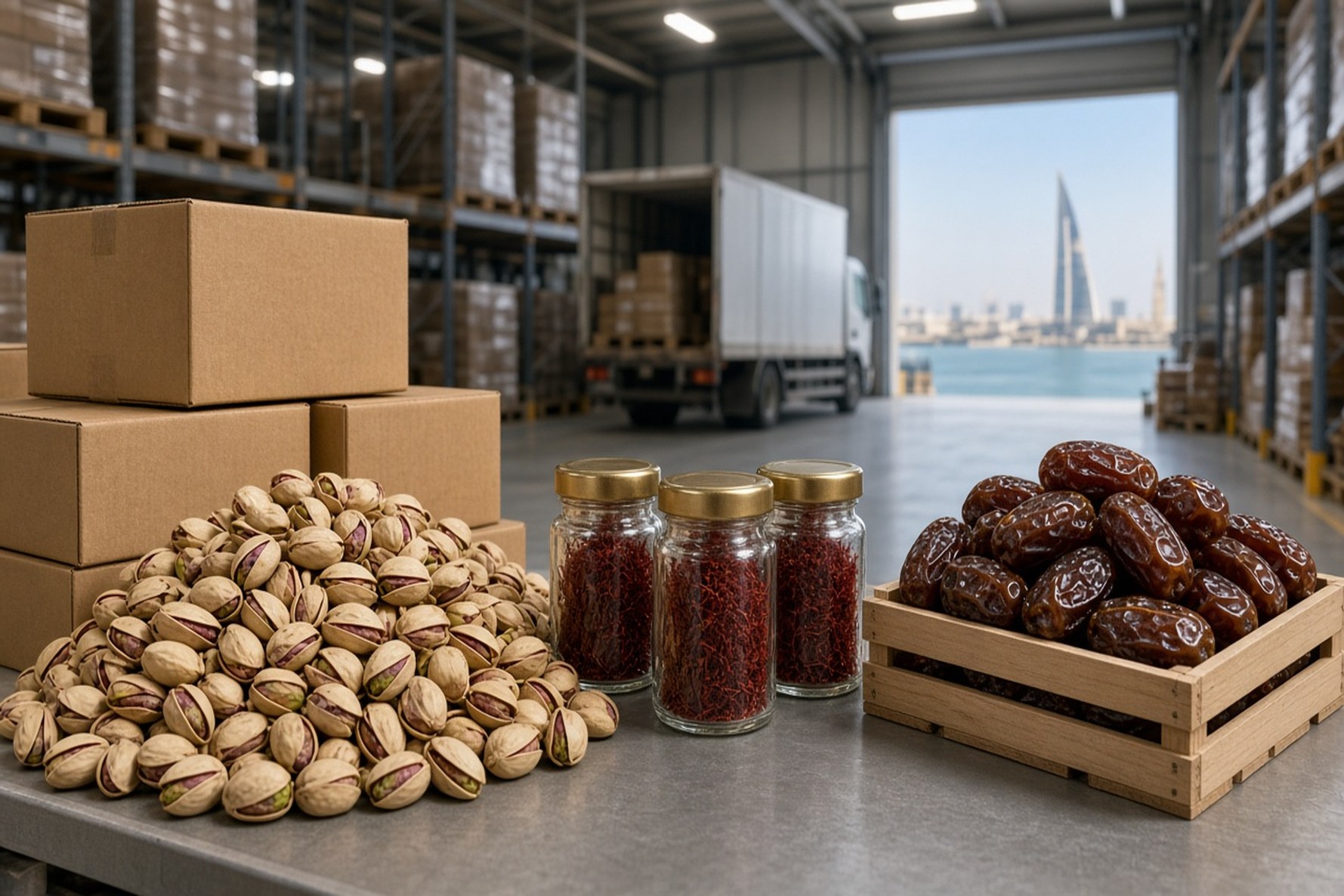
Southern Iranian ports are relatively close to Dammam and Jeddah, but success is not only transit time. A Saudi importer accepts cargo when Ghad registration, Fasah clearance, Arabic labels under SFDA.FD/GSO 9, health documents, QC and packaging match the target sales channel.
This guide has twelve practical sections: market channels, product groups (pistachio, saffron, dried fruit), buyer selection, Ghad, Fasah, labelling, halal, QC, HS and 12-digit tariffs, packaging, Dammam/Jeddah routing and pricing. It closes with a summary, exporter checklist, RFQ fields, FAQs and Iranco contact.
| Group | Iran strength | Regulatory risk |
|---|---|---|
| Pistachios & nuts | Snacking & HORECA demand | Aflatoxin, registration, labels |
| Saffron | High value, branding | Authenticity, GSO 9, testing |
| Raisins & dried fruit | Retail & industry | Moisture, foreign matter |
| Tomato paste & fruit prep. | Food industry | Brix, additives, Ghad |
| Spices & herbs | Retail & plants | Pesticides, microbiology |
1. Food sales channels in Saudi Arabia — who do you sell to?
Iranian exporters rarely sell to consumers directly; they contract with SFDA-registered importers or B2B distributors who place products in the channels below.
| Channel | Market scale (est.) | Pack & compliance |
|---|---|---|
| Retail | ~$50B | GSO 9, Ghad, barcode, remaining shelf life |
| HORECA | ~$30B | Bulk packs, spec stability, halal if needed |
| Food factories | Large processing sector | COA, industrial packs, ingredients |
| Modern chains | Panda, Tamimi, Carrefour | Listing fees, promos, private label |
- Retail: product registration and approved Arabic label before print
- HORECA: tourism, religious travel, hotels — repeat volumes
- Industry: puree, concentrate and nuts for Saudi processing lines
2. Product groups — where is Saudi demand attractive for Iran?
Total Saudi food imports are large (USD 15.6B consumer imports in 2024); choose groups with demand and reliable Iranian supply — often pistachios, saffron, dried fruit and processed goods rather than bulk rice and wheat.
| Group | Target channel | Iran strengths |
|---|---|---|
| Pistachios | Retail / HORECA / nuts | Grade, kernel, flavour — vs US & Turkey |
| Saffron | Retail & restaurants | Colour strength, authenticity, premium pack |
| Raisins & dried fruit | Shelf & industry | Colour, moisture, uniformity |
| Fruit/veg preparations | Plants & retail | Paste, puree, canned |
| Retail spices | Supermarket | Purity, residue limits |
3. Choosing a Saudi buyer — who to contract with?
The right buyer is not only the highest price. Verify food import activity, SFDA/Ghad registration, Fasah experience from Iran, warehousing in Dammam or Jeddah and alignment with your channel.
| Buyer type | Advantage | Exporter risk |
|---|---|---|
| SFDA-registered importer | Stable volume, Ghad/Fasah management | Label registration delays |
| HORECA wholesaler | Repeat orders, large packs | Uniformity sensitivity |
| Retail chain importer | Store listing | Listing & promo costs |
| Food factory | Long-term supply | Strict COA and specs |
- Confirm the buyer is active in Ghad and covers your product category
- Request prior shipments from the same factory and Iranian origin
- Fix destination port (Dammam vs Jeddah) and Incoterms before proforma
- Clarify SFDA inspection, lab and demurrage costs in the contract
4. SFDA and Ghad registration — before cargo moves
Commercial food imports go through a Saudi importer registered with SFDA. Current clearance guidance requires registering the company and products in the Ghad system before import. Exporters cannot register instead of the importer but must know registration status and trade name on labels before mass production.
- Importer registers company and product in Ghad (HS, formula, label image, barcode)
- After SFDA approval, production with the final label is allowed
- Major formula or label changes require registration updates
- Local sale requires successful Fasah clearance
5. Fasah clearance — electronic import pathway
Food clearance requests are submitted via the Fasah platform and integrated customs systems. The importer coordinates documents; the exporter must send a consistent document set early.
- Certificate of origin aligned with invoice
- Commercial invoice with batch and traceable specs
- Bill of lading
- Health certificate and phytosanitary where required
- COA or conformity certificate as agreed
- Halal certificate for applicable products
Mismatch between documents, carton marks and container content is the top Fasah delay — cross-check before final seal.
6. Arabic labelling — SFDA.FD/GSO 9
Mandatory consumer pack information must be in Arabic; other languages are supplementary and must match Arabic. The core reference is SFDA.FD/GSO 9 with GCC nutrition and date-marking standards.
- Product name and ingredient list — accurate Arabic
- Allergens, net weight, manufacturer/packer
- Production and expiry dates, batch, storage
- Country of origin, barcode and nutrition panel if required
- Health claims only under SFDA.FD 2333
Share label artwork before print for Ghad and GSO 9 alignment — not after loading.
7. Halal — when is it mandatory for Saudi exports?
Not all foods need halal certification; meat, poultry and products with animal-derived ingredients (gelatin, animal fat, certain derivatives) require certificates from bodies accepted by the Saudi Halal Center. Framework: SFDA.FD/GSO 2055-1.
- An Iranian certificate alone without Saudi acceptance review is insufficient
- A halal logo on pack does not replace certifier validation
- Dairy and animal products may need SFDA facility approval
8. QC testing and pre-shipment control
Three layers: factory QC, pre-shipment inspection, SFDA sampling at port or border. For pistachios, saffron and dried fruit, aflatoxin, moisture and uniformity are commonly contracted.
| Group | Common tests |
|---|---|
| Pistachios & nuts | Aflatoxin, moisture, kernel %, heavy metals |
| Saffron | Colour, purity, metals, adulteration |
| Fresh produce | MRL, visual inspection, quarantine |
| Paste & canned | Brix, pH, microbiology, hermetic seal |
| Dried spices | Pesticides, microbiology, metals |
9. HS codes, 12-digit GCC tariffs (2025) and 15% VAT
From 2025 the unified GCC tariff is 12-digit — final duty depends on the exact subheading (many foods around 5% CIF, some zero or higher). Standard Saudi VAT is 15% and must be modelled separately from customs duty in landed cost.
| Chapter | Group |
|---|---|
| 08 | Fruit & nuts (pistachio, almond, raisin) |
| 09 | Spices (saffron, barberry) |
| 07 | Fresh vegetables |
| 20 | Fruit/veg preparations (paste, canned) |
| 04 | Dairy (if plant approved) |
| Item | Exporter note |
|---|---|
| EXW/FOB factory | Comparison base |
| Haul to Iranian port + ocean | Bandar Abbas, Chabahar |
| Duty (12-digit HS) | Importer confirmation |
| VAT 15% | Separate from duty |
| Fasah, SFDA tests, demurrage | Registration delay risk |
10. Export packaging — heat, humidity and cold chain
Saudi heat and inland haul after the port make packaging critical. Pistachios and dried fruit need strong cartons and moisture control; fresh produce needs pre-cooling and reefers; retail packs need enough remaining shelf life on arrival.
- Standard palletisation for Dammam and Jeddah handling
- Legible batch and dates — match Fasah invoice
- Retail: barcode and Arabic on consumer-facing panels
- Ramadan season — higher nut demand; plan earlier
11. Routing — Dammam, Jeddah and port choice
In Q4 2024 King Abdulaziz Port Dammam handled about 28.4% and Jeddah Islamic Port about 21.2% of total merchandise imports (all goods). For food, align the port with the buyer’s warehouse city.
| Port | Best when | Cost risk |
|---|---|---|
| Dammam | Riyadh, east, central | Long inland haul to west |
| Jeddah | Makkah, Madinah, west | Ocean freight vs Dammam |
| Air | Saffron, samples, sensitive fresh | High cost |
Iran has no direct land border with Saudi Arabia; overland transit is usually less competitive for containerised food unless the buyer defines a specific corridor.
12. Competition, landed cost and B2B pricing
Competing with India (rice), Brazil (meat), Turkey and the US (pistachios) takes more than lowest FOB. Shipment-to-shipment consistency, Ghad/Fasah compliance, complete documents and fast RFQ response differentiate suppliers.
| Axis | Practical example |
|---|---|
| Tested quality | Pistachio COA with agreed aflatoxin cap |
| Batch stability | Same grade in shipments 2 and 3 |
| Labelling | GSO 9 Arabic approved before print |
| Logistics | Clear FOB + transit time to Dammam/Jeddah |
FOB alone is not enough — quotes should show landed cost structure (12-digit duty, 15% VAT, Fasah, QC).
Summary for export teams
Saudi Arabia combines large consumption (retail and HORECA in tens of billions USD) with structural imports (~70% supply share). Exporters who define the channel, partner with SFDA-registered importers for Ghad and Fasah, approve GSO 9 labels before print and match Dammam or Jeddah to the buyer’s warehouse improve repeat-order odds.
For pistachios, saffron and dried fruit, stable quality and regulatory fit often beat the cheapest FOB — Iranco can route RFQs with technical specs to suitable Iranian producers.
20-step exporter checklist before loading
- Confirm target channel (retail / HORECA / industrial)
- Select importer with SFDA registration and Iran origin experience
- Verify product registration status in Ghad
- Agree specs and COA in contract (pistachio: aflatoxin, moisture)
- Approve Arabic GSO 9 label artwork before print
- Fix 12-digit HS code with importer
- Review halal needs and accepted certifiers
- Health / phytosanitary certificates for fresh goods
- COO and invoice aligned with cargo
- QC plan and accepted laboratory
- Pre-load inspection (batch, weight, seal)
- Minimum shelf life on arrival in KSA
- Choose port (Dammam / Jeddah)
- Incoterms and demurrage allocation
- Reefer booking and temperature log if needed
- Send electronic document set for Fasah
- Plan fast port exit
- Capacity for second shipment — supply continuity
- Rejection clause and SFDA test costs
- Coordinate B2B RFQ with Iranco
Information needed for pricing (RFQ)
- Product name and form (dry / fresh / frozen / canned)
- Quality grade (e.g. pistachio grade, saffron colour strength)
- Quantity, unit weight, carton type
- Brand or private label
- Required tests and minimum shelf life on arrival
- Saudi city/port and Incoterm
- One-off or repeat programme
Iranco processes requests with these details faster for matching Iranian suppliers (pistachio, saffron, paste and dried fruit).
Frequently asked questions
What is the first step for an Iranian exporter selling to Saudi Arabia?
Define the sales channel and choose an importer who manages SFDA, Ghad and Fasah; align Arabic GSO 9 labels and specs before mass production.
Can we export without Ghad registration?
For local market sale, SFDA product and importer registration is required. Unregistered export is only possible in special scenarios confirmed by the buyer before loading.
Dammam or Jeddah — which is better from Iran?
Depends on warehouse and distribution. Dammam for Riyadh and the east; Jeddah for Makkah, Madinah and the west. Model freight and demurrage for both.
Are Persian or English labels enough for Saudi Arabia?
No. Mandatory information must be Arabic under SFDA.FD/GSO 9. Other languages must match Arabic.
What is the customs duty on food exports to KSA?
There is no single rate; the 12-digit GCC code applies from 2025. Many goods are around 5% CIF plus 15% VAT — confirm with the importer.
Which tests are common for pistachios to Saudi Arabia?
Aflatoxin, moisture, kernel percentage, uniformity and often heavy metals — per buyer agreement and SFDA sampling.
What is Fasah and what does the exporter do?
Fasah is the integrated clearance platform. The importer files; the exporter must supply accurate documents matching the cargo before departure.
How is landed cost calculated?
Product price + freight and insurance + duty (12-digit HS) + 15% VAT + Fasah, SFDA testing, demurrage and inland haul to warehouse.
Is land transport from Iran to Saudi practical?
No direct border; multi-country transit is common. For most food containers, compare ocean to Dammam/Jeddah.
How do I request an export quote via Iranco?
Specify product, quality, quantity, packaging, destination port and Incoterm via the Iranco contact form.
Supply and export through Iranco
Iranco (iranco.com) connects Iranian food exporters and factories with Saudi importers for technical specs, QC, export packaging and shipping coordination to Dammam and Jeddah.
- Pistachios, saffron, dried fruit, paste and packaged foods
- Document support (COO, health, COA) for Fasah
- Sample and bulk B2B order coordination
Featured Products










Related Articles



