 Iranco Magazine Team
Iranian almonds in world trade, India and Turkey markets, quality control, export requirements, packaging, logistics and competition with the US, Spain, Australia and Turkey
Technical & trade analysis · 2026
Iran Almond Export: Target Markets, Quality and Competition with Major Origins
Position of Iranian almonds in world trade, India and Turkey markets, quality control, export requirements, packaging, logistics and competition with the USA, Spain, Australia and Turkey.
Iranian almonds compete less on bulk volume than on origin, kernel character, sensory quality and recognised commercial types. Export success depends on contract specs, moisture and aflatoxin control, accurate sorting and packaging matched to the shipping lane.
Trade data for 2024 show Iran exported about 7,590 tonnes of shelled almonds while the USA, Spain and Australia operated at hundreds of thousands of tonnes. India imported more than $32.7 million of Iranian kernels — a strong niche for defined-origin premium product.
Introduction
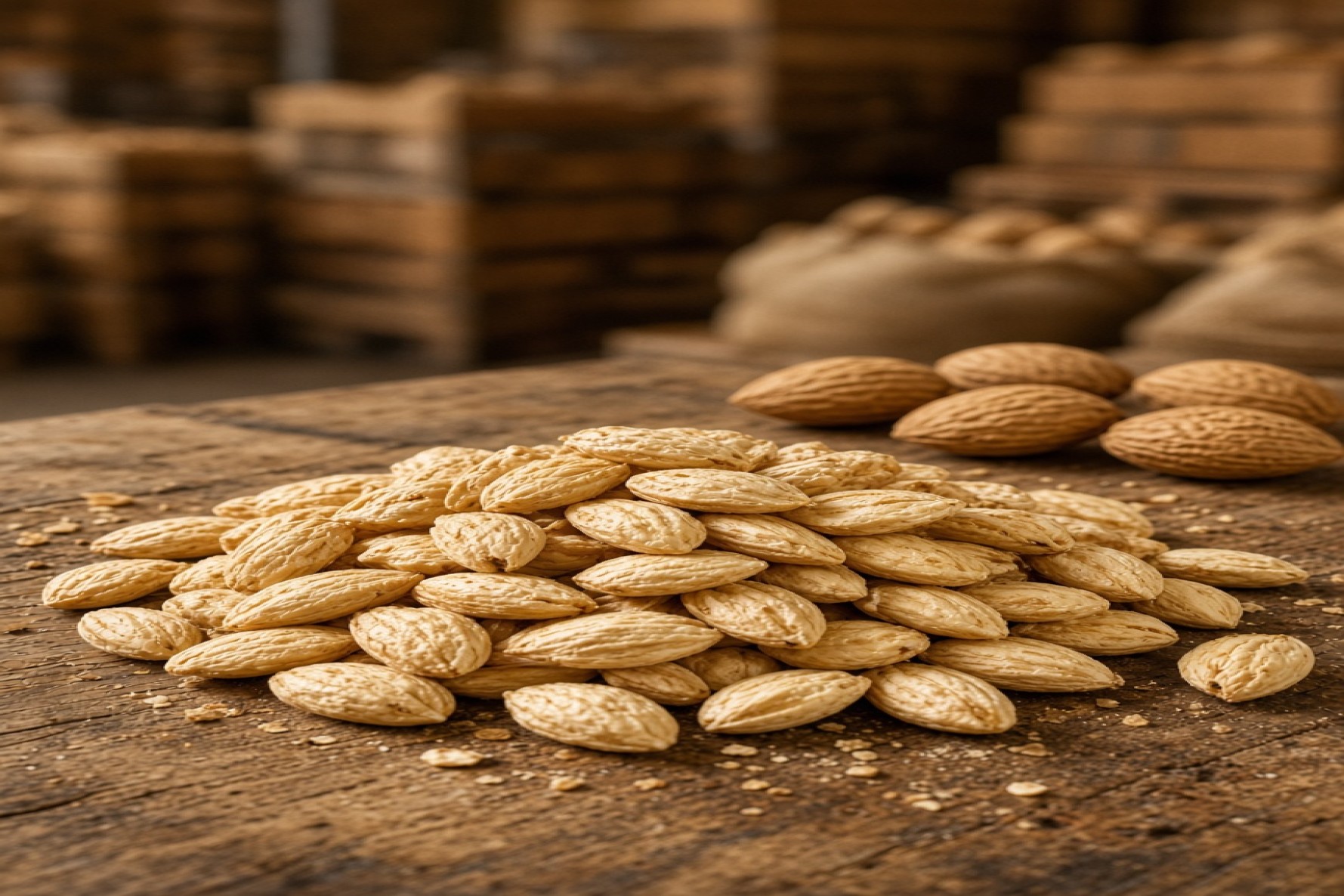
Iranian almond exports sit in a market dominated by mechanised giants such as the USA and Australia, yet products with distinct origin and sensory profile can earn premium value. Buyers care about commercial type, kernel shape and colour, taste, sound kernel percentage, uniformity, freshness, food safety and shipment match to the approved sample.
In 2024 kernel exports, the USA exceeded 716,000 t, Spain about 122,000 t and Australia over 89,000 t; Turkey exported more than 32,000 t of kernels. Iran’s ~7,590 t shows bulk copy of the US model is not the right strategy.
India imported over $32.7 million of Iranian kernels; Turkey took more than 4,621 t of kernels and about 571 t in-shell from Iran. Two paths emerge: specialty markets (India) and regional bulk trade (Turkey and neighbours).
“Iranian almond” alone is not a purchase spec. Orders must be measurable: type, in-shell vs kernel, size, breakage, moisture, foreign matter, pest damage, aflatoxin, residues, pack type and acceptance rules.
1. Iran’s position in export markets
Iran is a historic almond region with Mamra, White, Azar, Shokoufeh, Sahand, Shahroud and other commercial groups across Chaharmahal-Bakhtiari, East and West Azerbaijan, Semnan and the Iranian plateau.
Geographic spread is both opportunity (product diversity) and risk (mixed lots without sorting). Professional export turns orchard crop into repeatable commercial grades. Buyers expect the same grade across shipments — not a new mix each time.
Three value zones fit Iran: defined-origin kernels for specialty buyers; product for confectionery and premium nuts; flexible-grade contracts. The USA, Spain and Australia lead on scale, uniformity and distribution — Iran must offer measurable differentiation.
2. Commercial types and buyer differences
Iranian almonds are not homogeneous. Mamra is widely known, including as “Mamra” in India; Shahroud 12 is a major commercial cultivar.
| Commercial group | Typical supply form | Market / use | Buying note |
|---|---|---|---|
| Mamra | Sorted kernels | Premium nuts, India | Authenticity, size, uniformity |
| Shahroud | Kernel or in-shell by grade | Nuts & processing | Appearance and yield |
| Azar, Shokoufeh, White, Sahand | Kernel or in-shell | Regional & food industry | Name ≠ grade |
| Local hard-shell types | In-shell / process after crack | Bulk & processing | Shell hardness & yield |
| Broken / pieces | Industrial pack | Pastry, meal, slivers | Piece size & fines |
Two lots with the same trade name can differ in size, breakage, skin colour, moisture and freshness. Acceptance must be tied to sample and numeric spec.
3. Technical specs buyers must fix before pricing
UNECE DDP-06 classifies almond kernels commercially; higher grades require size sorting. Maximum kernel moisture under DDP-06 is 6.5%.
| Parameter | Define in order | Why it matters |
|---|---|---|
| Product form | In-shell, whole kernel, broken, slivers | Use & HS code |
| Commercial type | Exact group name | Avoid mixing |
| Size | Count or mm band | Uniformity & price |
| Moisture | Maximum % | Shelf life & mould |
| Broken kernels | Max % | Appearance & yield |
| Foreign matter | Tolerance | Sorting quality |
| Flavour & odour | No rancidity | Freshness |
| Aflatoxin | Per destination | Clearance |
| Packaging | Material & net weight | Transit protection |
| Crop year | On contract | Freshness |
Export-grade kernels must be sound, dry, clean and free of spoilage, insect damage and mould. Pretty appearance alone is not quality — sensory and lab checks on a representative sample are required.
4. Quality control, aflatoxin and essential tests
High fat and low moisture give good shelf life, but poor drying or storage raises mould and rancidity risk. Sampling must represent the whole lot.
Moisture
DDP-06 caps kernel moisture at 6.5%. Storage guidance recommends below 10°C and RH below 65%.
Aflatoxin
EU limits for direct consumption: B1 max 8 µg/kg, total of four aflatoxins 10 µg/kg. For product sorted or physically processed before retail: 12 and 15 µg/kg respectively.
| Destination use | B1 limit | Total limit |
|---|---|---|
| Direct food / retail | 8 µg/kg | 10 µg/kg |
| Sort / process before sale | 12 µg/kg | 15 µg/kg |
- Moisture, aflatoxin and pesticide residues per destination
- Foreign matter, insects and contamination checks
- Sensory odour and taste
- Broken and damaged kernel percentages
Pair the reference sample with a written product spec. Pre-shipment testing at an accredited lab (ISO/IEC 17025 where required) reduces destination risk.
5. Target export markets for Iranian almonds
India imported ~269,500 t in-shell in 2024 (USA-dominated) but only ~13,200 t of kernels — Iran supplied ~2,763 t of kernels worth over $32.7 million.
India
Iran’s lane differs from bulk US in-shell. Success needs commercial authenticity, kernel appearance, freshness, tight sorting, moisture-resistant packs and lot-to-lot consistency.
Turkey
Turkey imported 65,000+ t of kernels globally in 2024 and exported 32,000+ t. From Iran it took 4,621 t kernels and ~571 t in-shell. Competitive price, defined grade and road freight matter.
EU and the region
EU kernel imports exceeded 247,000 t in 2024; direct imports from Iran were ~114 t. Gulf states, Iraq and Central Asia offer shorter hauls but fierce origin competition.
| Market | Iran status | Demand focus | Main challenge |
|---|---|---|---|
| India | Key kernel market | Premium sorted kernels | Australia & USA competition |
| Turkey | High volume | Kernels & in-shell | Domestic Turkish supply |
| European Union | Small share, huge pool | Standard & industrial kernel | Strict food safety |
| Persian Gulf | Regional | Retail nuts | Origin competition |
| Central Asia | Limited but active | Wholesale | Price & routing |
6. Competition with the USA, Spain, Australia and Turkey
The USA exported 716,000+ t kernels and 318,000+ t in-shell in 2024. Spain exported 121,000+ t kernels. Australia ranked third with 89,000+ t. Turkey both buys from Iran and exports 32,000+ t kernels to Russia, Iraq, Libya, Saudi Arabia and Central Asia.
| Country | Main edge | Fit for Iranian almonds |
|---|---|---|
| USA | Scale & uniformity | Specialty & Iranian origin |
| Spain | EU market access | Differentiated product + QC |
| Australia | Industrial Asia supply | Premium India segment |
| Turkey | Regional logistics | Proximity & product mix |
| Iran | Type diversity & niche recognition | Standardise grades & origin story |
Iran should not compete only on price in fully standardised bulk. Value comes from product definition, grade separation and repeatable supply chains.
7. HS codes and destination entry requirements
- HS 080211: almonds in shell, fresh or dried
- HS 080212: shelled almonds (kernels)
Roasted, salted, slivered, meal or compound products may fall under other headings. Professional exports include commercial invoice, packing list, certificate of origin, transport docs, phytosanitary certificates where required, COA, batch data and net/gross weights. Consumer packs need destination-compliant labels.
8. Export packaging for almonds
Almonds are oil-rich; rancidity is the main quality enemy. Packs must limit moisture, oxygen, contamination and mechanical damage.
| Sales form | Packaging | Priority |
|---|---|---|
| Bulk kernel | Inner liner in carton | Moisture & dirt |
| Premium kernel | Vacuum or inert gas | Freshness & aroma |
| In-shell | Dry strong cartons | Moisture & breakage |
| Consumer | Sealed retail pack | Shelf life & label |
| Industrial broken | Robust bulk bag | Fines & contamination |
9. Transport, storage and shelf life
Almonds do not need a full cold chain like fresh fruit, but heat and humidity hurt quality. Target storage below 10°C, RH below 65%, kernel moisture ideally below 6%.
Road: Turkey and Iraq — protect from rain, humidity and sun-soaked stops.
Sea: Main lane to India — dry, clean containers; desiccants; avoid loading warm product into cold containers. Do not store next to strong odours; FIFO by batch.
10. How export price is formed
- Commercial type and supply form
- Size, uniformity and sound kernel %
- Crop year, sensory quality and lab results
- Packaging and order volume
- Incoterms, insurance and destination
Compare price only after technical specs match.
11. Importer checklist before ordering Iranian almonds
- Exact product form — kernel vs in-shell
- Commercial type, crop year and size method
- Maximum moisture and broken kernel %
- Foreign matter, pest and colour/wrinkle limits
- Aflatoxin and residue tests for the destination
- Representative and sealed reference samples
- Net weight, pack materials, cartons and pallets
- Accept/reject rules and pre-loading inspection
- Destination, Incoterms and import documents
- Supplier capacity for repeat orders
12. Sourcing Iranian export almonds through Iranco
The challenge is not finding a seller name but a supplier who delivers measurable specs. Iranco connects buyers with Iranian food-industry supply capacity.
Submit almond type, product form, grade, volume, packaging, destination and quality terms — including samples, technical sheets, export pack coordination and bulk order definition.
Precise product data beats generic “grade one” labels and makes supplier comparison reliable.
Summary
Iranian almond exports gain most when generic sales become defined products. India and Turkey are active kernel markets; the EU is attractive but strict. Define type, size, moisture, breakage, aflatoxin, packaging and acceptance before you buy. Iran’s edge is differentiated product, better sorting, provable quality and sample-to-shipment consistency.
FAQ
Which Iranian almond type is best for export?
Depends on destination. Mamra is known for premium trade and India, but verify size, moisture, breakage, appearance, taste and lab results — not the name alone.
Main kernel export market for Iran?
2024 data: India by value (over $32.7M from Iran) and Turkey by volume of Iranian kernels.
Mamra vs ordinary almonds?
Mamra is a recognised commercial type in premium channels; each lot still needs separate QC.
Acceptable kernel moisture?
DDP-06 maximum 6.5%; store cold and dry for better shelf life.
Key export tests?
Aflatoxin, moisture and residues per destination, plus physical and sensory defect checks.
Kernel HS code?
Kernels: HS 080212; in-shell: HS 080211. Processed forms may differ.
Best kernel export packaging?
Limit moisture, dirt and oxygen; vacuum or inert gas for premium long lanes.
Can Iran compete with US almonds?
Different models — US strength is bulk standardisation; Iran’s opportunity is specialty origin, flexible grades and defined product.
How is export price calculated?
Type, size, sound %, moisture, freshness, tests, pack, volume and delivery terms — compare only at equal specs.
Featured Products



Related Articles



