 Iranco Magazine Team
Industrial processing protocols, weight grades, MAP and IQF packaging, quality indices and landed-cost modelling for wholesale buyers
Supply Guide · Trout & Seafood
Gutted Rainbow Trout: Weight Grading, Processing, and Wholesale Buying Guide
An operational guide for procurement managers, national distributors, and exporters: industrial processing protocols, weight grades, MAP and IQF packaging, laboratory quality indices, yield loss, and landed-cost modelling for gutted rainbow trout.
Growth in seafood protein consumption and shifting retail habits in recent years have moved commercial demand for rainbow trout away from traditional whole round fish with viscera toward ready-to-use, cleaned, hygienic products. Gutted trout is now a core item in seafood distribution chains for supermarket groups, national distributors, industrial kitchens, canning and filleting lines, and export wholesale markets. Removing non-edible portions not only saves transport and logistics cost but also restrains biological and chemical spoilage of muscle tissue over the storage period.
Sustainable success in bulk trade and supply of this strategic product requires full command of industrial processing protocols, precise weight grading aligned with target markets, advanced storage and packaging technology, biochemical quality variables, and economic analysis of yield loss. This guide explains the processing, valuation, and commercial purchasing dimensions of gutted trout in a practical, comprehensive way for industry participants.
1. Biological foundations and commercial advantages of gutted trout
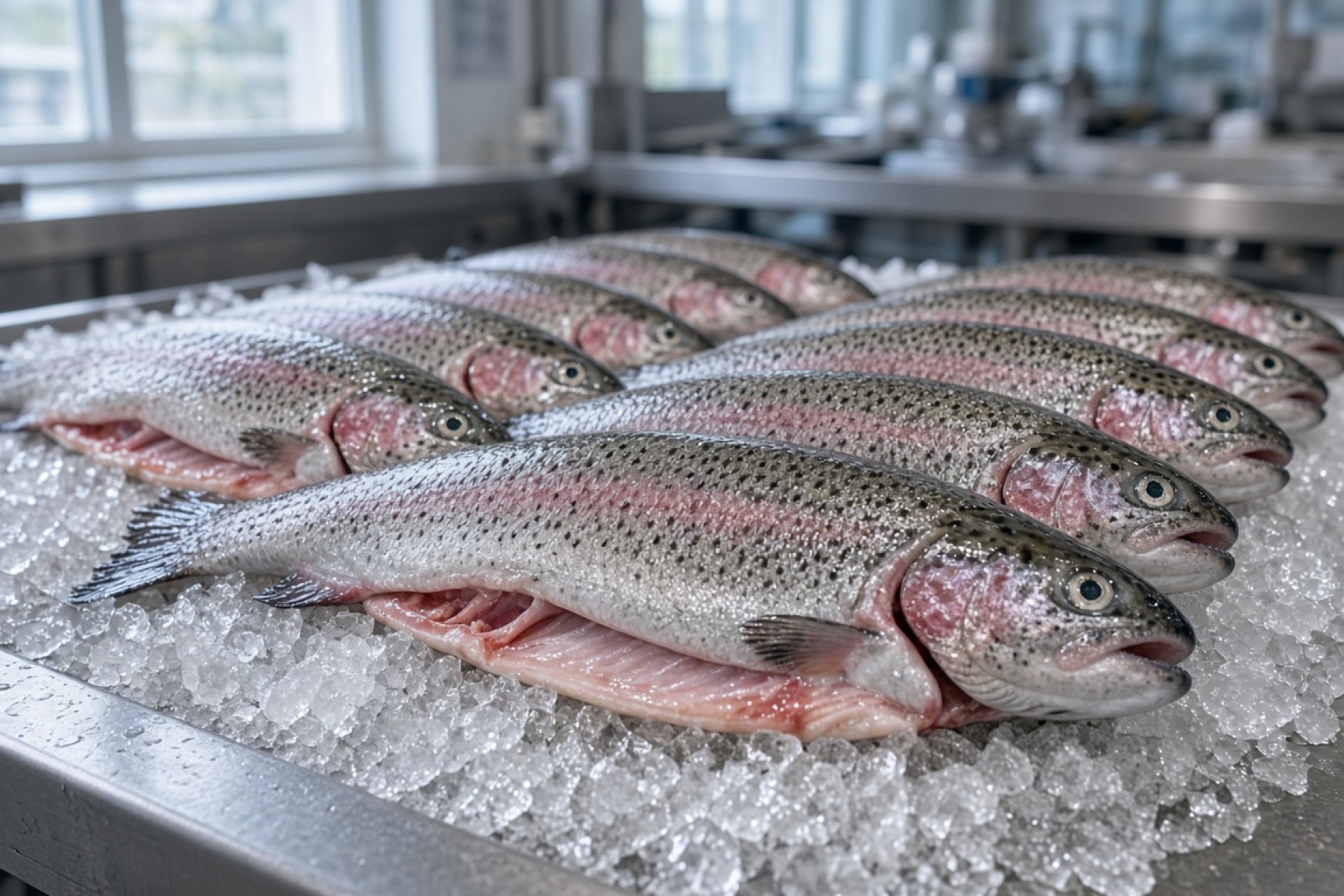
Rainbow trout (Oncorhynchus mykiss) is a cold-water species with dense muscle, high protein content, and notable omega-3 fat. In wholesale trade, “gutted” product refers to a carcass from which the head, internal organs, ventral fins, and — under export standards — the full kidney bloodline have been removed, with final wash and drain completed. The main difference versus round (whole) fish is shippable volume, core cooling rate, and lower microbial load from gut contents.
From a post-harvest physiology perspective, digestive enzymes and gut bacteria in round fish raise TVB-N and pH more quickly. Timely gutting — preferably within a few hours of bleeding — materially shortens the spoilage cycle and enables uniform freezing and lower drip loss.
| Criterion | Round (with viscera) | Industrial gutted | Effect on bulk buyer |
|---|---|---|---|
| Shippable weight per container | Lower (viscera volume) | Higher; optimal load density | Lower logistics cost per kg protein |
| Core cooling speed | Slow; high thermal mass | Faster in tunnel and cold store | Texture quality after thawing |
| Microbial shelf life | Higher initial load | Controlled under HACCP | Lower risk on long chains |
| Industrial kitchen readiness | Requires separate line | Ready for filleting or cooking | Less labour and waste |
| Export market acceptance | Limited (Iraq, some wholesale) | Standard for Russia, Eurasia, Gulf | Alignment with TR EAEU 040/2016 |
| Yield loss vs live weight | About 2–4% (bleeding and drain) | 14–20% cumulative | Basis for net pricing |
2. Industrial processing lines: four critical stages
Trout processing plants with supervisory code IR and HACCP systems divide the production line into four standard operational blocks. Deviation at any stage — especially delay between harvest and bleeding — directly affects odour, colour, and TVB-N.
Stage one: bleeding (Bleeding)
Immediately after harvest or within a maximum window of 30 to 60 minutes, the caudal arch artery is cut or pierced and fish are held in clean chilled water (4–8°C) until blood drains from muscle. Inadequate bleeding leads to dark fillets, metallic taste, and higher histamine on extended storage. For exports to Russia, inspectors often judge bloodline quality from the inner belly surface.
Stage two: gutting (manual or automatic)
A ventral cut runs from the anal vent to the concave pelvic area; viscera are fully removed and the gall bladder is separated without bursting onto the fillet. Automatic lines (Gutting Machines) at 20 to 40 fish per minute ensure cut uniformity and lower waste; manual lines remain common on smaller farms or special orders. Ruptured gall bladder or retained gut sections cause microbial contamination and off-flavour.
Stage three: kidney and bloodline removal (Kidney / Bloodline)
Dark kidney tissue along the spine is removed with a dedicated tool (Kidney Spoon) or high-pressure water nozzle. This step is mandatory for Eurasian markets; retained bloodline appears after freezing as brown streaks and fails market sorting.
Stage four: final wash and drain (Final Wash & Drain)
Washing with potable or treated spring water and controlled chlorination; then draining on an inclined conveyor or in a wet basket for 2 to 5 minutes so surface moisture before freezing is minimised. Over-wet fish create abnormal glaze and apparent weight gain — detectable in glaze audit (Glaze Test).
- Bleeding: less exudate and better fillet colour.
- Gutting: viscera removal and preparation for chilling.
- Bloodline: export standard and sensory compliance.
- Wash and drain: microbial load and contract weight control.
3. Weight grading and target-market analysis
Weight sorting of gutted trout uses in-line dynamic scales or manual grading after drain. Typical contract tolerance is ±5% within each grade; mixing grades in one carton is rejected unless an explicit “mix” agreement exists.
| Weight grade | Domestic / retail | Restaurant & hotel | Export & distribution | Technical note |
|---|---|---|---|---|
| 250–350 g | Single portion, supermarket | Buffet, light catering | Iraq, Afghanistan (bulk) | Fast grow-out; relatively thicker skin |
| 350–500 g | Top-selling retail size in Iran | Mid-scale restaurants | Regional transit | Price/volume balance for fillet |
| 500–700 g | Hypermarket, promotions | Specialist fish restaurants | UAE, northern Iraq | Suited to kebab and whole cooking |
| 700–1000 g | Premium home use | 4- and 5-star hotels | Persian Gulf, Armenia | Favourable fillet-to-weight ratio |
| 1000–1500 g | Limited | Industrial kitchens | Russia (lower salmon-trout range) | Requires uniform deep freezing |
| 1500–2500 g | Rare in retail | Steak and smoking | Russian Federation, salmon trout | SalmoFan 26+ colour; long feeding period |
| 2500 g+ | Almost no retail market | Secondary processing | Selective Eurasian export | Fat and texture control; geosmin risk |
Domestic market and national distribution
Iranian retail chains mainly order 350–500 g and 500–700 g grades in MAP or 500–800 g vacuum packs. Visual uniformity (body curve, no bruising) and clear freeze date on the label matter.
Russia and Eurasian export market
Demand concentrates on 1.5 to 2.5 kg with orange flesh (farmed salmon trout). Gutted fish must be free of viscera residue, with intact skin and unbroken tail. IQF or block freeze with 5–10% glaze is standard.
Persian Gulf and hospitality
Sizes from 700 g to 1.2 kg are in strong demand at premium restaurants in Dubai and Doha. Air-freight chilled MAP sometimes replaces frozen; halal certification and GSO compliance are mandatory.
4. Storage and packaging technologies
After pre-chilling, product either reaches −18°C frozen storage or follows a chilled MAP path to the domestic market. Technology choice depends on time to consumption, distribution channel, and contractual glaze terms.
| Technology | Storage temperature | Approx. shelf life | Suitable channel | Contract considerations |
|---|---|---|---|---|
| Flake ice (fresh) | 0 … +2°C | 3–5 days | Iraq, local wholesale | Fast transport; no re-freeze |
| MAP (protective gas) | 0 … +4°C | 8–10 days | Supermarket, hotel | CO₂/O₂ ratio in contract |
| Frozen cold chain | ≤ −18°C | 12–24 months | Export, bulk warehouse | Data logger; no partial thaw |
| Flat vacuum | ≤ −18°C | 18 months | Frozen retail | Film thickness and permeability |
| Skin Pack | ≤ −18°C | 18–24 months | Premium retail | Prevents freezer burn |
MAP packaging (modified atmosphere)
In MAP, gutted fish are packed in a tray or bag with a gas mix of carbon dioxide and oxygen to slow aerobic bacteria and preserve flesh colour. For trout, CO₂ is typically set at 30–50% and O₂ at about 5–10%. A 10-day shelf life at 0 to 4°C is achievable with an unbroken cold chain and fresh raw material.
Vacuum and Skin Pack
Vacuum removes oxygen, reduces omega-3 fat oxidation, and suits frozen warehouse storage. Skin Pack bonds film to a foam tray, applies even pressure on the fish surface, and limits surface evaporation in the cold store — suited to visual presentation on the frozen retail shelf.
IQF freezing and glazing
In bulk export, each gutted piece is frozen in an IQF tunnel (air temperature about −35 to −40°C) so pieces do not stick together. Immediately after, immersion or sterile water spray forms a 5% to 10% ice layer (maximum 20% per contract). Glaze percentage is controlled by differential weighing in a cold water bath and must be stated clearly on label and invoice.
5. Quality assessment: sensory, biochemical, and microbiological
Bulk lot acceptance depends on a certificate of analysis (COA) per batch and sensory inspection at origin or destination. For export frozen gutted trout, TVB-N, fat oxidation, and microbiology are decisive.
TVB-N, peroxide, and TBA
Total volatile basic nitrogen (TVB-N) is the main protein freshness index; a ceiling of 30 mg per 100 g is common for frozen seafood export. Peroxide value (PV) and thiobarbituric acid (TBA) indicate onset of unsaturated fat oxidation — more important in fatty farmed trout. Fresh muscle pH is usually 6.2 to 6.6; rise above 6.8–7.0 with ammonia odour signals spoilage.
Microbiology
Beyond Salmonella negative in 25 g, aerobic plate count (APC) for frozen gutted product is often capped at 10⁶ CFU/g. Initial microbial load is controllable after good washing and fast freezing; cold-chain failure raises load exponentially.
| Area | Index | Limit / target | Method | Action if out of spec |
|---|---|---|---|---|
| Biochemical | TVB-N | ≤ 30 mg/100g | Kjeldahl / titration | Reject batch; stop loading |
| Oxidation | PV / TBA | PV < 5–8 meq/kg (contractual) | Peroxide and TBA | Review cold chain and dates |
| Physicochemical | Muscle pH | 6.2–6.6 | Glass electrode | Check processing delay |
| Microbial | APC | ≤ 10⁶ CFU/g | Agar culture | HACCP audit of wash line |
| Safety | Salmonella | Negative / 25 g | ISO 6579 | Void health certificate |
| Sensory | Odour / texture / colour | No muddy or geosmin odour | Panel or field inspection | Isolate water or feed source |
| Contractual | Glazing % | 5–10% (±2%) | Differential weighing | Adjust net-weight invoice |
- Organoleptic: glossy skin, clear mucous surface, firm muscle with quick rebound.
- Gutted cavity: no viscera residue; clean open belly without dried blood spots.
- Salmon trout: fillet colour minimum 26 SalmoFan for Eurasian export.
6. Yield-loss economics and landed cost
Yield loss from live to frozen gutted is typically 14 to 20% and depends on operation quality, holding time before processing, and fish grade. Ignoring this variable in pricing systematically distorts margin for buyer or seller.
| Stage | Approx. loss | Components | Management control |
|---|---|---|---|
| Bleeding and drain | 2–4% | Blood, surface water | Bleeding time and water temperature |
| Head and viscera removal | 10–14% | Head, gut, gall bladder | Cut accuracy; no rupture |
| Final wash and drain | 1–2% | Surface moisture | Conveyor drain time |
| Cumulative to gutted | 14–20% | — | Record actual per batch |
| Glaze (contractual add-on) | +5 to +10% | Surface frozen water | Separate from net weight |
Landed cost per kg gutted — formula
To calculate price per kilogram of final gutted product from live fish, use the relationship below where P is live fish price per kg, F is processing cost (labour, energy, primary packaging) per kg of output, and L is yield loss as a decimal (e.g. 0.16 for 16%):
C = (P + F) / (1 − L)
Numeric example: if live price is 200,000 tomans, processing cost 10,000 tomans, and loss 16%: C = (200,000 + 10,000) / (1 − 0.16) = 210,000 / 0.84 ≈ 250,000 tomans per kg gutted. If actual loss is 20% (L = 0.20): C = 210,000 / 0.8 = 262,500 tomans — a difference of 12,500 tomans per kg. On a 20-tonne shipment, an error in assumed yield alone creates about 250 million tomans of financial variance.
Hunger management (Hunger Management)
Withholding feed for 48 to 72 hours before harvest reduces gut volume and contents, improves gutted quality, and lowers loss from full intestines. Harvesting satiated fish increases yield loss and raises belly-rupture risk on the line.
Spawning season example (Spawning)
Near spawning season, fat and texture change; sensory quality and fillet yield may fall. Export buyers often prefer autumn–winter harvest windows for heavy weights and salmon-trout colour, and define seasonal quotas in annual contracts.
7. Bulk purchase contract checklist
- Explicit product definition: frozen gutted rainbow trout, scientific name Oncorhynchus mykiss, HS code 0303.14.
- Weight grade (e.g. 700–1000 g) with ±5% tolerance and permitted “mix” percentage.
- Price basis: net weight excluding glaze after thaw, or labelled pack weight minus contractual glaze.
- Target glaze percentage (5%, 8%, 10%) and reference measurement method.
- COA terms: TVB-N ≤ 30, APC ≤ 10⁶, Salmonella negative; random sampling at loading.
- Bloodline cleaning and clean open belly; rejection criteria for field inspection.
- Delivery and transit temperature: tissue core ≤ −18°C; data logger chart on handover.
- Plant supervisory code IR and destination registry alignment (Eurasia, GSO).
- Label: freeze date, batch number, grade, net weight, country of origin.
- Third-party inspection (SGS / origin) and penalty clause for grade or glaze deviation.
- Payment terms, Incoterms (FOB Bandar Abbas, CFR Novorossiysk, etc.) and cargo insurance.
- Health certificate validity and minimum remaining shelf life at destination (12–18 months).
8. Export standards: Russia, Eurasia, and the Persian Gulf
Russian Federation and Eurasian Economic Union
Export of frozen gutted trout to Russia falls under technical regulation TR EAEU 040/2016. The origin plant must be on the Rosselkhoznadzor approved list and a veterinary health certificate must accompany the shipment. Key limits include TVB-N, histamine, heavy metals, zero tolerance for antibiotics, and no viscera residue in product. Weights from 1.5 kg upward with suitable flesh colour have the strongest acceptance in Moscow retail.
Persian Gulf states
The UAE, Qatar, Oman, and Saudi Arabia regulate imports against GSO standards and halal requirements. Trout as a scaled fish requires halal certification. Packaging should be in English and Arabic (where required) with clear expiry in solar and/or Gregorian dates. Sea route to Jebel Ali in reefer containers at −22 to −25°C and air freight for chilled MAP loads are common.
- Documents: health certificate, COA, invoice, customs seal, insurance.
- Processing: fully gutted; free of off-odour and geosmin.
- Cold chain: no temperature break; temperature log at destination.
9. Conclusion
Gutted trout is the main pillar of Iran’s farmed trout bulk trade — from supermarket shelf to Eurasian export container. Buyer success rests on locking weight grade, controlling 14–20% yield loss, laboratory compliance, and choosing the right packaging technology. Ambiguity in pricing formula or glaze becomes billions in loss at tens-of-tonnes scale.
Iranco is a specialist platform connecting B2B buyers with processed gutted trout suppliers under transparent contract specifications. For enquiries on grade, volume, destination, and cold-chain terms, contact the Iranco team or submit your request.
Featured Products


Related Articles



