 Iranco Dergisi Ekibi
Teknik özellikler, hijyen ve helal gereklilikleri, soğuk zincir ve Orta Doğu pazarları ile uluslararası ticaret için ticari stratejiler
İhracat Rehberi · Hayvansal Protein · Orta Doğu
Donmuş Kuzu Eti: Toptan Satın Alma ve İhracat Ticareti Rehberi
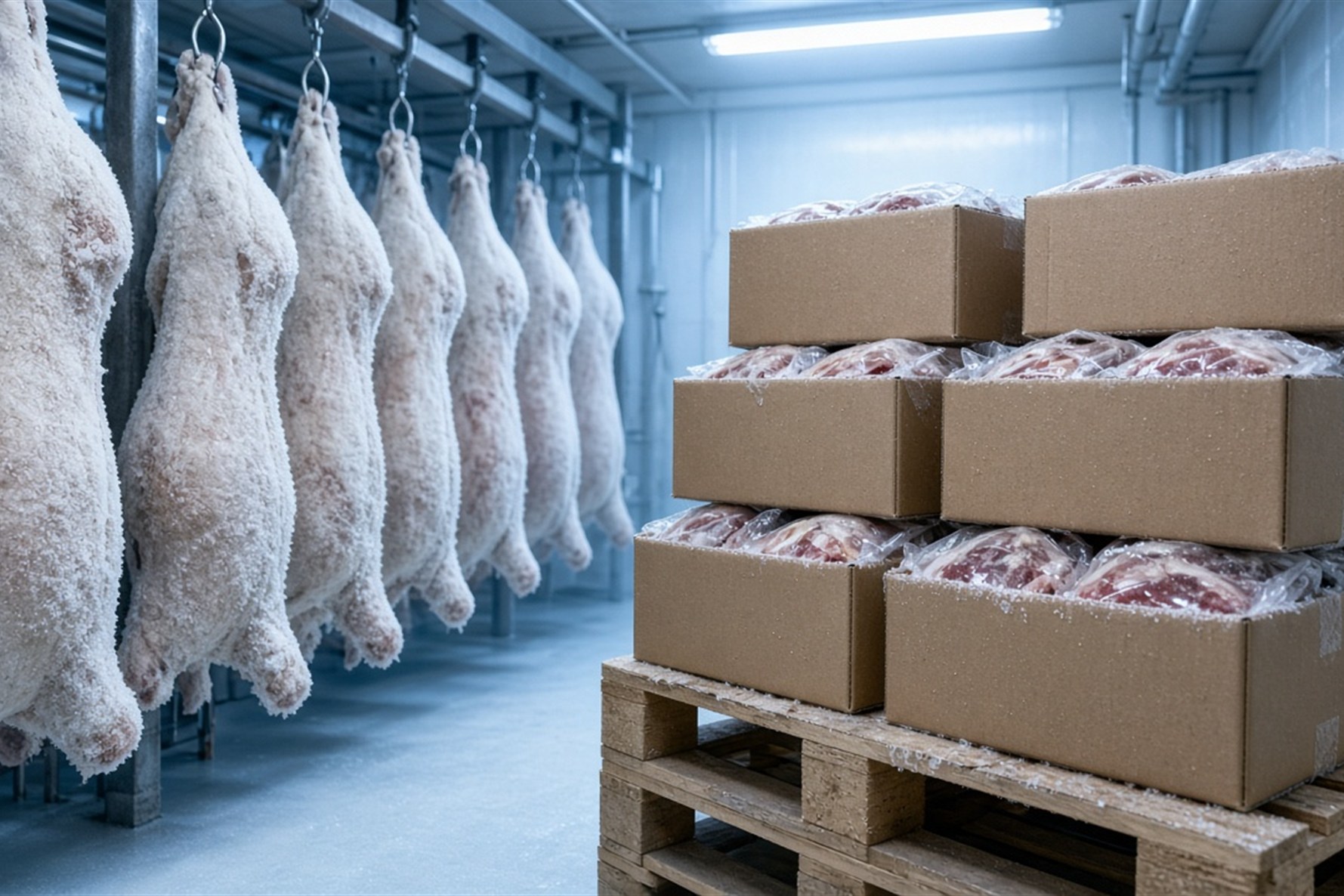
Teknik özellikler, helal ve hijyen gereklilikleri, soğuk zincir lojistiği ve Orta Doğu ile uluslararası ticaret stratejisi — Iranco dergisinde yayınlandı.
Bu uzman rehber, donmuş kuzu eti ticaretinin temellerini, toptan satın alma koşullarını ve ihracat gerekliliklerini kapsamlı biçimde ele alır. Tüccarlar, satın alma yöneticileri, distribütörler ve uluslararası ithalatçılar; karkas sınıflandırması, mikrobiyolojik ve helal sertifikasyon standartları, ambalaj mühendisliği, maliyet değişkenleri ve soğuk zincir yönetimi hakkında derinlemesine bilgi edinir.
Hayvansal protein uluslararası ticaretindeki büyüme, kuzu etini Orta Doğu ve Orta Asya ticaretinde stratejik bir emtia haline getirmiştir. Kaliteli kırmızı et talebi ve Körfez İşbirliği Konseyi (KİK) üyesi ülkelerdeki geleneksel tüketim alışkanlıkları, mera yetiştiriciliği için geniş bir pazar oluşturmuştur. Birleşik Arap Emirlikleri, Umman, Katar, Kuveyt ve Irak dünyada kişi başına koyun eti tüketiminin en yüksek olduğu ülkeler arasındadır. İran platosunun yerli ırkları, dengeli intramusküler yağ, yumuşak kas lifleri ve Orta Doğu damak zevkine uygun lezzet profilleri sayesinde ayrı bir ticari konuma sahiptir.
Artan talebe rağmen toptan tedarikte ve ihracat kanallarına sürdürülebilir girişte başarı, teknik ve ticari ayrıntılara tam hâkimiyet gerektirir. Soğuk zincirde küçük sıcaklık sapmaları, alıcı spesifikasyonlarıyla uyuşmayan anatomik kesimler veya katı helal sertifikasyonu ve mikrobiyolojik limitlere uyulmaması ticari yatırımı durdurabilir.
1. Kuzu Eti Stratejik Konumu ve Orta Doğu Ticaret Akışları Analizi
Koyun ve kuzu eti uluslararası ticareti iki ana kanaldan örgütlenir: soğutulmuş taze sevkiyatlar ve donmuş konsinyeler. Biyolojik stabilite ve uzun raf ömrü sayesinde donmuş ürün, stratejik stoklama, işleme sanayii, büyük ölçekli catering, yemek hizmetleri ve hipermarket tedarik zincirlerinin büyük bölümünü karşılar. Körfez pazarları kurak iklim ve sınırlı yem üretimi nedeniyle yapısal olarak ithal hayvansal proteine bağımlıdır. Genç kuzu, yumuşak doku ve üstün duyusal özellikler sayesinde yaşlı hayvan etine kıyasla ticarette sürekli en yüksek birim değeri taşır.
BAE ve Irak’ta talep akışları
BAE talebi lüks otel-restoran tüketimi ve bölgesel yeniden ihracat arasında bölünmüştür. Dubai ve Abu Dabi’deki uluslararası oteller ve konaklama işletmeleri hassas terbiyeli, temiz kemiksiz kesimler ister; altyapı projelerinde çalışan göçmen iş gücü ise daha ekonomik kesimlere sürekli talep oluşturur.
Irak ise tam karkas ve kemikli yarım karkasların geleneksel alıcısıdır. Mutfak sürekliliği ve coğrafi yakınlık, Irak pazarının yerel yemeklerde yüksek pişirme verimi için kuyruklu mera kuzularını tercih etmesine yol açar. Irak’a ihracat konsinyeleri çoğunlukla Hüsrevi, Mehran ve Parvizhan gibi batı sınır geçişlerinden girer ve doğrudan Bağdat, Basra ve Erbil toptan pazarlarına dağıtılır.
Umman, Katar ve Kuveyt pazarları
Umman ve Katar sıkı ithalat kontrolleri uygular. Ummanlı ve Katarlı ithalatçıların ticari eğilimi ince yağ örtüsüne sahip hafif karkaslara yönelir. Kuveyt, ulusal tüketici kooperatif ağları (jamiyyat) ile desteklenerek orta ağırlıkta donmuş karkaslar ve standart ana kartonlarda paketlenmiş kesimlerin toplu alıcısıdır.
Bu ülkelerdeki mevsimsel talep İslami takvimle — Ramazan, Ramazan Bayramı ve diğer dini günlerle — doğrudan ilişkilidir; bu nedenle bu dönemlerden önceki aylarda tedarik zamanlaması kritiktir.
Canlı koyun ihracatından işlenmiş donmuş ürüne geçiş
İran, genetik ve dağ mera koşulları sayesinde kaliteli hafif hayvan üreticisidir. Geçmiş on yıllarda ticaretin önemli bir payı canlı hayvanların komşu limanlara guletlerle taşınmasıyla gerçekleşti. Transit kayıpları, sınır hastalık riski ve kesimhane zincirinde kaybedilen katma değer gibi zorluklar politikayı işlenmiş donmuş ihracata kaydırmıştır. Menşede modern endüstriyel kesim, Codex tabanlı parçalama ve kartonlu primal paketleme ihracat verimini artırır ve canlı ticaretle ilişkili karantina dalgalanmasını azaltır.
2. Gümrük Tarife Sınıflandırması ve Uyumlu Sistem (HS Kodu) Yapısı
Et proteinli sevkiyatların gümrüklenmesinde doğru HS kodu ataması zorunludur. Kod, idari değerleme tabanını, ithalat vergisi hesabını ve veteriner belge uyumunu belirler. Koyun ve kuzu ürünleri uluslararası düzeyde 0204 başlığı altında sınıflandırılır.
- 0204.10: Kuzu karkas ve yarım karkas, taze veya soğutulmuş
- 0204.21: Diğer koyunların (kuzu hariç) karkas ve yarım karkası, taze veya soğutulmuş
- 0204.22: Koyun veya kuzunun diğer kemikli kesimleri, taze veya soğutulmuş
- 0204.23: Koyun veya kuzunun tamamen kemiksiz kesimleri, taze veya soğutulmuş
- 0204.30: Kuzu karkas ve yarım karkas, donmuş
- 0204.41: Diğer koyunların (koyun ve koç) karkas ve yarım karkası, donmuş
- 0204.42: Koyun veya kuzunun diğer kemikli kesimleri, donmuş
- 0204.43: Koyun veya kuzunun kemiksiz kesimleri, donmuş
Kuzu ve olgun koyun arasındaki yasal ayrım
0204.30 (donmuş kuzu karkası) ve 0204.41 (diğer koyun donmuş karkası) alt başlıkları arasındaki teknik fark kesim yaşı ve iskelet yapısında yatar. Uluslararası standart tanımları ve gümrük muayene kurallarına göre kuzu; 12 aydan küçük, alt çenede daimi kesici dişi olmayan ve omurga eklemlerinin tam kemikleşmemiş hayvandır.
3. Biochemical Traits, Iranian Plateau Breeds, and Carcass Yield
Frozen lamb quality specifications depend on pre-slaughter physiology and breed genetics. Native Iranian plateau sheep belong to fat-tailed breeds. The tail fat depot adapts metabolism so intramuscular fat distributes evenly through muscle tissue—preserving natural water-holding capacity and flavor tenderness after thawing.
Biochemical kinetics of muscle-to-meat conversion
Frozen meat quality is strongly affected by pre-slaughter stress management and initial chilling. Tired, dehydrated, or physically stressed animals deplete muscle glycogen. After bleeding, insufficient lactic acid develops in tissue and final pH does not fall adequately.
Optimal lamb carcass pH after 24 hours in pre-chill rooms at 0–4°C should stabilize in the range 5.5 to 5.8. pH above 6.0 indicates dark, firm, dry (DFD) meat. Such tissue loses interstitial water during freeze-thaw cycles due to reduced protein-water binding and is prone to early spoilage in distribution.
Comparative analysis of native meat breeds
- Afshari:Mountain regions of Zanjan, Azerbaijan, and Kurdistan; heavy hindquarter and loin; hot carcass yield about 48–51%; suited to bulk food-service cuts.
- Shal:Buin Zahra plain, Qazvin; fine bone structure and broad muscle; yield 49–52%; premium choice for prime cuts.
- Qezel:Sahand ranges, Azerbaijan; soft fiber and light pink-red color; yield 48–50%; strong Gulf market demand.
- Moghani:Moghan plains; cohesive muscling; yield about 49–51%; suited to retail carton portioning.
- Baluchi:Eastern Iran; lighter, less fat-tailed carcasses; yield 45–49%; suited to markets preferring lower weights.
| Technical attribute | Afshari | Shal | Qezel | Moghani | Baluchi |
|---|---|---|---|---|---|
| Carcass yield (%) | 48–51 | 49–52 | 48–50 | 49–51 | 45–49 |
| Subcutaneous fat thickness | Medium to thick | Medium | Thick | Balanced | Thin |
| Marbling index | High | High | Very high | Medium | Medium |
| Muscle color | Light cherry red | Light red | Pink-red | Light red | Medium red |
| Meat-to-bone ratio | 4.5 : 1 | 4.8 : 1 | 4.3 : 1 | 4.4 : 1 | 4.0 : 1 |
| Average finished carcass weight | 16–22 kg | 18–24 kg | 16–20 kg | 15–20 kg | 12–16 kg |
4. Commercial Cut Anatomy, Carcass Breakdown, and Grading Systems
Standard cut nomenclature underpins international contracts. Codes under the UNECE sheep meat standard and the Australian AUS-MEAT system are widely accepted frameworks that prevent anatomical definition disputes.
Six-way wholesale cut anatomy
Frozen lamb wholesale supply is typically offered as whole carcass or six-way breakdown. In the six-way method, the carcass is sawn along the midline into two symmetrical sides, then each side is divided into three primal sections:
- Bone-in leg:Gluteal and biceps femoris muscles with femur, shank, and tail vertebrae through the hock joint; highest lean density.
- Bone-in forequarter:Shoulder, arm muscles, and 4–5 fore ribs; becomes tender after slow cooking.
- Loin and rack:Mid-spine and longissimus dorsi; highest-value portion and source of steaks, fillet, and French racks.
Carcass fat scoring (Fat Scoring)
Carcass fat cover under the global AUS-MEAT standard is measured at the GR site (110 mm from the carcass midline over the 12th rib) and ranked in five technical classes:
- Score 1 (very lean):0–5 mm; prone to freezer burn.
- Score 2 (lean, muscular):6–10 mm; preferred in premium and modern retail.
- Score 3 (balanced, ideal):11–15 mm; top commercial grade for Middle East export.
- Score 4 (fat):16–20 mm; may require trimming.
- Score 5 (very fat):over 21 mm; mainly industrial and further-processed uses.
| Commercial cut | Weight range (kg) | Optimal fat score | End-use channel |
|---|---|---|---|
| Whole frozen lamb carcass | 12–18 | Score 2–3 | Wholesale markets, traditional butchers |
| Bone-in leg | 2.2–3.5 | Score 2 | Catering, household, traditional kebab |
| Bone-in forequarter | 1.8–3.0 | Score 3 | Premium stews, slow industrial cooking |
| Bone-in loin | 1.2–2.2 | Score 2–3 | Steaks, restaurant kebab and shish |
| Bone-in neck | 0.8–1.5 | Score 3–4 | Rich soups, broth |
| Boneless shoulder | 1.0–2.0 | Score 3–4 | Burgers, sausages, kofta |
| Boneless leg center | 1.5–2.5 | Score 1–2 | Hotels, luxury vacuum packs |
5. Sanitary Frameworks, Microbiological Safety, and Halal Slaughter Requirements
Compliance with sanitary standards and Islamic slaughter rules are inseparable conditions for meat clearance in Muslim markets. Destination food and drug authorities evaluate shipments using laboratory tests against international criteria.
Halal slaughter principles under regional standards
Halal standards—especially OIC/SMIIC 1:2019 and Gulf livestock slaughter regulation GSO 993—impose strict slaughterhouse requirements:
- Slaughterer qualification:Direct slaughter by a Muslim adult knowledgeable in Sharia, under supervision of an authorized religious representative.
- Cut method:Single-pass sharp stainless-steel knife cut across the throat; severing trachea, esophagus, and both carotid and jugular vessels without decapitation.
- Tasmiyah:Pronouncing the name of God at the moment of cut.
- No pre-death stunning:Prohibition of mechanical or chemical stunning that stops the heartbeat before bleeding.
- Complete bleeding:Minimum 6–8 minutes suspension on the line for blood drainage.
Microbiological quality control criteria
Under GCC food microbiological standard GSO 1016:2015, microbiological limits for frozen lamb are assessed via defined sampling plans. Pathogens (Salmonella and STEC) must be absolutely negative in all 25 g samples. Any pathogen colony triggers rejection or destruction of the entire container load.
| Microbiological or chemical test | Test basis | Limit / acceptance |
|---|---|---|
| Total aerobic count | ISO 4833 | Per GSO sampling plan |
| Enterobacteriaceae | ISO 21528 | Slaughter hygiene indicator |
| Non-pathogenic E. coli | ISO 16649 | Within m and M limits |
| Salmonella in 25 g | ISO 6579 | Negative (zero)—not acceptable if positive |
| E. coli O157 in 25 g | ISO 16654 | Negative (zero)—not acceptable |
| Antibiotic residues | Chromatographic screening | Below Codex MRL—zero tolerance |
| Heavy metals (Pb, Cd) | Atomic absorption | Above standard range = full rejection |
6. Freezing Engineering, Advanced Packaging, and Cold-Chain Logistics
Physical freezing is the fundamental biochemical method to halt enzymatic reactions and fully suppress microbial growth. Final meat quality after thawing depends entirely on ice crystal size formed during freezing. Slow freezing produces large, irregular extracellular crystals that rupture muscle cell membranes—leading to extensive drip loss on defrost and leathery texture.
Chilling phases and blast-freeze kinetics
- Initial chill (pre-chill):0–2°C, 85–90% relative humidity, 18–24 hours until leg core below 4°C and rigor completed without cold shortening.
- Blast-freeze tunnel:Air at −35 to −40°C and airflow 3–5 m/s; target geometric center of thickest cut to −18°C within 24–36 hours, then storage at −18 to −22°C.
Export packaging and film engineering
- Thermoplastic vacuum shrink bags:Polyamide, polyethylene, and EVOH layers; near −1 bar vacuum and 1–2 s dip in 85–90°C water for heat shrink.
- Pure cotton stockinette bags:For whole and half carcasses with thin polyethylene underliner.
- 5- and 7-ply moisture-resistant cartons:Heavy kraft with water-resistant adhesive; telescopic boxes stack-stable to 2.4 m at −18°C.
Reefer container settings
- Refrigeration unit set to −20°C to offset door openings and coil defrost cycles.
- Fresh-air vents 100% closed for frozen meat.
- Observe top air-gap loading line; do not block floor channels.
- Minimum two calibrated digital data loggers—center pallet and near container door.
7. Gulf Import Market Structure and Consumption Patterns
| Country | High-demand format | Preferred weight | National standards | Peak demand season |
|---|---|---|---|---|
| UAE | Boneless cuts, loin and fillet | 10–20 kg vacuum cartons | ZAD system, Dubai Municipality rules | Nov–Apr and Ramadan |
| Iraq | Whole carcass, bone-in six-way | 16–22 kg fatter carcass | Border inspection, veterinary certificate | Muharram, Safar, Ramadan, Eids |
| Oman | Light carcass in stockinette, bone-in leg | 10–14 kg lean carcass | Ministry of Agriculture, GSO 1016 | Ramadan, Eid al-Adha |
| Qatar | Light carcass, telescopic cartons | 11–15 kg carcass | Ministry of Public Health, GSO 993 | Winter and religious holidays |
| Kuwait | Whole carcass and bone-in portion cuts | 12–16 kg carcass | Kuwait Food and Nutrition Authority | Shaaban, Ramadan, pre-Adha |
8. Comparative Analysis of Major Exporters and Iran’s Competitive Position
Global sheep and lamb trade is multipolar, with Australia and New Zealand managing a large share of volume. Iranian plateau pasture lamb, however, offers distinct organoleptic traits that differentiate it from industrial Oceania production.
Major lamb and mutton supply flows to the Middle East
├── Australia & New Zealand ── Mass production, electronic traceability, lean texture, long transit
├── India (goat & sheep) ──── High volume, low price, very lean carcass, limited culinary value
├── Central Asia (Kazakhstan) ─ Fat-tailed breeds, regional taste profile, slaughter infra bottleneck
└── Iranian plateau ────────── Favorable marbling, native taste fit, fast transit
Sensory differentiation and native taste advantage
Merino and European Oceania breeds produce lean meat with grassy notes. By contrast, Iranian plateau sheep grazing semi-arid foothills rich in aromatic shrubs and diverse fat-tailed genetics yield evenly marbled meat with appealing aroma—a critical advantage in authentic Middle Eastern slow cooking, stews, and kebab.
Logistics chain advantage and order management
Sea distance from Australian and New Zealand ports to the Gulf requires 20–35 days transit. Iran’s geography enables 24–48 hour sea transit from southern ports to UAE or Omani coasts and under three days overland to Iraqi cities.
| Supply country | Strengths | Challenges | Price band | Key markets |
|---|---|---|---|---|
| Australia | Scale, cut uniformity | Long haul, aroma mismatch with local taste | Mid to high | China, USA, UAE, Saudi Arabia |
| New Zealand | Strict hygiene, premium cuts | High price, heavy packaging cost | Premium | EU, UK, China, UAE |
| India | Low cost | Low sensory quality, dry texture | Economy | UAE, Kuwait, Oman (labor catering) |
| Kazakhstan / Georgia | Regionally familiar breeds | Slaughter standard volatility | Competitive mid | Iran, UAE, Russia, Uzbekistan |
| Iran | Superior flavor, logistics speed | Seasonal admin volatility, packaging upgrade needs | Competitive to premium | Iraq, UAE, Oman, Kuwait, Qatar |
9. Landed Cost Structure, Pricing Variables, and Incoterms
The final price per kilogram ready for loading reflects a chain of direct and indirect costs:
- Live animal base price at livestock markets (rainfall, feed, and seasonal demand)
- Net dressing yield (roughly 50% live weight to raw meat)
- Slaughter, sorting, trimming, sanitary inspection, and religious oversight
- Pre-chill energy, −40°C blast tunnel, and central cold store
- Export packaging (vacuum, stockinette, kraft cartons, pallets)
- Veterinary, halal, customs seal, and third-party inspection certificates
- Refrigerated logistics and cargo insurance
International commercial terms (Incoterms)
- FOB:Exporter completes customs and loads at standard temperature on board at port of shipment; ocean freight is buyer’s responsibility.
- CFR:Seller pays reefer freight to port of entry; risk transfers to buyer after loading.
- CIF:Navluna ek olarak, alıcı lehine geçerli bir uluslararası sigorta gereklidir; en az 24 -48 saat boyunca reefer jeneratör arızası için açık teminat önerilir.
10. Kalite Göstergeleri, Yaygın Kusurlar ve Soğuk Depolamanın Önlenmesi
- Yüzey dondurucu yanığı:Hermetik olmayan paketlerde veya sıcaklık dalgalanmalarında nem göçünden kaynaklanan opak, kuru beyaz veya sarı - kahverengi lekeler.
- Yağ oksidasyonu ve ekşimesi:Yağ rengi açık kremden koyu sarıya ve bayat yağ kokusuna oksijen veya ışığa maruz kalmadan kayar.
- Büyük buz kristalleri ve donmuş temizleme:Taşımada termal suistimal ve kısmi çözülme kanıtı.
- Koyu sert kuru (DFD):6.0 'ın üzerindeki pH ve kesim öncesi stresten kaynaklanan morumsu - kahverengi renk.
- Kas morarması:Fiziksel darbe veya standart dışı şoklama voltajı nedeniyle fileto ve bel kısmında kılcal damar yırtılması.
11. Sipariş Vermeden Önce İthalatçı Kontrol Listesi
- Uluslararası standartlara göre anatomik özellikleri tanımlayın (tüm karkas, altı yönlü veya kemiksiz).
- İzin verilen karkas ağırlık aralığını ve ağırlık toleransını ayarlayın.
- AUS-MEAT Fat skorunu belirtin (tercihen 2 veya 3).
- OIC/SMIIC 1:2019 uyarınca geçerli helal sertifikası talep edin.
- GSO 1016:2015 uyarınca mikrobiyolojik gereksinimleri belirtin.
- Ambalajı tanımlayın (vakum, stokinet, 5 veya 7 katlı kartonlar).
- İki dilli Arapça ve İngilizce etiket örneklerini onaylayın.
- Hedef onaylı tesis listelerinde menşe kesimhane sağlık onayını doğrulayın.
- Reefer konteyneri başına en az iki veri kaydedici gerektirir.
- Menşeinde üçüncü taraf denetimini şartlandırma (§ 0§).
- Incoterms (FOB, CFR veya CIF) ve yükleme limanını kabul edin.
- Hasar tazminatı, kilo kaybı limitleri ve tahkim çerçevesini tanımlayın.
12. Doğru Fiyat Teklifi Vermek İçin Hangi Bilgiler Gereklidir?
- Tam ürün ve kesim açıklaması (tüm karkas, altı yönlü veya belirtilen primaller)
- Kalite sınıfı ve yağ örtüsü
- Birim başına ağırlık aralığı
- Toplam sipariş hacmi ve teslimat programı (tonaj veya 40 ft konteyner; konteyner başına yaklaşık 22 -26 t)
- Ambalaj şekli
- Required standards and certificates (halal, veterinary, COA)
- Label content and languages
- Final port or border delivery point
- Desired delivery terms and Incoterms
13. Direct Sourcing of Frozen Lamb from Iran via Iranco
In livestock product trade, a credible supply source that combines native carcass quality, international standard compliance, and a stable freezing chain creates lasting competitive advantage for bulk buyers and distributors. Pasture-finished lamb from Iranian industrial slaughter facilities—with even fat distribution, tender fiber, and favorable aroma—is well suited to protein supply chains in the Gulf and neighboring countries.
Iranco is a specialized platform for trade and supply in food-industry products, connecting international importers, distributors, hotel procurement teams, and traders directly with modern industrial slaughter and protein processing facilities in Iran. Buyers can register technical requirements—including carcass weight grade, cut specification, moisture-resistant packaging, and quarantine certificates—through a formal supply request.
14. Conclusion
Frozen lamb trade is highly profitable but demands technical discipline, livestock physiology knowledge, and committed cold-chain management. Genetic traits of Iranian plateau sheep—high dressing yield and flavorful, juicy texture—offer competitive advantage over industrial Oceania product in Middle East consumption markets. Converting that natural potential into durable commercial value requires rapid freezing at −40°C, optimal carcass pH, oxygen-barrier packaging, and documented compliance with GSO 1016 microbiological rules and halal certification SMIIC 1:2019.
Success for bulk buyers and trade managers depends on transparent contracts, international cut codes, continuous temperature monitoring in transit, and validated supply routes. Meeting these engineering and commercial requirements minimizes shipment risk and supports long-term profitability for food industry participants.
Frequently asked questions
1. What is the main difference between young lamb and mature sheep in export trade?
Lamb is a sheep under one year without permanent teeth. Lamb meat has tender muscle, light pink-red color, and mild flavor. In international markets, frozen lamb commands higher value and price than mature sheep meat.
2. What are standard blast-freeze tunnel parameters for lamb?
Blast tunnels should operate at −35 to −40°C with 3–5 m/s airflow so the deepest muscle tissue reaches −18°C within a maximum of 24 hours.
3. What are the core requirements for halal slaughter certification?
Under OIC/SMIIC 1:2019, slaughter must be performed by a Muslim slaughterer with a sharp knife, in one continuous cut severing the four throat vessels, with invocation of God’s name and complete blood drainage. Supervision by an authorized religious observer is mandatory.
4. What is the standard shelf life of frozen lamb?
Under GSO 150-1, maximum shelf life for frozen lamb stored continuously at −18°C is 12 months from date of slaughter.
5. How can freezer burn be prevented in storage?
Multi-layer vacuum shrink films with oxygen barrier, cotton stockinette on carcasses, and stable cold-store temperature at −18 to −22°C help prevent this defect.
6. What details are needed for an accurate quote and formal proforma?
Buyers should specify exact cut type, fat score, weight range, packaging standard, total order volume, destination country and port, and Incoterms. This information can be submitted via a formal request on the Iranco platform.
7. Which HS codes apply to frozen carcasses and cuts?
Subheading 0204.30 covers frozen lamb carcasses and half-carcasses. Bone-in frozen cuts are declared under 0204.42 and boneless cuts under 0204.43.
8. What causes excessive drip loss during defrost?
Slow freezing at inadequate temperatures, temperature abuse during container transit, and high pre-freeze meat pH break protein cell structure and cause extensive interstitial water loss.
Öne Çıkan Ürünler


İlgili Yazılar



