 Iranco Magazine Team
Comprehensive review of technical specs, lab test methods, packaging standards, pricing variables and export-development pathways
Export Guide · Yazd Traditional Sweets · Quality & Packaging
Yazd Qottab: Wholesale Buying, Quality and Export Guide
A comprehensive review of technical specifications, laboratory test methods, packaging standards, pricing variables and export-development pathways — published in the Iranco magazine.
| Key indicator | Value or technical specification | Supplementary notes |
|---|---|---|
| International tariff code (HS Code) | 19059090 | Heading “other bakers’ wares, pastrycooks’ products and biscuits”; use of code 17049090 is not recommended |
| Maximum peroxide value | Below 2 milliequivalents of oxygen per kilogram of fat | In a fresh product the ideal value is below 0.5 milliequivalents per kilogram |
| Total product moisture | 4 to 6% by weight (maximum 6%) | Standard range for maximum texture shelf life and mould prevention |
| Filling share in premium grade | 40 to 50% of each piece by weight | Primary quality marker and value driver in export contracts |
| Shelf life with modified atmosphere (MAP) | Fried 6 to 9 months; oven-baked 9 to 12 months | Subject to residual oxygen below 0.5% and controlled-temperature storage |
This specialist guide sets out the technical and commercial principles of wholesale buying and export of Yazd qottab for importers, trade managers and food-industry operators. Formulation structure, physicochemical and microbiological standards, modern packaging technologies, customs rules and priority markets are analysed so that common sourcing errors are reduced to a minimum.
Iran’s traditional confectionery industry reflects indigenous food-processing know-how built on climate and agricultural advantages. Among the authentic sweets of the central plateau, Yazd qottab — a complex two-layer product with a crisp flour-based shell and a dense core of oily nuts and aromatic spices — attracts notable demand abroad. The product has strong potential as a durable export line in the processed-food basket. Moving this traditional item from workshop scale into international distribution nevertheless faces technical challenges: fat vulnerability to oxidative rancidity, physical fragility in transit and fluctuation in raw-material quality.
Developing trade in this commodity requires leaving traditional supply habits behind and adopting food-engineering protocols. Correct understanding of moisture behaviour, selection of films with very low permeability, monitoring of pesticide residues and aflatoxin in dried nuts, and knowledge of destination hygiene rules are foundational for target markets. Investors, procurement managers and trading firms in confectionery and souvenirs need a documented methodology that safeguards quality while covering financial, sanitary and customs risks on high-volume orders.
1. Economic Geography and Commercial Capacity of Yazd Qottab
Yazd Province, on the edge of the central desert, is the historic cradle of sweets whose inherent stability against early spoilage is a defining trait. Qottab’s dense structure and very low free moisture were ancestral solutions for storing energy-dense foods in an arid climate. That history is now an economic advantage and has made Yazd the exclusive supply hub for this product. The industry’s supply chain in Yazd is tightly linked to almond-producing regions in neighbouring provinces, green-cardamom suppliers and edible-oil refining plants.
Annual traditional-confectionery output in Yazd reaches tens of thousands of tonnes, much of it qottab and baklava. Clustering of specialist workshops and continuous forming and industrial baking lines in Yazd industrial parks enables response to high-tonnage demand. Industrial qottab production is year-round, although seasonal buying patterns for raw materials — especially the autumn almond harvest — strongly influence cost of goods.
On the international commercial calendar, export demand peaks in the months leading to Ramadan, Eid al-Fitr and the Gregorian New Year. Informed traders manage raw-material price swings and production-line congestion by locking long-term supply contracts before these peak periods begin.
2. Qottab Typology by Cooking Method and Filling Composition
Commercially, Yazd qottab is classified by two main variables: heat application (deep-fried in oil or baked in an oven) and the type of core filling. Each type has distinct rheological, textural and shelf-life behaviour that the wholesale buyer must specify for the destination market.
Traditional oil-fried qottab
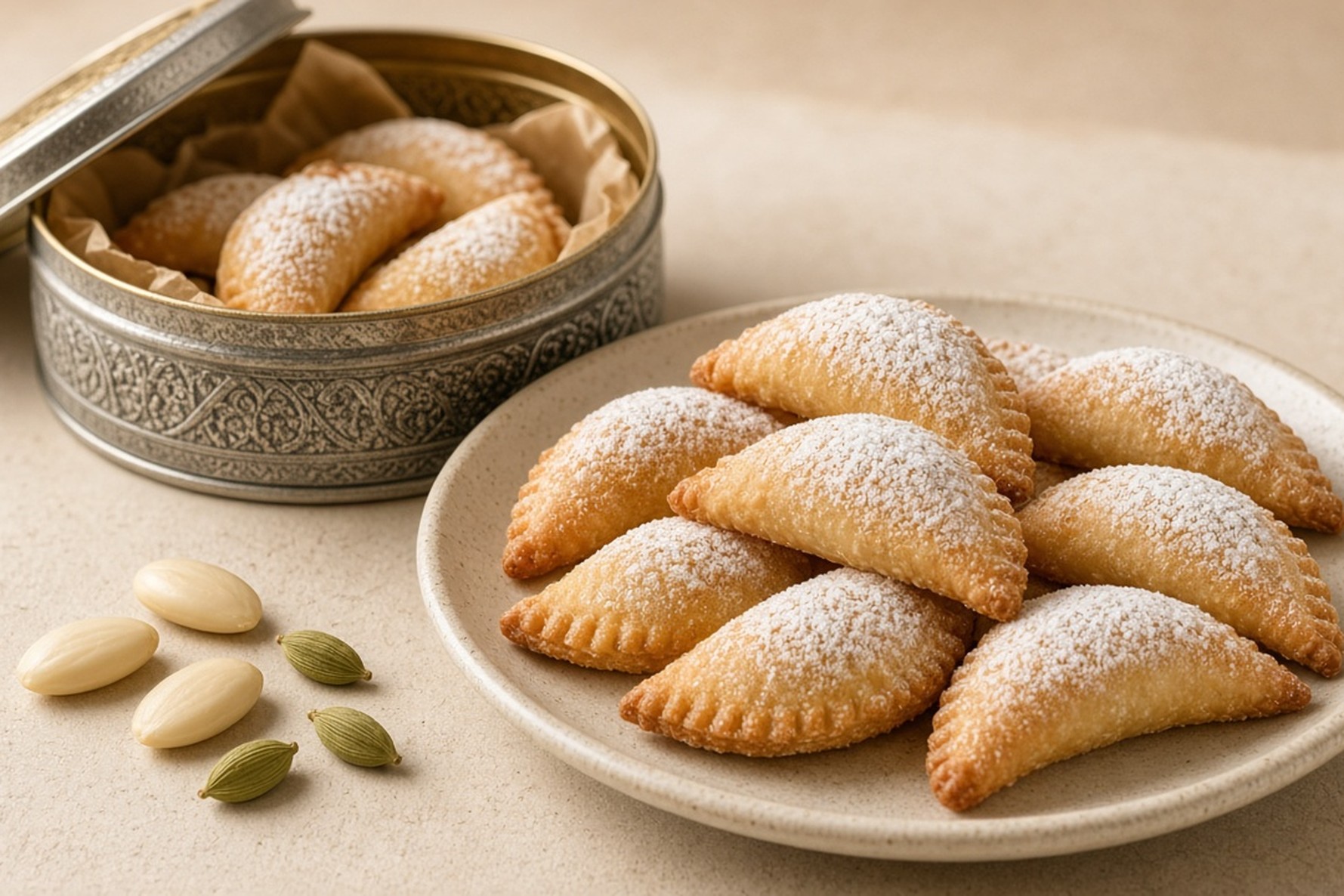
This is the classic form. Thin moulded dough, after filling placement, is closed by hand or machine and deep-fried in a hot-oil bath. The result is a crisp, layered, porous, brittle shell with a characteristic aroma. The main commercial challenge is absorption of 15 to 20% oil in the shell, which makes the product highly prone to lipid oxidation in light and air. After cooking and thorough oil draining, the sweet is rolled in powdered sugar containing cardamom.
Oven-baked (kiln) qottab
The oven type grew in response to health-oriented markets and stricter fat standards in Western countries. Product is baked in convection or tunnel ovens under hot-air flow. The outer layer resembles soft traditional biscuits and total fat is assessed at about 40% lower than the fried type. Higher oxidative stability curbs oil rancidity and extends natural shelf life without preservatives.
Filling diversity
Although sweet almond powder is the traditional base filling of Yazd qottab, other variants are processed according to market pull:
- Authentic almond qottab: filling exclusively from pure blanched sweet-almond powder, sugar powder and green cardamom.
- Premium pistachio qottab: high-greenness pistachio used as part or all of the filling, placing the product in ceremonial, very high-price confectionery.
- Walnut qottab: some regional lines use freshly ground walnut with cinnamon powder.
- Low-calorie sweetener qottab: sugar replaced by isomalt or sucralose for pharmacies and diet stores.
| Evaluation parameter | Traditional oil-fried qottab | Oven-baked (kiln) qottab |
|---|---|---|
| Heating method | Full immersion in hot edible oil | Hot-air convection in a baking oven |
| Shell texture characteristics | Flaky, crisp, layered and bubbly | Dense, evenly crisp, biscuit-like |
| Total product fat | 22 to 28% by weight | 12 to 15% by weight |
| Main storage risk | Oxidative rancidity of shell fats | Starch staling and gradual dough hardening |
| Shelf life in ordinary packaging | 30 to 45 days in a cool place | 60 to 90 days in a cool place |
| Shelf life with modified atmosphere (MAP) | 6 to 9 months | 9 to 12 months |
| Surface powdered-sugar share | 10 to 15% of total product weight | 8 to 12% of total product weight |
3. Technical Specs, Ingredients and Formulation Parameters
In international trade, product specs must be recorded in a technical data sheet (TDS). Balance between outer flour-layer thickness and filling volume is the primary quality marker of Yazd qottab. Wholesale buyers should specify formulation requirements in detail.
The shell is based on pastry wheat flour with standard wet gluten (about 26 to 28%), fresh pasteurised egg yolk, strained low-fat yoghurt without whey, and stable edible fats. Natural yoghurt acidity helps open the gluten network and create a flaky texture during baking. After forming, the outer layer should be at most 1.5 to 2 mm thick so weight balance between shell and filling is preserved.
The filling must account for at least 40 to 50% of each piece’s total weight. It must not contain excess starch, soy or cake/bread crumbs. Almond powder must be fine enough (particles below 1 mm) to feel cohesive under the tooth. Traditional sugar-to-almond ratio is usually 1:1; for export orders sugar can be reduced to 1:1.5 (one part sugar to 1.5 parts almond powder) to align flavour with international taste.
| Technical parameter | Expected buyer standard range | Reference test method | Commercial evaluation importance |
|---|---|---|---|
| Filling weight share of the sweet | Minimum 40% (optimum: 45 to 50%) | Physical separation and precise weighing | Guarantees nutritional value, almond aroma and quality authenticity |
| Total product moisture % | Maximum 6% (desirable range 4 to 6%) | Dean–Stark / thermal oven method | Prevents mould and softening of surface sugar |
| Peroxide value of extracted fat | Below 2 milliequivalents per kg of fat | Standard iodometric titration | Controls oxidative spoilage and frying-oil health |
| Free fatty acidity | Below 0.6% as oleic acid | Acid–base titration with sodium hydroxide | Absence of hydrolytic oil breakdown during cooking and frying |
| Total product ash | Maximum 2.5% | Incineration in a 550 °C electric furnace | Controls mineral purity and base flour |
| Acid-insoluble ash | Maximum 0.05% | Dissolve in hydrochloric acid and weigh | Monitors absence of soil impurities with almonds |
| Net weight per qottab piece | 25 to 30 g | Balance accurate to 0.01 g | Content uniformity and stable packaging-machine operation |
Wholesale buyers seeking suppliers whose production formally follows this technical data sheet can pursue purchase requests through Iranco’s commercial structure.
4. Laboratory Tests and Quality-Control Standards (INSO and GSO)
Alignment of export consignments with origin and destination standards is a precondition for fast clearance and for avoiding seizure or return at customs. In Iran, qottab falls under national standard No. 3493 (flour confectionery — characteristics and test methods) and general food-hygiene rules. For Middle East and Gulf destinations, microbiological criteria of GSO 1016 guide food and drug inspectors.
Aflatoxin control in almond kernels
Aflatoxins are fungal metabolic toxins from Aspergillus moulds that grow when almonds are poorly processed or stored. Iranian national standard No. 5925 and EU and Codex rules make measurement mandatory. Laboratories must quantify aflatoxin B1 and total aflatoxins by high-performance liquid chromatography (HPLC). Total aflatoxin must not exceed 4 µg/kg and aflatoxin B1 must not exceed 2 µg/kg. An almond health certificate is a prerequisite for export certification.
Microbiological indicators
Because water activity (Aw) is usually below 0.60, qottab is not a favourable medium for active bacterial growth; yet raw ingredients such as egg and hand-forming of some types raise microorganism-transfer risk if hygiene fails. Recognised standards set the following limits:
| Microbiological indicator | Iran national limit (INSO 2395) | Gulf limit (GSO 1016) | International reference method |
|---|---|---|---|
| Aerobic mesophilic plate count | Maximum per INSO 2395 limit | Maximum per GSO 1016 limit | ISO 4833 |
| Mould and yeast count | Maximum per INSO 2395 limit | Maximum per GSO 1016 limit | ISO 21527-2 |
| Coliform bacteria | Below 10 per gram | Negative in 0.1 g | ISO 4832 |
| Escherichia coli (Escherichia coli) | Negative per gram | Negative per gram | ISO 16649-2 |
| Coagulase-positive Staphylococcus aureus | Negative per gram | Negative per gram | ISO 6888-1 |
| Salmonella (Salmonella) | Negative in 25 g | Negative in 25 g | ISO 6579 |
| Bacillus cereus | Maximum per INSO 2395 limit | Negative in 0.1 g | ISO 7932 |
Monitoring trans fatty acids and peroxide
To protect the end consumer, trans fatty acids in oil extracted from the finished product must not exceed 2%. Peroxide value, which indicates the onset of rancidity, should be near zero at production and must not exceed 2 milliequivalents of oxygen per kilogram of fat at export clearance.
5. Diagnosing Texture Defects, Sensory Changes and Quality Assessment
Warehouse and pre-loading quality control rests on simultaneous sensory and laboratory monitoring. In wholesale trade, visible and flavour defects immediately cut price or void contracts.
Pasty sugar and powdered-sugar sweating
Surface powdered sugar strongly absorbs ambient moisture. If warehouse relative humidity exceeds 55%, sugar takes up air moisture and forms a sticky, damp, dull layer. Controlled particle-size sugar plus an allowed share of food-grade modified corn starch (about 1 to 2%) as anti-caking agent delays moisture ingress.
Oil migration and surface spotting
If dough is not drained of oil at the right temperature and for long enough after frying, trapped oil slowly migrates toward the powdered-sugar surface. Yellow, greasy spots appear and stale-oil odour accelerates. Holding frying temperature near 175 °C and using vibrating oil-drain tables with cool-air blowers removes this structural defect.
Abnormal hardness and dry dough texture
Dry texture stems from starch retrogradation and gradual loss of internal moisture in poorly ventilated environments. Premium qottab has a shell that crumbles easily under the tooth and must not feel gummy or bony. Measured amounts of tragacanth gum or natural hydrocolloids in the dough formula help retain water bonds in the shell and preserve acceptable softness over storage.
Edge breakage and seam bursting
Seam bursting occurs in frying when dough edges are incompletely bonded; trapped air in the filling expands with heat and tears the shell. Besides scorching almond filling in oil, this drives a large volume of hot oil into the filling. Visually, pieces with open seams or broken hand-formed edges fail export standards.
6. Modern Packaging Technologies for Export Consignments
Packaging is vital in qottab trade because it blocks direct contact with air oxygen, ambient moisture and physical shocks. Long shelf life for sea and road transport requires barrier packaging technologies.
Modified-atmosphere packaging (MAP)
Modified atmosphere is the accepted industrial standard for extending qottab shelf life up to 9 months. Air inside the pack is evacuated and a defined mix of inert gases is injected:
- High-purity nitrogen (minimum 99.9%): replaces oxygen and, being inert, fully suppresses oxidation of almond fat and shell oil. It also acts as a gas cushion against crushing.
- Carbon dioxide (20% with 80% nitrogen): CO₂ has antifungal and bacteriostatic properties and stops possible mould spores.
- Residual oxygen: must always remain below 0.5% in the finished pack.
Multilayer polymer barrier films
Primary packs must have very low water-vapour transmission (WVTR) and oxygen transmission (OTR). Three-layer laminates of metallized polyester (MPET), clear biaxial polypropylene (BOPP) and sealable linear polyethylene (LLDPE) or cast polypropylene (CPP) form an optimal light and moisture barrier.
Sealed metal tins (Tin Containers)
Seam-sealed metal tins with tin protective layer and easy-open or silicone-gasket lids are the best option for luxury export markets. Metal fully blocks UV and gases and protects against lateral pressure in handling and container transit. Food-grade iron-based oxygen absorbers and silica-gel moisture absorbers inside the tin secure product under temperature swings.
| Packaging method | Oxygen and moisture permeability | Shelf life at 18 °C | Relative cost per pack unit | Logistics impact resistance | Primary application |
|---|---|---|---|---|---|
| Sealed metal tin with oxygen absorber | Zero (absolute impermeability) | 9 to 12 months | Very high | Excellent; resists physical deformation | Luxury chain stores and long-haul export |
| Nitrogen-flushed (MAP) multilayer foil pack | Very low | 6 to 9 months | Medium to high | Good (with gas cushion) | Standard regional supermarket distribution |
| Hard cardboard box with inner laminate | Medium (depends on inner vacuum seal) | 3 to 4 months | Medium | Medium | Regional markets with fast road access |
| Cardboard box with ordinary workshop cellophane | High | 30 to 45 days | Low | Weak against vertical pressure | Seasonal traditional supply and local distances |
7. Export Target Markets, Consumer Behaviour and Regional Patterns
Export success requires precise product fit to organoleptic preferences, religious rules and retail channels. Based on food-distribution structure, foreign markets can be analysed in four main poles:
GCC members (UAE, Qatar, Oman, Kuwait)
These countries are historic buyers of Iranian flour confectionery. Shared culture around aromatic sweets (cardamom and saffron) supports the category. In UAE and Qatar demand leans toward luxury metal gift packs with Eastern artistic design in 300, 500 and 1,000 g. Municipal health inspections (e.g. Dubai Municipality standards) focus on freedom from unhealthy trans fats and full nutrition labelling in Arabic and English.
Iraq market
Iraq is a major volume destination for Iranian food exports. Taste in Baghdad, Karbala, Najaf and Basra favours rich, very sweet, nut-heavy sweets. Competition centres on price and heat endurance. Moisture- and heat-resistant packs in 400, 700 and 1,000 g with Arabic print sell strongly in wholesale markets such as Baghdad’s Shorja. Religious seasons, especially Muharram and Safar, are peak import periods.
European Union and United Kingdom
Primary demand comes from Middle Eastern diaspora communities in cities such as Hamburg, Frankfurt, London and Malmö, with rising shelf presence in specialist international stores. Requirements include full pesticide-residue control on almonds, total aflatoxin certificate below 4 µg/kg and clear allergen warnings. Oven-baked (lower-fat) type with MAP and official bilingual labels fits best.
Central Asia and Eurasia (Russia, Kazakhstan, Azerbaijan)
Tea-time sweets culture is widespread. Qottab, rich in nutritious nuts, is a valued alternative to commercial biscuits and cookies. In Russia, Eurasian Economic Union safety rules (EAC) and Russian-language technical conformity marking are mandatory.
| Destination country / region | Preferred pack format | Core entry requirements | Main distribution channel | Best-selling qottab type |
|---|---|---|---|---|
| United Arab Emirates | Luxury decorative metal tin (300, 500 and 1,000 g) | Health certificate, Mohassas registration and product authenticity code | Premium chains and ceremonial hospitality centres | Fried with almond and pistachio filling |
| Iraq | Laminated cardboard with moisture barrier (400, 700 and 1,000 g) | Compliance with Iraqi quality control (COSQC) | Regional wholesalers and traditional Shorja markets | Traditional fried with high sugar ratio |
| Germany | Vacuum carton under inert gas with multilayer film | Aflatoxin below 4 µg/kg and detailed allergen table | Middle East specialist supermarkets and organic stores | Oven low-fat and classic almond |
| Russia | Rigid polymer packs with full airtight seal | Eurasian technical conformity (EAC Declaration) | Nationwide distribution chains and hypermarkets | Traditional fried in impact-resistant packaging |
Traders seeking market-share growth in any of these destinations can evaluate available production options and labelling standards through Iranco’s expert network.
8. Customs Rules, Tariff Codes, Permits and Legal Labelling
Lawful export of Yazd qottab requires correct Harmonized System classification and the necessary commercial and health documents.
Customs tariff code analysis (HS Code)
- Tariff code 19059090: heading “other bakers’ wares, pastrycooks’ products and biscuits” is the primary official code for clearing Yazd qottab at most entry and exit points. Structure is baked wheat-flour dough with oily nuts, so it falls in Chapter 19 (preparations of cereals, flour, starch or milk). Declaring under this heading avoids customs valuation disputes.
- Tariff code 17049090: heading “other sugar confectionery not containing cocoa” is used locally for some traditional sweets. Because flour is the main layer of qottab, this code is not recommended and may trigger laboratory inspection and declaration amendment at advanced customs.
Mandatory documents and export permits
- Valid commercial card of the goods owner or official customs broker.
- Export health certificate issued by the Food and Drug Administration, Ministry of Health.
- Valid sanitary manufacturing licence and standard mark of the supplying factory.
- Certificate of Origin from the Iran Chamber of Commerce, Industries, Mines and Agriculture.
- Phytosanitary certificate for almond kernels from the Plant Protection Organization.
- Official Halal certificate for Islamic-market destinations.
- Certificate of Analysis (COA) matching the shipment batch.
Legal labelling requirements (Labeling Requirements)
Packaging must display the following in legible font in the destination language or English:
- Standard product title: traditional Yazd almond-filled qottab confection.
- Name, address and postal code of the manufacturing plant and country of origin (Iran).
- Full ingredient list in descending weight order (explicit almond percentage).
- Net weight in grams with allowed standard tolerance.
- Nutrition information table per 100 g or per serving.
- Exact production date, expiry date and batch/lot number.
- Allergen warnings: contains tree almond, wheat flour (gluten) and egg.
- Storage conditions: cool (15 to 18 °C), away from sunlight, in a dry place.
9. Transport Conditions, Cold-Chain Engineering and Container Logistics
Given shell fragility and fat sensitivity to heat, transfer-chain management directly affects stability until destination warehouse delivery. Bulk handling or ignoring container conditions destroys commercial value.
Container temperature and relative humidity
Optimum carriage for qottab consignments is 12 to 18 °C with relative humidity below 55%. Dry general containers in summer are not allowed; chamber temperature at Gulf port stops can exceed 45 °C, melting sugar, driving oil from the shell and causing rapid oxidation. For land or sea transit over five days, refrigerated containers with temperature and humidity data loggers are fundamental to quality retention.
Export master-carton features
Outer cartons should be five-layer compressed board with moisture-resistant reinforced flutes. Cellular dividers inside prevent direct vertical pressure on primary packs. Void space between boxes must be filled with cardboard sheets to stop shifting on road bumps.
Pallet layout and loading standards
Export pallets must meet heat-treatment criteria (ISPM 15). Cartons should be block-interlocked so columns do not slip under vessel or trailer motion. Cartons must not overhang the pallet. Resistant cardboard corner posts, horizontal and vertical strapping, and multi-layer stretch wrap secure mechanical integrity through the transport cycle.
10. Cost Structure and Drivers of Wholesale Price
Yazd qottab pricing tracks agricultural raw-material costs in the formulation. Buyers who compare on price alone often receive product lacking standard almond grade and stable oil.
Main cost drivers include:
- Sweet almond kernel price swings: almond holds the largest material share. Seasonal yield and dried-nut export demand directly move qottab rates.
- Green cardamom grade: large-seed premium imported green cardamom is among the costliest spices. Synthetic essences cut cost but damage authentic aroma.
- Process and frying oil quality: high smoke-point oils with controlled iodine value and high oxidative stability cost more than ordinary hydrogenated oils.
- Packaging equipment and technology: decorative metal tins and inert-gas injection into metallized films form a significant share of product price.
- Final order volume: full-container (FCL) orders gain meaningful commercial discounts versus less-than-container (LCL) loads through overhead spread, bulk film print and direct factory loading.
| Cost-of-goods component | Approximate share of total cost | Sensitivity to market swings | Quality factor affecting cost |
|---|---|---|---|
| Sweet tree-almond kernels | 35 to 45% | Very high | Purity, fine powder and absence of bitter taste |
| Cooking and process fat | 15 to 20% | Medium | Rancimat oxidative resistance and absence of trans fat |
| Cardamom, saffron and flavourings | 8 to 15% | Very high | Large-seed cardamom grade and authentic herbal distillates |
| Sugar and coating powdered sugar | 8 to 12% | Medium | Grind fineness (high mesh) and freedom from lumps |
| Flour, egg and dough materials | 5 to 8% | Low | Gluten-network stability and standard flour moisture |
| Final packaging (tin / MAP) | 12 to 25% | High | Gas-barrier performance and print quality |
11. Competitive Position of Qottab Versus Regional Traditional Sweets
Abroad, Yazd qottab is not traded in a vacuum; it competes with familiar Middle Eastern and Mediterranean sweets such as Turkish baklava, Arabic maamoul and traditional halvah. Knowing advantages and limits helps traders position correctly in distribution channels.
Unlike Turkish baklava, qottab has no free syrup, which prevents box wetting and syrup leakage and yields cleaner transport. Versus Arabic maamoul often filled with date paste, qottab’s pure almond and cardamom place it in a denser, higher nut-nutrition tier. The largest challenge versus industrial biscuits or aseptic baklava remains physical fragility and limited shell life without modified-atmosphere packaging.
| Competitor country | Flagship product | Main advantage in target market | Structural limit in competition | International price level |
|---|---|---|---|---|
| Iran (Yazd) | Traditional almond qottab | High almond density, no liquid syrup, natural cardamom aroma | Edge fragility; dependence on oxygen-barrier packaging | Medium to high |
| Turkey | Istanbul baklava | Strong global distribution, pack variety, high pistachio share | High stickiness from sugar syrup, high gross weight, liquid leakage | Very high |
| Lebanon and Syria | Maamoul and baklava fingers | Strong regional reputation, use of stable doughs | Lower share of expensive nuts in some commercial types | High |
| Greece and Cyprus | Kourabiedes (Kourabiedes) | Strong European retail presence and modern branding | High flour and solid-fat use; less flavour diversity | Medium |
12. Importer and Wholesale-Buyer Checklist Before Order Placement
Professional buyers and procurement managers should implement the following audit step by step before contracting and remittance to cut quality and financial risk:
- Specify thermal type: fried-in-oil or oven (kiln) clearly in the formal RFQ.
- Set formulation and filling ratio: record filling weight share (minimum 40 to 50%) in contract terms.
- Ban substitute kernels: explicitly forbid peanut, soy or apricot-kernel substitutes in pure almond filling.
- Set physicochemical limits: formal maximum moisture (below 6%) and oil peroxide (below 2 meq/kg).
- Require aflatoxin certificate: HPLC laboratory confirmation for almond aflatoxin with the shipment.
- Define packaging engineering: barrier film type, nitrogen injection and residual oxygen below 0.5%.
- Review label design and text: allergen warnings, health licences, expiry and traceability barcodes per destination law.
- Test master-carton strength: confirm five-layer board, cellular dividers and vertical crush resistance.
- Evaluate pre-production sample: receive and run organoleptic and chemical tests on active-line samples.
- Set transit protocol: refrigerated container at 12 to 18 °C and RH below 55% in shipping documents.
- Appoint an independent international inspection firm: technical inspection before container sealing at the factory for weight and visual integrity.
- Verify clearance documents: validate draft export health, Halal and Certificate of Origin before departure from origin customs.
13. What Information Must Be Sent to Obtain an Accurate Price?
Calculating a wholesale quote for Yazd qottab requires detailed product specs. Full information enables accurate factory pricing. A price inquiry should include:
- Product type by cooking: fried in oil or oven-baked.
- Filling composition: 100% pure almond, pistachio–almond blend, or custom nut percentage.
- Filling-to-shell volume ratio: filling weight share (40%, 45% or 50%).
- Primary pack format: sealed metal tin, nitrogen-flushed pack, or laminated cardboard box.
- Net weight per pack: 250 g, 500 g, 1,000 g or workshop bulk.
- Pack gas specs: no protective gas, or modified atmosphere (nitrogen / carbon dioxide).
- Total order volume: pack count, master-carton count or total tonnes.
- Final destination country and city: for legal rules, duties and special-permit costs.
- International delivery term (Incoterms): ex works (EXW), free on board at origin port (FOB Bandar Abbas) or cost and freight / insurance (CFR/CIF).
- Custom label and pack design: private label preference or supplier brands.
- Required certificates list: export health, Halal, inspection conformity or aflatoxin test.
Register a Purchase and Export-Supply Request for Yazd Qottab with Iranco
Industrial-scale supply of traditional Yazd qottab faces challenges such as batch non-uniformity, texture fragility and early staling risk in distribution. Wholesale buyers and trading companies can register supply requests through Iranco to manage these risks. On Iranco, order details — almond filling percentage, cooking method, pack format and required laboratory approvals — are matched to qualified Yazd factory standards. Coordinating pre-production samples, validating analysis sheets, supervising modified-atmosphere packaging standards and following export health processes are among the services Iranco provides to cut trade risk and enable direct buying for food-industry operators.
Summary
Yazd qottab is a high nutritional-value product with authentic cultural grade in Iran’s traditional-confectionery export basket. Sustainable profitability in wholesale trade rests on scientific food-industry criteria, moisture and peroxide monitoring, and modified-atmosphere or sealed-tin packaging. Choosing the right type for target taste, recording technical commitments in contracts and applying cold-chain rules protect exporter and importer from quality challenges. With a rich almond core and no free syrup, qottab has latent capacity for a durable share on international shelves; scientifically organised supply chains unlock that economic advantage.
Frequently Asked Questions
What is the main chemical indicator of qottab freshness?
Peroxide value of oil extracted from the product is the most reliable freshness measure. In fresh qottab it is below 0.5 meq/kg; above 2 meq/kg signals onset of fat oxidation and sensory quality loss.
What causes stickiness and darkening of powdered sugar on qottab?
Powdered sugar is strongly hygroscopic. Ambient moisture from non-standard packs or high warehouse humidity dissolves sugar crystals and forms a sticky, spotted syrup layer on the surface.
Is oven-baked (kiln) qottab better for export?
For long-haul markets or EU members with strict trans-fat and calorie rules, the oven type is preferable due to longer shelf life and better resistance to oil rancidity.
How should warehouse temperature for qottab be managed?
Best range is 15 to 18 °C in a dark place with relative humidity below 55%. Above 20 °C accelerates oxidative fat spoilage; high humidity softens and sticks the outer texture.
What is the most common adulteration in wholesale qottab production?
Lowering almond filling weight share, replacing almond powder with roasted flour, starch or cake crumbs, or using chemical essences instead of green cardamom seed are the most common non-standard cost-cutting methods.
What is the usual minimum order quantity (MOQ) for export qottab?
For standard pack formats, MOQ starts at 500 kg. For private-label, multilayer metallized-film print and modified-atmosphere injection, MOQ rises to 2 to 5 tonnes.
How can quality fit to the target market be confirmed before a container order?
Buyers can define required technical specs and tests and obtain laboratory-approved pre-production samples through Iranco for quality checks before final production.
What information is needed for a current export-shipment price?
Cooking type (fried or oven), almond filling percentage, pack type, pack weight, Incoterms delivery and destination country are essential for accurate cost of goods; these can be registered and reviewed on Iranco.
Featured Products





Related Articles



