 Iranco Magazine Team
Formulation engineering, kernel ratios, ISIRI 3023 requirements, lab tests, supply chain and institutional buying checklist
Export Guide · Confectionery · Quality Control & Wholesale Buying
Pistachio Gaz: Kernel Percentage, Quality, and Wholesale Buying Guide
An engineering analysis of formulation, kernel percentages, ISIRI 3023 requirements, laboratory tests, supply-chain control, and institutional purchasing checklists — published in the Iranco magazine.
This specialist guide provides a comprehensive review of the chemical and physical structure of pistachio gaz, analysis of standard pistachio-kernel ratios, sanitary requirements, and laboratory conformity indicators. Trade managers and wholesale buyers can use this reference to distinguish economy from premium grades, define modified-atmosphere packaging requirements, apply shelf-life principles, and manage risk in large supply contracts.
Pistachio gaz is Iran’s premier traditional confection and a hallmark of advanced aeration technology applied to sugar suspensions combined with oil-rich tree nuts. This nut confection results from a stable foam network built with natural hydrocolloids and egg-white protein that embeds pistachio kernels rich in unsaturated fatty acids within a viscoelastic matrix free of crystalline sugar. The link between Isfahan Province and the high plains of Chaharmahal and Bakhtiari with pistachio-growing hubs on the central plateau creates a strategic advantage for fresh raw-material supply with short haul times.
Even so, wholesale trade and sustainable export of this refined confection face several specialist challenges: seasonal price swings in open-shell pistachio kernels, the sensitivity of pistachio fat to oxidation, the risk of fungal toxin contamination in consignments, and management of elastic texture in warm seasons—all of which present material commercial risks for institutional buyers. Pistachio gaz is not merely an everyday sweet; it is a high value-added item in the secondary food-processing chain. Scientifically managed wholesale purchasing requires precise knowledge of physicochemical parameters, methods for verifying kernel percentage, and conformity requirements for cross-border markets. This guide analyzes every stage of the product value chain from kettle processing through final customs clearance.
1. Economic Geography and Geopolitical Production Capacity for Gaz in Iran
Iran’s principal industrial and workshop gaz production bases are concentrated in two historical and industrial hubs. Isfahan Province, as the historical origin and cradle of formulation development, hosts the largest number of registered units, modern factories, brands with export track records, and ancillary industries such as box-making and packaging graphic design. The city of Isfahan, with equipped laboratory infrastructure and advanced packing lines, plays a major role in registering national standards and developing exclusive flavors. Adjacent to this hub, the city of Boldaji in Chaharmahal and Bakhtiari Province is recognized as the country’s workshop and industrial capital for gaz. Boldaji, with dozens of active industrial units and a foothill location in the Zagros, is the center of high-volume, cost-competitive production. The geographical indication for Boldaji gaz is registered with the World Intellectual Property Organization, providing a strong basis for preventing brand counterfeiting in international markets.
The climatic advantage of these two regions includes ready access to pastures where gazangabin and taranjabin manna plants grow, dry weather in cool seasons that limits ambient moisture uptake during molding, and short overland distance to pistachio orchards in Kerman, Yazd, and Fars provinces. Pistachio gaz, with inherently suitable shelf life, is exported to more than forty countries, including the United Arab Emirates, Oman, Iraq, Germany, Canada, and Australia. The gap between actual and potential markets stems from how the product is positioned: in actual markets, Iranian communities and Gulf Arab populations are the main consumers, whereas in potential European and East Asian markets, gaz can be offered as a distinctive natural confection—free of trans fat and rich in protein and antioxidants—as a premium alternative to conventional Western sweets.
| Comparison Axis | Isfahan Production Hub | Boldaji Production Hub |
|---|---|---|
| Dominant production structure | Large industrial units; heritage brands with capillary distribution networks | Dense specialist workshops; dynamic production clusters with high throughput |
| Marketing focus | Luxury export packaging, premium gift gaz, brand development | Competitive cost of goods, bulk orders, wholesale market supply |
| Pistachio sourcing | Primarily sorted pistachio from Rafsanjan, Sirjan, and Mehriz | Pistachio from Dehaj, Anar, Damghan, and Kerman |
| Registration and trade marks | National registered brands with individual standard certificates | International geographical indication and national industrial-cluster mark |
2. Typology and Physical Structure of Pistachio Gaz
Pistachio gaz is divided into three distinct commercial types by shaping method, geometry, packaging approach, and interaction with its surrounding bed. Each type has specific rheological behavior and warehousing requirements that wholesale buyers must select according to retail infrastructure and consumer preferences in the destination market.
Bite-Size (Lozenge) Type
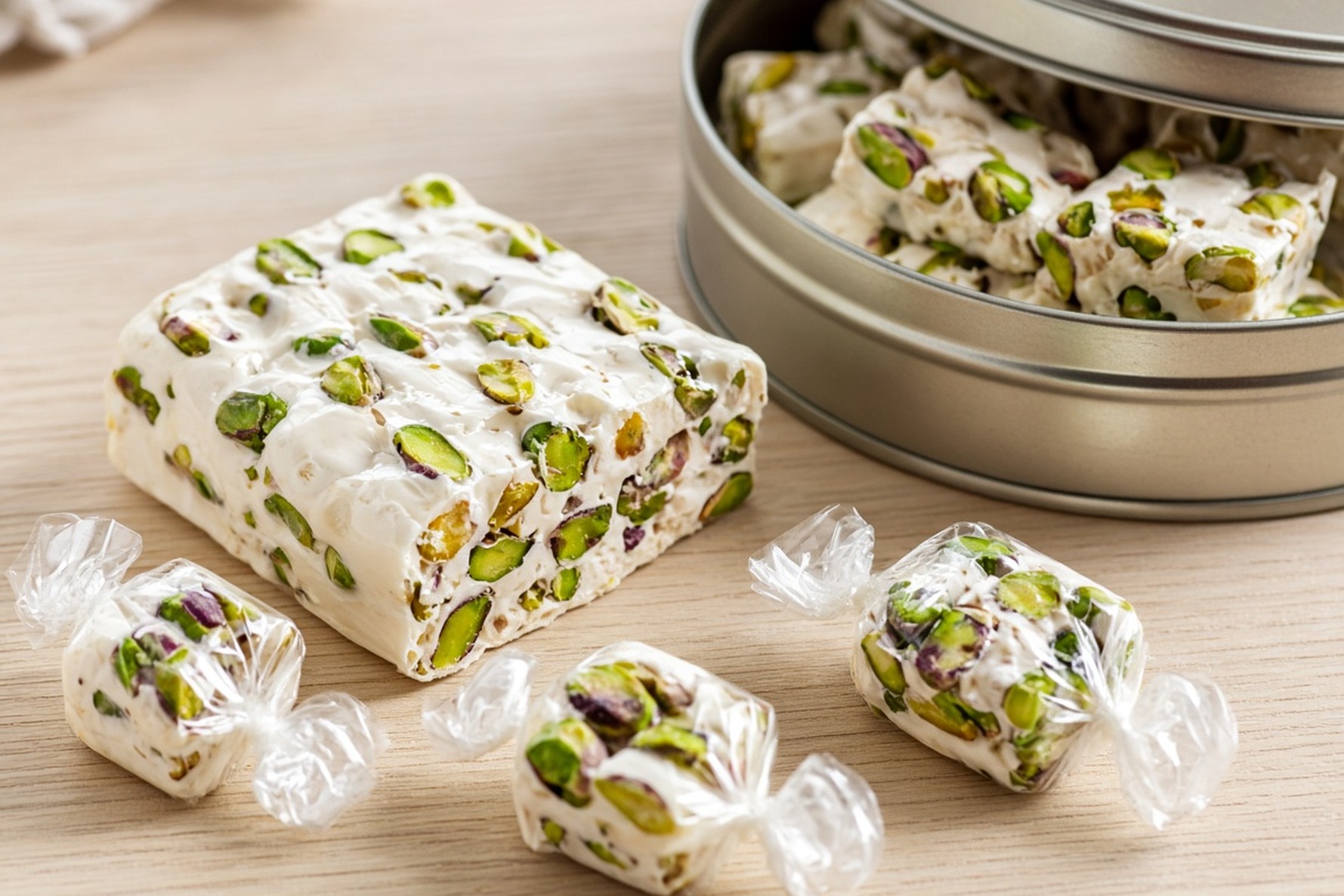
Bite-size gaz is recognized as the most standard export form. After pistachio kernels are added, the cooked paste mass is formed into continuous ribbons on extruders and cooling rollers, then cut with rotary cutters into typical dimensions of 3 × 4 cm or 2.5 × 3 cm. Each piece is individually wrapped in cellophane or metallized film and heat-sealed by pillow-pack. Dedicated wrapping of each piece prevents moisture ingress or egress and avoids direct hand contact or environmental contamination. Bite-size gaz retains the highest physical stability under vibration from long container journeys and is an ideal option for modern chain retail.
Flour-Dusted Type
The historical, classic form of gaz is the flour-dusted type. Round, square, or rectangular cut pieces are placed without nylon or polymer wrapping directly into cardboard boxes whose beds are lined with low-moisture white flour (refined wheat null flour). The flour prevents pieces from sticking and deforming and, by moderating surface moisture, gives a soft, crisp, authentic texture. The commercial challenge in the supply chain is the flour’s extreme sensitivity to heat and high humidity. If warehouse temperature exceeds 20 °C, the flour becomes a focus for stored-product pests and souring; exporting this form therefore requires a continuous cold chain.
Coin (Disc) Type
Coin gaz has essentially the same base formulation as bite-size gaz, distinguished by a thin circular cross-section 3 to 4 cm in diameter and roughly 6 to 8 mm thick. Because of the thin section, more pistachio kernel surface is visible to the consumer, and lower chew force creates little stickiness in the mouth. Coin gaz is typically arranged in transparent luxury packs or metal tins and holds a special place in formal hospitality and ceremonial occasions.
| Technical and Commercial Parameter | Wrapped Bite-Size Type | Traditional Flour-Dusted Type | Coin Type |
|---|---|---|---|
| Cross-section geometry | Regular rectangular prism | Round, circular, or square shapes | Thin circular disc |
| Individual packaging system | Heat-sealed cellophane or metallized wrap | Immersed in white null-flour bed | Single-serve cellophane or flat arrangement |
| Sensitivity to temperature swing | Moderate up to conventional warehouse temperatures | Very high (requires below 20 °C) | Moderate to high given thin section |
| Mechanical behavior in transit | Resistant to crushing and friction | Requires rigid boxes without vibration | Good resistance in dense packing |
| International distribution channel | Hypermarkets and general retail | Specialty nut and souvenir shops | Ceremonial and gift-item suppliers |
3. Technical and Economic Analysis of Pistachio Kernel Percentages: Economy to Premium
The weight ratio of pistachio kernel in gaz is the primary quality-grade separator and the most important driver of wholesale price volatility. Kernel percentage in factory formulation means grams of pure dry pistachio kernel per 100 g of finished product leaving the line. This indicator directly affects textural behavior, sweetness intensity, and mouthfeel.
Economy Grade (10% to 18% Pistachio Kernel)
In 10% to 18% gaz, most of the product volume is sweet foam base. Pistachio density per cut face is low, and each bite typically shows two to three kernel pieces. Because less pistachio is used, the base price is highly competitive and is a strategic choice for export markets with lower per-capita income, mass-distribution baskets, and border markets such as Afghanistan, Pakistan, and southern Iraqi cities.
Standard Commercial Grade (20% to 28% Pistachio Kernel)
Gaz containing 20% to 28% pistachio forms the backbone of domestic wholesale and regional export. At this ratio, a balanced equilibrium emerges between the fat and nutty flavor of pistachio and the elasticity and sweetness of the gaz base. Pistachio is distributed evenly throughout, and chewing delivers a desirable balance of kernel crunch and soft base. Twenty-eight percent gaz is the most requested option in organizational, trading-company, and chain-retail baskets.
Premium Export Grade (38% to 40% Pistachio Kernel)
Thirty-eight and forty percent pistachio gaz is a rich product with striking visual density. Green pistachio kernels dominate the structure, and the white gaz base acts mainly as a binding matrix among kernels. Texture is firmer, fracture is greater, and glucose sweetness is less prominent. This grade is the first choice for Gulf markets, Moscow, and specialty stores in Western Europe.
Custom Ultra-Premium Grade (42% Pistachio Kernel)
Forty-two percent is the technical and engineering ceiling for adding pistachio kernel to traditional gaz base without damaging structural continuity. Exceeding 42% (for example custom 45% gaz) leaves the paste short of binding matrix and causes shedding and disintegration during cutting and handling. Because more than two-thirds of its cost of goods is first-grade pistachio, 42% gaz ranks as a luxury product and is sold in wooden boxes, khatam work, or contemporary gift packs.
| Quality and Commercial Grade | Nominal Kernel % | Gaz Base Mass % | Visual Kernel Density | Market Stretch and Economic Profile |
|---|---|---|---|---|
| Economy gaz | 10% to 18% | 82% to 90% | Scattered kernels; base-dominant | High stretch at low prices; everyday consumption |
| Standard gaz | 20% to 28% | 72% to 80% | Uniform distribution across all sections | Highest-volume wholesale item; broad export |
| Premium export gaz | 38% to 40% | 60% to 62% | Dense kernels; compact texture | High margin; affluent markets and international hotels |
| Special ultra-premium gaz | 42% | 58% | Pistachio forms structure; minimal base | Corporate gifts; special institutional purchases |
4. Industrial Formulation, Ingredient Chemistry, and the Role of Base Compounds in Gaz Consistency
Industrial-scale gaz production rests on colloidal phenomena, osmotic-pressure control, and stabilization of protein foams. The base syrup—water, sucrose (beet or cane sugar), and liquid glucose (corn-starch hydrolysis syrup with dextrose equivalent 38 to 42)—is heated in double-jacketed steel or copper kettles until a defined Brix is reached. Simultaneously, pasteurized liquid egg white is whipped in high-speed mechanical beaters. During whipping, albumin and ovotransferrin proteins unfold and trap air molecules, forming thin foam films with high surface tension. Injecting this protein foam into hot syrup at 65 to 75 °C causes controlled protein denaturation and fixes the porous gaz structure. The next stage is prolonged beating (black-wood working) under uniform indirect heat, which may continue for several hours until bound water evaporates and gaz reaches target moisture.
Chemical Function of Liquid Glucose in Preventing Crystallization
Industrial liquid glucose contains a mixture of glucose, maltose, and oligosaccharides. These variable polymer chains prevent sucrose molecules from ordering into a crystalline lattice. Insufficient liquid glucose quickly leads to sugar-phase crystallization, grainy texture, and sugar bloom. Glucose also supplies the viscosity needed for gaz elasticity and, by moderating freezing point and water activity, supports microbial stability.
Natural Mannas and Their Biochemical Value
Although sugar and corn syrup are the usual ingredients of modern industrial gaz, authentic Iranian gaz is made with natural plant mannas that, beyond unique flavor, deliver marked technological benefits:
- Gazangabin: A sugary exudate secreted and dried on leaflets of gazangabin astragalus after puncture by a small psyllid insect. It consists mainly of mannitol sugar, sucrose, glucose, and polysaccharide gums. Gazangabin gives gaz an exceptionally soft, stable texture that does not dry over time and, by creating a cooling mouthfeel, offsets the warm nature of pistachio.
- Taranjabin: Dew-like insect exudates on camelthorn plants in desert regions. Taranjabin contains melezitose sugar, sucrose, and organic acids that impart a caramel-sweet taste and mild color to the gaz base.
- Natural honey and shir-khesht: Honey, with high fructose, is hygroscopic and helps prevent the gaz base from staling. Shir-khesht, owing to mannitol, contributes a fast-melting, soothing texture.
| Raw Material | Share in Base Formulation | Technological and Textural Role | Effect on Finished Product |
|---|---|---|---|
| Sucrose (crystal sugar) | 30% to 35% | Forms soluble solid phase and base sweet taste | Primary structure-former; energy source |
| Liquid glucose (corn syrup) | 35% to 45% | Crystallization inhibitor; viscosity control | Creates elasticity; softens sharp sweetness |
| Pasteurized egg white | 3% to 5% | Aeration agent; forms stable structural foam | Aerates texture; gives opaque white base color |
| Mannas and natural honey | 1% to 5% (specialty grades) | Natural hydrocolloid; texture-freshness stabilizer | Organoleptic differentiation; long-lasting softness |
| Botanical aromatic extracts | 1% to 3% (rose water, willow blossom, cardamom) | Natural fragrance; masks albumin odor | Sensory and aromatic signature of Iranian confectionery |
| First-grade roasted pistachio kernel | 10% to 42% of total gaz weight | Discontinuous oily phase; mechanical crunch | Nutty flavor; increases protein and healthy fat |
5. Technical Specifications Expected by Wholesale Buyers and Physicochemical Standards
In tender documents or technical annexes to gaz purchase contracts, wholesale buyers should require precise physicochemical indicators as numerical obligations. The table below is the technical reference for inspection and quality control before load delivery:
| Technical and Chemical Parameter | ISIRI 3023 Standard Range | Standard Test Method | Commercial Quality Importance |
|---|---|---|---|
| Total moisture of gaz base | 5.0 to 8.5 g% | Vacuum oven at 70 °C | Above 8.5%: stickiness and souring risk; below 5%: excessive hardness |
| Total sugar as sucrose | Minimum 58 g% | Lane–Eynon method after hydrolysis | Biochemical stability and standard caloric energy |
| Sucrose on dry-matter basis | Minimum 31 g% | Difference in sugar before and after hydrolysis | Flavor balance; avoids atypical use of low-grade glucose |
| Total ash | Maximum 1.0 g% | Electric furnace at 550 °C | Indicator of raw-material purity |
| Acid-insoluble ash | Maximum 0.05 g% | Dissolution in hydrochloric acid | Indicator of pistachio cleaning from sand and dust |
| Peroxide value of pistachio fat | Maximum 2 meq O₂/kg | Cold titration of fat extract | Indicates pistachio freshness and absence of lipid oxidation |
| Acid value of extracted fat | Maximum 1.5 mg KOH | Titration of free fatty acids | Controls triglyceride hydrolysis |
| Total acidity of gaz base | Maximum 0.2% as citric acid | Titration with 0.1 N NaOH | Assures base soundness and absence of microbial fermentation |
| Hardness and elasticity of texture | Elastic; no spontaneous deformation | Physical texture analysis | Gaz does not stick to wrap or teeth |
6. Laboratory Assessment, Microbiological Limits, and Aflatoxin Monitoring
Sanitary conformity of pistachio gaz is assessed around two critical factors: microbial purity of the egg-based matrix and toxicological soundness of the oil-rich pistachio kernel.
Monitoring Mycotoxins and Pistachio Aflatoxin
Pistachio kernel is the most sensitive gaz component under border clearance testing in the European Union, Japan, and Gulf ports. Aspergillus flavus and Aspergillus parasiticus can synthesize carcinogenic aflatoxins during orchard, harvest, or storage stages. Per Iranian National Standard No. 5925 and National Standard No. 218 for pistachio kernels:
- Maximum aflatoxin B1: 5 micrograms per kilogram (ppb).
- Maximum total aflatoxin: 15 micrograms per kilogram (ppb).
Many European importers demand stricter limits in the 4 to 10 µg/kg range for total aflatoxin; therefore high-performance liquid chromatography (HPLC) with post-column derivatization should be obtained for every pistachio consignment before mixing into the gaz kettle.
Microbiological Indicators for Confectionery Products (ISIRI 2395)
High osmotic pressure from high sugar Brix creates an unfavorable environment for vegetative bacteria. Even so, secondary contamination via workers, packing lines, or non-pasteurized egg white remains possible. The table below sets permitted limits for microscopic organisms:
| Organism Tested | ISIRI 2395 Limit | Reference Culture Medium | Consequence of Non-Conformity |
|---|---|---|---|
| Aerobic mesophilic plate count | Maximum 10⁴ CFU per gram | Plate count agar (PCA) at 30 °C | General quality loss and early base spoilage |
| Escherichia coli | Negative in 1 g of product | EC broth and lauryl sulfate | Fecal contamination; immediate rejection of export load |
| Enterobacteriaceae (coliforms) | Fewer than 10 CFU per gram | Violet red bile glucose agar (VRBG) | Hygiene defects on the processing line |
| Salmonella | Negative in 25 g of product | Pre-enrichment in buffered peptone and Rappaport | Food-poisoning risk and legal seizure of goods |
| Coagulase-positive Staphylococcus aureus | Negative in 1 g of product | Baird–Parker agar | Skin and respiratory contamination from personnel |
| Mold and yeast count | Maximum 10² CFU per gram | Dichloran glycerol 18 agar (DG18) | Sugar spoilage, pack swelling, and sour flavor |
7. Authenticity Checks, Structural Defects, and Lab Sample versus Commercial Load Divergence
Identifying quality, authentic gaz requires simultaneous assessment of physical, behavioral, and chemical traits. In wholesale trade, some suppliers use covert fraudulent practices to present unrealistically low prices.
Common Fraud Practices in Pistachio Gaz
- Understating kernel percentage: The producer labels 28% gaz but injects only 18% to 20% kernel in practice.
- Substituting weak pistachio or dyed almond slivers: Use of broken halves, immature closed-shell pistachio cracked by machine, or almond/peanut slivers colored with chlorophyll and pistachio essence. This fraud is revealed by fat extraction and fatty-acid profiling with gas chromatography.
- Using flour in the base instead of egg white: Adding wheat starch or flour to the cook for faster body and lower egg-white use, producing a sandy “mashiness” under the teeth.
- Unauthorized oils or stabilizers: Using hydrogenated trans fats to make the gaz base appear whiter.
Field Methods for Detecting Quality Decline
- Base color assessment (Maillard reaction): Sound gaz base should be bright ivory to pearly white. Dark cream or mild brown indicates unrefined industrial glucose, sugar scorching in a copper kettle, or excessive drying temperature.
- Pistachio fat oxidation taste test: Kernel in sound gaz should be crisp, evenly green, and free of bitter or stale taste. If chewing yields thinner, paint, or soap odors, the kernel is spoiled and peroxide value has exceeded the permitted range.
- Fracture and stickiness test: A bite-size piece at 20 °C should not deform or stretch. Under two-finger pressure it should compress somewhat and gently resist; excessive jelly-like softness indicates excess water (above 8.5%).
A major challenge for corporate buyers is receipt of hand-picked samples with high pistachio percentage and masterful cook, while in high-volume orders pistachio is mixed unevenly in the kettle and box contents swing widely. Prevention requires an explicit contract clause that delivery lots must conform under random inspection per international sampling frameworks.
| Quality and Structural Defect | Physical / Chemical Origin | Shelf Commercial Consequence | Contractual Control Measure |
|---|---|---|---|
| Chalky, grainy texture (sugar bloom) | Sucrose recrystallization from insufficient glucose | Sharp drop in end-buyer satisfaction | Require defined sucrose-to-reducing-sugar ratio |
| Gaz sticking to wrap | High base moisture or undercooked egg white | Wrap fails to open cleanly; appearance damaged | Weight penalty and rejection of loads above 8.5% moisture |
| Sharp, stale pistachio odor | Hydroperoxide reaction from aged pistachio | Bitter taste and digestive risk | Require kernel freshness analysis sheet from origin |
| Uneven pistachio distribution in the box | Inadequate mixing when pistachio enters the kettle | Buyer dissatisfaction with bite-to-bite variation | Require kernel tolerance with maximum 1% standard deviation |
| Softening and syrup weeping | Storage above 30 °C or moisture ingress | Geometric collapse and fat bloom on the surface | Use cold chain and refrigerated containers |
8. Export Market Analysis and Regional Preferences of International Buyers
United Arab Emirates and GCC Countries
The UAE (especially Dubai), Qatar, Kuwait, and the Sultanate of Oman are hubs for luxury, high-kernel gaz consumption. Arab populations in these countries, owing to gaz’s fit with Arabic-coffee hospitality traditions, are primary buyers of bite-size gaz at 38% to 42% pistachio. Packaging design is decisive: embossed metal tins with Iranian miniature motifs, khatam wooden boxes, and multi-layer hardboxes record the highest demand stretch. Entry requires full Arabic and English labeling including clear Gregorian production and expiry dates, customs data, and an approved Halal certificate.
Iraq and the Kurdistan Region
Iraq is the largest buyer by weight of Iranian export gaz and sohan. Purchasing patterns in central and southern cities such as Baghdad, Najaf, and Basra focus mainly on economy, low-price gaz at 10% to 18% kernel and traditional flour-dusted types. In Sulaymaniyah and Erbil, bite-size 28% gaz in gift packaging shows growing demand. Because of intense competition among Iranian producers at Parvizkhan, Mehran, and Shalamcheh borders, landed cost per master carton decides tender outcomes. Required documents include certificate of origin, health inspection certificates from international firms stationed at the border, and a commercial invoice stamped by the Chamber of Commerce.
European and North American Markets
Germany, Sweden, the Netherlands, the United Kingdom, and Canada are principal hosts of Iranian gaz consignments. Historically the main sales channel was Middle Eastern local supermarkets, but distributors increasingly place the product in organic stores and retail chains. European buyers value hygiene, clear ingredient lists, precise nutrition tables, and absence of synthetic colors or chemical preservatives over traditional appearance. Declaring allergens (such as egg and pistachio) on the box is a legal requirement. These markets prefer 28% to 40% bite-size gaz in airtight metallized wraps.
| Destination Country / Region | Preferred Kernel % | Best-Selling Packaging | Key Regulations and Clearance Documents |
|---|---|---|---|
| United Arab Emirates | 38% and 42% premium | Embossed metal tins and luxury hardboxes | Official Halal certificate; bilingual Arabic–English label |
| Iraq (central and southern) | 10% to 18% economy | Master cartons; plain 400 g cardboard packs | Border health certificate; transit manifest; Arabic invoice |
| Germany and the European Union | 28% and 40% with quality kernel | Pharma-grade hygienic cartons; inert-gas packaging | Aflatoxin test certificate; allergen table |
| Russian Federation | 20% to 28% mixed and pistachio | Impervious vacuum packs with Russian label | Eurasian conformity (EAC mark); Anzali–Astrakhan bill of lading |
9. Packaging Technology, Modified Atmosphere, and Cold-Chain Control
Gaz packaging functions as an engineered system to control water-vapor exchange and halt chemical spoilage reactions. More than 50% of pistachio kernel weight consists of triglycerides rich in oleic and linoleic acids. Oxygen trapped in traditional packs, together with sunlight, breaks double bonds in these fatty acids and forms free radicals, producing sharp odor and stale taste.
Modified Atmosphere Packaging (MAP) with Inert Gas
The most modern method for protecting export bite-size gaz quality is evacuating ambient gas and injecting inert nitrogen. On modern pillow-pack lines, before longitudinal and transverse film sealing, oxygen around the gaz is removed by suction and nitrogen of at least 99.8% purity is injected. Reducing oxygen concentration below 0.5% to 1% brings pistachio fat oxidation near zero and extends shelf life from 3 months to 9 to 12 months.
Selecting Barrier Polymer Films
- Two-layer metallized cellophanes (BOPP/Met-PET/PE): The metallized aluminum layer acts as a physical UV barrier and extends shelf life.
- Clear films with silicone or PVDC coating: Used where visual product display is required while maintaining high air impermeability.
Warehousing and Container Storage Conditions
- Optimal storage temperature: 12 to 18 °C with relative humidity below 50%. Above 25 °C the gaz base tends to weep syrup and soften; below 5 °C the texture hardens and becomes excessively brittle.
- Transit container ventilation: For overland and sea shipments to tropical regions, refrigerated containers with thermostats set to 15 °C should be used. Five-ply master cartons with high crush resistance prevent box deformation under stacking loads.
| Packaging Technique | Protective Film Layer Build | Shelf Life | Export-Chain Performance |
|---|---|---|---|
| Single-layer OPP cellophane with ambient air | Single clear layer 20 to 30 microns | 60 to 90 days under ordinary conditions | Suitable for local markets and rapid consumption |
| Nitrogen MAP | Three-layer metallized film 40 to 50 microns | 180 to 300 days without flavor loss | Ideal for sea and long-haul export |
| Flour-dusted gaz in laminated box with heat cellophane | Hygienic board with flour bed and shrink | 90 to 120 days conditional on below 18 °C | Requires continuous refrigerated container |
10. Cost-of-Goods Drivers, Pricing Structure, and Pistachio Price-Risk Management
Calculating the cost of pistachio gaz is tied directly to dried-nut market movements. Factory cost structures show that in high-kernel grades (such as 38% and 40%), more than 65% of total direct raw-material cost is attributable solely to the spot value of pistachio kernel.
- Pistachio kernel: Price depends on agricultural cultivar (Akbari, Ahmad Aghaei, Kaleh Ghouchi, Fandoghi), open-shell percentage, greenness, and kernel caliber. Double-skinned green kernel is the most expensive input and sharply raises cost of goods in luxury gaz.
- Base gaz matrix: Sugar, glucose, and egg-white costs swing more gently by season, but pasteurized industrial egg-white prices in winter affect the base directly.
- Flavorings and mannas: Using natural gazangabin and taranjabin can raise base formulation cost several-fold; manna gaz therefore sits in a special-margin product class.
- Packaging and wrap: Metal tins, hardboxes, and three-layer metallized films account for 8% to 18% of finished box cost.
- Energy and specialist wages: Traditional and semi-industrial beating requires skilled gaz masters, elevating overhead labor costs.
Pistachio price swings can leave either supplier or buyer at a loss. In long-term deals, floating price formulas or buying the full consignment’s pistachio at harvest (September–October) and holding it in refrigerated warehouses is the most reliable strategy for stabilizing gaz prices through the year.
| Cost-of-Goods Volatility Factor | Approximate Share of Final Cost | Wholesale Buyer Cost-Control Strategy |
|---|---|---|
| Spot pistachio kernel rate | 50% to 70% of total product cost | Lock wholesale purchase at harvest and set a price-review index |
| Purity grade and pistachio type used | 15% to 20% price swing | Specify clearly: whole kernel or sorted broken kernel |
| Natural manna instead of sugar | Base price uplift up to 300% | Reserve this formulation for ultra-luxury markets only |
| Box and film packaging materials | 8% to 15% of pack cost | Optimize box dimensions and buy master cartons in volume |
11. Importer and Wholesale Buyer Checklist before Firm Order Placement
Before paying deposit and concluding a final wholesale supply contract, the following supervisory and legal steps are mandatory to secure commercial success:
- Define exact physical form: formally record product type—bite-size, flour-dusted, or coin—with piece dimensions in purchase specifications.
- Fix nominal pistachio kernel percentage: explicitly state weight ratio in the contract (e.g. 10%, 18%, 28%, 40%) and allow a maximum one-percentage-point weight tolerance as technical error.
- Receive and seal a production-line sample: obtain a sample from the current factory line and retain a sealed portion as the commercial dispute reference.
- Lock ISIRI 3023 chemical requirements: written supplier commitment to moisture ceiling 8.5%, ash below 1%, and minimum total sugar 58%.
- Pistachio aflatoxin health certificate (COA): require a valid laboratory report confirming total aflatoxin below 15 µg/kg.
- Wrap technical specifications: define wrap material (e.g. two-layer metallized film), film thickness, and nitrogen injection on pillow-pack systems.
- Label design and destination language conformity: ensure ingredients, Gregorian production and expiry dates, calorie/nutrition table, and traceability barcodes appear in the destination language.
- Define delivery terms under Incoterms: clarify responsibility for temperature-stable transport and the place of goods inspection.
- Validate sanitary licenses: verify manufacturing health license authenticity with Iran’s Food and Drug Organization and system certificates such as food safety and Halal.
- Define visual defect tolerance: set percentage tolerance for deformation, wrap errors, or breakage in transit.
- Plan cook and loading timing: schedule so gaz is loaded within five to seven days of kettle production, maximizing useful life on arrival at destination port.
12. What Information Should Be Sent to Obtain an Accurate Price?
Incomplete inquiries create ambiguity in factory cost calculation and unreal price quotes. Institutional buyers should specify the following components on their price-request sheet:
- Structural gaz type: bite-size, traditional flour-dusted, or coin.
- Nominal pistachio kernel percentage: one of the commercial percentages (10%, 18%, 28%, 38%, 40%, or 42%).
- Grade and form of pistachio used: whole green kernel, slivers, broken open-shell kernel, or mixed.
- Base sweetener type: sugar and glucose syrup, or a formulation containing a share of gazangabin, taranjabin, or natural honey.
- Wrap covering each piece: ordinary clear cellophane or light- and heat-protective metallized wrap.
- Pack filling technology: inert nitrogen injection in the wrap or ambient-atmosphere packing.
- Net consumer-box weight: pack weights (e.g. 250, 400, 450, or 500 g) or bulk order in five-kilogram cartons.
- Master-box material and specs: light cardboard carton, hardbox, or embossed metal gift tin.
- Total order volume: gross or net consignment tonnage or number of master cartons.
- Destination country, port, and customs: for analyzing quarantine health documents and border inspection requirements.
- Labeling language rules: need for private-label packaging under the buyer’s brand or multilingual labeling on the origin brand.
Direct Supply of Pistachio Gaz from Iran with Iranco
International and wholesale purchase of pistachio gaz is more than comparing rial or dollar factory quotes. Authenticity of pistachio used, prevention of common texture frauds, precise adherence to nominal kernel percentages, and control of the aflatoxin and microbiology laboratory chain are the variables that shape importer profitability and trade continuity.
Iranco, as a specialist supply network for Iranian food-industry products, provides a structured bridge between distribution companies, international importers, and wholesale buyers and standard, established gaz producers in Isfahan and Boldaji. Through this mechanism, buyers can register expected attributes including kernel percentage, physical form, packaging structure, and laboratory requirements. Iranco organizes matching orders to real factory capacity, dispatch of sealed production-line samples for destination laboratory validation, oversight of chemical tests and health certificates, and coordination of refrigerated-container logistics.
13. Conclusion
Pistachio gaz is an unmatched union of traditional confectionery craft with the proteins and micronutrients of Iran’s oilseed kernels. Sustained success in wholesale trade of this product depends on a full grasp of the biochemistry of the aerated base, maintaining reducing-sugar balance to prevent sugar bloom, and continuous moisture monitoring in the 5% to 8.5% range under ISIRI 3023. Rigorous pistachio aflatoxin assessment, principled kernel-percentage selection by real purchasing power in the destination country, and modified-atmosphere packaging with nitrogen injection neutralize quality and commercial risks. Managing procurement through physicochemical conformity standards and direct-supply infrastructure will clear the path to stabilizing authentic Iranian gaz brands in international distribution networks.
Frequently Asked Questions
1. What are the main variables affecting wholesale pistachio gaz prices?
Wholesale gaz price is driven first by weight percentage of pistachio kernel in the formulation and the spot pistachio rate in the dried-nut market. Next come use of plant mannas instead of liquid glucose, packaging with inert-gas injection or metal/hardbox packs, and finally order volume as determinants of final cost of goods.
2. How long does pistachio gaz keep, and how is shelf life extended?
In ordinary packaging in a cool, dry environment (below 18 to 20 °C), gaz retains sensory quality for 2 to 4 months. With three-layer barrier metallized wraps plus nitrogen injection (MAP), pistachio oil oxidation is suppressed and standard shelf life rises to 9 to 12 months.
3. What is the essential difference between bite-size and flour-dusted gaz?
Bite-size gaz is sealed as separate pieces in polyethylene or metallized wraps by pillow-pack and has high physical resistance to moisture. Flour-dusted gaz has no nylon wrap and sits in a white wheat-flour bed so flour prevents sticking and crisps the texture; however it is highly vulnerable in transit, and ambient temperatures above 20 °C quickly sour the flour and degrade quality.
4. Which tests does ISIRI 3023 require for gaz?
Mandatory tests include total base moisture (5% to 8.5%), total sugar (minimum 58%), sucrose percentage (minimum 31%), total ash, and acid-insoluble ash. In addition, pistachio aflatoxin per ISIRI 5925 and Salmonella, coliform, and mold control per ISIRI 2395 must be performed.
5. How is actual pistachio kernel percentage in gaz measured?
A defined sample of gaz (usually 100 g) is weighed and placed in warm distilled water at 60 °C until the entire sugar and albumin base dissolves. Remaining pistachio kernels on a laboratory sieve are rinsed with warm water until sugar-free, then dried to constant weight in a 105 °C oven. Dividing dry kernel weight by initial sample weight yields the true pistachio percentage.
6. Which grade is recommended for Gulf export markets?
Affluent markets such as Dubai, Qatar, and Kuwait strongly prefer bite-size 38% and 42% pistachio gaz with willow-blossom or manna-scented base. Khatam metal packs, luxury gift cartons, and a recognized Halal mark with English and Arabic labeling are requirements of these markets.
7. What is the international HS tariff code for pistachio gaz?
The Harmonized System (HS) code for official export and clearance of Iranian gaz and sohan is subheading 17049010. For destinations that lack this national subheading, the general sugar confectionery without cocoa code 17049090 is used.
8. How can pistachio gaz be sourced from Iran without intermediaries and with quality assurance?
Buyers can register desired attributes such as pistachio percentage, packaging type, weight, and destination country as a wholesale purchase request on the Iranco platform so matching to production-line standards, sealed-sample coordination, laboratory oversight, and export formalities are organized directly.
Featured Products















Related Articles



