 Iranco Magazine Team
Technical specs, ISO 3632 lab standards, authenticity methods, export packaging and customs requirements in global markets
Export Guide · Negin Saffron · Quality Control
Iranian Negin Saffron: Quality Assessment and Selection Guide for Trade and Export
Expert analysis of technical specifications, ISO 3632 laboratory standards, authenticity methods, export packaging and customs requirements in international markets
This guide is a comprehensive resource for procurement managers, traders and international importers. Using laboratory indices, national and international standards, modern purity testing and export packaging criteria, it supports low-risk bulk evaluation and purchase of Iranian Negin saffron.
Analytical introduction
International saffron trade has undergone a fundamental shift in recent years. The product has moved beyond a traditional spice into a specialised segment serving modern pharmaceuticals, functional foods and premium cosmetics. In this commercial structure, colloquial trade names or unsupported quality claims are not a basis for professional buying decisions. True saffron grade is now measured through precise physicochemical testing in accredited laboratories against international standards. Among processed forms, Negin saffron stands at the centre of high-value export demand thanks to outstanding biochemical traits and the visual appeal of the stigmas.
Iran, with the unique climate of its eastern plains and a long history of saffron corm cultivation, is the world’s primary origin of this strategic spice. Despite that central supply role, wide variation in harvesting, separation and drying practices creates a broad quality spectrum under the shared Negin label. Importers, distributors and food-industry managers face serious challenges: mismatch between final shipment and approved sample, sophisticated adulteration and weight manipulation, plant-protection residues and moisture volatility.
Mastery of ISO 3632 and Iran National Standard 259, accurate reading of laboratory certificates of analysis, and understanding modified-atmosphere packaging requirements are essential for sustainable trade. This article offers a strategic framework for informed decisions on sourcing, quality assessment, commercial contracts and customs clearance for Iranian Negin saffron.
1. Production geography, crop climate and market position of Iranian Negin saffron
Intrinsic saffron quality is directly linked to geographic origin. The main source of Iran’s finest saffron is the country’s eastern semi-arid belt, including Razavi Khorasan and South Khorasan provinces. Areas such as Torbat-e Heydarieh, Zaveh, Qaenat, Gonabad, Birjand and Ferdows have sandy-loam soils with excellent permeability. The defining climate pattern is cold winters, mild springs and intensely hot, dry summers—a cycle that limits fungal disease in corms and supports plant metabolism through summer dormancy and autumn awakening.
Sharp day–night temperature swings in early autumn are a key driver of higher concentrations of active compounds, especially crocin and picrocrocin, in the stigmas. Harvest in these regions begins in late September and runs through early December at the latest. Premium Negin production depends on precise harvest timing: flowers must be picked before sunrise while petals are still closed so ultraviolet radiation and heat do not degrade stigma biochemistry. Transfer to processing workshops within 24 hours and skilled stigma separation are foundational steps toward intact, uniform stigmas free of style material.
In international trade terms, roughly 200 to 250 tonnes of saffron are exported annually through Iranian customs; in Iranian calendar year 1403, volume exceeded 214 tonnes with a value of more than USD 184 million. Trade-flow analysis nonetheless reveals a deep gap between actual and potential markets: much production ships in bulk and large packs to countries such as the United Arab Emirates and Spain. These hubs re-check, further process and repackage Iranian saffron under local brands, then redistribute to premium consumer markets such as Germany, the United States and the United Kingdom at multiples of the original margin. International buyers shifting toward direct contact with Iranian processing networks can remove intermediaries, lower landed cost and access fresher, fully traceable lots.
2. Commercial taxonomy and morphology: Negin and Super Negin versus other grades
Understanding stigma anatomy and separation method is the foundation of commercial valuation. The saffron flower has a white to yellowish style at its base, from which three ruby-red stigma threads branch. In international trade, processed forms are classified by stigma length, attached style ratio, physical integrity and drying method.
Standard Negin saffron (Negin)
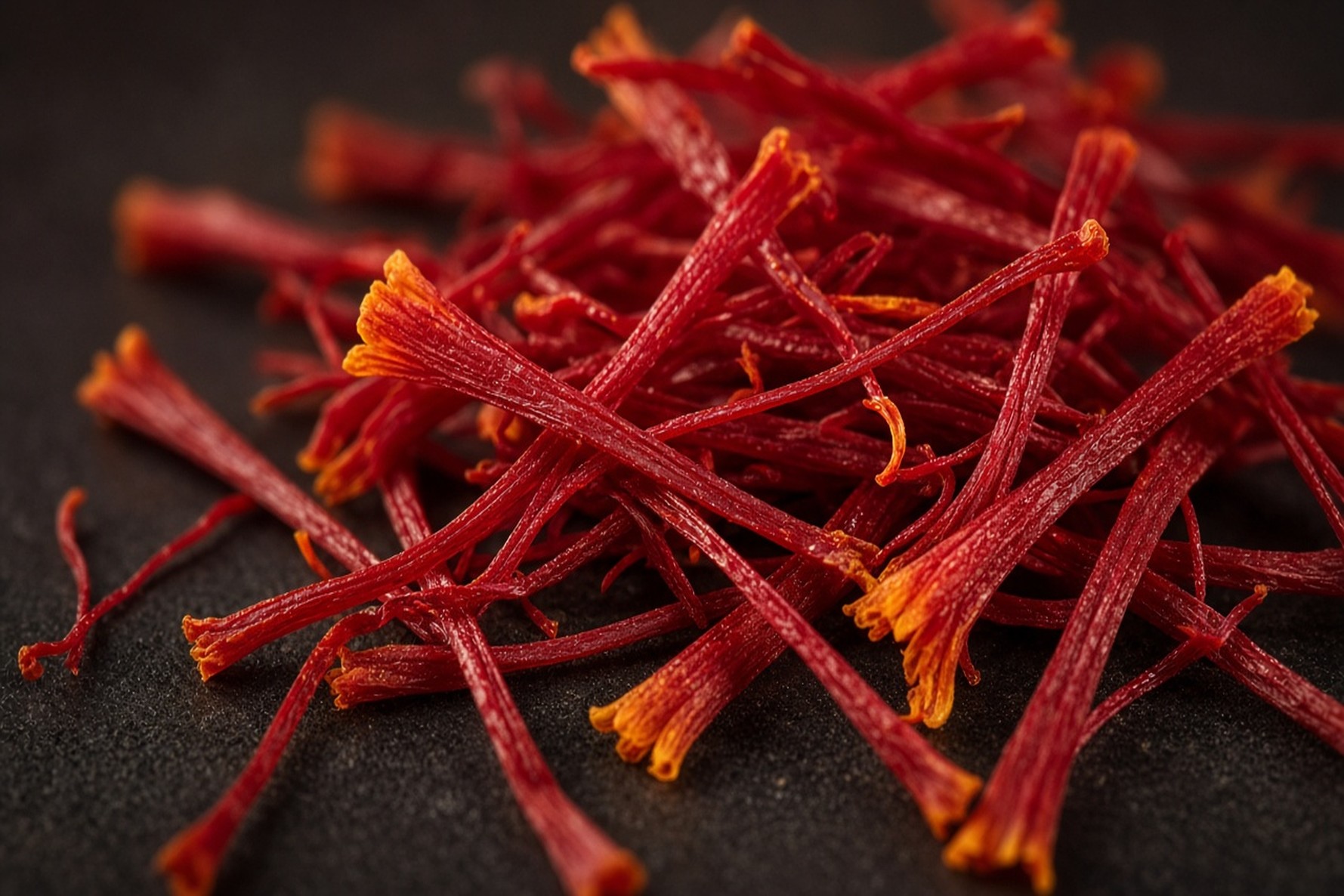
In this type, all three stigma branches are cut flush at the junction with the white style so no yellow or white appears in the product. Threads are intact, uniformly red and show natural curl from traditional or semi-industrial drying. This grade is the primary choice of packaging companies for first-tier products in European and Gulf markets.
Super Negin saffron (Super Negin)
Super Negin represents the highest level of processing engineering in the saffron industry. Stigmas come from fresh, high-moisture flowers and are processed in mechanised dryers with controlled airflow. The result is thick, elongated, smooth, ironed stigmas without creasing, breakage or deformation. Large, uniform Super Negin stigmas command the strongest commercial pull in China’s luxury segment and Gulf states.
Sargol, Poushal and Bunch grades
- Sargol: Fully red threads without yellow portions, but shorter than Negin and with a high share of broken threads and fines; suited to food and industrial confectionery.
- Poushal (Pushal): Red stigmas with 1 to 3 mm of yellow style attached; high apparent volume and lower colouring strength for dairy and blended spice applications.
- Bunch / Dokhtar-pich (Dasteh): Full thread with long style, twisted with string; sometimes more than 30% of weight is style, with the lowest colouring power.
| Saffron type | Style content | Physical traits | Crocin | Primary use |
|---|---|---|---|---|
| Super Negin | Zero | Smooth, ironed, thick | 260 to 280+ | Luxury packaging, perfumery |
| Export Negin | Zero | Elongated with slight curve | 240 to 260 | Premium retail in Europe and Asia |
| Premium Sargol | Under 1% | Short with minor breakage | 220 to 240 | Food formulation and tea bags |
| Export Poushal | 1 to 3 mm | Style attached, high bulk | 200 to 220 | Dairy, beverages, blended spices |
| Bunch (Dokhtar-pich) | 30 to 45% by weight | Thread-wrapped bundle | 160 to 190 | Traditional and household use |
3. Biochemical basis, laboratory indices, ISO 3632 and National Standard 259
Commercial value of Negin saffron rests on three secondary metabolites that define sensory and therapeutic properties. Grading requires precise instrumental analysis under international standard ISO 3632 in two parts (ISO 3632-1 for specifications and ISO 3632-2 for test methods), together with Iran National Standard 259.
Colouring strength from crocin (Crocin)
Crocins are water-soluble di-ester glycosides in the carotenoid family that produce a clear golden-yellow hue in aqueous media. Crocin is measured by UV-visible spectrophotometry at 440 nm on a 1% solution in a 1 cm quartz cell. ISO 3632 sets a floor of 200 absorbance units for the highest class, Category I. In premium Iranian Negin, values typically fall between 240 and 270; in fresh, ironed Super Negin they can exceed 280. Higher crocin reduces the dose needed downstream to achieve the same colour intensity.
Taste index from picrocrocin (Picrocrocin)
Picrocrocin is a bitter, colourless crystalline glucoside that creates pure saffron’s distinctive aroma and bitterness. Laboratory measurement uses 257 nm. ISO 3632 requires a minimum of 70 for the premium class; Iran Standard 259 requires at least 85 for Grade 1 saffron. Unusually low values suggest aged stock, excessive heat treatment or dilution with low-value plant matter.
Aroma index from safranal (Safranal)
Safranal comprises most of saffron’s volatile and essential-oil fraction. It is measured at 330 nm. ISO 3632 defines a bilateral range of 20 to 50. Unlike crocin, values above 50 do not indicate quality; they show improper storage temperature, severe ageing, or hydrolysis of picrocrocin into safranal through heat and time.
Moisture and volatile matter
Free water in stigma tissue is a key spoilage driver. ISO 3632 allows up to 12% moisture; Standard 259 caps it at 10%. For export Negin, lots above 8% moisture carry storage risk and weight-fraud exposure. The optimal range for long shelf life and preserved brittleness and potency is 6 to 8%.
| Parameter | Test method | ISO 3632 Category I | Standard 259 Grade 1 | Optimal Negin range |
|---|---|---|---|---|
| Crocin (colouring strength) | Spectroscopy 440 nm | Min. 200 | Min. 220 | 240 to 280+ |
| Picrocrocin (taste) | Spectroscopy 257 nm | Min. 70 | Min. 85 | 85 to 110 |
| Safranal (aroma) | Spectroscopy 330 nm | 20 to 50 | 20 to 50 | 25 to 45 |
| Moisture & volatile matter | Oven 103°C | Max. 12% | Max. 10% | 6 to 8% |
| Total ash | Calcination 550°C | Max. 8% | Max. 8% | Under 6.5% |
| Acid-insoluble ash | Reaction with HCl | Max. 1% | Max. 1% | Under 0.5% |
| Extraneous plant matter | Physical inspection | Max. 2% | Max. 2% | Under 0.2% |
4. Comprehensive COA review, microbiological testing and MRL screening
The certificate of analysis (COA) is the cornerstone of international saffron transactions. Trade managers and quality officers use it to predict product safety, authenticity and market access. Issuance by an ISO 17025-accredited laboratory is the first condition of document validity.
Sample identity comes first: the COA must align batch number, exact lot weight, packaging type, harvest date and consignee with the packing list and shipping documents. Next, spectroscopic indices are interpreted. Although UV-visible spectrophotometry is the core ISO 3632 test, highly sensitive or large-tonnage purchases may require high-performance liquid chromatography (HPLC) to verify trans- and cis-crocin isomers and rule out synthetic dyes.
Microbiological limits are the next validation step. Typical acceptance criteria at European and advanced-market entry points include:
- Total viable count: fewer than 105 CFU per gram
- Mould and yeast: fewer than 103 CFU per gram
- Enterobacteriaceae: fewer than 102 per gram
- Escherichia coli: absent in 1 g
- Salmonella spp.: absent in 25 g
Aflatoxin B1 must not exceed 5 µg/kg (ppb) and total aflatoxins must not exceed 10 µg/kg. The limit for ochratoxin A is 15 µg/kg. In the European Union, maximum residue limits (MRLs) for pesticides follow the default 0.01 mg/kg unless a specific limit is registered. Buyers should obtain multi-residue pesticide screening by LC-MS/MS and GC-MS/MS from international laboratories.
5. Commercial fraud in the saffron market and Negin authenticity testing
Because of its high unit value, saffron is among the most economically adulterated products. Negin’s structural advantage—intact stigmas without white style—makes fraud harder than with cut, Sargol or powdered forms. Bulk trade nonetheless sees many schemes to mislead buyers.
Weight inflation and moisture absorbents
Bad actors spray stigmas with glycerin, invert sugars, brine, honey or animal or mineral oils, raising lot weight by 5 to 15% with little visible change. Pressing several threads between blotting paper leaves a greasy transparent stain if oil or glycerin is present. Elevated total ash and acid-insoluble ash also reveal salt or sugar addition.
Synthetic dyes and saffron-like fibres
Stigmas may be treated with industrial dyes such as tartrazine (E102), sunset yellow (E110), Ponceau 4R (E124) or banned Sudan Red. Authentic threads release a light golden colour slowly over 10 to 15 minutes; adulterated material often turns water dark red or orange immediately and bleaches within minutes. Mixtures with marigold petals, dyed corn silk or calendula are detectable under a stereo microscope: saffron stigmas are tubular, hollow, trumpet-shaped at the tip with serrated edges.
| Fraud type | Visual and sensory signs | Laboratory test |
|---|---|---|
| Weighting with sugar and salt | Sweet or salty taste, stickiness | Total ash above 8% |
| Fat-based weight gain | Unusual sheen, grease on paper | Soxhlet fat extraction |
| Chemical dyeing | Instant colour release in cold water | TLC and HPLC |
| Plant fibre admixture | Absence of trumpet-shaped stigma | Microscopy |
| Ageing and reconditioning | Caramelised odour, dull colour | Low crocin vs high safranal |
6. Major export markets and regional buyer preferences
Saffron demand patterns differ worldwide. Knowing each market’s requirements minimises commercial risk and clarifies supply strategy.
- Spain: Largest importer and re-packer; buys bulk Negin in 0.5 to 1 kg packs with moisture under 7% and pesticide-free certification.
- UAE (Dubai): Redistribution hub; highest prices for ironed Super Negin in crystal and embossed metal retail packs.
- China: Pharmaceutical and functional-food use; very large stigmas, 100% red, crocin above 260; strict GACC inspection.
- Western Europe (Germany, Italy, France): Nutraceuticals and premium food; high MRL sensitivity, transparent supply chains and biodegradable or violet-glass packaging.
| Country | Chain role | Preferred grade | Priority index | Dominant packaging |
|---|---|---|---|---|
| Spain | Re-export and reprocessing | Negin and Sargol | ISO-aligned COA and price | Bulk 500 g to 2 kg |
| UAE | Transit hub and luxury consumption | Ironed Super Negin | Smooth stigmas, minimal fines | Metal and crystal containers |
| China | Pharma and functional foods | Large Super Negin | Crocin >260 and absolute purity | Vacuum under inert gas |
| Germany | Industrial extraction and pharma | Negin with stable potency | Pesticide residues below EU MRL | Food-grade aluminium tins |
| India | Ritual, confectionery and pharma use | Negin and Sargol | Fast colour release in milk | Metal packs 1 to 10 g |
7. Customs rules, HS codes and clearance documentation
Saffron is classified in Chapter 9 of the Harmonized System under heading 09102000. National customs subheadings include:
- 09102010: Filament saffron not crushed, retail pack under 10 g
- 09102020: Saffron powder, retail pack under 10 g
- 09102030: Filament saffron not crushed, pack 10 to 30 g
- 09102040: Saffron powder, pack 10 to 30 g
- 09102090: Other packings; base code for bulk wholesale and lots over 30 g
For smooth clearance, the shipment file should include a phytosanitary certificate, quality COA, certificate of origin, commercial invoice and packing list, valid air waybill and, where required, halal certification.
8. Export packaging engineering and stabilisation of bioactive compounds
Active compounds degrade quickly; at room temperature and poor conditions, crocin can lose more than 50% of colouring power within months from light and oxygen. Main drivers are radiation, oxygen ingress and relative humidity swings; dry stigma tissue is highly hygroscopic.
For 1 to 5 kg lots, modified atmosphere packaging (MAP) is best practice: triple-laminate pouches (aluminium foil / polyester / polyethylene), air evacuation, 99.9% nitrogen flush and heat sealing, then placement in tin-plated metal cans. For retail, common formats include polycrystal jars with matte cardboard sleeves, amber or biophotonic violet glass, and embossed metal tins (khatam-style).
| Structure type | Weight range | Light protection | Primary use |
|---|---|---|---|
| Food-grade metal tin + nitrogen | 500 to 1000 g | 100% barrier | B2B export bulk |
| Vacuum aluminium foil pouch | 1 to 5 kg | 100% barrier | Pharma and extraction |
| Polycrystal with cardboard sleeve | 0.5 to 10 g | Depends on outer box | Gulf retail |
| Sealed amber glass | 1 to 5 g | Excellent UV block | Pharmacy and European retail |
9. International air logistics: supply-chain control and risk management
Saffron’s very high value relative to volume sets it apart from other agricultural goods. Sea freight’s long transit (20 to 60 days) and variable humidity create severe quality-loss risk. Commercial saffron moves almost exclusively by air cargo.
- Transit timing: On direct routes, total time from origin customs handover to destination clearance should not exceed 3 to 5 days.
- Cabin climate: 15 to 20°C and relative humidity under 50%; reflective thermal covers on the ramp.
- Physical security: Tamper-evident tape and double strapping; weight recorded to 0.01 kg precision.
- Insurance: Institute Cargo Clauses (A) covering theft, loss, fire and physical damage.
Under Incoterms, FOB Imam Khomeini Airport or CIP at the buyer’s airport are most common. For importers who prefer not to manage Iranian air-side formalities, CIP is often the safest option.
10. Pricing dynamics, cost drivers and competitor analysis
Bulk Negin pricing is multidimensional, driven by quality indices, supply cycles and market elasticity. Factors include harvest season and crop year (first-flush stigmas carry a 10 to 15% premium), COA physicochemical grade, physical form (ironed Super Negin commands the top), and lot moisture. A 2% moisture difference on one tonne equals 20 kg of lost dry plant matter.
| Country | Competitive advantage | Crocin | Price level |
|---|---|---|---|
| Iran | Volume leader (>85% global), grade diversity | 240 to 280+ | Global price benchmark |
| Spain | La Mancha branding, EU membership | EU-stabilised profile | Very high (added value) |
| Afghanistan | Herat-like climate, niche market access | 220 to 260 | At or slightly below Iran |
| India (Kashmir) | Kashmir geographical indication | Excellent when authentic | Up to 2× Iran |
| Greece | Kozani cooperatives, EU support | Solid EU profile | High in European market |
11. Industrial applications and Negin derivatives in advanced sectors
Negin saffron’s highest active load, lowest woody style and fibre residue, and strong solubility make it a key raw material in three advanced sectors:
- Pharmaceuticals and nutraceuticals: Antidepressant research, macular-protection (AMD) products, nootropic supplements; requires low microbial load and HPLC verification.
- Premium food: Stable crocin colour in botanical drinks, blended teas, luxury confectionery and functional dairy.
- Cosmetics and cosmeceuticals: Tyrosinase inhibition in brightening serums and organic anti-ageing creams.
12. Importer checklist and RFQ drafting guide
A precise request for quotation (RFQ) is the basis of an unambiguous supplier agreement. Pre-order checklist for importers:
- Define physical type and grade (ironed Super Negin, premium export Negin) and allowable breakage threshold
- Require ISO 3632 Category I and National Standard 259 compliance
- Set minimum crocin (240 or 260), minimum picrocrocin (85) and safranal range (20 to 50)
- Cap moisture (max. 8%) and require pesticide screening to destination MRL
- Obtain microbiological tests and a sealed reference sample of 25 to 50 g
- Specify packaging, crop year, approved air routes and ICC (A) insurance
- Include dispute resolution, pre-shipment inspection and penalty for sample–shipment mismatch
For a professional quote, buyers should state grade, minimum crocin, harvest year, packaging type and weight, order volume, destination airport, Incoterms and any supplemental tests. Export buyers can submit these details as an RFQ through Iranco.
13. Direct Negin supply from Iranian producers through Iranco
The gap between two price offers in saffron trade is never only the invoice total. Lot uniformity, absence of broken stigmas, no weight manipulation, stable colouring and full alignment of shipped goods with the original laboratory sample define a brand’s commercial future. Direct access to farm networks and mechanised workshops in hubs such as Qaenat and Torbat-e Heydarieh without technical and logistics know-how carries high risk for importers.
Iranco is a specialised platform connecting bulk buyers, processing plants and international importers with leading Iranian Negin producers and packers. Through this channel, buyers submit technical criteria—stigma grade, biochemical potency, packaging format and quarantine rules—for transparent, traceable evaluation and supply.
Submit a purchase request on Iranco14. Conclusion
Iranian Negin saffron is a flagship processed stigma grade in the global spice trade, and its transaction value is measured directly against laboratory compliance. In specialised food and pharma commerce, sourcing decisions rest on three simultaneous factors: documentary verification under ISO 3632, close inspection of stigma geometry and physical integrity to ensure freedom from breakage and style, and customs files aligned with destination sanitary rules and pesticide MRLs. Combining modern ironed processing with robust inert-gas packaging and fast air logistics supports reliable delivery to end markets. Success for traders and buyer industries depends on moving beyond unsupported traditional deals toward scientific, data-driven, documented sourcing end to end.
15. Frequently asked questions
1. What is the fundamental difference between Negin and Super Negin saffron?
Negin stigmas are fully red and free of yellow style, but may show slight curvature and creasing. Super Negin is processed in mechanised dryers, yielding straight, ironed, broad, voluminous stigmas with the highest crocin (above 260) and strongest visual presentation.
2. Which COA indices confirm a premium Negin lot?
For premium Negin, crocin at 440 nm should exceed 240. Picrocrocin at 257 nm should be above 85, safranal should sit between 20 and 50, and total moisture should be recorded below 8%.
3. Can adulterated saffron show artificially high colouring strength?
Yes. Industrial dyes such as tartrazine or Sudan Red can falsely inflate spectrophotometer absorbance. Definitive detection requires HPLC or TLC.
4. What is the commercial shelf life of Negin saffron and how is it preserved?
Negin retains standard quality for up to two years after harvest when stored in light- and oxygen-barrier packs with nitrogen flush, below 20°C and under 50% relative humidity.
5. What drives price differences between suppliers?
Daily pricing reflects crocin grade, stigma size and drying method, crop year, moisture and packaging. Buyers can submit technical specs and volume on Iranco for comparable, market-aligned quotes.
6. Why is saffron not shipped by sea internationally?
High unit value, degradation of actives from prolonged heat and humidity in containers, and the need for fast capital turnover mean commercial lots move by air within 3 to 5 days.
7. How can importers source guaranteed-authentic Negin from Iran?
Professional buyers condition payment on accredited COAs, pre-shipment sealed reference samples and contracts tied to ISO 3632 criteria. These steps can be coordinated with production options through a purchase request on Iranco.
8. What is the typical MOQ for bulk Negin purchases?
In bulk metal packaging, minimum orders are usually 5 to 10 kg so phytosanitary certification, pesticide testing and airport handling costs are economically justified. For retail packs, MOQ is calculated by unit count.
Featured Products




Related Articles



