 Iranco Magazine Team
Quality structure, authentic provincial varieties, physicochemical standards, modified-atmosphere packaging and international customs requirements
Export Guide · Traditional Iranian Baklava · Quality & Packaging
Iranian Baklava: Regional Types, Wholesale Buying and Export Guide
Quality structure, authentic provincial varieties, physicochemical standards, modified-atmosphere packaging technology and international trade customs requirements — published in the Iranco magazine.
| Key indicator | Value or technical specification | Supplementary notes |
|---|---|---|
| International tariff code (HS Code) | 190590 / 170490 | 190590 for baked confectionery with a prominent dough base; 170490 for dense nut-heavy baklava with a dominant syrup share |
| Moisture and water activity | Moisture 9–14%; Aw below 0.64 | Per national standard 19696; microbial growth control without chemical preservatives |
| Shelf life with MAP | From 30 days to more than 180 days | Subject to residual oxygen below 0.5% and controlled-temperature storage |
| Optimal temperature conditions | 15–18°C or freezing at −18 to −24°C | Preserves nut-fat stability, syrup viscosity and dough-layer crispness in transit |
This comprehensive guide is written for traders, importers and food-industry procurement managers who need to manage wholesale and export risk in baklava through precise laboratory indicators, formulation specifications across Iran’s regions and modern packaging rules. After reading this report, business operators can structure commercial contracts on transparent technical criteria and deliver a stable product to global markets.
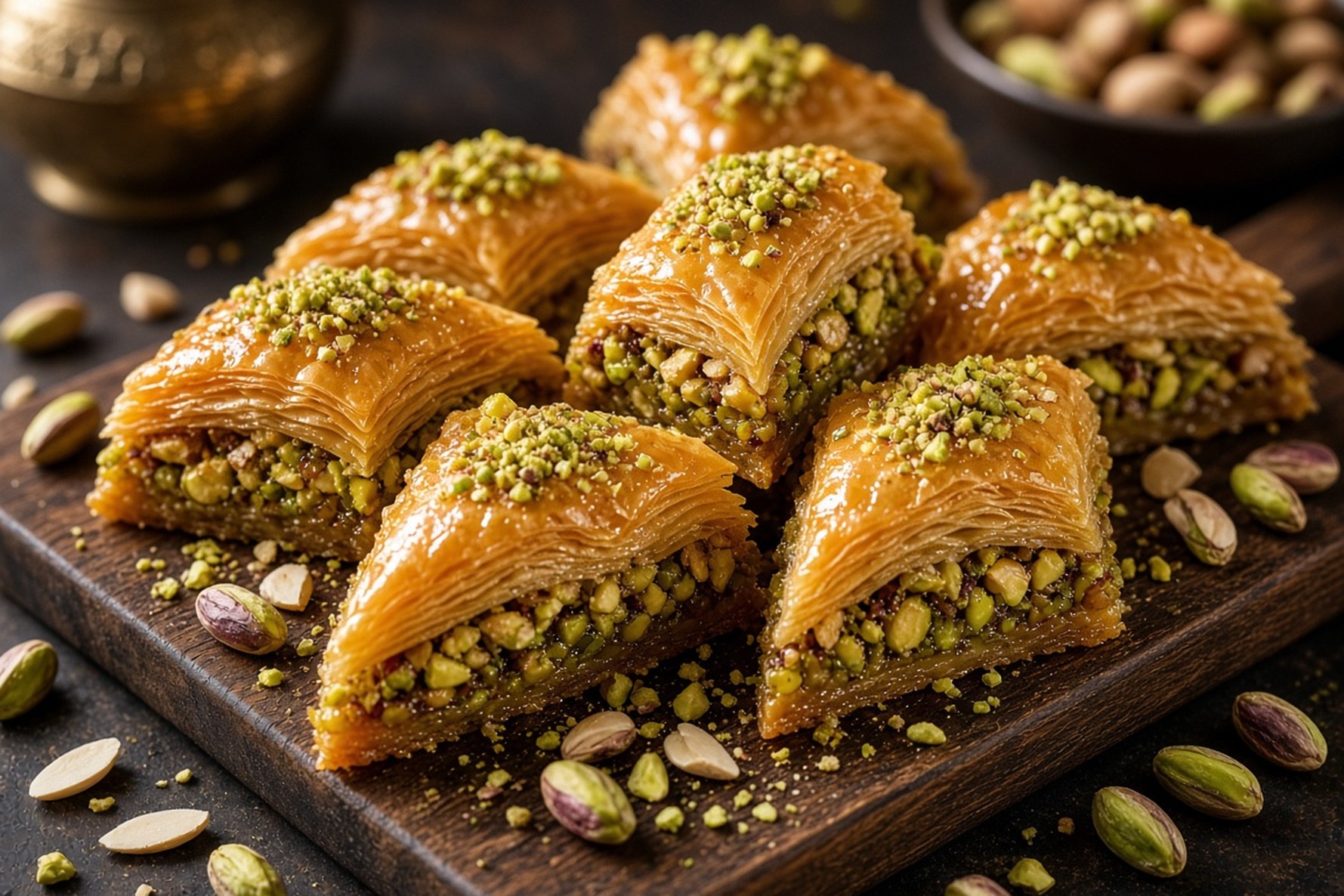
Iranian baklava is among the most authentic traditional confectionery products in the Middle East. Its fundamental differentiation lies in a high volume of premium tree nuts, pure animal fat, natural saffron extract and botanical distillates such as rosewater and cardamom. Unlike common Eastern Mediterranean baklava, where much of the product weight comes from many layers of starch dough and thin sugar syrup, Iran’s confectionery tradition emphasises compacted, graded nut powders. In the most prominent Iranian baklava types, pistachio and slivered almond can exceed half of total product weight.
Despite this quality potential, successful entry into target markets depends on solving shelf-life challenges, controlling oxidation of nut lipids and managing syrup body. On international hauls, wholesale buyers face issues such as texture staling, surface sugar crystallisation from sucrose recrystallisation, spoilage from lipid hydrolysis and regulatory limits on pesticide residues and aflatoxin. Overcoming these barriers requires a shift from traditional workshops without quality control toward plants equipped with industrial monitoring, modified-atmosphere packaging lines and cold-chain management.
1. Regional Trade Position of Iranian Baklava and Formulation Chemistry
Developing baklava exports requires a deep understanding of rheological behaviour and chemical balance among its components. From a food-engineering perspective, baklava is a heterogeneous multiphase system: a structural solid phase (thin wheat-flour dough layers and oily nut particles) and a supersaturated liquid syrup phase (sucrose, invert sugar and aqueous aromatic extracts). How free water in the syrup interacts with unsaturated fats in pistachio and almond determines shelf life and mouthfeel.
Unlike moist sweets, traditional Iranian baklava is a medium-to-low-moisture product. Low water activity (Aw) slows rapid bacterial spoilage but creates acute sensitivity to moisture migration between layers. When syrup cannot penetrate nut-powder pores uniformly, or osmotic balance between the outer lavash dough and the middle texture breaks down, the outer dough sheet absorbs syrup moisture and loses its initial crispness — a confectionery phenomenon known as “sogging” or texture staling.
In premium Iranian formulation, invert sugar plays a strategic stabilising role. Controlled sucrose hydrolysis to glucose and fructose raises total soluble solids in the aqueous phase and increases syrup Brix without forming large sugar crystals. Pure butter or animal fat, by forming a microscopic hydrophobic layer on flour particles, slows moisture exchange and reinforces dough crispness under temperature fluctuation. From a market standpoint, Iranian baklava can capture a significant share of luxury gift confectionery (Gift Confectionery) provided industrial production and modern packaging preserve organoleptic qualities through sea and land transfer.
2. Comprehensive Atlas of Iran’s Regional Baklava Types and Textural Traits
Climate diversity and access to indigenous raw materials across Iran have shaped distinct baklava schools. Each region combines local resources into a textural style and sensory profile compared in the table below.
| Regional style | Middle nut composition | Dough-layer characteristics | Syrup body and composition | Texture and appearance |
|---|---|---|---|---|
| Traditional Yazd lozenge baklava | Premium almond powder, pistachio, fatty coconut powder | Two extremely thin, dense lavash bread sheets | Thick, high-Brix invert syrup, ground green cardamom | Firm, dense, semi-dry; regular lozenge cuts without dripping syrup |
| Qazvin three-colour (flag) baklava | Premium green pistachio, blanched white almond powder | Egg-yolk and milk dough under 0.5 mm thick | Mild saffron syrup, pure rosewater and fine cardamom | Distinct three layers (green, white, yellow); brittle, compact powdery texture |
| Tabriz nut-style baklava | Light blanched walnut kernels, coarsely chopped pistachio | Multiple filo sheets brushed with animal butter | More fluid sucrose and lemon-juice syrup, mild sweetness | Very crisp, flaky, voluminous, aerated with separate sheet layers |
| Kashan five-nut baklava | Pistachio, almond, walnut, hazelnut and diced cashew | Thicker traditional dough, fully baked crisp under oven heat | Thick aged syrup with authentic double-distilled Qamsar rosewater | Large, chewy, full of bite-sized nut pieces; intense rosewater aroma |
| Gilan jasmine baklava | Almond powder steeped in jasmine flower petals | Very delicate, low-fat dough sheet, white bake | Light, clear syrup without saffron colour or pungent spice | Soft, buttery, very pale with a natural floral scent |
Yazd lozenge baklava
Yazd baklava reflects sweet structure adapted to central Iran’s hot, dry climate. Free moisture is minimised and the finished product resembles very dense nut cakes. The top and bottom dough layers — locally called “baklava lavash” — are extremely thin; more than 70% of each piece is compacted almond powder, cardamom and powdered sugar. Syrup Brix above 75 prevents surface wash-off and allows stacking in metal tins without leakage. This physical stability makes Yazd baklava one of the most resilient options for road haulage and standard bulk export.
Qazvin three-colour baklava
Qazvin baklava, also known as lozenge or flag baklava, symbolises refinement in traditional confectionery. National standard 19696 defines premium Qazvin baklava as requiring at least 54% nut powder in the middle section. Layering comprises green Qazvin pistachio powder, white almond powder and saffron-tinted almond. Cuts are made with very sharp angled blades into uniform lozenges.
Tabriz nut-style baklava
Tabriz confectionery, influenced by historic trade links with the Caucasus and Ottoman regions, developed filo formulations. Unlike Yazd and Qazvin, where nut powder is enclosed in bread dough, Tabriz baklava stacks dozens of very thin yufka sheets with proportional melted animal butter between them. Chopped walnut or pistachio sits among layers; after baking, a low-viscosity mild syrup is poured over. Texture is extremely crisp and fragile, but shelf life is shorter than dry Yazd styles.
Kashan five-nut baklava
Kashan, with almond and walnut orchards and traditional rosewater distilling, produces a distinctive nut-heavy baklava. Nuts are not fully powdered but cut to 2–4 mm pieces. Pistachio, almond, walnut, hazelnut and cashew with concentrated double-distilled rosewater yield a chewy texture and powerful aroma.
Gilan jasmine baklava
On Iran’s northern coast and in Gilan Province, a different flavour approach applies. No pungent spices such as cardamom are used. Gilani confectioners dry blanched almonds in cloth bags filled with unopened Razqi jasmine petals to transfer natural floral essence and volatile terpenes into almond lipids. Jasmine baklava is pale, mildly syrupy and delicate — regarded as the finest local Iranian baklava for niche luxury markets.
Buyers who wish to choose among these styles for target-market eating habits can use Iranco’s communication infrastructure to receive and evaluate samples from leading health-certified workshops in the shortest time.
3. Technical Specifications, Physicochemical Requirements and Standard Limits
Defining technical specifications in wholesale purchase contracts is the basis for preventing commercial disputes between buyer and exporter. Without precise quantitative indicators, terms such as “premium quality” lack legal and commercial weight. Iran’s national standard 19696 for traditional Qazvin baklava and general confectionery standards such as standard 2395 define foundational acceptance criteria.
The table below summarises critical technical parameters that must appear on product analysis sheets (COA) and sales contracts.
| Physicochemical parameter | Permitted standard range | Reference test method | Commercial and functional importance |
|---|---|---|---|
| Final moisture content | 9.0 to 14.0% by weight | Vacuum-oven drying (standard 2705) | Above 14% causes early staling and mould; below 9% increases undesirable brittleness. |
| Water activity (Aw) | 0.55 to 0.64 at 25°C; maximum 0.64 | Digital dielectric sensors | Primary determinant of microbial growth; control without chemical preservatives is mandatory. |
| Injected syrup Brix | 72 to 78°Brix | Optical refractometry at 20°C | Prevents sugar crystallisation from sucrose crystals and stabilises texture body. |
| Fat peroxide index | Maximum 2.0 to 3.0 meq O₂/kg | Iodometric titration of extracted fat | Marker of pistachio and almond fat oxidation onset; higher values cause sharp rancid odour. |
| Free fatty acids (FFA) | Maximum 1.0 to 1.5% as oleic | Acid–base ethanol titration | Indicates fat hydrolysis from improper heat or poor oil and nut quality. |
| Total ash and acid-insoluble ash | Total ash: max 2.0% / insoluble: max 0.1% | Electric furnace ignition at 550°C | Controls mineral impurities, dust and grit from inadequate nut cleaning. |
| Total aerobic mesophilic count | Less than 10³ CFU per gram | Pour plate on PCA (standard 2395) | Hygiene index of processing environment and baking/packing line personnel health. |
| Yeast and mould | Less than 10² CFU per gram | Culture on YGC medium (standard 2395) | Main cause of visible spoilage during traditional sweet storage. |
| Enterobacteriaceae and E. coli | Negative in 0.1 g (not detected) | Selective enrichment on VRBG | Biosecurity assurance and absence of secondary contamination at final packing. |
Beyond these specifications, the ratio of reducing sugars to total sugar must be monitored carefully. Invert sugar as a share of total sugars in the syrup should stay in the 20–30% range. If this ratio falls below 15%, sucrose tendency to leave supersaturation and form white crystalline deposits on the baklava surface increases sharply. Conversely, above 35% causes severe ambient moisture uptake, loss of desirable hardness and abnormal stickiness in the mouth.
4. Nut Hygiene, Oxidation Biochemistry and Contaminant Management
Most nutritional value and spoilage vulnerability in baklava lies in tree nuts. In export production, pistachio, almond and walnut quality must be managed against contaminant standards.
Aflatoxin control in pistachio kernels
Pistachio kernel is the most sensitive baklava component in international port and customs inspections. Aspergillus flavus and A. parasiticus grow on soft pistachio shells under unfavourable humidity and temperature and produce carcinogenic aflatoxins (especially B1, B2, G1 and G2). For export to the European Union and Gulf markets, the limit for aflatoxin B1 is 2 µg/kg and total aflatoxins maximum 4 µg/kg.
To meet these strict limits, reputable export baklava processors use so-called double-shelled green kernels or hand-sorted lots. After cracking, pistachios pass optical sorters and UV inspection to remove dark-stained or mould-suspect kernels entirely. Pistachio is then milled at low temperature, because friction and heat in conventional mills rupture cell walls, releases fats and accelerates spontaneous oxidation.
Fat oxidation kinetics in walnut and almond
Walnut oxidises much faster than pistachio and almond because of polyunsaturated fatty acids (linoleic and linolenic). Oxidation begins when oxygen free radicals attack double bonds in fatty acids, forming hydroperoxides. These unstable intermediates quickly break down into aldehydes, ketones and short-chain acids that cause unpleasant rancid odour and bitter taste in baklava.
Keeping peroxide value below 2.0 milliequivalents per kilogram at factory release helps ensure the product does not reach organoleptic spoilage threshold during distribution. To slow the reaction, besides using current-year fresh nuts stored below 10°C before use, natural antioxidants in spices (such as antioxidant terpenes in green cardamom) effectively delay radical reactions.
5. Commercial Defects, Causes and Acceptance Limits in Bulk Shipments
When quality inspectors receive cargo at destination ports, visual uniformity and adherence to defined specifications govern acceptance. Common baklava quality defects stem from baking lines, syrup adjustment or handling. The table below describes deviation matrices, root causes and tolerance thresholds for bulk export orders.
| Quality defect name | Sensory and organoleptic signs | Technical root cause | Maximum acceptable tolerance |
|---|---|---|---|
| Surface crystallisation (sugaring) | White powdery layer or fine brittle crystals on surfaces and cut edges | Brix above 80, insufficient invert sugar or severe warehouse temperature swings | Zero percent (critical defect leading to cargo rejection) |
| Staling and rubbery bread | Loss of dough snap (crunch) and undesirable chewiness in the mouth | Aw above 0.68 and syrup moisture absorbed by starch dough layers | Maximum 2% of total carton weight |
| Oil bleed and fat leakage | Liquid fat stains on pack walls and excessive softness of middle layers | Processing temperature too high for fat, poor post-bake cooling, or transit above 30°C | Maximum 1% of packaging surface area |
| Breakage and edge chipping | Detached lozenge corners, nut powder at tin bottom, irregular pieces | Dull blade cutting or severe mechanical vibration in logistics | Maximum 2–3% of total pack weight |
| Browning and pistachio colour change | Green pistachio matting to pale yellow or grey-brown | Chlorophyll oxidation from oxygen ingress or direct UV exposure | Maximum 2% of pistachio surface area |
| Non-uniform piece dimensions | More than 2 mm difference in length, width or height of lozenges in one row | Operator error on hydraulic cutters or press moulds | Maximum 3% of pieces by count |
Under international inspection protocols, any sign of insect filth, visible mould spores, live or dead insects, or foreign metal or plastic bodies causes immediate full rejection. To minimise these risks, food-safety management systems based on international standards such as ISO 22000 and HACCP on supplier processing and packing lines are essential.
6. Export Packaging Engineering and Modified Atmosphere (MAP) Technology
Traditional packaging in coated cardboard boxes or ordinary plastic tubs suits domestic short hauls but fails for cross-border trade. Oxygen presence and water-vapour exchange are the two main quality drivers. To guarantee long commercial shelf life without texture and flavour change, modern industry uses modified-atmosphere packaging (MAP).
Mechanism and gas chemistry in modified atmosphere
In MAP systems, headspace air is evacuated by vacuum pumps before heat sealing and immediately replaced with a defined food-grade gas mixture:
- Nitrogen (N₂) at 70–80%: Nitrogen is inert, odourless, colourless and poorly soluble in water and fat. Its main role is filling pack volume to prevent collapse under atmospheric pressure and displacing reactive oxygen. Removing oxygen nearly eliminates oxidation rate of unsaturated nut fats.
- Carbon dioxide (CO₂) at 20–30%: Carbon dioxide has antimicrobial and antifungal properties. Dissolved CO₂ in surface moisture forms weak carbonic acid, slightly lowering surface pH and inhibiting aerobic mould spores and bacteria.
- Residual oxygen (O₂ below 0.5%): Oxygen in the final pack must stay below half a percent to prevent photo-oxidation of pistachio chlorophyll and yellowing.
High-barrier polymer engineering (High-Barrier Films)
MAP effectiveness depends on impermeable multilayer film structure. Thermoformed trays of polyethylene terephthalate, ethylene vinyl alcohol and polyethylene (PET/EVOH/PE) are the industry gold standard. The middle ethylene vinyl alcohol (EVOH) layer provides an exceptional barrier to oxygen and carbon dioxide permeation.
| Packaging method | Material and film structure | Permeability indices (OTR and WVTR) | Shelf life at 18°C | Commercial advantages and limitations |
|---|---|---|---|---|
| Modified atmosphere (MAP) in thermoformed tray | Rigid multilayer PET/EVOH/PE tray with impermeable lidding film | OTR below 2; WVTR below 1 | 120 to 180 days with full crispness and flavour retention | Best for modern supermarket shelves; transparent luxury appearance; higher equipment cost |
| Metal tins with sanitary seal and gas flushing | Sanitary tinplate with acid-resistant internal lacquer | OTR and WVTR effectively zero | 180 to 360 days without nut quality loss | Highest crush resistance; complete light barrier; higher packaging dead weight |
| Heat vacuum in aluminium foil pouches | Three-layer laminate PET/Al/PE with mechanical vacuum | OTR and WVTR near zero | 90 to 120 days | Strong oxygen and light protection; vacuum pressure may damage delicate layer texture |
| Traditional metallised cardboard with stretch wrap | Food-grade board with thin BOPP film coating | OTR above 1000; WVTR above 15 | 25 to 35 days under standard humidity | Low unit cost but unsafe for long ocean transit to distant markets |
When choosing a packaging system, importers should specify internal dividers (honeycomb or gold polymer inserts). These restrain lateral piece movement and limit edge breakage under container vibration stress.
7. Cold Chain, Relative Humidity Management and Export Logistics
Temperature and humidity management in the baklava supply chain determines product condition at final delivery. Baklava is sensitive to phase-change heating. Rising temperature softens syrup, melts fats and accelerates oxidation, while abrupt improper freezing can trigger sugar-phase crystallisation.
Transit options and transport fleet selection
Exporters deploy two distinct logistics chains based on market type and transit time:
- Cool dry chain in refrigerated containers (15–18°C): For MAP-packed shipments, maintaining cool temperature and relative humidity below 50% throughout road or sea journey is ideal. In this range, fats remain stable, syrup viscosity is unchanged and dough stays dry and crisp.
- Industrial deep-freeze chain (−18 to −24°C): For long ocean transits or distribution of semi-finished baklava to distant destinations, shock freezing (IQF) at the plant and haul in standard freezer containers is used. Rapid freezing prevents large ice crystals in the product matrix.
Dew point and container rain
A major risk when moving transit containers from Gulf origins to other destinations is port humidity and temperature swing. Warm air above 80% relative humidity in coastal zones, contacting unevenly cooled container walls, forms condensation on master cartons. This Container Rain weakens carton layers and drives moisture into board packs.
The following technical measures are required to prevent damage:
- Use standard plastic pallets or ISPM 15 treated wooden pallets to block floor moisture wicking from the container.
- Place high-capacity silica gel or calcium chloride desiccant bags in container headspace and along walls.
- Fully wrap pallets in shrink and stretch film with micro-venting to avoid trapped water vapour in the load block.
- Gradual thermal equilibration: after a frozen container arrives at destination port, cargo should remain at least 24 hours in a pre-cool room at 10–12°C so piece and ambient temperature difference eases without condensation on sweets.
8. Customs Classification and International Clearance Procedures (HS Code)
Correct Harmonized System (HS Code) assignment in baklava export prevents customs holds, penalties and duplicate sanitary inspections. In international trade, two main tariff headings apply according to declared formulation:
| Customs tariff code | Official tariff description | Use in baklava export | Declaration and clearance notes |
|---|---|---|---|
| 1905.90 | Bread, pastry, cakes, biscuits and other bakers’ wares | Tabriz, Qazvin and filo styles where wheat-flour dough base is prominent | Common in EU, UK and North American customs; clearance requires cereal-product hygiene compliance |
| 1704.90.90 | Sugar confectionery without cocoa | Traditional Yazd lozenge and dense pressed nut-heavy baklava with dominant syrup share | Common in Iran export offices and West Asia / Eurasia markets for high-syrup sweets |
To avoid reclassification at destination customs, the exporter should attach a factory formulation sheet with exact component percentages. If flour weight exceeds a defined share of total dry weight, World Customs Organization interpretations require classification in Chapter 19.
Mandatory document list for fast clearance
- Official international transport document (sea, air or road CMR).
- Commercial invoice and packing list with pack details and gross and net weight per carton.
- Certificate of Origin issued by the Iran Chamber of Commerce, Industries, Mines and Agriculture.
- Phytosanitary certificate for tree nuts from the Plant Protection Organization.
- Transport Health Certificate from the Ministry of Health Food and Drug Deputy.
- Comprehensive laboratory analysis (COA) recognised by international standards bodies.
- Valid halal certificate for Islamic-country markets.
Through Iranco’s commercial infrastructure, trading teams review technical documents and verify alignment with destination customs procedures before shipment moves, so goods enter export markets without delay and demurrage cost.
9. Target-Market Requirements and Regional Standardisation
Rules for imported processed foods differ by geography; failure on labelling detail or safety requirements leads to returns.
Gulf markets and unified GSO requirements
- Bilingual labelling (GSO 9): Nutrition facts, calorie table, exact Gregorian production and expiry dates, factory name and country of origin must be printed directly on the pack in Arabic and English.
- Shelf-life limits (GSO 150): Shorter permitted period for non-gas packs; with MAP technical documentation, approval up to six months is possible.
- Halal compliance: Any fat, emulsifier or flavour must be pork-free with official halal certification.
European Union, United Kingdom and North America
- Food allergen warnings: Tree nuts (pistachio, almond, walnut, hazelnut), wheat gluten protein and dairy derivatives must appear in bold, contrasting type in the specification panel.
- Periodic pesticide and heavy-metal testing: Residue limits on dried nuts and monitoring of lead, cadmium and arsenic per international standards are mandatory.
- Ban on artificial colours: Petroleum-based synthetic colours (such as tartrazine) are prohibited on premium-labelled products.
Iraq, Kurdistan Region and Eurasian countries
- Production and expiry dates in clear day/month/year Arabic format on master carton and retail pack are mandatory.
- Fat content checks and random microbiological testing at border laboratories (Mehran, Parvizkhan and Bashmaq) are performed.
- For Eurasian Economic Union members, EAC Declaration of technical regulation conformity (based on TR CU 021/2011) is a clearance prerequisite.
| Target region and country | Reference regulatory framework | Language and labelling requirements | Inspection and testing red lines | Consumption preferences and grade type |
|---|---|---|---|---|
| UAE, Qatar, Oman and Saudi Arabia | Unified GSO technical regulations | Arabic and English (direct print) | Total aflatoxin below 4 ppb, halal certificate compliance, clean animal fat | Qazvin three-colour and Yazd lozenge in luxury gift boxes |
| European Union member states | EU food safety regulations | Official language of destination country plus English | Aflatoxin B1 below 2 ppb, allergen warnings, no tartrazine | Lower-syrup crisp filo with pistachio in clear trays |
| Iraq and Kurdistan Region | Iraq national standard (COSQC) | Clear, legible Arabic | Fat peroxide value, visual integrity, syrup Brix | Tabriz walnut and pistachio in economical packs |
| Russia and Belarus (Eurasia) | Customs Union technical regulations (TR CU 021 and 022) | Russian (approved official label) | Microbial load, fat hydrolysis, absence of heavy metals | Kashan five-nut as tea accompaniment snack |
10. Cost Structure, Pricing Formula and Competitive Comparison
Export baklava price reflects agricultural market swings and industrial processing requirements. Understanding each cost block helps wholesale buyers spot unrealistic offers.
Tree-nut share and raw-material volatility
- Green pistachio powder and almond slivers: account for 50–65% of direct raw-material cost in premium export baklava.
- Pure butter or animal fat: about 10–15% of cost. Replacing butter with hydrogenated vegetable oils lowers price but raises trans fatty acids.
- Sugar, saffron, cardamom and traditional extracts: 8–12% of cost.
- Engineered packaging: high-barrier multilayer trays, N₂/CO₂ flushing, hardbox and multilayer master cartons represent 6–10% of cost.
- Processing labour and laboratory testing: 5–8% of the remainder.
Comparative positioning of Iran exports versus competitors
The global baklava market competes among Iran, Turkey and the Levant (Lebanon and Syria). Iranian baklava is far richer in tree-nut value than regional rivals and can be positioned as premium gift confectionery.
| Country | Core competitive advantages | Weaknesses and limitations | Commercial price band | Distinct organoleptic traits | Main export destinations |
|---|---|---|---|---|---|
| Iran | Nut diversity, premium Qazvin pistachio, authentic saffron, provincial style variety | Limited MAP machinery on traditional lines, cost of access to distant markets | Mid to upper tier in luxury segment | Dense nuts, balanced sweetness, natural cardamom and rosewater aroma | Gulf, Iraq, Eurasia, diaspora in the West |
| Turkey | Large industrial scale, advanced filo equipment, international branding | High syrup and dough share versus nuts, staling vulnerability without MAP | Mid to high for famous brands | Very crisp initially, strong butter note, soaked in sugar syrup | EU, North America, Middle East |
| Lebanon and Syria | Diverse bite-size shapes, pine nut and cashew variety | Limited large-scale capacity, pistachio import dependence | High in Arab luxury markets | Light, low-syrup, very thin dry dough, mild orange blossom | Gulf, France, Canada and Australia |
11. Industrial Applications and Derivatives in Food Service (HORECA)
Beyond household retail packs, baklava and semi-finished forms have broad food-service uses:
- International hotels and fine dining: Traditional baklava as tea and coffee dessert in Gulf and Turkish luxury buffets is highly popular. This channel needs 10–15 g bite pieces with fully geometric, uniform cuts.
- Dairy and ice-cream processing: Frozen crushed baklava as inclusions in growing traditional ice-cream lines requires lower moisture and tighter Brix control so quality does not collapse after freezing in the mix.
- Chain coffee shops and takeaway: Single-serve vacuum baklava with hot drinks is gaining share as an alternative to Western industrial snacks in the Middle East.
12. Importer Checklist Before Placing an Order
To ensure shipment matches agreement and avoid technical mismatch, the wholesale buyer should verify the checklist below before payment and production start:
- Written definition of regional baklava style (Yazd, Qazvin three-colour, Tabriz, Kashan five-nut or Gilan jasmine).
- Minimum weight percentage of tree-nut powder (minimum 54% in premium grades per standard 19696).
- Seller obligation to provide valid analysis sheet (COA) covering moisture, water activity (Aw), fat peroxide and microbial load.
- Maximum total aflatoxin (below 4 µg) and aflatoxin B1 (below 2 µg).
- Specified oil type and trans-fatty-acid footprint.
- Sweetener type and syrup body (sucrose and invert with Brix 72–78).
- Primary pack type (MAP tray with PET/EVOH/PE film or sealed metal tin).
- Defined flush gas ratio (70–80% N₂, 20–30% CO₂, O₂ below 0.5%).
- Language, font size, nutrition table and allergen warnings per destination regulations.
- Maximum physical defect threshold (breakage and fat stain maximum below 2%).
- Temperature chain on the transport document (chilled 15–18°C or frozen −18 to −24°C).
- Alignment of customs tariff code (190590 or 170490) between exporter and entry-border broker.
13. What Information Is Required for an Accurate Price?
Accurate bulk pricing depends on detailed specifications. A realistic proforma invoice requires the following on the purchase enquiry:
- Exact baklava type and style: Yazd lozenge, Qazvin three-colour, Tabriz filo nut-style or Kashan five-nut.
- Nut formulation analysis: weight percent pistachio, almond slivers, walnut, hazelnut or blends.
- Fat phase specification: pasteurised animal butter or authentic local oil.
- Flavour extracts: saffron stigma, green cardamom, double-distilled rosewater or jasmine oil.
- Piece dimensions and weight: 10, 20 or 30 g.
- Retail pack type and structure: 250, 500, 800 or 1000 g; MAP tray, metal tin or metallised box.
- Secondary carton: units per five-layer carton and palletisation conditions.
- Total demand volume: tonnage or container count.
- Destination country, port or border customs.
- International delivery term (Incoterms): EXW, FOB Bandar Abbas or CFR/CIF.
- Requested certificates: halal, toxicology analysis or specific quality standards.
On Iranco’s trading platform, international buyers can register these details in a price-enquiry request so supply options from vetted producers are reviewed.
14. Sourcing Export Iranian Baklava to Buyer Specifications Through Iranco
Sustainable baklava export trade requires exact alignment of the finished product with sanitary requirements and consumer taste in the destination market. Variation in pistachio ratio, unclear oil acidity or defective MAP seal integrity can cause quality loss in transit. Technical evaluation and supplier validation before contract signing therefore removes operational risk for the buyer.
Iranco, as Iran’s food-industry sourcing platform, connects international traders directly with the most reputable health-licensed factories and workshops in Qazvin, Yazd, Tabriz and Kashan hubs. Through the platform, importers register technical needs including baklava style, nut percentage, syrup and oil type, and pack structure. Sample dispatch, receipt of valid laboratory COAs and oversight of packaging standards before transit are managed under Iranco specialists.
15. Summary
Traditional Iranian baklava, with nut-dense formulation and natural saffron, rosewater and cardamom aroma, is a distinctive food-industry product with a strong position in the luxury segment. From Yazd’s dry dense style to Qazvin’s coloured layering and Kashan and Tabriz nut textures, the range covers broad overseas demand.
Export success depends on quality-control parameters: keeping water activity below 0.64, controlling pistachio and almond fat oxidation with peroxide below 2, and using modified-atmosphere (MAP) technology in multilayer PET/EVOH/PE packs can secure shelf life up to 180 days. With strict contaminant limits, allergen warnings and bilingual labelling, entry to Gulf, European and Eurasian markets becomes a smoother, profitable path for operators in this chain.
16. Frequently Asked Questions
Which Iranian baklava style has the greatest physical stability on long hauls?
Traditional Yazd lozenge baklava, with compacted almond powder, low final moisture and high-Brix invert syrup, is the most resistant to mechanical stress and biological spoilage. This structure limits bread souring and syrup leakage from the pack on international routes.
How can baklava shelf life be extended without chemical preservatives?
Controlling water activity (Aw) in the 0.55–0.64 range and using modified-atmosphere packaging (MAP) with 70–80% N₂ and 20–30% CO₂ inhibits microorganisms and oxidative fat spoilage and can extend shelf life beyond six months.
What is the main cause of surface sugaring during retail storage?
Sugaring results from sucrose recrystallisation when syrup Brix exceeds standard, invert sugar concentration is inadequate, or packs face warehouse temperature fluctuation. Proper sugar balance prevents this defect.
Which tariff codes apply to export of Iranian baklava?
Code 190590 for baked confectionery and 17049090 for cocoa-free sugar confectionery are the two official, internationally accepted headings, selected according to formulation and flour-to-sugar ratio.
What is the strictest entry criterion for baklava in EU markets?
Monitoring total aflatoxin (below 4 µg/kg) and aflatoxin B1 (below 2 µg/kg) in pistachio kernel and precise allergen labelling (tree nuts and gluten) are the main regulatory requirements at European entry points.
How can export baklava be sourced directly from Iranian factories?
Buyers should first document technical needs including baklava type, nut percentage, packaging type and destination. They can then register these requirements in Iranco’s purchase request form so production options and sample coordination can proceed.
What are standard temperature conditions for shipping MAP baklava?
Best practice is ventilated containers at controlled 15–18°C and relative humidity below 50%. For semi-finished loads, deep-freeze chain at −18 to −24°C is used.
What information is mandatory for an accurate export price from Iran?
Baklava type, nut powder percentage, butter and oil specification, primary pack material, pack weight, total order volume and delivery Incoterms are essential. On Iranco, registering a price request with these details enables transparent proforma quotes from suppliers.
Featured Products




Related Articles



