 Iranco Magazine Team
From variety selection and sorting to Iraq, Afghanistan, UAE, Turkmenistan and Azerbaijan — quality specs, packaging and export logistics
Export guide · Potato · UNECE FFV-52 · HS 0701
Iran Potato Export: Import Markets and Wholesale Buyer Specifications
From variety selection and sorting to Iraq, Afghanistan, the UAE, Turkmenistan and Azerbaijan — quality requirements, packaging, transport and professional bulk ordering.
Iranian potatoes in regional trade are bulky, time-sensitive and sorting-dependent; success depends on the buyer’s order specs and haul distance at least as much as on farm volume.
In the first nine months of 1403, Iran exported more than 307,000 tonnes of potatoes to 15 countries. Iraq, Afghanistan, the UAE, Turkmenistan and Azerbaijan led the list. UNECE FFV-52 sets a 35 mm minimum for ordinary table potatoes.
Introduction
Iran’s main export advantage for potatoes combines production capacity, diverse growing regions and geographic proximity to large consuming markets. Hamedan, Ardabil, East Azerbaijan, Isfahan and other provinces feed the chain, and staggered harvest windows allow supply across much of the year.
High farm output alone is not an export advantage. Wholesale buyers focus on size uniformity, shape, skin colour, soundness, soil load, firmness, sprouting, greening and bruising. Mismatch between an approved sample and the main truckload is a frequent cause of disputes.
Neighbouring markets differ: Iraqi buyers often prioritise competitive pricing, medium sizes and fast delivery; UAE importers are more sensitive to sort consistency, pack appearance and quality repeatability; processors care about dry matter and frying behaviour. Professional export starts with a precise order definition, not with an undifferentiated field load.
1. Iran’s potato production structure and export advantage
Iran produces several million tonnes of potatoes annually. In the 2019–2020 crop year, more than 5.5 million tonnes came from about 149,000 hectares at roughly 37 t/ha — seed, storage and trade infrastructure are well established.
Hamedan
Summer and autumn crops extend the marketing window; collection centres and stores make the province a key source for large orders.
Ardabil
Agria, Santé, Jelly and Marfona appear in local research; cooler parts of the province suit sound tuber formation.
East Azerbaijan
Areas such as Ajab Shir contribute strongly to summer supply; north-west location supports trade with Azerbaijan and Caucasus routes.
- Short land distance to Iraq, Afghanistan, Turkmenistan and Azerbaijan
- Access to southern ports for the UAE, Oman, Kuwait and Qatar
- Supply from several production belts
- Product suited to both fresh table and processing channels
These advantages become durable when product is managed to buyer specs from harvest through loading.
2. Important trade varieties and how they differ
Not every potato fits every channel. Agria, Santé and Savalan are studied in Iranian processing research; genetics affect reducing sugars, fry colour and acrylamide potential.
| Variety | Key trait | Typical use |
|---|---|---|
| Agria | Fairly large elongated tuber, yellow flesh | Fresh table, foodservice, fries and some fried products |
| Santé | Widely grown in Iran | Bulk wholesale and some processing lines |
| Savalan | Suitable dry matter in processing research | Processing and chips |
| Satina | Yellow skin, fairly uniform appearance | Fresh market and packaging |
| Jelly | Large tuber for fresh supply | Bulk and household consumption |
| Marfona | Relatively uniform shape | Fresh table and bulk market |
Buyers should not rely on the variety name alone. Region, harvest date, skin set and size can make two “Agria” loads very different. For industrial orders, dry matter and a frying trial before contract are essential.
3. Specifications wholesale export buyers expect
Terms like “export quality” or “grade one” are not contract-grade. UNECE FFV-52 requires sound, firm, reasonably clean tubers free from serious decay: minimum 35 mm for ordinary table, 30 mm for elongated types and 28 mm for early crop; general maximum based on an 80 mm screen (75 mm for elongated).
| Parameter | Contract wording | Why it matters |
|---|---|---|
| Product name | Agria, Santé, Jelly or agreed name | Defines use and behaviour |
| Size | e.g. 45–75 or 50–80 mm | Pack uniformity and end use |
| Shape | Round, oval, elongated | Retail or processing |
| Skin colour | Yellow, light or as agreed | Market appearance |
| Skin set | Fully set, mature skin | Less damage in transit |
| Sprouting | None or agreed tolerance | Shelf life |
| Greening | No noticeable greening | Safety and appearance |
| Soil and foreign matter | Minimum per contract | Load cleanliness |
| Mechanical damage | Numeric tolerance | Less decay |
| Packaging | Mesh, woven or custom | Handling and sale |
Size affects price, use and acceptance. Very small tubers often trade at a discount unless a niche market exists; oversized tubers are not always premium — mid-size uniformity suits retail packs. For fries and foodservice, length matters more than for household packs.
| Product group | Minimum diameter |
|---|---|
| Ordinary table potatoes | 35 mm |
| Elongated types | 30 mm |
| Early crop | 28 mm |
| General maximum (screen) | Pass 80 mm screen (elongated: 75 mm) |
4. Assessing export potato quality
True load quality cannot be judged from a few tubers on the truck surface. Samples must be taken from different points in the load or from several bags, ideally with random sampling at loading.
Firmness: Tubers should be hard. Softening may indicate moisture loss, long storage, sprouting or early quality decline.
Skin soundness: Set skin is critical for storage and export. Immature skin rubs off in handling. UNECE requires mature skin for storage potatoes; slight skin slip on very fresh crop is treated differently.
Greening: Direct light causes green skin and glycoalkaloids. Stores and packing lines must limit exposure; noticeable greening is removed in sorting.
Sprouting: Not allowed on fresh-dug crop; for stored potatoes UNECE effectively limits sprouts to about 3 mm.
Bruising and internal defects: Sub-surface bruising may appear days after loading. Drops, sorter impacts and heavy bag stacks are common causes.
Cuts, cracks and rot: Growth cracks, harvest cuts and deep wounds shorten life. Any rot must be removed — a few rotten tubers can spoil much of a long transit.
Soil: Washing is not always best. Brushing for many overland exports avoids excess moisture; if washed, surfaces must be dry before packing.
5. Main export markets for Iranian potatoes
In the first nine months of 1403, Iraq took about 110,000 t, Afghanistan nearly 50,000 t, the UAE over 45,000 t, Turkmenistan about 42,000 t and Azerbaijan more than 33,000 t.
| Market | Position | Demand traits |
|---|---|---|
| Iraq | Largest destination in first 9 months of 1403 | High volume, road haul, price sensitivity |
| Afghanistan | Second major destination | Road freight, bulk and urban demand |
| UAE | Key Gulf market | Sorting, appearance and packaging |
| Turkmenistan | North-east destination | Land distance and fast delivery |
| Azerbaijan | Caucasus market | Visual quality and road transport |
| Oman | Notable importer | Competition with India, Egypt, Pakistan |
| Kuwait & Qatar | Smaller but commercial Gulf markets | Packaging, appearance and supply quality |
Iraq
Large volume and short haul; stable uniformity and honest bag weights beat price-only competition.
Afghanistan
Overland bulk trade; quality must match the sales channel — wholesale produce vs retail pack.
UAE
Competitive market; 2023 fresh potato imports near USD 85.5 m. Egypt and Pakistan are strong rivals; sort and repeatability matter.
Oman
2023 imports near USD 52 m; Iran’s share is limited — a development market needing tight sorting and reliable logistics.
Turkmenistan
Important north-east destination; align phytosanitary paperwork and border inspection before loading.
Azerbaijan
Caucasus demand with emphasis on appearance; 2023 quarantine updates require certificate wording agreed with the importer.
Kuwait & Qatar
Smaller volumes but quality-focused; pack presentation and net weight consistency support acceptance.
6. HS codes and destination entry requirements
Potatoes are a quarantine-sensitive product. A phytosanitary certificate from the competent authority in Iran and compliance with the destination must be confirmed before loading.
- 070110 — seed potatoes, fresh or chilled
- 070190 — other fresh or chilled potatoes (ordinary table)
- Main heading: HS 0701
Phytosanitary certificate: The load must meet plant quarantine rules in the destination country. Quarantine pests and additional declarations differ — importers should communicate requirements before dispatch.
UAE: Phytosanitary certificate, transport documents and certificate of origin where required; border inspection and MRL compliance. Additional declarations may apply for certain origins.
Iraq: Agricultural quarantine and potato-specific import rules; origin, pest status and importer permits must be checked before shipment.
Azerbaijan: Updated 2023 plant quarantine rules; certificate text must match the importer’s stated conditions for north-west Iran road shipments.
7. Suitable export packaging
Packaging must ventilate, limit mechanical damage and allow handling.
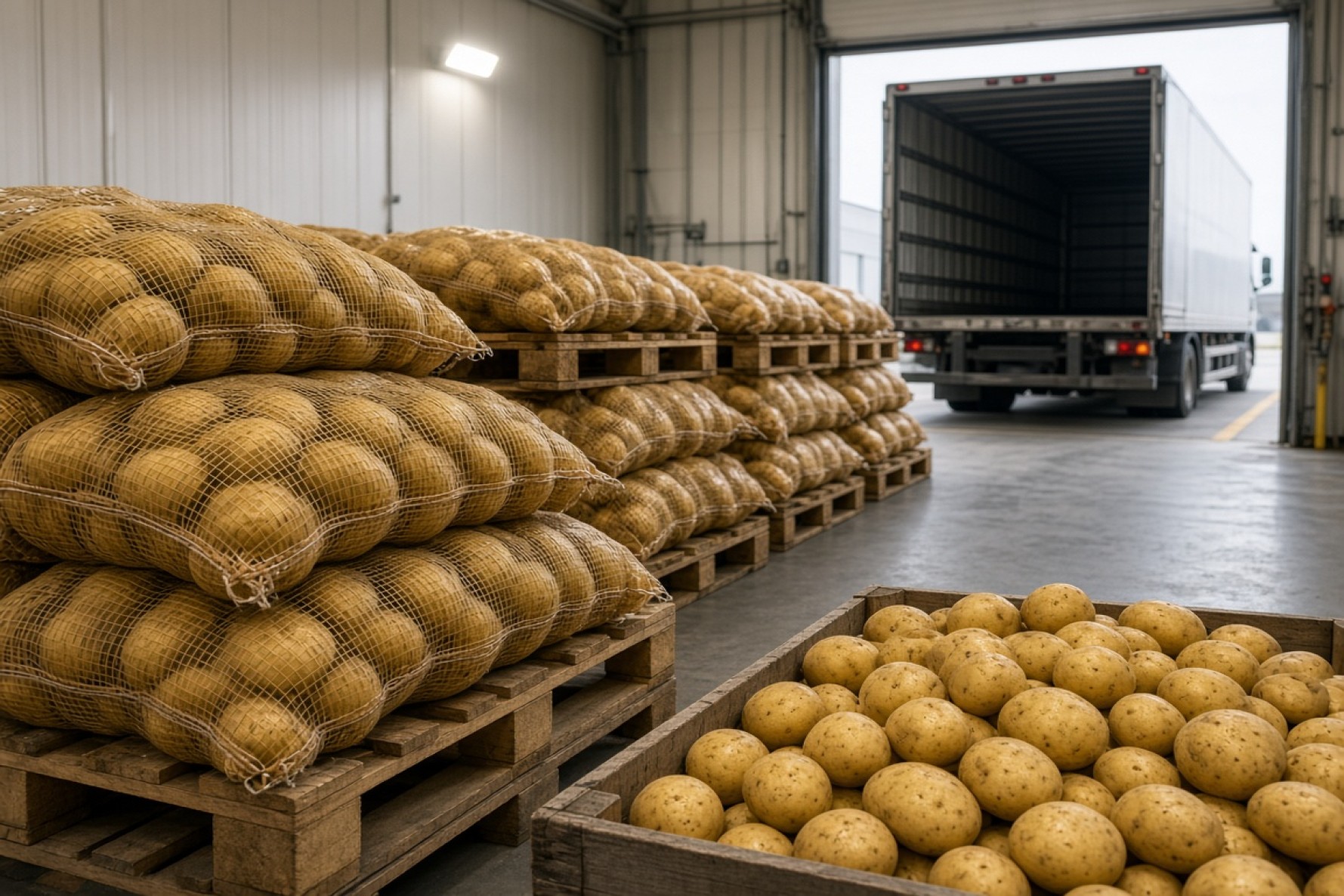
Mesh bags are the most common option in regional bulk trade — good airflow and visible product. Net weights (e.g. 10, 20 or 25 kg) must be agreed; heavier bags increase pressure on bottom layers.
Perforated woven bags suit bulk road loads if airflow is adequate. Cartons are not always economical for field-run bulk but add value for premium and retail packs. Small retail packs need tighter size and appearance uniformity before packing.
| Method | Advantage | Typical use |
|---|---|---|
| Mesh bag | High ventilation and visible product | Regional bulk trade |
| Perforated woven bag | Good strength | Bulk road shipments |
| Carton | Better protection and presentation | Premium grade and retail |
| Small mesh pack | Ready for shelf | Retail |
| Buyer-branded pack | Market development | Retail chains |
Wet or washed tubers packed before the surface is dry increase decay risk — washing methods must match transit time and market.
8. Transport, temperature and storage
Potatoes remain metabolically active after harvest. For fresh table use, about 7°C and very high relative humidity (near 98%) are reference post-harvest conditions; excessive chilling can raise reducing sugars for some processing uses.
Road transport is the backbone for Iraq, Afghanistan, Turkmenistan and Azerbaijan. Trucks must be clean, dry and odour-free. For the UAE and the Gulf, sea routes and cargo ventilation matter; reefer containers help on long or sensitive lanes.
- Shorter transit than distant suppliers
- Fewer trans-shipment steps
- Direct delivery to buyer warehouses
- Flexible shipment sizes
Sea freight: Can be economical in large volumes to the UAE, Oman, Qatar and Kuwait; poor stack ventilation raises core temperature.
Reefer containers: Better temperature control on long or demanding routes; set points must match table vs processing intent.
Relative humidity: Low RH causes shrivelling; high RH without airflow increases condensation and decay — aim for high humidity without free water on tubers.
Light control: Stores, trucks and waiting areas must avoid direct sun; clear mesh bags left in sunlight increase greening risk.
9. Regional supplier competition
In the Gulf, Egypt, Pakistan and India are strong competitors; Turkey is serious in Iraq and the Caucasus. In 2023 the UAE imported roughly USD 22 m and USD 18 m of potatoes from Egypt and Pakistan respectively.
| Country | Commercial edge | Challenge for Iran |
|---|---|---|
| Pakistan | Large production and regional exports | Intense price competition |
| Egypt | Established in Arab markets | Sorting and professional export networks |
| India | Scale and sea access | Competition in Oman and the Gulf |
| Turkey | Proximity to Iraq and Caucasus | Packaging quality and distribution |
| Iran | Short distance to several markets and diverse growing areas | Need for stable sorting and supply planning |
The sustainable edge is delivery exactly to spec — if the buyer ordered 50–80 mm, a large share of 30–40 mm tubers cuts realisable value.
10. How export potato prices are formed
- Harvest season
- Growing region
- Variety name
- Size and uniformity
- Defect percentage
- Washed vs unwashed
- Sorting cost
- Pack type and weight
- Order volume
- Inland haul to border or port
- International freight
- Destination and Incoterms
- Certificates and laboratory tests
- Domestic supply and export policy
Unit export values to different destinations diverged in the first nine months of 1403. Temporary export restrictions (e.g. late Bahman 1403) show long-term contracts need fixed loading windows.
11. Samples, contracts and pre-loading inspection
Samples must represent the main load with numeric specs on a data sheet. “As per sample” without numeric tolerances is insufficient for hundred-tonne lots.
- Minimum, maximum and average size
- Skin and flesh colour, shape, skin condition, defects, sprouting, greening, soil
- Cut test for hidden defects
- Bag weights from several points
- Open bags and check size distribution
The contract must state acceptance criteria at loading — “as per sample” without numeric tolerances is insufficient for large lots.
Cut tests reveal internal bruising, hollow heart and hidden defects. Weigh bags from several points and open units to verify size distribution.
Importer checklist before ordering
- Define end use: household, foodservice, chips or fries.
- State the required variety name on the order.
- Define size in millimetres, not only “medium” or “large”.
- Specify tuber shape; length matters more for fries.
- Set tolerances for cuts, cracks and bruising.
- Check greening and sprouting on sample and main load.
- Agree washed, brushed or field-run condition.
- Obtain a commercial sample from the same region and harvest window.
- For industrial use, run a processing/frying test.
- Confirm pack type and net weight.
- Align phytosanitary certificate and destination quarantine rules before loading.
- Specify transport: standard truck, temperature-controlled vehicle or reefer.
- Define delivery place and transfer of responsibility (Incoterms).
- Inspect before loading: size, bag weight, defects and appearance.
- Assess ability to repeat supply on the next order.
What to send for an accurate quote
- Variety and use (table, foodservice, industrial)
- Target size and shape in millimetres
- Skin and flesh colour; washed, brushed or field-run
- Acceptable defect levels
- Pack type and weight per unit
- Order quantity, country and city/border/port
- Transport mode, private label if needed
- Quarantine documents or lab tests and loading date
A vague “export potato price” request is not comparable; numeric specs, pack, volume, destination and tests are required.
Sourcing export potatoes through Iranco
Matching buyer specs to production areas, packaging and samples matters more than finding any field. Iranco can register purchase requests with variety, size, pack, volume, tests and destination so supply options are reviewed on the same basis.
Summary
Iranian potato exports work best where distance is short, logistics are manageable and fresh demand is steady — Iraq, Afghanistan, the UAE, Turkmenistan and Azerbaijan are clear examples.
Success depends on controlling size, uniformity, skin set, sprouting, greening, bruising, rot, soil and bag weights; processors add dry matter and frying behaviour.
Proper packs, ventilation, darkness, ~7°C where appropriate and gentle loading directly affect salable volume at destination.
Professional importers define use and numeric specs first, then samples, quarantine, transport and only then price — that structure turns potatoes into a repeatable contract product.
Frequently asked questions
Is Iranian potato suitable for export?
Yes. Iran has broad commercial production, multiple growing regions and short access to Iraq, Afghanistan, Turkmenistan, Azerbaijan and Gulf countries. Whether a specific lot is suitable depends on sorting, tuber soundness, size, harvest timing, storage and packaging — bulk buyers should contract on defined specs.
Who are the main buyers of Iranian potatoes?
In the first nine months of 1403, Iraq was the largest destination, followed by Afghanistan, the UAE, Turkmenistan and Azerbaijan. Oman, Kuwait, Uzbekistan and Qatar also import from Iran. The mix shifts with season, domestic supply and market conditions.
What size is appropriate for export potatoes?
It depends on the buyer and use. UNECE FFV-52 sets a 35 mm minimum for ordinary table potatoes. In practice, ranges such as 45–75 mm or 50–80 mm are common. Uniformity across the whole shipment matters more than a single fixed number.
Is washed or unwashed export potato better?
It depends on the destination. Washed product looks cleaner for some retail buyers but must be fully dry before packing and in transit. For many bulk road deals, brushing off excess soil without full washing can improve haul life.
What is the best export packaging?
For regional bulk trade, mesh bags are the most common because of ventilation and visibility. Perforated woven bags are also used. Cartons or smaller packs suit premium and retail channels. Net weight per bag must be agreed before ordering.
Must potatoes travel in a refrigerated container?
Not always on short land routes if transit time is limited and ambient conditions are acceptable. On long routes, hot climates or demanding buyers, temperature control is a real advantage. Reference storage for fresh table use is about 7°C with high relative humidity.
Which HS codes apply to potato exports?
Fresh or chilled potatoes fall under HS 0701. Code 070110 covers seed potatoes; 070190 covers other fresh or chilled potatoes. Most ordinary table export moves under 070190.
How can a buyer verify quality before shipment?
Sample from several points in the load, measure size, weigh bags, check sprouting and greening, cut tubers to reveal internal bruising or hollow heart, and record mechanical damage. Sample specs should become numeric contract criteria.
What drives the export price of Iranian potatoes?
Season, growing region, variety, size, sorting, defects, washing status, packaging, order volume, freight, destination, delivery terms and any required tests. Two quotes are comparable only when product specs, net bag weight and delivery point match.
Featured Products




Related Articles



