 Iranco Magazine Team
Saffron, raisins, pistachios, sweets and Iranian fruit products in Bahrain — import data, rivals, standards, labelling, packaging, logistics and price requests
Export Guide · Bahrain · Food Market · Saffron · Pistachio · Raisins
Iran Food Exports to Bahrain: Which Products Have the Best Sales Prospects?
Saffron, raisins, pistachios, sweets and Iranian fruit products in Bahrain — import data, competitors, GSO 9 labelling, packaging, logistics and price requests.
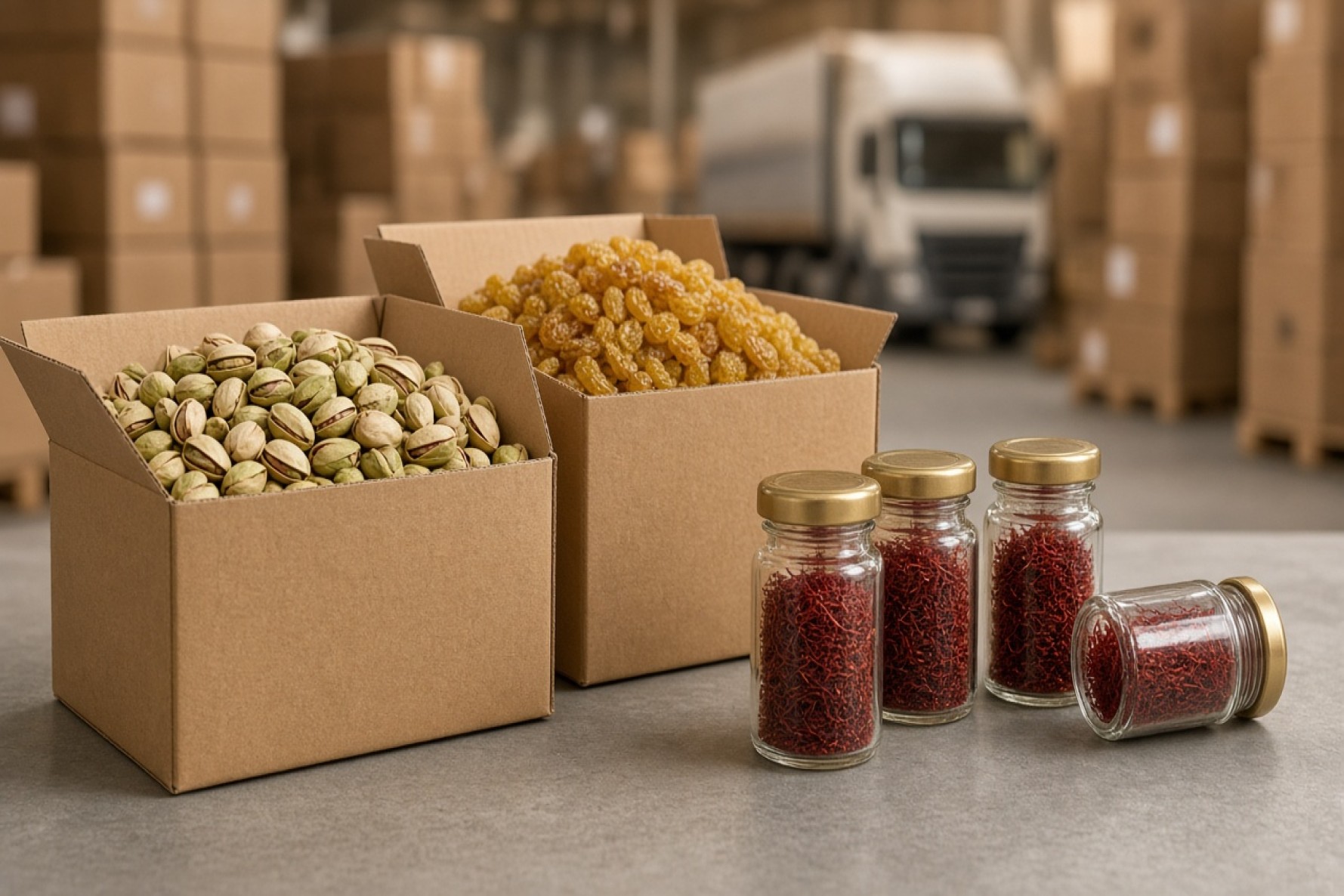
Bahrain does not offer equal opportunity for every Iranian food product. 2024 trade data show measurable Iranian presence in saffron, raisins, pistachios, sweets and some fruit products. This report separates proven opportunities from purely potential markets and covers entry rules, quality control, packaging, sales channels and order structure.
Analytical introduction
Bahrain’s market size cannot be compared with Saudi Arabia or the UAE, but for food exporters a smaller market is not necessarily a weakness. Bahraini importers typically work through relatively compact distribution networks, short warehouse-to-shelf distances, and access to retail, food service and specialist stores.
Total merchandise imports to Bahrain in 2024 were about USD 15.6 billion. Suppliers from Saudi Arabia, the UAE, India, Turkey, China, Europe, the United States and the region are active. Geographic proximity alone is not enough; products must compete on quality, repeatable supply, packaging, label data and landed price.
2024 data split the market into goods where Iranian origin is already visible in imports — saffron, raisins, pistachios and some sweets — and categories such as fresh fruit and vegetables where import demand is large but competitors hold the main share.
The professional exporter should ask: which Iranian product, with which specifications, through which channel and at which cost structure, can actually be sold in Bahrain?
1. How should the Bahrain market be assessed for Iranian food exports?
Assessing export opportunity requires four factors together: real import size, purchase history from Iran, competition intensity and ability to preserve quality to the point of sale. High imports alone do not mean the product suits Iranian exporters — fresh tomato imports exceeded USD 18.4 million in 2024, yet Jordan, Syria, Egypt and Oman dominated.
| Product group | Bahrain imports 2024 | Imports from Iran | Iran position |
|---|---|---|---|
| Saffron | $1.618M | $1.334M | Highly established |
| Raisins | $1.683M | $587K | Strong |
| Pistachios | $5.896M | $1.024M | Important but competitive |
| Confectionery without cocoa | $15.041M | $1.066M | Room to grow |
| Jam, jelly, purée and fruit paste | $3.831M | $346K | Expandable market |
| Tomato products (subheading 200290) | Active market | >$263K | Industrial and retail opportunity |
In 2024 Bahrain imported about USD 1.334M of saffron, USD 1.024M of pistachios, USD 587K of raisins and over USD 1.066M of cocoa-free confectionery from Iran. Starting with a product the market already accepts from Iran is usually smarter than creating demand where rivals are entrenched.
2. Which Iranian products have the best sales prospects in Bahrain?
Saffron — Iran’s strongest position
Bahrain imported about USD 1.618M of saffron in 2024, roughly USD 1.334M from Iran — about 82.5% by value. Spain was the next key supplier. The market can absorb consumer packs, gift packs, bulk for restaurants and patisseries, and raw material for private labels.
- Competition focuses on authenticity, colouring strength, aroma, broken threads, uniformity and laboratory results.
- Low price alone does not create a durable advantage.
Raisins
Bahrain imported about 654 tonnes of raisins worth nearly USD 1.68M in 2024. Iran supplied over 229 tonnes and about USD 587K — the largest origin by value. Bakeries, patisseries and nut wholesalers are potential buyers.
Pistachios
Pistachio imports were about USD 5.9M; the United States supplied about USD 3.77M and Iran over USD 1.02M. Iran’s edge can be variety, taste, raw or roasted formats, kernels and premium packs; for industry users, kernel uniformity and aflatoxin control matter more than shell appearance.
Sweets and sugar confectionery
HS 170490 imports exceeded USD 15M. Turkey and China led supply; Iran ranked among key suppliers with about USD 1.066M and nearly 492 tonnes. Products must withstand Gulf distribution heat, shelf life, carton pressure and Arabic label rules.
Jam, marmalade, purée and fruit paste
Imports in this group were about USD 3.83M; Iran supplied over USD 346K. Industrial jam, purée and fruit paste for hotels, restaurants and patisseries can be more attractive than fighting only in retail jars.
3. Which sales channel fits each product?
| Product | Better channel | Offer format | Decision driver |
|---|---|---|---|
| Saffron | Specialty store, food service | Small and bulk packs | Authenticity and quality |
| Pistachios | Nuts, supermarket, patisserie | Consumer and bulk | Aflatoxin, size, price |
| Raisins | Wholesale, bakery, patisserie | Carton or consumer pack | Cleanliness, moisture, uniformity |
| Confectionery | Supermarket, wholesale | Consumer pack | Shelf price and shelf life |
| Jam and purée | Retail, hotel, restaurant | Jar or industrial pack | Taste, Brix, texture |
| Tomato products | Food service and wholesale | Can or industrial container | Consistency, colour, formula |
Private-label production for nuts, sweets, jam and some fruit products is a strong option; Arabic artwork, minimum pack runs and formula stability matter.
4. Technical specs the Bahraini importer should define before buying
| Product | Order specifications | Key tests |
|---|---|---|
| Saffron | Type, broken %, thread form | Authenticity, contamination |
| Pistachios | Type, size, raw/roasted, kernel or in-shell | Aflatoxin, moisture |
| Raisins | Type, colour, size, process | Moisture, residues, sulphite |
| Confectionery | Formula, weight, flavour, units per carton | Microbiology, stability |
| Jam | Fruit type, fruit %, texture | Brix, pH, microbiology |
| Juice | Composition, juice % | Brix, acidity |
- Approved samples must link to written specifications.
- For multiple products, the same specs can be entered in an Iranco purchase request.
5. Standards and entry requirements for food in Bahrain
Entry is controlled by the Ministry of Health. For new products, pre-shipment approval matters; initial approval form, trade registration and outer-pack photos are required (stated turnaround three working days).
After arrival, safety and compliance inspection is required; inspection form, packing list, bill of lading and health certificate are core documents.
| Shipment weight | Inspection fee |
|---|---|
| Up to 1000 kg | 8 Bahrain dinars |
| 1000 to 5000 kg | 9 Bahrain dinars |
| Higher weight band | 10 Bahrain dinars |
Labelling follows GSO 9:2022 and amendment GSO 9:2022/Amd1:2025. Labels must cover food name, ingredients, net weight, country of origin, dates, storage, nutrition and allergens with Arabic text. GSO 2810:2025 matters for allergen declaration on prepacked foods.
6. Tariff codes, customs duty and tax
Customs duty depends on precise classification in the GCC unified tariff. Bahrain offers an official HS classification service (invoice and catalogue; BHD 5 fee; stated seven working days).
| Product | HS code in trade data |
|---|---|
| Saffron | 091020 |
| Raisins | 080620 |
| Pistachios (legacy data classification) | 080250 |
| Confectionery without cocoa | 170490 |
| Jam, purée, fruit paste | 2007 |
Standard VAT is 10%, but some staple foods are zero-rated. Commercial offers should separate product price, freight, insurance, destination charges, duty and tax.
7. Packaging suited to the Bahrain market
Bahrain is a hot, import-dependent distribution market. Pack structure must protect product in transit and storage; GSO 2231:2012 covers food-contact materials.
- Saffron: moisture, light and odour barrier; secondary pack and seals for bulk.
- Pistachios: limit oxygen and moisture; uniform retail packs.
- Raisins: pack matched to process; food-grade liner in cartons for bulk.
- Confectionery: mechanical stability under carton stack and heat.
- Jam and fruit products: container choice for acidity and thermal process.
8. Shipping food from Iran to Bahrain
Pistachios, raisins and sweets usually suit sea freight. High-value, low-weight saffron may move by air. Fresh produce depends on cold chain and delivery speed.
- Carton count and net weight, batch code, dates and seals
- Label match to approved sample and agreed test results
- Pallet photos and packing list match to actual load
9. Pricing Iranian food for Bahrain
| Factor | Effect |
|---|---|
| Quality and grade | Base price |
| Volume and pack | Spread of production and freight |
| Testing | Cost for sensitive goods |
| Freight and Incoterms | Risk and cost split |
| Customs duty and VAT | Depends on HS and product type |
For comparable quotes, record the same technical specs, pack weight, volume and destination in an Iranco purchase request.
10. Iran’s main competitors in Bahrain
| Product | 2024 competitors | Iran position |
|---|---|---|
| Saffron | Spain, India, UAE | Leading supplier |
| Raisins | Afghanistan, India, UAE | Leading supplier (by value) |
| Pistachios | United States, UAE, Turkey | After the United States |
| Confectionery without cocoa | Turkey, China, UAE | Strong presence, high competition |
| Jam and purée | France, Saudi Arabia, UAE | Among key suppliers |
Importer checklist before placing an order
- Exact product name and processing form
- Measurable grade and quality specs
- Real sample and required tests
- Pack and Arabic label artwork approval
- HS code check and remaining shelf life on arrival
- Production capacity, Incoterms and export documents
- Trial shipment and reorder plan
What information is needed for an accurate price quote?
- Product name, grade, pack weight and order volume
- Pack type, label and required tests
- Destination: Bahrain; delivery point and transport mode
- For pistachios: raw/roasted and kernel/in-shell; for raisins: colour and process; for saffron: quality and pack weight
Supply path for Iranian food to the Bahrain market
Comparing two offers on price per kilo alone is misleading. Iranco lets buyers submit purchase requests on a single spec set — product, quality, volume, packaging, tests and destination — so Iranian supply options can be compared fairly.
Summary
Best success odds sit where Iran has production strength, Bahrain imports actively and trade data already show Iranian supply: saffron, raisins, pistachios, sweets and fruit products. Sustainable entry needs contract specs, GSO labelling, robust packs and correct customs classification.
Frequently asked questions
Does Bahrain import food from Iran?
Yes. 2024 data show imports from Iran in saffron, pistachios, raisins, confectionery, jam and some processed foods; intensity varies by group.
Which Iranian product has the best sales prospects?
Saffron is extremely strong; in 2024 Iran supplied about USD 1.334M of Bahrain’s USD 1.618M saffron imports. Raisins, pistachios and sweets also have proven demand.
Is there a market for Iranian pistachios in Bahrain?
Yes; over USD 1M of nearly USD 5.9M pistachio imports came from Iran. The United States is the larger rival; quality, aflatoxin and packaging must be defined.
Is Arabic labelling required?
For consumer products, Bahrain and GCC label rules including GSO 9:2022 and the 2025 amendment apply; Arabic information is essential.
Can packaging be approved before shipment?
A pre-import review service exists and outer-pack images are required; using it before mass printing reduces rejection risk.
What drives export pricing?
Quality, volume, pack, testing, freight, Incoterms, duty, VAT and distribution. Factory price comparisons without matching specs mislead.
Is fresh fruit a good opportunity?
Import demand is active but rivals dominate apples and tomatoes; season, cold chain and delivered price decide Iran’s room.
What is needed for pistachio or raisin quotes?
Type, grade, size, pack, volume, tests, destination and delivery terms — can be recorded in an Iranco purchase request.
Do all foods carry 10% VAT?
No; the standard rate is 10% but some staples are zero-rated; status depends on exact classification.
What is the best way to start with a Bahraini importer?
Clear technical specs, approved sample and controlled trial order; scale volume after market feedback.
For Bahrain food export advice and purchase requests from Iranian suppliers
Contact Irancoinfo@iranco.com · WhatsApp: +98 913 104 4182 · Telegram: @irancofood
Featured Products










Related Articles



