 Iranco Magazine Team
From Estahban dried figs and commercial grades to aflatoxin requirements, order specs, packaging, storage and analysis of China, Europe, Japan and East Asian markets
Export Guide · Dried Figs · Estahban · Buyer Markets
Iran Dried Fig Exports: Buyer Countries and Importer Specifications
From Estahban figs and 101/AAA/AA grades to aflatoxin rules, UNECE DDP-14, Codex CXC 65-2008, packaging, storage and analysis of China, EU, Japan and East Asian markets
Iranian dried figs — especially Estahban in Fars — serve diverse export channels, from large Asian buyers to strict EU and Japanese importers. Professional sales need measurable contract specs, not grade names alone.
Estahban joined FAO GIAHS in 2023 with about 25,950 hectares of rain-fed orchards reported. 2024 trade data highlights China at roughly 13,775 t imports under HS 080420.
Real opportunity lies in segmenting by use and destination: bulk, food industry, EU repackers and premium retail each need different specifications.
This guide covers grades, specs, quality control, 2024 markets, standards, packing, storage, pricing and competition with Turkey.
1. Iran dried figs and Estahban in the export chain
Estahban is the best-known name in Iran's dried fig trade. Rain-fed orchards have adapted to dry conditions over decades; most fruit is picked ripe on the tree and sun-dried.
FAO's GIAHS system records about 2.6 million fig trees on nearly 25,950 hectares for Estahban; the site was listed in 2023. Recent provincial reports put total orchard area near 26,000 ha and forecast roughly 18,000 t dried fig for the next season.
How does harvest season affect buying?
Harvest usually runs from mid-August to October. Annual buyers should fix purchase plans before the season ends; post-harvest assessment of that year's grade mix becomes clearer.
Why is each crop not identical to the last?
Size, colour, opening, texture and grade shares shift with weather, harvest timing and storage. Contracts that only say 'AAA' invite disputes.
2. Commercial grades: 101, AAA, AA and closed figs
Iranian trade uses 101, AAA, AA, A, B and parak names. They must not replace measurable contract specs; diameter or open-fruit percentage definitions differ between suppliers.
101 AAA is often quoted above about 23–24 mm while AA/A boundaries vary by seller.
Is open fruit always higher quality?
For premium dried-fruit retail, open light figs look better and cost more. A factory making paste or powder usually should not pay for top appearance.
| Commercial grade or form | Typical appearance | Market position | Best suited for |
|---|---|---|---|
| Parak (super open) | Very open, large and light-coloured | Premium with limited supply | Luxury packs |
| 101 AAA | Large, light and mostly open | Top export grade | Premium retail and dried-fruit shops |
| 101 AA | Light and open, smaller than AAA | Quality–price balance | Retail and wholesale |
| 101 A | Medium size, lower open percentage | Commercial grade | More price-driven markets |
| Closed AA/A | Tighter shape, usually lower price | Direct use or processing | Food industry and economy packs |
| B and industrial | Smaller, darker or lower appearance value but sound | Raw material | Powder, paste, confectionery |
Professional buying specifies size, open percentage, crop year, defects, moisture and aflatoxin limits for the destination — not just '10 t AAA'.
3. Technical specifications importers expect
Professional buyers need a product specification sheet — the basis for sampling, testing, pricing and pre-load inspection.
UNECE DDP-14 defines sizing by count per kilogram, from at most 40 fruits per kg for the largest class to 121 or more.
For appearance-driven markets, combine
- Minimum agreed diameter
- Count per kilogram band
- Open-fruit percentage
- Colour uniformity
| Parameter | What to fix in the order | Importance to buyer |
|---|---|---|
| Product form | Open, closed, mixed, parak or industrial | Direct effect on price and use |
| Size | Diameter or count per kilogram | True supplier comparison |
| Colour | Agreed light-to-dark range | Retail presentation |
| Open percentage | Minimum agreed share | Appearance and commercial value |
| Moisture | Contract ceiling | Texture, shelf life, mould risk |
| Water activity | If requested | Microbial stability |
| Crop year | Harvest year | Freshness and storage time |
| Visual defects | Maximum allowed percentage | Avoid delivery disputes |
| Mould and spoilage | Very strict rejection rule | Safety and salability |
| Pests | No live insects | Baseline for dried-fruit trade |
| Foreign matter | Agreed limit | Safety and quality |
| Aflatoxin | Per destination market | Major export risk |
| Ochratoxin A | Where required | Mycotoxin control |
| Pesticide residues | Per destination rules | Strict markets |
4. Quality control matters more than grade names
Sampling must represent the whole lot, not a few fruits on a carton top. UNECE DDP-14 sets Extra, Class I and II defect tolerances, bans live pests and caps mineral impurities.
Moisture affects quality and safety
UNECE DDP-14 caps moisture at 26% for unprocessed dried figs. Codex CXC 65-2008 suggests ~24% moisture and water activity below 0.65 to limit mould risk.
Aflatoxin: a leading export risk
CXC 65-2008 covers orchard to warehouse; UV sorting removes suspect fruit but does not replace representative lab testing of the shipment.
Sound product for direct consumption
- Natural colour matching the agreed grade
- No mould, off-odours or live pests
- Texture aligned with moisture; reasonable size uniformity
- Limited very dark or damaged fruit
- No sand, soil or foreign matter
- Lab results matching destination rules
Key pre-export tests
- Moisture and water activity
- Aflatoxin B1 and total B1, B2, G1, G2
- Ochratoxin A where required
- Pesticide residues and microbiology if requested
- Foreign matter and sensory checks
5. Buyer countries: where is the real market?
HS 080420 groups fresh and dried figs; 2024 data still shows China leading with about 13,775 t and roughly USD 19.19 million reported under the code.
These are destination-reported imports from Iran and should be read separately from Iran's declared export statistics.
| Market | Reported imports from Iran in 2024 | Key commercial trait |
|---|---|---|
| China | ~13,775 t | High-volume, critical market for Iran |
| Germany | ~175 t | Gateway to strict EU requirements |
| Japan | ~170 t | Quality stability and documentation |
| South Korea | ~95 t | Asian market with quality rules |
| Australia | ~69 t | Controlled, well-packed product |
| Canada | ~57 t | Dried fruit and imported food use |
Estahban agriculture reports also cite China, Hong Kong, Vietnam, India, Malaysia, Tajikistan and Gulf markets.
Three questions for any 'potential' market: proven purchases from Iran, feasible legal and logistics entry, and grade fit with local channels.
6. What importers in each market want
There is no single 'export grade' for every country. Specifications follow sales channel first, then destination.
China
Large orders need supply stability and consistent quality across consecutive loads; sudden colour or size shifts between shipments cause commercial disputes.
Germany and the EU
EU limits for dried figs: aflatoxin B1 max 6 µg/kg and total of four aflatoxins 10 µg/kg; ochratoxin A max 8 µg/kg. Pesticide MRLs must match EU rules.
Japan
Uniformity, cleanliness, pest control, packaging and supply stability matter; label and test requirements should be fixed before final packing.
Korea, Australia and Canada
Smaller volumes but attractive for premium packed product; small uniform lots with strong documents can avoid pure price competition.
7. Standards, tariff code and entry rules
HS code 080420 covers fresh or dried figs; national subheadings at destination must be checked — not every trade figure under 080420 is dried fig.
UNECE DDP-14 is a useful contract framework; CXC 65-2008 treats aflatoxin as a whole-chain issue, not a final test alone.
Retail label points to agree before printing
- Product name and net weight
- Country of origin and batch/lot
- Required dates and producer/importer details
- Storage conditions and nutrition panel if required
- Accepted language(s) for the market
8. Export packaging: bulk to retail
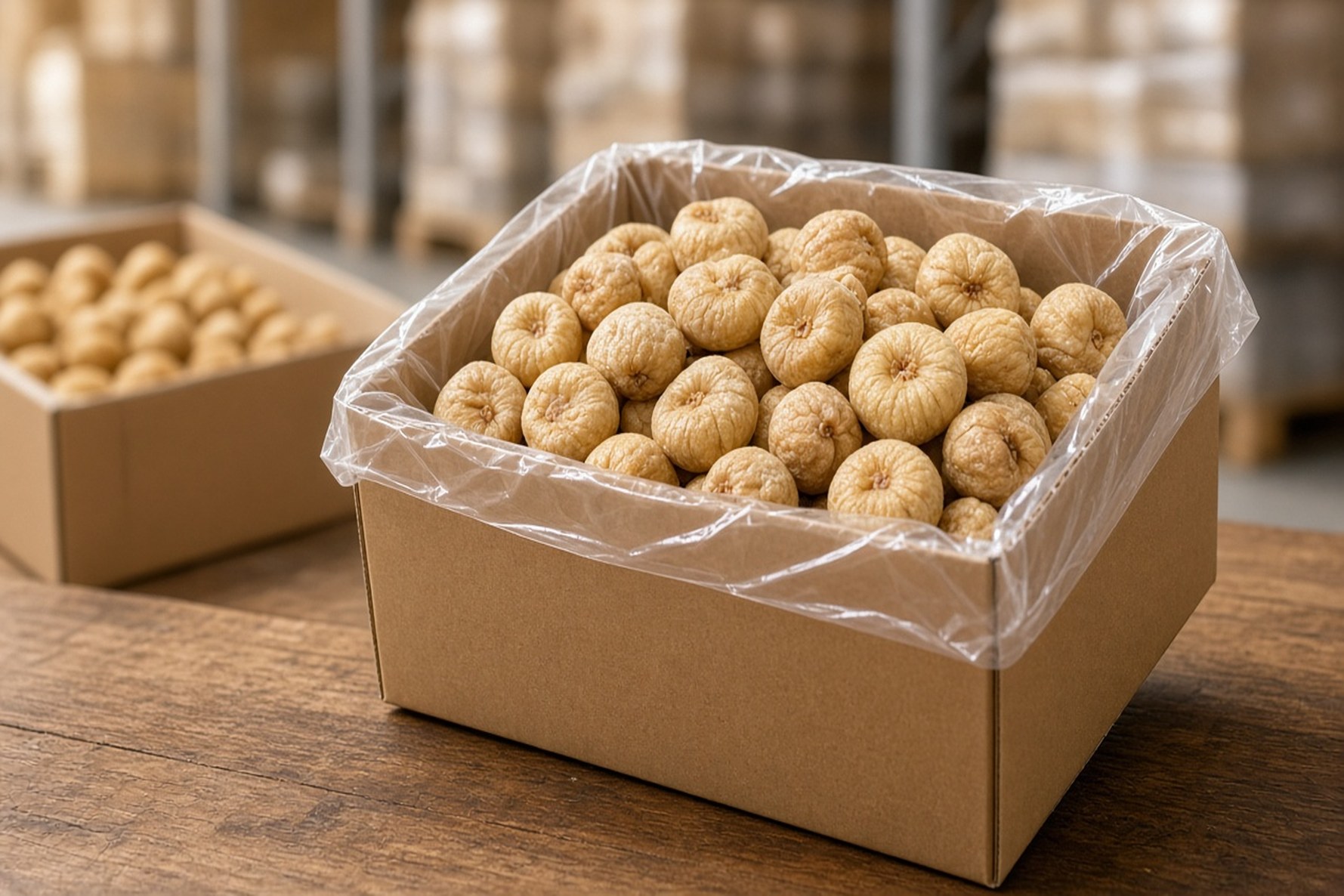
Packaging must block moisture uptake, physical damage and contamination. Bulk export typically uses food-grade inner liners in master cartons; 8 or 10 kg cartons appear in trade but follow buyer specs.
Retail packs need size and colour uniformity in clear film; heavy vacuum is not always suitable for open figs.
Industrial packs
Per-fruit appearance has less economic value; focus on safety, moisture, flavour, mycotoxins and process yield.
9. Transport, storage and moisture control
Dried figs are more stable than fresh fruit but storage still matters. Codex guidance for aflatoxin risk cites 5–10 °C storage, RH below 65% and no direct floor contact.
Dry container or refrigerated?
Depends on route, season, product moisture and cargo value. In dry boxes, condensation and dew point on cartons are the main risks — pallets, wall gaps and desiccants help.
| Factor | Target condition | Risk if poorly managed |
|---|---|---|
| Storage temperature | 5–10 °C per Codex guidance | Higher mould risk |
| Relative humidity | Below 65% | Moisture uptake and instability |
| Water activity | Below 0.65 for safety control | Microbial growth |
| Floor contact | Avoid direct contact | Moisture transfer and contamination |
| Ventilation and hygiene | Controlled | Off-odours and storage pests |
| Palletising | Stable with air gap | Carton crush and poor airflow |
10. How export dried fig prices are set
Two sellers may both say 'export AAA' yet differ in size, colour, openness, tests and packing. Sorting yield after cleaning can sharply raise the cost per kg of the final grade.
| Factor | Typical price effect |
|---|---|
| Fruit size | Larger usually commands more |
| Open percentage | Premium market price driver |
| Light, uniform colour | Higher retail value |
| Defect level | Lower defects raise sorting cost |
| Test results | Strict-market loads worth more |
| Harvest year | Fresh crop preferred |
| Order volume | Affects sorting, packing and freight |
| Pack type | Retail costs more than bulk |
| Certified organic | Needs chain and valid certificate |
| Delivery terms | Place and freight responsibility |
Pricing from photos or grade names alone is unreliable; approve sample and spec sheet first.
11. Competition with Turkey and industrial uses
Turkey reported over 86,000 t exports under 080420 in 2024 worth about USD 419 million. Iran need not copy Turkey; Estahban identity and light open grades can win in chosen markets.
Sound figs for industrial use
- Fig paste and powder
- Confectionery, cakes and bakery
- Fruit bars and energy products
- Breakfast blends and fruit sauces
- Mixed nuts and food ingredients
| Factor | Iran | Turkey |
|---|---|---|
| Key region | Estahban and Fars | Main Turkish fig areas |
| Known commercial form | Light open figs and 101 grades | Wide dried and processed range |
| Global trade scale | Smaller | Very large |
| Iran opportunity | Differentiation and focused markets | Broad export network |
| Iran challenge | Uniformity and grade standardisation | Intense competition |
Importer checklist before placing an order
Before issuing a purchase order for Iranian dried figs, fix these points in writing:
- Product form: open, closed, mixed, parak or industrial.
- Grade name is not enough: define AAA/AA with size, colour and open percentage.
- Harvest year: current crop vs stored stock must not be swapped without notice.
- Representative sample: from the same lot or quality to be loaded.
- Numeric moisture: “export dry” is not a precise contract term.
- Defect limits: dark, damaged, mouldy, crushed or infested fruit.
- Aflatoxin testing: sampling method, lab and destination limits agreed upfront.
- Pesticide residues: match destination, especially the EU.
- Net pack weight: nominal weight, tolerance and units per master carton.
- Packaging: film, carton, label and pallet pattern approved before production.
- Storage history: review supplier warehouse records.
- Supply capacity: a small premium sample does not prove multi-tonne consistency.
- Pre-load inspection: acceptance criteria must match the initial sample.
- Lot traceability: critical for industry buyers and strict markets.
- Delivery terms: place, freight, insurance, documents and payment.
Written criteria reduce gaps between sample, quoted price and final shipment.
What to send for an accurate price quote
A professional dried fig quote request should include:
- Commercial grade and open vs closed form
- Size or count per kilogram
- Colour and minimum open percentage if needed
- Maximum moisture and required tests
- Crop year and order volume
- Pack weight and pack type
- Private label if required
- Destination country, port and delivery terms
The more precise the request, the more comparable supplier offers will be.
Export supply of Iranian dried figs to your specification
The gap between two offers is usually wider than the per-kg price difference; without a shared spec sheet, comparison is unreliable.
Start by defining use: premium retail appearance vs factory processing priorities.
Iranco lets buyers submit purchase requests with grade, size, form, volume, packaging and destination so available options are screened against real needs.
Summary
Iranian dried fig exports create most value when product moves from a generic commodity to clear technical specs; Estahban and GIAHS anchor Iran's advantage and China is the largest visible buyer in 2024 data.
Destination alone does not guarantee success — size, colour, openness, moisture, aw, defects, aflatoxin, packing and warehouse conditions must be fixed before the deal.
Premium channels reward light uniform fruit; food industry buyers may prefer sound economy grades — segmentation raises total export value.
Professional buyers define product before asking price; clear specs make quotes comparable and cut sample-vs-shipment disputes.
Frequently asked questions
Is Estahban dried fig suitable for export?
Yes — Estahban is a core origin with FAO GIAHS status, but the name alone does not guarantee grade. Each order needs separate review of size, colour, moisture, openness, defects and destination tests.
Who is Iran's main dried fig buyer?
2024 destination-reported data puts China first by far at about 13,775 t under 080420; Germany, Japan, Korea, Australia and Canada also recorded purchases.
How does 101 AAA differ from 101 AA?
Both are common names for light open figs; AAA is usually larger. Size boundaries differ by catalogue — contract should state diameter, count/kg, open % and colour.
What moisture level for export dried figs?
UNECE DDP-14 max 26% unprocessed. Codex CXC 65-2008 suggests ~24% and aw below 0.65 for aflatoxin prevention. Stricter contract limits are possible.
EU aflatoxin limits for dried figs?
B1 max 6 µg/kg and total of B1,B2,G1,G2 max 10 µg/kg. Testing must be on a representative sample with good storage moisture control.
How should export dried figs be stored?
Codex aflatoxin guidance: 5–10 °C, RH below 65%, no direct floor/wall contact, protected from moisture and foreign odours.
Is open fig always better to buy?
For premium retail, open light figs have higher appearance value; processors care more about safety, moisture, aflatoxin, taste and foreign matter than luxury look.
What information is needed for a price from Iran?
Grade, size, openness, colour, moisture, volume, packaging, tests, destination and Incoterms — without these, price comparison is weak.
Tariff code for dried figs?
Six-digit HS 080420 for fresh or dried; check national subheading at destination for final declaration.
What to check before loading?
Grade/size vs approved sample, moisture, colour, openness, defects, pack integrity, net weight, lot ID and COA representative of the load.
Featured Products




Related Articles



