 Iranco Magazine Team
A complete guide to quality evaluation, lab specs, international standards, cold-chain logistics and wholesale buying checklists
Wholesale Buying Guide · Citrus Concentrate · Industrial Juice · Cold Chain
Iranian Citrus Juice Concentrate: Types and Wholesale Buying Guide
A comprehensive guide to quality evaluation, laboratory specifications, international standards, cold-chain logistics, and commercial checklists for bulk procurement
0. Analytical introduction
This technical guide provides a full review of Iran’s citrus processing capacity, bulk purchasing criteria for juice plants, soft-drink and confectionery manufacturers, and intermediate food industries, together with international trade requirements. A professional concentrate buyer does not rely on “price per kilogram” alone; corrected Brix, sugar-to-acid ratio, fruit authenticity, colloidal stability, cold-chain integrity, and COA alignment with the contract are evaluated in a single economic model.
With annual production of roughly 4.5 to 5.0 million tonnes of citrus—including orange, tangerine, bitter lemon, sweet lemon, and grapefruit—Iran is a major food-ingredient supply hub in West Asia. Processing lines in the northern belt (Mazandaran and Gilan) and the southern region (Fars, Kerman, and Hormozgan) enable simultaneous production of diverse concentrates with distinct sensory profiles. The north–south corridor, Caspian Sea access, southern port gateways, and proximity to high-consumption markets in Iraq, the Russian Federation, and Gulf Cooperation Council states make bulk sourcing from Iran attractive for regional importers.
Globally, Huanglongbing (HLB) and climate shocks in traditional groves in Brazil and Florida have tightened orange concentrate supply and pushed procurement managers toward alternative origins with transparent technical contracts. In that context, successful buying from Iran requires mastery of laboratory specifications, packaging choice (frozen versus aseptic), and destination compliance—including Eurasian regulations and GSO requirements. For deeper analysis of exports and target markets, see the companion article Iranian Citrus Concentrate Exports: Quality and Target Markets.
| Indicator | Value or criterion | Message for the buyer |
|---|---|---|
| Annual citrus production in Iran | 4.5 to 5.0 million tonnes | Variety diversity and relatively stable supply across harvest seasons |
| Standard orange concentrate Brix | 60 to 65 degrees Brix | Basis for financial settlement on soluble solids |
| Common industrial pack format | 260 kg steel drum with aseptic bag | 80 drums per 20-foot container ≈ 20.8 tonnes net |
| Primary customs tariff codes | 2009.11 (frozen) · 2009.19 (other / aseptic) | Correct classification on proforma invoices and clearance documents |
1. Orchard geography and processing capacity
Bulk procurement planning must align with harvest calendars and real capacity at northern and southern plants; orders outside the processing window either delay delivery or force quality compromises from long-stored fruit.
Northern basin: Mazandaran and Gilan
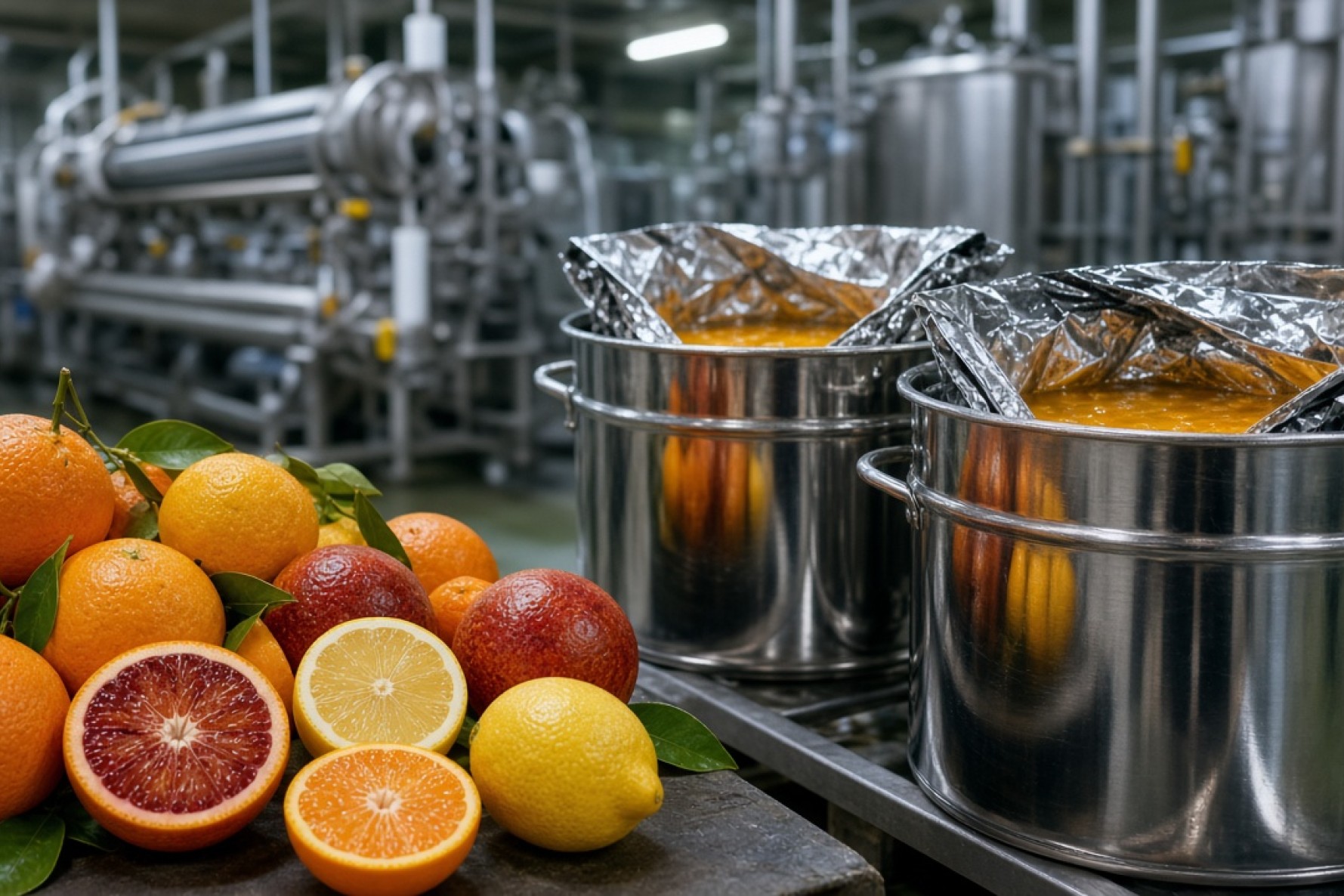
Mazandaran is the country’s main orange and tangerine production hub. Moderate Caspian humidity, regular rainfall, and cool winters yield fruit with suitable initial Brix, balanced acidity, and clear golden colour. Juice extraction and vacuum evaporation plants are concentrated along the coastal strip, and short orchard-to-factory distance reduces domestic logistics cost and fruit damage risk.
Southern basin: Fars, Kerman, and Hormozgan
Jahrom, Qir and Karzin, Darab, Jiroft, and Kahnuj are centres for bitter lemon, sweet lemon, and part of the local grapefruit and orange crop. Long sunshine hours, higher initial Brix, and sharp acidity in southern bitter lemon make the region ideal for syrups, lemon soft drinks, and flavour systems.
Seasonal harvest and processing calendar
- North: Tangerine from mid-autumn; Thompson and local orange from late autumn through mid-winter; fresh orange and tangerine concentrate delivery is mainly in deep winter.
- South: Bitter lemon from late summer through late autumn; southern grapefruit and local orange from early winter through late winter.
| Region | Dominant variety | Processing window | Buying note |
|---|---|---|---|
| Mazandaran | Golden orange, tangerine | October through January | Reserve plant capacity before peak harvest |
| Fars / Kerman | Bitter lemon, sweet lemon | August through November | Stress acidity and minimum Brix on the COA |
| South (winter) | Grapefruit, local orange | December through March | Control naringin and permitted bitterness in grapefruit |
2. Types of citrus concentrate and line selection
Each concentrate type has a distinct acid, colour, and aroma profile. Wrong variety selection—for example, low-acid orange concentrate in a high-acid nectar formula—leads to costly citric acid correction and sensory downgrade.
- Golden orange concentrate: Core input for reconstituted 100% orange juice and commercial nectars; 60–65°Bx; stable cloudy phase after dilution.
- Blood orange concentrate: Natural anthocyanins; 45–60°Bx; premium beverages and colour enhancement in blends.
- Tangerine / mandarin concentrate: Strong fruity aroma and orange colour; 50–60°Bx; single-fruit nectar or orange blends.
- Cloudy / clear bitter lemon concentrate: Cloudy for fruit drinks and syrups; clear after filtration and enzymatic treatment for transparent soft drinks and sauces; acidity 23–32%.
- Grapefruit concentrate: 55–60°Bx; controlled naringin and bitterness; diet and sports beverages.
| Type | Brix (°Bx) | Acidity (% citric) | Appearance | Industrial use |
|---|---|---|---|---|
| Golden orange | 60 – 65 | 4.0 – 8.0 | Cloudy, orange–golden | Reconstituted juice, nectar, beverage base |
| Blood orange | 45 – 60 | 4.0 – 7.5 | Red–ruby | Premium, energy, confectionery |
| Tangerine | 50 – 60 | 4.0 – 7.0 | Cloudy, deep orange | Nectar, orange aroma correction |
| Cloudy bitter lemon | 37 – 45 | 23 – 32 | Turbid, suspended pulp | Syrup, industrial lemon juice |
| Clear bitter lemon | 40 – 50 | 25 – 32 | Transparent | Soft drinks, sauces, flavouring |
| Grapefruit | 55 – 60 | 4.5 – 8.0 | Pink or yellow | Isotonic, diet nectar |
3. COA technical specifications and contract parameters
The Certificate of Analysis is the reference document for financial settlement and quality disputes. Bulk buyers should list mandatory parameters and test methods in a contract annex before any advance payment.
- Corrected Brix: Measured at 20°C with a refractometer; ±0.5 tolerance at 65°Bx is common in export deals.
- Total acidity and ratio: Acidity as citric acid anhydrous; Brix-to-acid ratio in golden orange is typically desirable at 10–16.
- Pulp (%): For cloudy product, contractual range (e.g. 2–8%) affects colloidal stability and mouthfeel.
- Recoverable oil: Aroma and authenticity index; in orange, typically 0.02–0.04% by weight in concentrate; sharp reduction indicates harsh extraction or diluted fruit.
- PME inactivation: Pectin methylesterase must be inactivated in pasteurisation; negative PME test is required to prevent unwanted clearing after dilution.
- Formol index, HMF, ethyl alcohol: Authenticity, heat damage, and fruit condition before extraction.
| Parameter | Orange 65°Bx | Bitter lemon | Reference method |
|---|---|---|---|
| Corrected Brix | ≥ 60.0 (target 65) | ≥ 37.0 | Refractometry at 20°C |
| Total acidity | 4.5 – 8.0% | 23 – 32% | Titration to pH 8.1 |
| Pulp | 2 – 8% (cloudy) | 0 – 6% | Centrifugation / drying |
| Recoverable oil | ≥ 0.02% | Per variety | Column or GC |
| PME test | Negative | Negative | In-house method / AIJN |
| Formol index | ≥ 50 | ≥ 65 | Formol titration |
| HMF (in diluted product) | < 20 mg/L | < 10 mg/L | HPLC |
| Microbial load (aseptic) | < 10 CFU/g | < 10 CFU/g | YDA culture |
4. Quality control, authenticity, and common defects
Beyond the factory COA, large buyers use independent testing, sensory panels, and—where needed—isotopic authenticity. In Eurasian and EU markets, SNIF-NMR and HPLC flavonoid profiling are common tools to reject unauthorised blending.
- TAB test (Thermo-Acidophilic Bacteria): Screens for Alicyclobacillus acidoterrestris spores on selective media at 45°C; absence of spores per gram is a release condition for reputable bottlers.
- Authenticity (HPLC / SNIF-NMR): Matches stable isotope ratios of sugars and acids to variety reference profiles; especially for long-term contracts and sensitive markets.
- Alicyclobacillus: For export COAs, negative spore certificate in 25 g is recommended.
| Defect | Likely cause | Sign | Mitigation when buying |
|---|---|---|---|
| Limonin bitterness | Peel pressure / immature fruit | Astringent aftertaste in diluted sample | Limonin cap < 5 ppm in reconstituted product |
| Cloudy product clearing | Active PME | Two liquid layers after 24 hours | Negative PME on COA + TAB test |
| Cooked flavour | High-temperature evaporation, warm chain | High HMF, brown colour | HMF cap + transport at 0 to +4°C |
| Guaiacol odour | Alicyclobacillus contamination | Disinfectant-like aroma | Independent spore test |
| Dilution / fraud | Added water or sugar | Low formol index, abnormal SNIF | Minimum formol index + periodic authenticity |
5. Standards: Iran, Eurasia, Codex, and AIJN
Compliance with the producer’s national standard and destination regulations is a condition for customs clearance and continued distribution contracts. In bulk deals, list applicable standards in the technical contract annex.
| Number | Subject | Importance for the buyer |
|---|---|---|
| INSO 4083 | Citrus concentrates and concentrated juices | Minimum Brix, purity, no unauthorised additives |
| INSO 2614 | Fruit juice and nectar — physicochemical specifications | Reference for reconstituting finished product from concentrate |
| INSO 2685 | Industrial lemon juice and lemon extract | Acidity and purity of lemon concentrate |
- Codex STAN 247 (CXS 247): Global framework for fruit juice and nectar; reconstituted orange Brix 11.2; prohibition of undeclared additions.
- TR CU 023/2011: Eurasian Economic Union entry — Russian labelling, authenticity, contaminant limits; details in export guide and Russia standard requirements.
- TR CU 021/2011 and 022/2011: Food safety and marking.
- AIJN (European Fruit Juice Association): Industry reference for test methods, pulp, PME, and authenticity; basis for negotiation with plants exporting to Europe.
- GSO (Persian Gulf): Juice and Arabic/English labelling; international halal certification.
6. Export markets and regional buying patterns
Even if the buyer is in Iran or a third country, understanding the ultimate destination market affects variety choice, certificates, and packaging. Three main hubs: Russia and Eurasia, Iraq, and the GCC.
- Russia: 65°Bx orange and tangerine; 260 kg aseptic drums; Caspian sea corridor; EAC and CT-3.
- Iraq: Orange and bitter lemon at competitive price; road delivery; CoC and pre-shipment inspection.
- GCC (UAE, Oman, Saudi Arabia): Premium varieties, halal, strict cold chain; entry from Bandar Abbas to Jebel Ali.
| Market | High-demand product | Packaging | Key certificate |
|---|---|---|---|
| Russia / Eurasia | Golden orange, tangerine | Aseptic 260 kg | EAC, CT-3, full COA |
| Iraq | Orange, bitter lemon | Drum, 20 L jerrycan | CoC, phytosanitary |
| UAE / GCC | Blood orange, grapefruit | Aseptic, ISPM 15 palletised | Halal, GSO, data logger |
7. Competitive comparison: Iran versus Brazil, Turkey, and Egypt
Origin choice combines price, sensory quality, supply stability, and logistics cost. Iran has distance and variety advantages in Eurasian and Iraqi markets; Brazil remains the global FCOJ price benchmark at scale.
| Country | Advantage | Challenge | Price level | Natural markets |
|---|---|---|---|---|
| Brazil | FCOJ scale, export experience | Greening, high exchange pricing | Very high | Global |
| Iran | Energy, distance to Caspian/Iraq/Gulf, variety range | Reefer capacity at seasonal peak | Competitive | Russia, Iraq, GCC |
| Turkey | Marketing, proximity to Europe | Energy and currency costs | Mid to high | Russia, Iraq, EU |
| Egypt | Low-cost Valencia, labour | Limited aseptic capacity | Low | Gulf, Africa |
8. HS codes (2009.11 through 2009.39)
Incorrect tariff codes trigger customs penalties, clearance delays, and cargo insurance rejections. State the HS code explicitly on RFQs and proforma invoices.
| HS code | Technical description | Buying note |
|---|---|---|
| 2009.11.00 | Frozen orange concentrate (FCOJ) | −18°C chain; frozen warehouse at destination |
| 2009.12.00 | Orange juice Brix ≤ 20 | Mainly non-concentrated juice |
| 2009.19.00 | Other orange juice / aseptic concentrate > 20°Bx | Most common code for 65°Bx drum exports |
| 2009.21 / 2009.29 | Frozen / non-frozen concentrated grapefruit | Separate temperature and Brix on the bill of lading |
| 2009.31 / 2009.39 | Other citrus (lemon, tangerine, etc.) | Bitter lemon and Caspian tangerine |
9. Aseptic packaging and the cold chain
Bag-in-drum is Iran’s industrial standard for aseptic exports. Bag rupture, poor palletisation, or non-refrigerated transport destroys contract value—even when the initial COA is positive.
- Aseptic bag: PE layer + EVOH/aluminium barrier; 260 kg net; sterile fitment.
- Drum: 1–1.2 mm steel with epoxy-phenolic lining; sealable lid.
- Pallet: 4 drums per ISPM 15 pallet; 20 pallets per 20-foot reefer/container.
- Aseptic transport temperature: 0 to +4°C recommended; data logger in container.
| Format | Net weight | Storage temperature | Shelf life | Application |
|---|---|---|---|---|
| Aseptic drum | 260 kg | 0 – +4°C (in transit) | 12–24 months | FCL export, large plants |
| Frozen drum | 250–270 kg | −18°C | 12–18 months | FCOJ, sub-zero warehouse |
| IBC / stainless tanker | 1000 L | Chilled / frozen | Short term | Regional delivery, Iraq |
| 20 L jerrycan | ~20 kg | Cold store | 6–12 months | Samples, small industrial orders |
For reefer container logistics and Caspian corridors, see the cold-chain section of the citrus concentrate export guide.
10. Pricing and bulk purchase economics
Concentrate price depends on variety, contract Brix, harvest season, plant energy rates, packaging type, FCL volume, and Incoterms. Fair comparison should use cost per kilogram of soluble solids or cost to reconstitute one litre of 11.2°Bx juice—not factory gate price per kilogram of concentrate alone.
- Price basis: Usually FOB port or factory; for CIF/CPT, reefer, insurance, and freight are calculated separately.
- Brix adjustment: Deviation from target Brix (e.g. 65) is compensated or deducted per contract formula.
- Season: Northern peak processing (December–February) can pressure base price on supply; early capacity reservation secures delivery.
- Currency and settlement: USD, EUR, or regional structures; 20–30% advance with pre-shipment COA is common.
- Hidden cost: Quality loss without cold chain, formulation waste from poor ratio, and bitterness rework make headline price more expensive.
Simple economic comparison (orange 65°Bx)
To reconstitute 11.2°Bx juice, roughly 15.4 kg of 65°Bx concentrate is required per 100 litres of finished product (excluding added sugar in nectar). Effective price = (concentrate price × 15.4 / 100) + water, line energy, packaging, and waste costs.
11. Industrial applications of citrus concentrate
Concentrate feeds diverse food industry lines. Variety choice must match the product’s role in the sales portfolio.
- 100% juice reconstitution: Dilute 65°Bx with factor ~5.5; add recovered aroma.
- Nectar and fruit drinks: Legal minimum juice percentage; balance with sugar syrup.
- Soft drinks and energy: Clear bitter lemon and grapefruit; synergy with beverage bases and compounds.
- Syrups and flavouring: High-acid bitter lemon; control final pH.
- Dairy and ice cream: Concentrate with adjusted acidity and high Brix.
- Confectionery and jam: Natural sugar, colour, and acid source; shorter cooking time.
12. Twelve-point bulk buyer checklist
- Define variety (golden, blood, tangerine, cloudy/clear lemon, grapefruit).
- Target Brix and tolerance (±0.5 at 20°C).
- Acidity range and Brix-to-acid ratio for the line formula.
- Pulp percentage and need for aroma/recoverable oil.
- COA including negative PME, formol index, HMF, alcohol, and microbiology.
- Limonin cap in diluted product (< 5 ppm for orange).
- Packaging type: aseptic 260 kg, frozen, or IBC.
- ISPM 15 pallet and standard strapping.
- Bill of lading temperature regime and reefer data logger.
- Correct HS code (2009.11 / 2009.19 / 2009.39).
- Destination certificates (halal, EAC, CT-3, Iraq CoC).
- Incoterms, payment terms, pre-shipment sample, and independent inspection.
13. RFQ information and sourcing through Iranco
Proforma quotes without valid technical data are not reliable. For a formal RFQ, send the following in one message:
- Variety and preferred origin (north / south if sensitive).
- Brix, acidity, pulp, cloudy or clear.
- Volume: metric tonnes, number of FCLs, or number of drums.
- Packaging and loading window.
- Incoterms and port/border of delivery.
- Destination country and required certificates.
- Company name, destination warehouse address, and quality contact details.
The Iranco B2B platform (iranco.com) streamlines RFQ submission, comparison of vetted supplier offers, coordination of laboratory samples, and cold-chain logistics for plants and importers.
- Register technical parameters and receive transparent FOB/CIF offers.
- Verify COA and export documents before payment.
- Coordinate reefer containers and data loggers to destination.
Summary
Bulk citrus concentrate from Iran creates lasting value when the contract is built on measurable specifications (corrected Brix, acidity, ratio, pulp, PME, formol index), standard 260 kg aseptic packaging, and a disciplined cold chain. Climate diversity between north and south, access to Russia, Iraq, and Gulf markets, and global supply pressure after orchard crises in Brazil and Florida make Iran a serious option for procurement managers. Alignment with INSO, Codex, AIJN, and destination rules (including TR CU and GSO) plus the twelve-point checklist minimises quality disputes and hidden formulation costs. To start sourcing, register your technical specifications and receive comparable offers through Iranco’s RFQ process.
Frequently asked questions (FAQ)
1. What is the standard orange concentrate Brix for bulk purchase from Iran?
The common commercial range is 60 to 65 degrees Brix at 20°C. Most FCL contracts are concluded at 65°Bx with ±0.5 tolerance; this concentration optimises freight and storage and simplifies reconstitution to 11.2°Bx juice.
2. What is the difference between aseptic and frozen concentrate in industrial buying?
Frozen (HS code 2009.11) requires −18°C storage throughout the chain. Aseptic product in 260 kg drums with sterile bags is more stable in transit at 0 to +4°C and is often more practical for many Eurasian and Gulf buyers.
3. Which COA parameters are essential to detect fraud?
Minimum formol index, Brix and acidity within variety limits, low HMF, ethyl alcohol below 0.15 g/kg, and—in sensitive contracts—SNIF-NMR authenticity or HPLC profile. Abnormally low formol index indicates dilution.
4. Why do PME and TAB tests matter when buying cloudy concentrate?
Active PME demethylates pectin and can cause phase separation or gelation. The TAB test detects Alicyclobacillus acidoterrestris spores, which produce guaiacol and a medicinal off-flavour. Negative PME on the COA and absence of TAB spores are critical release conditions for beverage plants.
5. How many tonnes of aseptic concentrate fit in a 20-foot container?
With 20 pallets and 4 drums of 260 kg per pallet, the load is 80 drums and approximately 20.8 tonnes net concentrate (20,800 kg).
6. Which standard should be stated on the RFQ for re-export to Russia?
Compliance with TR CU 023/2011 and 021/2011, Russian labelling, EAC declaration, and CT-3 certificate of origin. Technical details are covered in Iranco’s export guide for the Russian market.
7. How do we distinguish cloudy and clear bitter lemon on the order?
State explicitly “cloudy with pulp” or “filtered clear” on the RFQ; HS code is usually under 2009.39 and acidity 23–32%, but appearance and filtration specs on the COA and label must match.
8. How do we request pricing and supply from Iranco?
Send variety, Brix, FCL volume, packaging, Incoterms, and destination country via the Iranco contact page. After RFQ registration, you receive comparable offers and laboratory samples can be arranged if needed.
Featured Products






Related Articles



