 Iranco Magazine Team
A complete guide to technical specs, international standards, cold-chain supply and Eurasia–Gulf export market analysis
Export guide
Iran Citrus Concentrate Export: Quality Specs and Target Markets
A complete guide to technical specifications, international standards, cold-chain supply and Eurasia–Gulf export market analysis.
Iran’s citrus concentrate export growth rests on more than five million tonnes of fresh fruit annually, modern concentration technology in northern and southern plants, and logistics advantages. This analytical report reviews quality indicators such as Brix, acidity and aseptic packaging standards, maps technical entry requirements for the Eurasian Economic Union and Gulf markets, and offers an operational playbook for international importers and commercial managers.
| Key indicator | Value / criterion | Strategic importance |
|---|---|---|
| Annual citrus production in Iran | 5.6 million tonnes | Stable feedstock for industrial evaporation and extraction lines |
| Standard orange concentrate Brix | 60–65° | Dry-matter stability and lower container freight per reconstituted litre |
| Net aseptic drum fill weight | 260 kg | Optimal physical restraint on standard export pallets |
| 40′ reefer payload | 20.8 t net (80 drums) | Even airflow and lower logistics cost per kilogram |
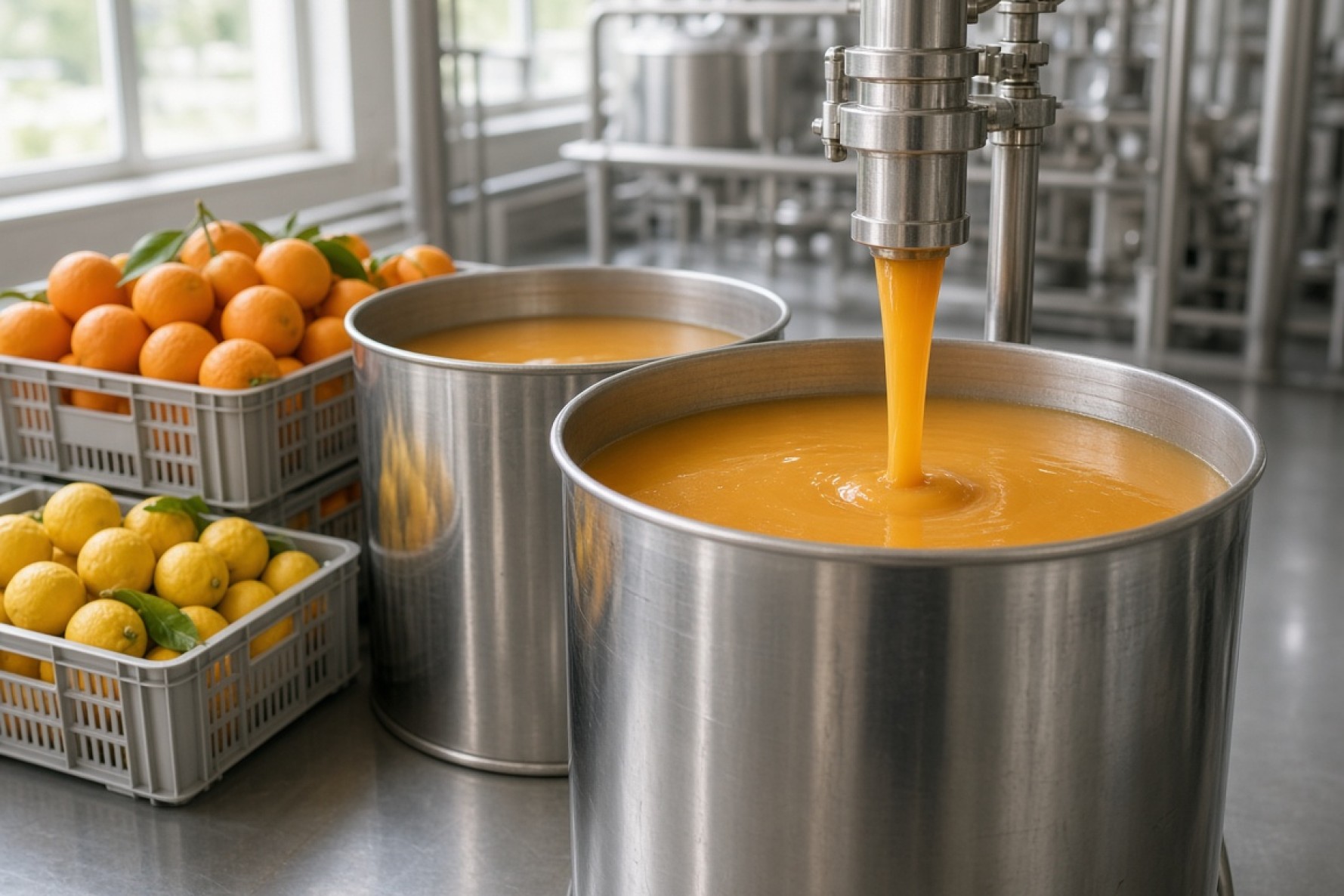
Iran’s citrus industry has shifted from fresh-fruit sales toward value-added industrial products. Distinct climates along the Caspian and in southern plains yield about 5.6 million tonnes of oranges, mandarins, limes and grapefruit each year. Climate shocks and citrus greening in Brazil and Florida have tightened global concentrate supply and pushed buyers toward new origins. Iran’s North–South corridor, Caspian access to Russian ports and proximity to the Gulf and Iraq create a clear commercial opportunity—provided physicochemical specs (Brix/acid, formol number, colour stability, toxicology) and destination hygiene rules are met.
1. Production ecosystem and processing capacity
Official agricultural data put annual citrus output above 5.6 million tonnes: roughly 3.4 Mt oranges, 800 kt mandarins, 500 kt sour lime and about 700 kt sweet lime and grapefruit—placing Iran among the world’s top ten citrus producers.
Northern and southern production hubs
- North (Mazandaran & Gilan): Mazandaran alone exceeds 3.5 Mt; Qaemshahr, Babol, Sari and Tonekabon are core orchards. Caspian humidity yields juicy oranges with mild acidity and golden colour. Most legacy extraction plants sit on the Mazandaran coast.
- South (Fars, Kerman & Hormozgan): Jahrom, Qir-o-Karzin, Darab, Jiroft and Kahnuj dominate subtropical belts. Qir-o-Karzin (~38 t/ha, ~171 kt/year) is Iran’s lime capital; intense sunshine raises primary Brix and acidity.
Seasonal harvest and processing calendar
- North: Mandarin from mid-autumn (Aban); local and Thomson Navel oranges peak from early Azar through late Bahman; fresh aseptic concentrate is typically ready in Dey–Bahman.
- South: Sour lime from early Shahrivar through Aban; grapefruit and southern oranges from early winter through Esfand.
2. Export concentrate typology
- Golden orange: Export backbone from Thomson Navel and northern locals; sugar–acid balance; Brix 60–65; ideal for 100% reconstituted juice and nectars.
- Blood orange: Natural anthocyanins; ruby colour; Brix 45–60; premium beverages and confectionery.
- Southern sour lime: Acidity 23–32% as anhydrous citric acid; pH 1.8–2.8; syrups, carbonates, sauces.
- Mandarin: Dense carotenoids and aroma; Brix 50–60; single-fruit nectar or orange blend.
- Grapefruit: Yellow or red flesh; controlled naringin bitterness; Brix 55–60; diet and isotonic drinks.
| Type | Brix | Acidity % | pH | Formol min. | Main use |
|---|---|---|---|---|---|
| Golden orange | 60–65 | 4.0–8.0 | 2.5–4.0 | 50 | NFC juice, nectar |
| Blood orange | 45–60 | 4.0–7.5 | 2.5–4.0 | 50 | Specialty drinks, confectionery |
| Southern lime | 37–45 | 23.0–32.0 | 1.8–2.8 | 65 | Syrup, sauce, soft drinks |
| Caspian mandarin | 50–60 | 4.0–7.0 | 2.8–3.8 | 45 | Nectar, colour/aroma boost |
| Grapefruit | 55–60 | 4.5–8.0 | 2.5–3.7 | 75 | Isotonic, diet nectar |
3. Industrial processing and concentration technology
Wash, sort and prep
Fruit is washed in flumes with high-pressure jets, then food-grade sanitised, brushed and visually sorted. Even a small share of immature or damaged fruit sharply raises microbial load and bitterness.
Low-bitterness extraction
Peel oil sacs and albedo carry limonin precursors. Cup extractors with hollow plungers draw core juice without rupturing oil glands or contacting outer peel.
Clarification, vacuum evaporation and aroma recovery
- Screw filters, vibrating screens and centrifuges; pulp typically held below 6–8%.
- Single-strength juice at 9–12° Brix is concentrated to ~65° in falling-film vacuum evaporators at 45–60°C to avoid cooked flavour.
- Aroma-recovery columns capture early volatiles and return them to the concentrate.
- Plate/tubular pasteurisation at 90–95°C for a few seconds inactivates PME and stabilises the cloudy phase.
4. Physicochemical QC and laboratory specs
Every export lot needs an official COA. Core tests: Brix (refractometer at 20°C), titratable acidity, Brix/acid ratio (typically 10–16 for golden orange), formol number (authenticity), relative density (≥1.31 at 65° Brix), total ash 2.5–5.0%, ethanol ≤0.15 g/kg, plus Codex-aligned pesticide MRL and heavy-metal screens.
| Parameter | Orange | Lime | Reference method |
|---|---|---|---|
| Brix | Min. 60.0 | Min. 37.0 | Refractometry 20°C |
| Total acidity | 4.5–8.0% | 23.0–32.0% | Citric acid titration |
| Formol number | Min. 50 | Min. 65 | Formol titration |
| Total ash | 2.5–5.0% | 2.5–5.0% | 550°C furnace |
| Ethanol | Max. 0.15 g/kg | Max. 0.15 g/kg | Enzymatic / GC |
| HMF | < 20 mg/L reconstituted | < 10 mg/L reconstituted | HPLC |
| Aseptic TPC | < 10 CFU/g | < 10 CFU/g | YDA plate count |
5. Common defects and contract clauses
| Defect | Cause | Sign | Suggested clause |
|---|---|---|---|
| Excess bitterness | Limonin / naringin | Bitter aftertaste | Limonin < 5 ppm reconstituted |
| Cloud separation | Active PME | Clear upper layer | Negative enzyme test + 24 h stability |
| Browning / cooked note | Maillard / overheating | Rising HMF | HMF cap + cold chain |
| Medicinal odour | Alicyclobacillus | Guaiacol / phenolic note | Negative spore cert. in 25 g |
| Drum fermentation | Torn aseptic bag | Alcohol rise, gas leak | Heat seal + ethanol < 0.15 |
6. International standards and destination rules
- Codex CXS 247-2005: Reconstituted orange juice min. 11.2° Brix; no undeclared sugar/acid/colour; ethanol in diluted product ≤ 3 g/L.
- EAEU TR CU: 023/2011 juice products; 021/2011 food safety; 022/2011 Russian labelling; EAC declaration; isotope authenticity checks.
- GCC GSO: GSO 1820:2021 juices/nectars; GSO 9:2022 Arabic/English labels; Halal certificate mandatory.
- Iraq COSQC: Pre-shipment CoC from accredited inspection firms.
7. Export markets and industrial demand patterns
- Russia & Belarus: Steady demand for 65° orange and 60° mandarin in 260 kg aseptic drums; Caspian sail to Astrakhan/Makhachkala under five days; FTA tariff relief.
- Iraq & Kurdistan: Orange and high-acid lime; road delivery via Mehran, Khosravi, Bashmaq, Parvizkhan.
- UAE & GCC: Blood orange, grapefruit and premium lime; Bandar Abbas to Jebel Ali/Sohar in 1–3 days; strict aseptic and Halal rules.
- Kazakhstan & Uzbekistan: Confectionery and beverages; rail via Sarakhs/Incheh Borun.
| Market | Top products | Brix / quality | Preferred corridor |
|---|---|---|---|
| Russia | Golden orange, mandarin | 60–65, cloud stability | Caspian / Astara |
| Iraq | Orange, southern lime | Brix 60; lime acid >25 | Western road borders |
| UAE | Blood, lime, grapefruit | Premium + Halal | Bandar Abbas → Jebel Ali |
| Kazakhstan | Orange, mandarin | Brix 60 + high formol | Sarakhs rail / Caspian |
8. Global dynamics, Brazil shock and competitors
Brazil supplies over 70% of world FCOJ trade. Drought and greening in São Paulo and Minas Gerais cut harvests toward 230 million boxes at troughs and pushed NY futures near USD 5/lb solids. Turkey is the regional rival with EU-grade plants but high energy costs; Egypt offers cheap Valencia fresh fruit yet limited aseptic concentration. Iran’s competitive energy, Caspian access and north/south variety mix support a durable price–quality position.
| Country | Advantage | Constraint | Core markets |
|---|---|---|---|
| Brazil | Bulk ocean logistics | Greening, low stocks | EU, USA, China, Japan |
| Iran | Energy, Caspian, aroma | Reefer scarcity at peak | Russia, EAEU, Iraq, GCC |
| Turkey | EU standards, marketing | Energy & FX cost | Russia, E. Europe, Iraq |
| Egypt | Valencia volume, labour | Focus on fresh fruit | GCC, Russia, Africa |
9. Customs regime, HS codes and documents
- 2009.11.00 — Frozen concentrated orange juice (FCOJ)
- 2009.12.00 — Orange juice ≤ 20° Brix
- 2009.19.00 — Other orange juice / aseptic concentrate > 20° Brix (main 65° aseptic code)
- 2009.29.00 — Grapefruit concentrate > 20° Brix
- 2009.39.00 — Other citrus (lime, mandarin, sweet lime)
Required papers: B/L or CMR, commercial invoice & packing list, certificate of origin (CT-3 for EAEU), phytosanitary certificate, lab COA and Halal for GCC ports.
10. Export packaging and pallet standards
- Aseptic bag-in-drum: Multilayer PE + aluminium/EVOH bag, 260 kg; steel drum 1–1.2 mm with food-grade epoxy-phenolic lining.
- Frozen non-aseptic: Double PE liners frozen to −18°C for buyers with deep-freeze warehouses.
- Palletising: HT wood pallets per ISPM 15; 4 drums per pallet; polyester strapping and stretch wrap; filled pallet ≈ 1,120 kg.
11. International logistics and cold chain
- Frozen: −18°C (±2); aseptic: 0 to +4°C.
- 40′ High Cube reefer: 20 pallets, 80 drums, 20,800 kg net, ≈22,500 kg gross; at least two temperature data loggers.
| Route | Transit | Temperature | Advantage |
|---|---|---|---|
| Amirabad/Anzali → Astrakhan | 3–5 days sea | −18 or 0–4°C | Avoids Caucasus road queues |
| Astara → Moscow | 6–9 days road | 0–4°C aseptic | Factory-door delivery |
| Bandar Abbas → Jebel Ali | 1–2 days | 0–4°C | Low freight, quick hub access |
| Mehran/Parvizkhan → Baghdad | 2–3 days | Cool / controlled | Simple border formalities |
12. Industrial uses, importer checklist and quoting
- 100% juice: 65° concentrate ≈ 5.5× purified water to 11.2° Brix; re-add aroma.
- Nectar: ≥50% natural juice solids under international rules.
- Soft drinks: lime >25% acidity; grapefruit in isotonic formulas.
- Dairy/ice cream: moderated acidity for casein stability; confectionery: shorter cook times and lower water activity.
For a comparable quote, state product type, Brix and acidity, packaging, tonnage or FCL count, loading window, Incoterms delivery point and special certificates (CT-3, Halal, phytosanitary). Iranco helps compare producers, arrange lab samples and COAs, and coordinate reefer logistics.
Summary
Iranian citrus concentrate export builds on 5.6 Mt of fruit and modern vacuum evaporators, securing a strong role in Middle East and Eurasian supply chains. As Brazil’s greening shock tightens global supply, Iran is a credible alternative origin. Durable trade depends on Brix, acidity, formol number, bitterness control, aseptic packaging, cold chain and TR CU / GSO compliance.
FAQ
What is the standard Brix for Iranian export orange concentrate?
Commercial standard is 60–65° refractometric at 20°C—maximising dry matter and cutting freight per reconstituted litre.
Why choose aseptic drums over frozen concentrate?
Frozen needs continuous −18°C; aseptic multilayer bags in 260 kg drums allow safe storage and shipping at 0 to +4°C while blocking air and microbes.
Why is the formol number critical?
It reflects natural fruit amino acids and is the main authenticity test against sugar, citric acid or water adulteration.
What is required to enter the Russian market?
Compliance with TR CU 023/2011 and 021/2011, an EAC declaration, Russian labelling and a CT-3 certificate of origin for preferential tariffs.
How do you prevent limonin bitterness?
Tune cup-extractor pressure and, if needed, use resin debittering columns; contract limonin < 5 ppm reconstituted.
How much fits in a 40′ reefer?
20 four-drum pallets, 80 × 260 kg drums, 20.8 t net and about 22.5 t gross.
Ideal aseptic shipping temperature?
0 to +4°C to protect pigments, limit Maillard browning and keep flavour fresh.
What details are needed for a firm quote?
Species, Brix, sugar/acid ratio, packaging, volume, Incoterms delivery point and special certificates.
Main sea corridor to Eurasia?
Caspian reefer sailings from Amirabad, Anzali and Nowshahr to Astrakhan and Makhachkala in 3–5 days.
How to source directly from Iranian plants?
Define technical specs and submit a purchase request on Iranco to shortlist suppliers, obtain samples/COAs and arrange reefer logistics.
Featured Products








Related Articles



