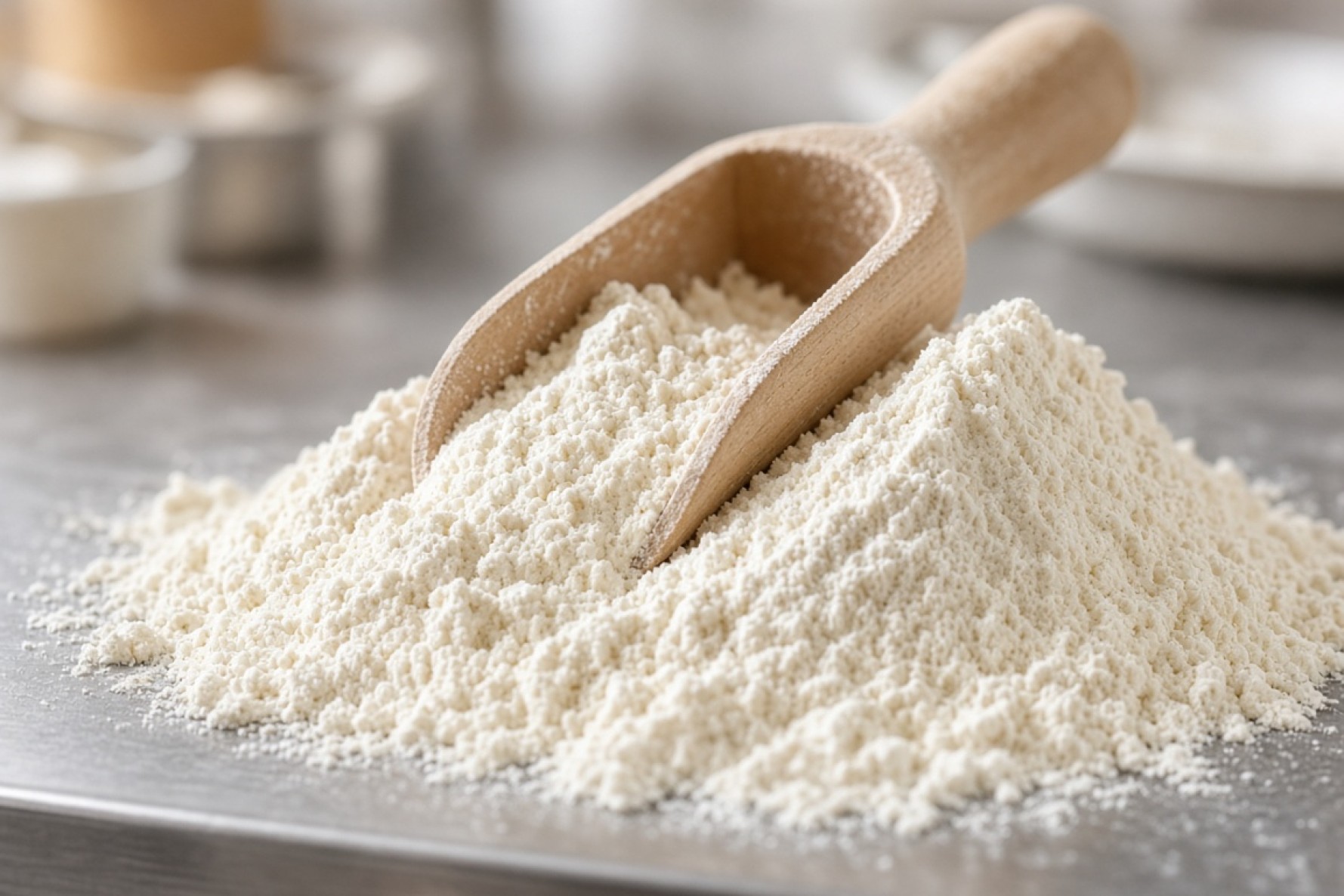
 Iranco Magazine Team
Physicochemical specs, gluten rheology, QC tests and industrial null-flour buying principles for cake, cookie and biscuit lines
Specialist Guide · Quality & Standards
Pastry Flour: Protein, Gluten and Industrial Procurement Criteria
Physicochemical specs, gluten rheology, QC tests and industrial null-flour buying principles for cake, cookie and biscuit lines — published in Iranco Magazine.
This specialist guide reviews the protein structure, gluten traits and rheological indices of pastry flour at industrial scale, and explains how raw-material technical specs link directly to continuous bakery line efficiency. Procurement managers, buyers and QC specialists can use these criteria to optimise null-flour supply, cut line waste and stabilise finished-product texture.
| Key index | Standard value or range |
|---|---|
| Allowed protein range (dry basis) | 7.0 to 10.0% |
| Wet gluten and gluten index | 20 to 27% with index 60 to 85 |
| Total ash (dry basis) | 0.380 to 0.500% |
| HS code for wheat flour | HS Code 11010000 |
Wheat flour forms the structural, textural and organoleptic base of bakery products. Among mill grades, pastry flour — defined in Iran’s national standard as null (noll) flour — is the primary raw material for industrial cake, cookie, biscuit, wafer and confectionery plants. Unlike bulk and semi-bulk breads that need a strong, elastic gluten network to hold fermentation gases, confectionery and biscuit processes need a fine balance between viscous and elastic proteins. Uncontrolled gluten development leads to tough crumb, poor dough spread in moulds, geometric distortion and shrinkage after baking.
Iran’s milling industry — more than 380 modern mills with nominal capacity above 27 million tonnes per year — has strong extraction and blending capability. Even so, variable incoming wheat quality keeps delivered lots swinging. Factory purchasing of pastry flour goes far beyond colour whiteness: buyers must master advanced rheology data — farinograph, alveograph, falling number, particle size and starch damage.
1. Biochemistry of wheat proteins and gluten-network dynamics
Wheat flour proteins are classed by solubility into albumins, globulins, gliadins and glutenins. Albumins and globulins (~15% of total grain protein) concentrate in outer layers and germ and are mostly enzymatic. Gliadins and glutenins — endosperm storage proteins — make up more than 80–85% of total protein and, with water and mechanical energy, form the continuous gluten network.
Gliadins are single-chain, relatively low-molecular-weight proteins stabilised by intramolecular disulphide bonds; they drive viscosity, flow, fluidity and extensibility. Glutenins are very high-molecular-weight polymers linked by intermolecular disulphide bonds; they deliver elasticity, spring-back and resistance to deformation. On continuous cake and confectionery lines, restraining glutenin structure is critical — mixer shear must not build dense peptide networks.
In a closed pastry dough system, water is partitioned among ingredients. Sucrose’s strong hydrophilicity binds free water and limits full hydration of gliadin and glutenin chains, restraining gluten formation. Specialty fats create a hydrophobic film on starch granules and protein strands — the classic shortening effect. If incoming flour protein exceeds 10%, base fat and sugar levels cannot cover the excess protein, and baking yields a rubbery, dense, uneven crumb instead of a soft sponge.
2. Pastry null-flour grades versus other industrial flours
Flour classification in Iran follows national standard No. 103, driven mainly by bran extraction and residual ash. The wheat kernel comprises starchy endosperm (~82%), bran (~14.5%) and oily germ (~3.5%). Pastry null flour is taken from the centre of the endosperm and has the highest bran extraction.
Industrial null-flour bran extraction sits in the 23–28% band — about 72–77 kg pure flour per 100 kg wheat. Ash is measured by incineration at 550–600 °C; good null flour lies between 0.380 and 0.500%.
| Technical parameter | Pastry null flour | Fancy star flour | Tafton & lavash flour | Whole wheat | Pasta semolina |
|---|---|---|---|---|---|
| National standard | ISIRI 103 | ISIRI 103 | ISIRI 103 | ISIRI 103 | ISIRI 103 |
| Approx. bran extraction | 23–28% | 18–21% | 12–15% | 0–5% | Durum-specific extraction |
| Total ash (dry basis) | 0.380–0.500% | 0.550–0.650% | 0.800–1.00% | 1.30–1.70% | 0.700–0.900% |
| Total protein (dry basis) | 7.0–10.0% | 10.5–12.5% | 10.0–12.0% | 11.5–13.5% | 12.0–15.0% |
| Wet gluten | 20–27% | 27–31% | 24–27% | 22–26% | 26–32% |
| Residue on 132 µm sieve | Max 2.0% | Max 5.0% | 10–15% | 50–70% | Coarse granular |
| Colour & appearance | Very bright white, crystalline | White to cream | Dark cream with bran flecks | Light brown with husk particles | Amber-yellow granular |
Star flour’s lower bran extraction and higher ash make it unsuitable for industrial biscuit and sponge-cake lines. Stronger gluten restricts even dough spread in forming dies and drives breakage and colour unevenness in the oven.
3. Advanced rheological indices and dough behaviour
Kjeldahl crude protein alone cannot predict continuous-line dough behaviour. Physical and mechanical dough properties must be measured with farinograph, Chopin alveograph and enzyme-activity equipment.
Key rheological parameters
- Farinograph: water absorption, development time, stability, degree of softening
- Chopin alveograph: tenacity (P), extensibility (L), configuration ratio (P/L), deformation energy (W)
- Alpha-amylase activity: Hagberg–Perten falling number
- Starch integrity: mechanically damaged starch percentage
Farinograph dough behaviour
- Water absorption: quality pastry null flour typically absorbs 50–54%. High absorption often signals starch damage and leads to uneven evaporation and cake-crust blistering.
- Development time: standard pastry flour should reach peak in 1.0–2.5 minutes to avoid over-mixing energy waste.
- Stability: optimal for cake and wafer is 1.5–3.5 minutes. Stability above 6 minutes indicates tight gluten bonds unsuitable for industrial cake and biscuit lines.
- Degree of softening: drop after 10–12 minutes of mixing; higher softening helps soft biscuit doughs without elastic spring-back.
Chopin alveograph and bubble behaviour
- Tenacity (P): for pastry flour keep low, typically 35–55 mm.
- Extensibility (L): optimal pastry range 70–100 mm.
- P/L ratio: for cake, cookies and soft biscuits keep below 0.60. Above 0.80 yields stiff dough hard to drive through piston depositors.
- Deformation energy (W): soft cake/biscuit flour should sit at 90–140 ×10⁻⁴ J. Values above 200 suit bulk breads or laminated doughs.
Falling number and alpha-amylase
- Below 200 s: field sprouting; uncontrolled starch hydrolysis collapses cake structure, sticky crumb and deep centre sinking.
- 250–350 s: desirable pastry band — enough reducing sugars for Maillard flavour without weakening cell walls.
- Above 400 s: insufficient enzyme activity; dry texture, lower aeration volume and faster staling.
4. Pastry-flour fit matrix for industrial bakery products
High-speed conveyors leave little room for raw-material quality error. Flour specs must match each product’s formulation.
| Target product | Protein % | Wet gluten | Gluten index | P/L | W (10⁻⁴ J) | FN (s) | Particle size |
|---|---|---|---|---|---|---|---|
| Sponge & roll cake | 7.5–8.5 | 22–24 | 60–70 | 0.40–0.50 | 90–120 | 250–300 | 98% under 125 µm |
| Oil cake & muffin | 8.5–9.5 | 23–25 | 65–75 | 0.50–0.65 | 110–130 | 260–320 | 95% under 125 µm |
| Soft moulded biscuit | 7.0–8.0 | 20–23 | 55–65 | 0.35–0.45 | 80–100 | 280–350 | Coarser; 60% on 100 µm |
| Hard biscuit & cracker | 9.5–11.0 | 25–27 | 70–80 | 0.60–0.75 | 130–160 | 240–280 | 80% under 125 µm |
| Puff pastry & pie | 9.5–10.5 | 27–29 | 75–85 | 0.80–1.10 | 220–260 | 280–350 | 90% under 140 µm |
| Wafer sheets | 7.0–8.0 | 19–21 | 50–60 | 0.30–0.40 | 70–90 | 300–360 | Fine, uniform powder |
Sponge cake requirements
Retaining air bubbles in whipped egg-white proteins is central to sponge cake. Strong gluten blocks early expansion and thickens cell walls. Flour must be low-protein and finely micronised for fast dissolution and even distribution.
Soft moulded biscuit requirements
Soft biscuits are fat- and sugar-rich; dough must not spring back. Elastic dough contracts after rotary moulding and fractures in pillow-pack. Minimum wet gluten and a low gluten index are non-negotiable.
Hard biscuit and cracker requirements
Cracker dough passes multiple sheeting rolls and is laminated. Flour needs a coherent but controlled elastic network so sheets do not tear, yet internal stress must not shrink the biscuit in the oven. Mills sometimes add small sodium metabisulphite or protease doses to weaken disulphide bonds.
Puff pastry and croissant requirements
Laminated doughs need hundreds of alternating dough and fat layers. Oven steam pressure must be held by elastic dough films so layers separate. Unlike most pastry uses, this needs stronger null flour with W above 220 for a crisp, flaky structure.
Wafer sheet requirements
Wafer batter is a high-flow liquid poured onto cast-iron plates. Active gluten clogs nozzles, sticks to plates and causes local burning. Wafer flour needs the lowest wet gluten and minimal starch damage.
5. Milling technology, particle size and flour ageing biochemistry
Pastry flour extraction and optimisation steps
- Primary cleaning, destoning and tempering (15.5–16.5% moisture for 24–36 hours)
- Break rolls to open the kernel without pulverising bran
- Purifiers and round sieves to strip bran particles
- Gradual reduction on smooth rolls with minimal heat stress
- Rest silos for 10–21 days to complete natural oxidation
Tempering and mechanical reduction
Wheat is cleaned then tempered to 15.5–16.5% moisture. A 24–36 hour temper makes bran elastic and endosperm brittle. Excess reduction pressure crushes starch granules and raises damaged starch.
Particle-size targets
- 100% through 475 µm
- Less than 0.5% residue on 180 µm
- More than 90–95% through 132 or 125 µm
Wide particle spreads cause uneven hydration: fines under 50 µm lump quickly, while particles above 150 µm stay dry and gritty in finished sweets.
Flour ageing and sulphydryl oxidation
Using flour immediately after milling is a major industrial error. Fresh flour is slack, wet and sticky because free sulphydryl (-SH) groups on glutenin and gliadin chains drive thiol–disulphide exchange and block stable structure.
During 10–21 days of silo rest at 15–22 °C, atmospheric oxygen slowly converts sulphydryl groups into covalent disulphide (S–S) bridges. Elasticity and dough strength reach a stable balance. Native lipoxygenase also bleaches yellow carotenoids. Fresh flour on continuous cake lines causes severe volume loss and wall collapse.
6. Plant QC, acceptance tests and legal limits
Every null-flour lot at the factory gate needs standard sampling, physicochemical tests to ISIRI 103 and hygiene checks to ISIRI 2393.
| Test parameter | National limit | Method | Line risk if out of range |
|---|---|---|---|
| Moisture | Max 14.2% | 105 °C oven, ISIRI 2705 | Caking and mould activity |
| Total ash | 0.380–0.500% | 600 °C incineration | Bran ingress; dull crumb |
| Acid-insoluble ash | Max 0.05% | Boiling HCl digestion | Stone/sand; poor cleaning |
| Aqueous pH | 5.6–6.5 | Potentiometric, ISIRI 37 | pH <5.4 signals fat hydrolysis |
| Acidity (as H₂SO₄) | Max 2.4° | Acid–base titration with NaOH | Sharp taste, oxidative rancidity |
| Sunn-pest damaged wheat | Max 2.0% kernels | Count + sedimentation | Bug protease destroys gluten |
| Wet gluten | 20–27% | Glutomatic wash | Hard biscuit or cake crumb collapse |
| Gluten index | 60–85 | Centrifugal force | Index <60: sticky, slack dough |
| Lead residue | Max 0.15 mg/kg | Graphite-furnace AAS | Cumulative toxicity; health cert void |
| Cadmium residue | Max 0.10 mg/kg | Graphite-furnace AAS | Kidney/bone harm; food-law fail |
| Deoxynivalenol (DON) | Max 1000 µg/kg | HPLC | Heat-stable Fusarium mycotoxin |
| Bacillus cereus | Within legal cfu/g | Mannitol egg-yolk agar | Oven-stable toxin; rope spoilage |
| Moulds & yeasts | Within legal cfu/g | ISIRI 2393 | Surface mould; mid-layer souring |
Failure on acid-insoluble ash, sunn-pest damage or fungal contamination is grounds for outright lot rejection by the plant laboratory.
7. Packaging standards, warehousing and supply-chain control
Best-practice pastry flour supply chain
- Multi-ply kraft or laminated PP bags with airtight stitching
- Stainless pneumatic bulk tankers for mega plants to eliminate bag waste
- Warehouse RH 55–60% and temperature below 22 °C
- Pallet spacing 50 cm from walls; max 10 bag layers
- FIFO rotation and non-chemical pest monitoring
Industrial packaging options
- Laminated woven PP: best for long hauls in 25, 40 and 50 kg — laminate blocks humidity exchange in humid climates.
- Multi-ply kraft: gold standard for premium export packs; mechanical breathability with less electrostatic dust.
- Bulk stainless tankers: for plants using over 20 t/day, pneumatic transfer from mill silos to plant silos supports HACCP and cuts labour, bag-fibre contamination and weight loss.
Storage dynamics
- Humidity: keep RH ≤60% or lipase activates and flour turns rancid.
- Pallet layout: ≥20 cm off the floor, ≥50 cm from walls; max 8–10 layers.
- FIFO: avoid holding beyond 4 months in warm seasons or 6 months in cold seasons.
- Pests: pheromone traps; aluminium phosphide fumigation only under expert supervision with full aeration.
8. Market economics, cost drivers and regional trade outlook
Industrial pastry flour production is tightly tied to wheat allocation and subsidies. With ~27 Mt nominal milling capacity and ~11.5 Mt domestic use, roughly 15 Mt of spare capacity remains. Leading mills can therefore run modern equipment and supply custom grades to industrial buyers.
Pastry flour cost-of-goods drivers
- Official trade-and-industry wheat rate or imported wheat price by tonnage
- Weight loss from bran extraction (25–28% of kernel)
- Hard/soft wheat blending and formulation cost
- Pack type and thickness (laminated PP or kraft)
- Bühler line depreciation, power and direct labour
- Road logistics to the buyer’s weighbridge
Roughly 1.35 kg wheat is milled per kg of pastry null flour with ash below 0.450. About 25–28% becomes bran sold cheaper as animal feed. Mills blend hard Golestan/Khuzestan wheats with softer western rain-fed stocks to hit 8–9% protein pastry targets.
A commercial advantage is Article 51 temporary wheat admission: mills import Russian or Kazakh wheat via northern ports without final import duty, process it, and export null flour under HS 11010000 to neighbouring markets.
| Destination | Dominant grade | Preferred pack | Active rivals | Iran transit edge |
|---|---|---|---|---|
| Iraq | Null flour, medium–high gluten | 50 kg PP bags | Turkey, UAE | Western land borders; fast road delivery |
| Afghanistan | All-purpose white flour | 50 kg bags | Kazakhstan, Uzbekistan | Rail/road via Dogharoun and Milak |
| Oman & Qatar | Premium null flour to Gulf specs | 25 kg kraft | Turkey, India, Australia | Short southern sea corridors |
| Armenia & Caucasus | Soft pastry flour for traditional sweets | 25 kg containerised pallets | Russia | Flexible lots with custom grades |
Iranco streamlines technical RFQs, capacity checks and mill coordination across Iran’s milling base.
9. Importer and procurement checklist before order
- Lock dry-basis ash limits in the contract — do not accept vague “white flour” wording
- Specify numeric protein and wet-gluten ranges for the finished product
- Set alveograph P/L and W acceptance windows
- Require written proof of 10–14 days minimum flour rest
- Take a sealed retain sample and test independently before main loading
- Mandate microbiology certificates to ISIRI 2393
- Check pesticide residues, lead, cadmium and mycotoxins on the COA
- Cap inter-lot protein swing at ±0.3%
- Define bag laminate, fabric weight, stitch strength and shrink-palletising
- Specify clean, odour-free vehicles with sound waterproof covers
- Add a lab-arbitration clause for destination test disputes
10. What to send for an accurate price quote
- Flour type/grade: pastry null flour with target bran extraction
- Total ash (dry basis): max 0.450 or 0.500%
- Protein (dry basis), e.g. 8.0–9.0% by Kjeldahl
- Wet gluten and gluten index, e.g. 22–24% with index 60–70
- Falling-number window in seconds
- Dedicated rheology: P/L and W bands if the line is sensitive
- Granulation: pass rates on 180 and 132 µm sieves
- Order volume and delivery cadence (daily/weekly/monthly lifts)
- Pack: laminated PP, 3-ply kraft, or bulk tanker
- Exact delivery point and Incoterms for export orders
Buyers can file this RFQ through Iranco so leading mills quote on identical technical terms.
11. Place an industrial pastry flour request with Iranco
Stable industrial pastry flour supply is not a seasonal spot purchase. Tiny swings in gluten structure or particle size can stop forming and baking equipment with million-scale losses. Year-round physicochemical uniformity, rested loads and hygiene control are core concerns for procurement and QC teams.
Iranco connects confectionery, chocolate, cake and biscuit plants to Iran’s best-equipped mills. Industrial buyers can register protein %, gluten index, bag type and bulk or palletised transport as a formal request.
12. Analytical summary
Pastry flour in industrial baking is a sensitive biochemical system that shapes texture, porosity, crispness and volume. Procurement has moved from price-only decisions to cereal-engineering metrics: glutenin/gliadin viscoelasticity, alveograph W, falling number and ash. High-speed lines leave no room for raw-material trial-and-error. Buying on valid COAs, monitoring flour rest and respecting national standards protects yield and capital returns.
FAQ
Why must pastry flour protein be much lower than bread flour?
With water, wheat proteins form a continuous gluten network. In cake and biscuit, strong elastic gluten blocks even gas expansion and yields dense, shrivelled crumb. Pastry flour needs about 7–10% protein to keep tenderness and crispness.
How do null and star flours differ under ISIRI 103?
Null flour comes from central endosperm at 23–28% bran extraction with ash max 0.500%. Star flour extracts less bran (~18–21%) with ash up to 0.650% and higher protein — better suited to bulk breads.
What does a low falling number do to industrial cake lines?
Falling number below 200 s means high alpha-amylase. In the oven, starch breaks down too far, batter over-slacks, crust stays wet and centres sink.
Why do continuous-line biscuits shrink after moulding?
Shrinkage usually comes from high gluten, high gluten index or unbalanced alveograph P/L. Springy dough pulls back after rotary forming and ruins geometry.
Why is fresh-milled flour banned in pastry plants?
Free -SH groups keep dough slack and sticky. After 10–21 days of natural oxidation, stable S–S bridges form and mechanical behaviour settles.
How can buyers source stable, on-spec pastry flour?
Start with a precise COA (ash, protein, wet gluten, rheology). Submit the demand via Iranco to shortlist mills with farinograph labs and retain samples.
What are the main purity indices for null flour?
Dry-basis total ash, acid-insoluble ash (silica/sand) and sieve particle size are the core markers of wheat cleanliness and bran separation accuracy.
What are the advantages of bulk tanker delivery versus bags?
Bulk removes unloading labour, bag-cling weight loss, thread/fibre contamination risk and rupture waste, while improving hygienic line safety.
Featured Products
Related Articles



