 Iranco Magazine Team
France food import market analysis — high-demand groups, land and sea routes, border controls, food safety requirements, tariffs and VAT, and practical notes for Iranian suppliers
Market Report · Food Imports · France · EU Gateways
France Food Imports: Products, Routes, Regulations & Costs
France food import market analysis — high-demand product groups, EU and third-country supply routes, Le Havre and Fos-sur-Mer gateways, border health controls, EU food safety rules, tariffs and VAT, and practical notes for Iranian suppliers.
Analytical Introduction
France cannot be assessed only as a large food producer. Its market is simultaneously a producer, exporter, importer, processing hub and one of the European Union's most important consumption centres. French food industries depend on imported raw materials, and retail, food service and fresh-produce networks buy products that domestic production cannot fully satisfy in volume, season, price or product characteristics.
The nature of France's import market has also shifted in recent years. In 2025, rising imports of cocoa-containing products, meat, slaughterhouse products and dairy were among the main drivers of import growth. In raw agricultural products, coffee, cocoa and fruit also played a significant role in the increase in foreign purchases. This shows that supply opportunities are not limited to tropical goods or products France does not produce; even in meat, dairy and processed foods, intra-EU trade plays a major role.
For an Iranian exporter, the key point is that "the France market" does not necessarily mean direct discharge at a French port. Some goods destined for France first enter a port or terminal in another EU country, complete Union entry formalities and then move to France within the single market. Choosing between direct entry to France and entry via another EU member state is therefore part of supply-chain design.
France is not an easy market for goods without precise specifications. Professional buyers typically review composition, country of origin, contaminant status, pesticide residues, packaging, shelf life, transport conditions, traceability and label compliance in addition to price. For sensitive products such as pistachios, border control requirements can directly affect clearance time and importer cost.
1. Which Food Products Do French Importers Focus on Most?
France's food import market is best viewed in two parts: first, goods to which France is structurally dependent on imports; second, goods imported to complement domestic supply, manage prices or feed food industries even where France also produces.
| Product group | Main import driver | Typical buyers | Main sensitivity |
|---|---|---|---|
| Fresh fruit | Season, variety, domestic shortfall | Fruit importer, wholesaler, chain retail | Pesticides, ripeness, cold chain |
| Meat | Supply complement, regional trade | Wholesaler, industry, food service | Health approval, cold chain |
| Fish & seafood | Consumption demand, domestic limits | Distributor, restaurant, retail | Temperature, origin, safety |
| Dairy, butter & cheese | Intra-EU trade, industrial need | Food industry, retail | Composition, cold chain |
| Coffee & cocoa | Structural import dependence | Factory, processor | Origin, quality, contaminants |
| Processed fruit & veg | Industrial and retail use | Factory, distributor | Brix, composition, packaging |
| Nuts & dried fruit | Direct and industrial consumption | Nut trade, confectionery, chocolate | Aflatoxin, moisture |
| Spices & saffron | Specialist and industrial use | Wholesaler, food industry | Purity, pesticides, fraud |
Fresh fruit
Fruit is one of France's most stable import groups. Part of demand relates to products with limited or seasonal domestic production; part to tropical, semi-tropical and out-of-season fruit. Citrus, bananas, avocados, kiwifruit, grapes, berries, stone fruit and off-season products all feature in France's import network. In this market, appearance, size uniformity, firmness, ripeness at delivery, pesticide residues and cold-chain performance matter greatly.
Meat and meat products
Meat is another major import segment. 2025 data show imports equivalent to 35% of France's meat consumption. Pork imports come mainly from EU countries; beef and poultry also rely heavily on regional trade. For exporters outside the EU, entry is harder than for plant products because both the country of origin and the production establishment must meet EU eligibility rules, and every third-country animal-product shipment is subject to official border control.
Fish and seafood
France has a broad consumption market for fish and seafood. Fresh and frozen fish, fillets, crustaceans, molluscs and processed products are imported to supply retail, restaurants and food industries. Beyond microbiological safety and the cold chain, origin, species, production or catch method and, where required, legal-catch documentation carry commercial weight.
Dairy, butter and cheese
France is itself a major dairy producer, but dairy trade within Europe is active and two-way. In 2025, rising imports of butter and cheese contributed to growth in processed food imports. The idea that a country with a large dairy industry needs no imports does not reflect the market accurately.
Coffee, cocoa and chocolate products
Coffee and cocoa are among the clearest examples of France's structural import dependence. Raw materials in this group are largely not produced in France's climate, and coffee, chocolate, confectionery, bakery and dessert industries rely on international supply chains. In 2025, rising imports of cocoa and cocoa-containing foods were a main driver of food import growth, partly under the influence of sharp global cocoa price increases.
Processed fruit and vegetables
Concentrates, purées, juices, processed vegetables, canned goods, sauces and fruit-based raw materials form another import demand segment. The advantage for exporters is that the product does not necessarily enter the fresh-produce market and can be supplied against the buyer factory's technical specifications.
Cereals, bakery and ready meals
Cereal products, biscuits, bakery items, pasta, semi-finished foods and some ready-meal groups also matter in France's regional trade. Beyond price, composition, allergens, nutrition information and the ability to produce under the buyer's brand are important.
Nuts, dates, saffron and specialist raw materials
This group is not comparable in volume to fresh fruit, meat or dairy, but it matters more for Iranian suppliers. Pistachios, saffron, dates, raisins, dried fruit, nuts, extracts and some confectionery and bakery raw materials can appeal to specialist importers, wholesalers, chocolate and pastry industries and international food stores.
2. Where Does France Buy Most of Its Food?
France's supply structure is strongly European. Spain has been one of the largest and, in many periods, the leading supplier of agricultural and food products to France. Belgium, the Netherlands and Germany are also among the main suppliers. The advantage of these countries is not only production; absence of external customs formalities in intra-EU trade, short distance and a dense road network also matter.
Spain
Spain is a natural supplier to the French market for fruit and vegetables, meat and many processed foods. Trucks from Spain enter France directly by land border, and once goods are in the single market there is no third-country customs control. The Pyrenees east and west corridors — especially the Mediterranean route from Catalonia toward Perpignan and the Atlantic route from the Basque Country — are the main road corridors between the two countries.
Belgium and the Netherlands
Belgium is both a producer and a distribution hub for goods imported from elsewhere in the world. The Netherlands also plays a major role in European food trade because of its port and distribution network. Goods cleared in the Netherlands can reach France via Belgium; the dispatch country, country of origin and first EU entry point are therefore not necessarily the same.
Germany and Italy
Germany is active in processed foods, dairy, meat and industrial food goods. Italy also has an active market in France beyond fresh products, especially in pasta, cheese, tomato products, oils and processed foods.
Countries outside the EU
For tropical products and raw materials such as coffee, cocoa, fish, some fruit, oilseeds and specialist goods, third countries play a larger role. In this trade, the port or airport of first entry into Union territory gains legal and sanitary importance.
3. Through Which Routes and Gateways Do Most Food Imports Enter France?
The answer depends on origin. For EU goods, road transport and land borders are the main practical trade structure. For third countries, seaports and border control posts become more important.
Land routes from the EU
When goods are purchased from Spain, Belgium, Germany or Italy, truck transport is usually the fastest and most flexible method. France is in the EU single market, and movement across internal Union borders does not involve third-country customs formalities. The term "import border" for European trade should not be confused with external customs.
Le Havre
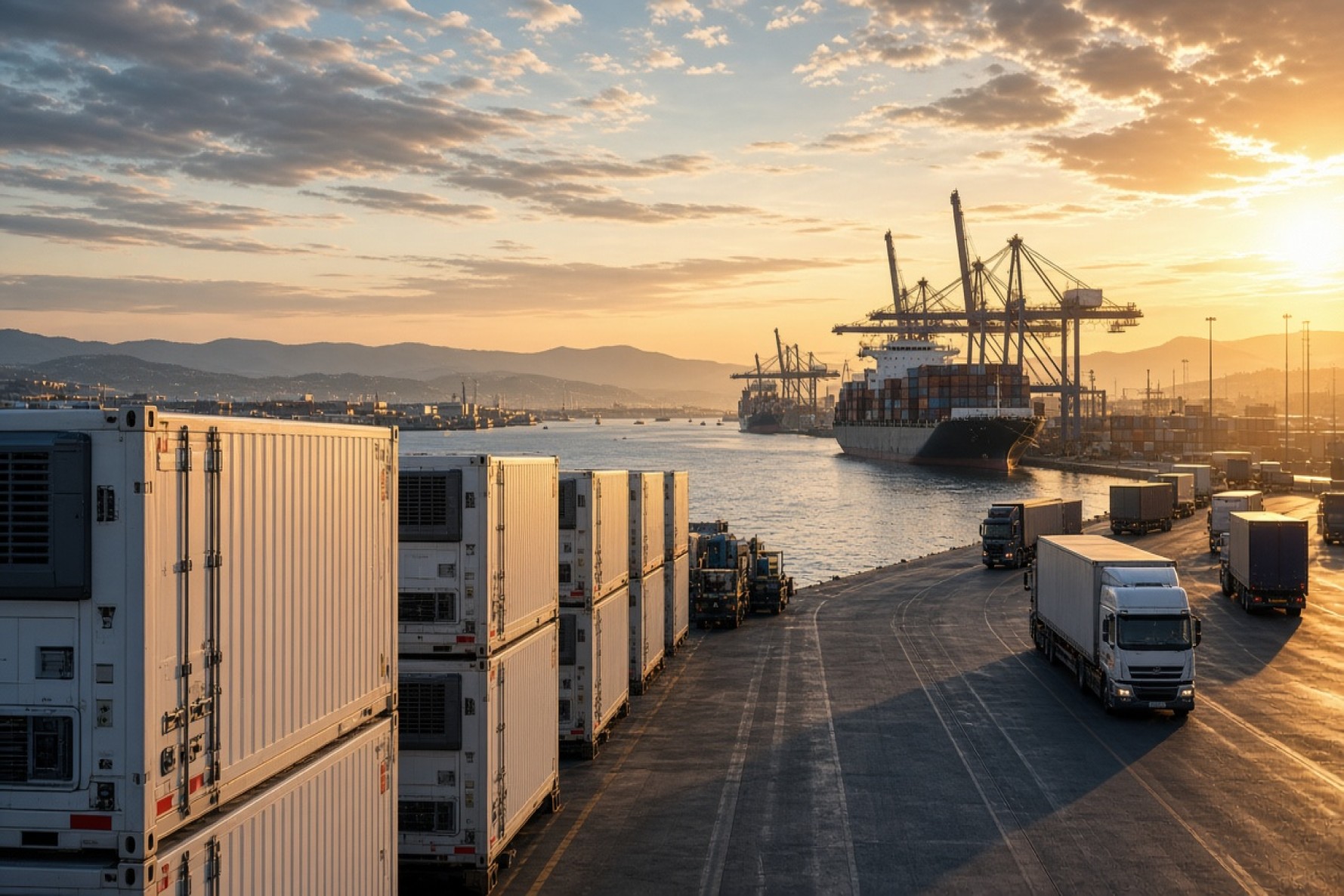
Le Havre is one of northern France's important container gateways and a major option for ocean-routed cargoes. It is listed among authorised border control posts for animal products and related entry points for certain plant and non-animal groups. For coffee, cocoa, nuts, packaged raw materials, seafood and many containerised goods, entry from northern France offers logistical advantage for Paris and industrial areas in the north and centre of the country.
Fos-sur-Mer and the Marseille area
For goods moving from the Mediterranean, Middle East, North Africa or via the Suez Canal, the Fos-sur-Mer and Marseille area is the more natural route. Fos-sur-Mer is on the official list of entry posts for animal products and some non-animal and plant groups. For an Iranian exporter choosing sea freight, comparison of Fos versus Le Havre should be based on shipping line schedules, transshipment port, transit time, final destination inside France and the ability to perform the required control for that product.
Dunkirk, Calais and the Channel Tunnel
Dunkirk and Calais matter for trade with northern Europe and Britain. After the UK's exit from the EU, food entering the Union from Britain is subject to third-country rules. Calais and the Channel Tunnel have control points for various product groups.
Paris Charles de Gaulle (CDG)
Paris Charles de Gaulle airport is an official entry and control point for several product groups including animal products and some plant products. Air freight is usually not rational for cheap, bulky foods, but it can be justified for high value-to-weight products or goods with high time sensitivity.
| Origin / flow | Main route | Key gateways | Best suited to |
|---|---|---|---|
| Spain | Road | Pyrenees land border | Fruit, vegetables, meat |
| Belgium & Netherlands | Road | Northern France | Dairy, meat, processed, goods cleared in north-EU ports |
| Germany | Road | Eastern France | Industrial foods, dairy |
| Italy | Road | Alps, south-east routes | Cheese, pasta, processed foods |
| Oceanic origins | Sea | Le Havre | Coffee, cocoa, dry and reefer containers |
| Mediterranean & Middle East | Sea | Fos-sur-Mer, Marseille | Nuts, raw materials, container cargo |
| United Kingdom | Ship & tunnel | Calais, Channel Tunnel | Wide range of food products |
| Fast, high-value cargo | Air | Charles de Gaulle (CDG) | Samples, special fresh goods, saffron, high-value items |
4. What Specifications Do French Buyers Require When Ordering Food?
In France's professional market, product name and price alone are not enough for negotiation. A purchase request should resemble a technical specification sheet.
| Parameter | Example requirement | Importance |
|---|---|---|
| Exact product name | Fresh, dried, frozen, processed | Rules and tariff code |
| Country of origin | Actual place of production | Customs and health control |
| Composition | Percentage of ingredients | Label and classification |
| Moisture | For nuts and dry goods | Shelf life and mould |
| Size and grading | Fresh or dried product | Price and application |
| Pesticide residues | EU MRL compliance | Safety and clearance |
| Contaminants | Aflatoxin, metals, related limits | Legal acceptance |
| Microbiological profile | Product-appropriate criteria | Food safety |
| Packaging | Consumer or bulk | Sales channel |
| Net weight | Per pack and carton | Contract and label |
| Shelf life | Duration and storage conditions | Distribution planning |
| Transport temperature | Where required | Quality retention |
| Label | French and regulation-compliant | Legal sale |
| Order quantity | Pallet, shipment or container | Price calculation |
| Delivery point | Port, warehouse or city | Final cost calculation |
For nuts and dried fruit, an approved sample must be accompanied by measurable criteria. Moisture percentage, breakage, foreign matter, appearance, pest status and aflatoxin test results should be specified. For industrial products such as concentrate or purée, indicators such as Brix, pH, acidity, colour, heat-treatment type and packaging type become more important.
5. EU Imports vs Third-Country Imports
This difference is one of the most fundamental issues in France's food trade.
Purchasing from within the EU
Goods with Union status entering France from another member state are not declared at the border like normal third-country imports. However, food safety, traceability, tax and related statistical and financial reporting requirements still apply. This structure is a major reason Spanish, Belgian, Dutch, German and Italian suppliers have a significant logistical advantage.
Imports from outside the EU
For third-country goods, the importer or their representative must complete customs formalities. EORI is mandatory for customs operations, and import declarations in France are filed in the DELTA IE system, operational for imports from March 2025. Goods may then be subject to veterinary control, food hygiene control, plant quarantine or enhanced control depending on their nature.
Common documents in an import file may include:
- Commercial invoice
- Packing list
- Sea, air or road transport document
- Importer EORI number
- French VAT number where relevant
- Customs declaration
- Proof of origin if preferential tariff is claimed
- Health or veterinary certificate for covered goods
- Phytosanitary certificate for plants and covered products
- Common Health Entry Document in TRACES-NT
- Test report where law or contract requires it
- Inspection certificate for organic product imported from a third country
6. Health Rules and Border Control of Food in France
France applies the EU's main food safety rules. Official border control is also carried out under the EU official control regulations.
Animal products
All animal-origin products imported from countries outside the EU for human consumption are subject to official control at a border control post. This covers many meat, dairy, fish and related product groups. In practice, before contracting the exporter must confirm that the country of origin and production establishment are authorised for that product group. A private test certificate alone does not replace these requirements.
Plant products
Not all plant foods are automatically subject to border quarantine control. Only plants and plant products covered by the relevant rules require phytosanitary control and, where necessary, the related certificate. The French Ministry of Agriculture designates authorised plant control points separately.
Non-animal products under enhanced control
Some non-animal foods from specified origins are subject to Regulation (EU) 2019/1793 because of risk history. Risk may include aflatoxin, pesticide residues, Salmonella, plant toxins or other defined contaminants. The current version of this regulation was amended in 2026 and lists covered products and origins. Listed consignments must enter through an authorised entry post and undergo identity and physical checks, sampling or testing at the set frequency.
TRACES-NT
TRACES-NT is the European system used for certification, pre-notification of consignments and recording of health and quarantine control results. The importer or responsible representative must register the necessary information in this system before covered goods arrive. After control, the relevant section is completed by the border control authority.
Pesticide residues
Maximum residue levels in food and feed are set under Regulation (EC) No 396/2005. The consolidated version of this regulation was updated through August 2026. Testing based only on the producer country's standard is therefore insufficient; export product must be aligned with EU limits.
Contaminants
Legal limits for food contaminants such as certain mycotoxins and metals are set under Regulation (EU) 2023/915. The August 2026 consolidated version is the current basis for control. For Iranian nut exporters, this is especially important for aflatoxin.
7. Important Case for Iran: Pistachios and Aflatoxin Control
Pistachios are a good example showing that market demand alone is not enough for successful export.
Under the current version of Regulation (EU) 2019/1793, pistachios in shell, pistachio kernels of Iranian origin and several groups of products containing Iranian pistachios fall within aflatoxin-related enhanced controls. For this group, the current list sets identity and physical check frequency at 50%.
This has several consequences for trade:
- Choice of laboratory and sampling method before shipment is highly important
- Consignment uniformity must be controlled
- A small, unrepresentative sample result is not enough for risk management
- Storage conditions before shipment affect mould growth and mycotoxin risk
- Test documents must be traceable to the same consignment
- The entry port must be able to perform the required control
- Likely control time must be built into delivery schedule and contract
From a French buyer's perspective, Iranian pistachio price should be compared together with control cost, possible shipment hold and documented quality — not only price per kilo. This example extends to other goods: before quoting a final price, the exporter should check whether the product–origin combination appears on the enhanced-control list.
8. Customs Duty, VAT and Real Import Cost
There is no single duty rate for "food products." Customs duty depends on precise CN/TARIC classification, origin, product composition, processing method, share of certain ingredients, tariff quotas and trade preferences. French customs emphasises that tariff classification, together with origin and customs value, is a main factor in determining duties and import requirements. A tariff code can determine not only duty rate but also restrictions, quotas and health requirements.
For an article covering all foods, stating one HS code is not correct. Meat, fish, fruit, coffee, cocoa, nuts and processed foods each fall under different chapters and subheadings.
Customs duty
Import duty must be calculated with the exact product code and origin in TARIC or the French tariff system. If the EU has a preferential agreement with the country of origin and origin rules are met, the rate may be reduced or zero. Preferential treatment requires valid proof of origin under that agreement.
Value added tax
For a large share of water, non-alcoholic beverages and human food, a reduced rate of 5.5% applies on imports into France. Some exceptions — including certain confectionery, specified chocolate and cocoa products, margarine, vegetable fats and caviar — are subject to the standard rate. Rate determination must be based on the exact product nature.
From 1 January 2022, self-assessment of import VAT is mandatory and automatic for companies registered for VAT in France. Under this mechanism, import VAT is recorded in the tax return and eligible importers can reflect collected and deductible VAT in the same return, reducing cash pressure at clearance.
Official control fees
For some consignments subject to official control, control cost is borne by the importer. For non-animal products under enhanced control, French regulations define fees based on risk and control frequency. For example, under the decree of 24 May 2024, the fee formula for aflatoxin risk is R = 15 + (559 × f), and for multi-pesticide-residue testing R = 15 + (525 × f), where f is the control frequency under the regulation. A separate formula exists for Salmonella. These fees apply only to goods covered by that control regime and should not be generalised to all foods.
| Cost component | Determining factors |
|---|---|
| Product price | Quality, volume, season, sale terms |
| International freight | Origin, mode, container, route |
| Insurance | Value and coverage level |
| Customs duty | CN/TARIC and origin |
| VAT | Legal product rate |
| Official control | Product type and regulatory status |
| Testing | Required parameters |
| Clearance services | Broker contract |
| Port and terminal | Operator service tariffs |
| Storage | Dwell period |
| Reefer container | Usage duration and power |
| Inland France haul | Distance to buyer warehouse |
| Relabelling or repacking | If domestic operation is needed |
There is no fixed professional rate for "the cost of importing one container of food to France." Calculation must start from the tariff code and delivery point. The tax base for import VAT is not factory price alone; costs such as packaging, commission, freight and insurance to the first destination may enter the tax base.
9. Labelling, Packaging and Traceability
Imported goods must still be suitable for legal sale in the French market after crossing the border. Many commercial disputes arise at this stage.
French language
Mandatory food information for products placed on the market in France must be provided in French. This requirement is explicit in French consumer law. For prepacked products, items such as food name, ingredient list, allergens, net quantity, best-before or use-by date, storage conditions, food business operator details, origin where required and nutrition information are important label elements. This matters much more for exporters selling final consumer product than for bulk industrial sale.
Food contact materials
Packaging must comply with EU requirements for materials in contact with food. The general framework is set in Regulation (EC) No 1935/2004. Choice of wrap, bag, tub, plastic container or other material should not be based on price alone.
Traceability
EU general food law requires traceability at production, processing and distribution stages. Food business operators must be able to identify their supplier and the business to which product is delivered. For professional export, production batch number should match on product, test documents and commercial documents.
Packaging by sales channel
For industrial sale, larger, transport-resistant packaging matters. For retail, appearance, pack size, French information and shelf displayability also enter the decision. For nuts and oxidation-sensitive products, oxygen and moisture control matter. For fresh fruit, ventilation, carton strength, stacking and the cold chain have higher priority.
10. Real Supply Opportunities for Iranian Products in the France Market
Iran's opportunity in France is best assessed by product advantage, not by assuming every Iranian good can enter the market.
Pistachios and pistachio kernels
Iranian pistachios have product recognition and industrial application diversity, but as noted, aflatoxin control is the main technical barrier to entry. A supplier with pre-shipment control, appropriate sampling and strong traceability has a different commercial position from a seller focused only on appearance and price. Potential buyers include nut packers, confectionery, chocolate, ice cream, bakery and specialist wholesalers.
Saffron
Because of high value relative to weight, saffron can also be considered for air freight. Purity, colouring strength, moisture, foreign matter, fraud risk, test results and packaging matter greatly. For the professional market, laboratory specifications and consistency between shipments matter more than general quality claims.
Dates
Dates can serve retail, natural products, international stores and food industries. Buyers usually specify date variety, size, moisture percentage, texture, pitted or unpitted, pack format and storage conditions.
Raisins and dried fruit
This group is used in bakery, breakfast cereals, confectionery, nut retail and fruit mixes. For industrial buyers, product uniformity, foreign matter, microbiological status and pesticide residues matter.
Tomato paste, purée and concentrate
Semi-industrial products can be an option for food industries if technical specifications match. Brix, acidity, colour, processing method, packaging and microbiological criteria should be specified in the purchase request.
Aromatic plants and spices
In this market, pesticide residues, microbiological contamination, purity and foreign matter have special importance. A seller offering only an appearance sample is not fully evaluable for an industrial buyer.
Importers wishing to review supply from Iran can register required specifications — product, grade, packaging, quantity and destination — through Iranco so matching supply options are reviewed against the same request.
11. 20-Item Importer Checklist Before Placing an Order
- Define exact product name and form — for example raw, roasted, frozen, dried or processed.
- Confirm CN/TARIC code before calculating import duty.
- Separate actual country of origin from dispatch country.
- Check whether the product–origin combination appears on the enhanced-control list under Reg. 2019/1793.
- For animal products, verify country and establishment eligibility before contracting.
- Obtain a commercial sample and record acceptance criteria.
- Define relevant tests such as aflatoxin, pesticide residues, metals, Salmonella, moisture or physicochemical indicators.
- Confirm batch number and traceability mechanism.
- Specify primary packaging and master carton type.
- Verify packaging materials comply with EU food-contact requirements.
- Approve French label text before bulk printing.
- Include required remaining shelf life at warehouse arrival in the contract.
- Set transport and storage temperature for sensitive product.
- Select the appropriate entry post for control of that product.
- Assign TRACES-NT pre-notification responsibility in the logistics contract.
- Include likely sampling, testing and hold costs in the import budget.
- Specify agreed Incoterms and exact point of cost and risk transfer.
- Clarify who pays customs duty, VAT, port fees and inland haul.
- Define rejection or claim conditions if goods do not comply.
- Record final-shipment conformity criteria against the initial sample in measurable, numeric form.
12. What Information Is Needed for an Accurate Quote?
A professional price request for the France market should include at least:
- Exact product name
- Processing form
- Quality grade
- Physical size or classification where relevant
- Moisture for dry products
- Indicators such as Brix or pH for industrial products
- Laboratory requirements
- Required contaminant and pesticide standards
- Weight per pack
- Packaging type
- Units per carton
- Total net order weight
- Palletisation requirement
- Buyer brand requirement
- Label language and design
- Trial order and main order quantities
- Destination country and city
- Port or delivery point
- Transport mode
- Desired delivery terms under Incoterms
- Approximate required delivery date
"Pistachio price for France" is not enough to compare offers. It must be clear whether in-shell or kernel, raw or processed, what size, with what moisture and aflatoxin limits, in what packaging and at what order volume. Through Iranco, purchase requests can be registered on this basis so supplier review uses a shared technical definition.
13. Sourcing Food from Iran for French Buyers via Iranco
In food purchases from Iran, the difference between two offers is not summarised by price per kilo alone. One seller may quote a lower price but omit testing cost, export packaging, border control or label correction. Another may quote higher but deliver product ready for the buyer's intended distribution channel.
Product and acceptance criteria must therefore be defined first. Then sample, test results, packaging, supply capacity, preparation time and transport route should be reviewed. Only after that can delivered price at a defined point be compared.
Iranco allows buyers and importers to register purchase requests based on their required specifications. Information such as product type, grade, quantity, packaging, destination country and delivery terms can be included so available options in Iran are reviewed on that basis. For products such as pistachios, saffron, dates, raisins, dried fruit or food-industry raw materials, sending technical specifications before requesting a price enables comparison of sellers on equivalent goods rather than offers that differ in quality and packaging.
14. Summary
France is a large food import market, but its structure differs from markets that rely mainly on imports from distant countries. A large share of the country's needs is met through the integrated EU supply network. Spain, Belgium, the Netherlands, Germany and other European suppliers have an important advantage because of short distance, road networks and absence of external customs borders.
For countries outside the Union, product advantage must offset entry cost and complexity. Le Havre and Fos-sur-Mer are major seaports; Calais, Dunkirk and Charles de Gaulle also matter for specific product groups. Sometimes entry via a port in another EU country followed by transfer to France is more suitable from a supply-chain perspective.
In product terms, fruit, meat, fish and seafood, dairy, coffee, cocoa, processed foods and some specialist raw materials are among the main external purchase areas. For Iran, practical advantage is more likely in products such as pistachios, saffron, dates, raisins, dried fruit and some processed raw materials. Success in France is not determined by low price alone. MRL compliance, contaminant control, traceability, French labelling, appropriate packaging, correct tariff code and a clear clearance plan matter equally. An exporter who defines these before negotiation will be a more evaluable trading partner for a French importer.
15. Frequently Asked Questions
Which food products offer the greatest import opportunity in France?
In market structure terms, fruit, meat, fish and seafood, dairy, coffee, cocoa and processed foods are major import groups. For Iranian exporters, a distinction must be made between "market size" and "Iran's ability to compete." Nuts, pistachios, saffron, dates, raisins and some food-industry raw materials are usually more realistic options to review.
Do food imports from EU countries require customs clearance in France?
Goods with Union status entering France from another member state are not cleared at the French border like third-country goods. However, tax, food safety, traceability and related reporting requirements still apply. This is one of the main reasons European suppliers have an advantage in the French market.
What are the most important ports for food imports into France?
Le Havre in the north and Fos-sur-Mer in the south are among the main seaports for container cargoes. Dunkirk, Calais, Sète and several other ports are also used depending on product and route. For goods subject to health control, port choice must be based on whether the border control post is authorised for that product group.
Are all imported foods tested at the French border?
No. Control type depends on product, origin and applicable rules. Third-country animal products are subject to border control. Some plant products and some non-animal foods are also controlled based on risk. Products listed under Regulation (EU) 2019/1793 may undergo identity, physical and laboratory checks at a set frequency.
What is the import tax on food in France?
For a large share of human food, a reduced VAT rate of 5.5% applies, but exceptions exist where the standard rate applies. Customs duty has no fixed rate and must be calculated from CN/TARIC code, origin and preferential status.
Can Iranian pistachios be exported directly to France?
Commercial entry is possible, but Iranian pistachios fall under enhanced aflatoxin-related controls. Pre-shipment control, appropriate testing, consignment traceability and choice of an authorised entry point are therefore critical. Under the current regulation, identity and physical check frequency for the Iranian pistachio group is set at 50%.
In what language must food labels be in France?
Mandatory information for food placed on the market in France must be provided in French. For prepacked goods, product name, ingredients, allergens, net quantity, date, storage conditions and nutrition information must be included as required for that product.
Can goods be cleared in the Netherlands or Belgium and then sent to France?
Yes. In many European supply chains this model is used. If goods complete the necessary formalities at the first EU entry point and obtain the status needed to circulate in the Union market, they can then be moved to France. For health-controlled goods, the order of border and customs control must be planned from the start.
How is the final cost of food imports to France calculated?
Final cost comprises product price, freight, insurance, customs duty, VAT, control fees, testing, port charges, clearance, storage, inland haul and, where needed, cold-chain cost. Two offers with the same factory price can therefore have very different delivered costs in France.
How can products be sourced from Iran for the France market?
First define product name and form, quality specifications, order quantity, packaging, required tests and delivery city or port. Then compare samples and technical documents against EU market criteria. Buyers can submit this information as an Iranco purchase request so available supply options from Iran are reviewed against the defined need.
Featured Products












Related Articles



