 Iranco Magazine Team
Technical guide to physicochemical specs, industrial formulation, standards, packaging requirements and wholesale buying strategy
Supply guide · Beverage base · Compound · Emulsion
Beverage Bases: Specifications and Buying Guide
Technical guide covering physicochemical specifications, industrial formulation, standards, packaging requirements and bulk procurement strategy
Beverage bases, compounds and concentrated emulsions are the core of formulation in carbonated soft drinks, juices, malt beverages and energy drinks, ensuring quality consistency, lower warehouse spoilage and economic efficiency on production lines. This comprehensive guide examines physicochemical specifications, stability testing, national and international standards, customs tariff codes and practical strategies for bulk purchasing and direct supply.
The beverage industry is one of the most dynamic and competitive segments of food and beverage processing. In modern production, achieving full uniformity in taste, colour, aroma, mouthfeel and product shelf life across consecutive batches is the primary concern of quality managers and plant directors. Beverage bases—known in food engineering literature as compounds, beverage foundations or concentrated emulsions—are a technological answer to that fundamental challenge. These products are engineered, highly concentrated blends of fruit concentrates, aromatic essences, organic acids, colloidal stabilisers, natural colours and functional nutrients that eliminate the complexity of weighing and dissolving dozens of raw materials in the syrup room.
Iran, thanks to its distinctive climate and broad access to quality orchard resources such as apple, white and red grape, pomegranate, sour cherry, peach and citrus, is an influential player in base concentrate and purée extraction across West Asia. Meanwhile, growing demand from soft-drink plants, malt beverage producers and juice packaging workshops in domestic and neighbouring markets—including Iraq, Afghanistan, Armenia, Russia and Gulf countries—has turned ready bases and compounds into a high value-added trade. A precise grasp of physicochemical, rheological, customs and standardisation aspects of these products is a prerequisite for sound decisions by raw-material importers, procurement managers and food-industry investors, so technological and legal risks in bulk transactions are kept to a minimum.
1. Technical definitions, chemical nature and fundamental differences among compound, emulsion and essence
In commercial and industrial usage, the terms compound, emulsion and beverage essence are sometimes used interchangeably, yet from colloid chemistry and process engineering perspectives they are three fully distinct systems with separate structures and applications.
| Base type | Core components | Brix | Use rate | Primary function |
|---|---|---|---|---|
| Beverage compound | Fruit concentrate, purée, acid, colour, flavour, gum | 35.0 to 68.0 | 5% to 25% by weight | Legal juice percentage, texture, sweetness and full flavour |
| Flavour emulsion | Oil essence, gum arabic, acid, aqueous phase | 10.0 to 25.0 | 0.05% to 0.2% | Oil aroma delivery, uniform turbidity |
| Neutral clouding emulsion | Neutral vegetable oil, hydrocolloids | 5.0 to 15.0 | 0.05% to 0.15% | Mouthfeel and cloudy appearance without flavour change |
| Essence / foundation | Aromatic compounds, propylene glycol or alcohol | Zero to 5.0 | 0.01% to 0.05% | Adjust olfactory signature and secondary taste |
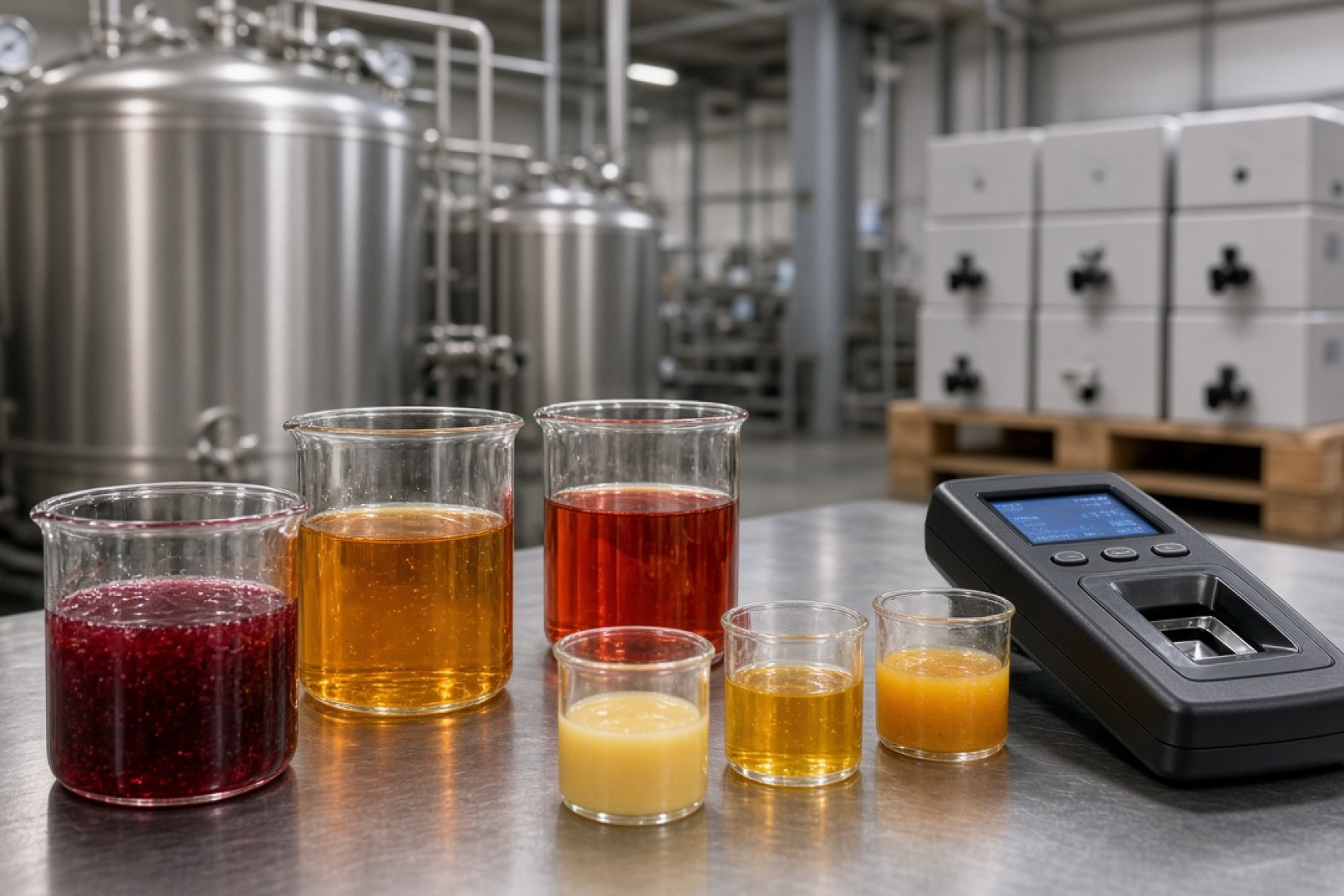
Beverage compound: The compound is the most complete form of ready-to-use base. In production, soluble liquid phases (concentrate, depectinised purée, citric and malic acid) are combined with clouding emulsions and natural colours. The plant adds only treated water, sugar syrup and, where required, carbon dioxide.
Beverage emulsion: Essential oils are water-insoluble and rise to the surface without emulsification. An emulsion is a colloidal oil-in-water system in which micron droplets are coated with gum arabic or modified starch layers to prevent phase separation.
Essences and foundations: Concentrated volatile blends to stimulate smell and taste; usually without natural fruit body or sugar and formulated on food-grade solvents compatible with the finished beverage matrix.
2. Classification of beverage bases by end product
Bases are manufactured in separate categories aligned with end use, each with different processing regimes. Sweetener, acidity, CO₂ gas and pasteurisation reshape the base formulation.
- Juice and nectar: Highest fruit solids content; pectin-free concentrate and depectinised purée to prevent gelling; resistance to pasteurisation at 85–95°C.
- Carbonated soft drink: Stability in acid media; cola foundation with caramel, cinnamon and lemon essence, caffeine and antifoam; low surface tension for carbonation.
- Energy and sports: Taurine, glucuronolactone, inositol, caffeine, B vitamins; in sports drinks, electrolytes and dextrose/maltodextrin at controlled osmolality.
- Flavoured malt: Barley malt extract; maltose and free amino acids; compatibility with fruit flavour systems.
| End product | Signature ingredients | Base dry matter | Thermal process | Storage sensitivity |
|---|---|---|---|---|
| Still fruit | Concentrate, purée, colour, citric acid | 50%–65% | Plate/tube pasteurisation | Anthocyanin oxidation, sedimentation |
| Carbonated soft drink | Essence emulsion, phosphoric acid, caramel, caffeine | 20%–40% | Micron cartridge filtration | Oil phase separation, gas stability loss |
| Energy drink | Taurine, caffeine, vitamin B, glucuronolactone | 30%–55% | Flash pasteurisation / hot fill | Vitamin degradation, crystal precipitation |
| Sports drink | Na, K, Mg, maltodextrin, malic acid | 25%–45% | Medium pasteurisation / aseptic | Salt–gum interaction |
| Flavoured malt | Malt extract, hops, fruit essence | 55%–70% | Pasteurisation tunnel | Protein haze, Maillard reaction |
3. Physicochemical specifications and quality control parameters
Base evaluation requires simultaneous measurement of density, Brix, pH, surface tension and rheology. Failure to match the certificate of analysis (COA) reduces packaging line yield.
Brix: Index of dissolved solids; measured with a refractometer at 20°C; for turbid samples, a densitometer or controlled dilution is used.
pH and acidity: A range of 2.0 to 3.5 is common; titratable acidity as citric acid; the Brix-to-acid ratio is the basis for sugar syrup adjustment on the line.
Density and viscosity: Density is typically 1.05 to 1.35 g/cm³ at 20°C; viscosity with a Brookfield viscometer to prevent nozzle blockage and pump flow loss.
| Index | Unit | Fruit compound | Carbonated foundation | Test method |
|---|---|---|---|---|
| Brix | °Bx | 40.0–65.0 (±0.5) | 20.0–45.0 (±0.5) | Refractometry 20°C |
| Total acidity | % citric | 2.0%–12.0% | 5.0%–20.0% | Titration to pH 8.1 |
| pH | — | 2.20–3.60 (±0.1) | 1.80–2.80 (±0.1) | Calibrated pH meter |
| Density | g/cm³ | 1.15–1.32 | 1.08–1.22 | Pycnometer / U-tube |
| Viscosity | mPa·s | 50–450 | 10–120 | Brookfield, spindle 2 |
| Turbidity | NTU | 500–3000 (cloudy) | 0–50 | 90° nephelometry |
| Total ash | % by weight | 0.3%–2.0% | 0.1%–0.5% | Calcination 550°C |
4. Laboratory, microbiological and sensory evaluation
Shipment quality is confirmed through microbiology, impurities testing and organoleptic panels.
Microbiology: Low Brix and pH make the matrix unfavourable for pathogens; the main risks are mould, osmophilic yeasts and Alicyclobacillus acidoterrestris, which produces guaiacol and a medicinal odour without visible change.
Pesticides and metals: GC-MS for residues; lead, arsenic, cadmium and copper per MRL; elevated copper and iron intensify oxidative off-aromas.
- Top note: Volatile notes after standard dilution.
- Mouthfeel: Balance of viscosity and gums.
- Aftertaste: Absence of bitterness, synthetic essence or oxidation.
5. Blending engineering in the syrup preparation room
High-speed bottling lines depend on stable syrup in the Syrup Room. Improper dissolution or temperature destroys emulsion structure.
- Aqueous phase: RO water with hardness <50 mg/L CaCO₃; 316L tank; 15–22°C.
- Sugar syrup: Brix 60–65; filtered; appropriate rotary agitation.
- Base injection: Agitate 10–15 minutes in the drum; avoid high-speed mixers that entrain air and dissolved oxygen.
- Line control: Brix and acidity; 100 micron filter; feed to carbonation system or filler.
Stokes’ law and emulsion stability
v = (2/9) · r² · (ρp − ρf) · g / η
- v: rise velocity of oil droplets to the surface
- r: radius of the oil essence droplet
- ρp and ρf: density of dispersed (oil) and continuous (water/syrup) phases
- g: gravitational acceleration
- η: viscosity of the aqueous phase
To reduce v and prevent an oil ring: two-stage homogeniser up to 300 bar for r below 0.4 micrometres; and density matching of phases with permitted esters or oils.
6. Iranian national standards and international alignment
Production, import and export of bases and finished beverages must comply with mandatory national and regional standards.
| Standard number | Scope and application |
|---|---|
| INSO 1250 | Carbonated cola, orange and soda soft drinks — limits on phosphoric acid (600 mg/L), caffeine (150 mg/L) and permitted colours |
| INSO 2837 | Still fruit beverages — minimum 20–25% juice; ban on synthetic colour; plant colour in compound |
| INSO 14345 | Juice, nectar and carbonated fruit drinks — physicochemical and CO₂ requirements |
| INSO 2279 | Malt beverage and malt drink — extract dry matter, ash, acidity, alcohol (max 0.5% v/v for export) |
| INSO 6693 | Energy and sports soft drinks — taurine ceiling (4000 mg/L), inositol, D-glucuronolactone, caffeine (~320 mg/L) |
GSO and Codex: In GCC markets, GSO 9 and GSO 1016 require declaration of plant origin, no alcohol as base solvent verified by NMR/GC and international halal certification. Codex Alimentarius is the reference framework for export trade.
7. Customs classification and tariff codes
Import and export of beverage raw materials require technical classification and alignment with import/export regulations and WCO rules.
- 33021010: Cola essence and foundation for soft drinks — highly concentrated liquid; special health licence.
- 33021090: Other aromatic mixtures — citrus essence emulsion without sugar.
- 21069090: Compound fruit juice blend with concentrate, acid, colour and sugar.
- 21069080: Enriched premixes, supplements and sports/energy base powder.
| HS code | Description | Technical nature | Clearance authority (Iran) |
|---|---|---|---|
| 33021010 | Soft-drink cola essence | Concentrated aromatic, caramel, phosphoric acid | Food and Drug Administration |
| 33021090 | Other beverage aromatics | Oil essence emulsion | Standards organisation and FDA |
| 21069090 | Other food preparations (compound) | High-Brix liquid compound | FDA, origin health certificate |
| 21069080 | Supplement and enriched base | Vitamin/isotonic formula | Food supplement affairs, FDA |
8. Quality defects and accelerated stability testing
- Flocculation and coalescence: Zeta potential imbalance; gelatinous sediment at tank bottom.
- Ostwald ripening: Oil molecules migrate from small to large droplets; phase separation.
- Terpenoid oxidation: In citrus; limonene epoxide and carvone; industrial bitter odour.
- Maillard reaction: At Brix >55 with free amino acid; colour change and burnt odour.
- Centrifuge: 3500 rpm, 20 minutes, 20°C — no oil layer or sediment.
- Thermal shock: Three 48-hour cycles at 4°C and 40°C — stable viscosity and pH.
- UV: 100 hours — resistance of natural colour and essence.
9. Packaging, cold chain and logistics
- Aseptic metal drum: 220–240 kg; multi-layer aluminium bag; vacuum or nitrogen; standard sea freight.
- Bag-in-Box: 20–25 kg; PE + EVOH; daily use without full drum emptying.
- IBC: 1000 L; continuous dosing and road transport.
- ISO Tank: 20–24 tonnes; 316 double-walled stainless; nitrogen blanket.
Natural compound without preservative: transport at 18-°C. Base with sorbate/benzoate and Brix >60: 4+ to 8+°C. ISPM 15 pallets; typically four 220 L drums per pallet.
| Pack type | Net weight | Gas barrier | Transit temperature | Stability |
|---|---|---|---|---|
| Aseptic bag in drum | 220–240 kg | Aluminium foil | 18- or 4+°C | 18–24 months |
| BIB | 20–25 kg | PE + EVOH | 4+ to 8+°C | 12–15 months |
| IBC | 1000–1200 kg | UV-resistant PE | Cold store / controlled | 6–9 months |
| ISO Tank | 20–24 tonnes | 316 stainless, jacket | Constant nitrogen | 3–6 months |
10. Economic analysis and price drivers
Pricing is a function of agricultural inputs, chemicals, packaging and international freight. The real procurement index is base cost per litre of finished beverage, not price per kilogram of base alone.
Agricultural segment
- Fruit harvest season
- Concentrate price (60–75% of compound value)
- Drought and frost (Urmia, northern regions)
Chemical industries
- Food acids
- Gum arabic (Sudan, Chad)
- Caffeine, taurine, vitamins
Logistics and cold storage
- Reefer container
- Aseptic packaging
- Customs duty and levies
A higher-priced base at 5 kg/1000 L may be more economical than a cheaper base at 20 kg/1000 L. To compare supply options from Iran, you can register technical specifications with Iranco.
11. Importer and procurement manager checklist
- ☐Define end product (juice, nectar, carbonated, malt, energy)
- ☐Injection dose (kg/1000 L) for cost of goods
- ☐Sealed sample from the same batch + official COA
- ☐Match Brix, acidity, pH and density with buyer laboratory
- ☐Pilot blending and centrifuge in R&D
- ☐Microbial certificate, Bacillus spores, osmophilic yeast
- ☐International halal certificate
- ☐Additive compliance with destination country standard
- ☐Committed transit temperature and container data logger
- ☐Pack type (aseptic drum, BIB) and ISPM 15 pallet
- ☐Contract tolerance (e.g. Brix ±0.5)
- ☐HS code alignment with trade unit and customs broker
12. Information required for price quotation (RFQ)
- Flavour and aroma signature (lemon, pomegranate, caramel cola, etc.)
- Product class: 100% juice, 50% nectar, 20% fruit drink, consumer syrup
- Clear or cloudy; natural colour; synthetic colour prohibited for still drinks in Iran
- Maximum line use rate (kg/tonne of beverage)
- Packaging: 220 L drum, IBC, BIB
- Pilot tonnage and monthly/annual estimate
- Delivery location and Incoterms
- FDA or export destination certificates
International buyers can submit these specifications as a quotation request to Iranco so connections with Iranian formulation lines can be established.
13. Beverage base supply through Iranco
Sourcing bases from abroad always involves challenges of standard compliance, microbiology and formula stability. Iran’s beverage industry, with access to Middle Eastern orchards and essence distillation and aseptic lines, has significant regional capacity.
Iranco is a gateway for food-industry trade and connects regional buyers with beverage base manufacturers. Register your technical need so samples, standard certificates and competitive offers are reviewed centrally.
Enter base type, target dose, packaging and annual volume in the platform to begin technical evaluation and industrial options.
14. Summary
Beverage base is the pivot linking agricultural science, colloid chemistry and packaging engineering on high-speed lines. Correct base selection secures production accuracy, working capital in raw materials and flavour uniformity.
Successful bulk buying requires numeric parameters in contract—Brix, particle size, Brix-to-acid ratio and stability testing. Cold-chain monitoring and compliance with INSO, GSO, Codex and chapters 2106 and 3302 underpin sustainable margin in beverage trade.
15. Frequently asked questions
1. What does use rate mean for beverage bases?
The weight of base (kilograms) to produce 1000 litres of finished product; the cost-of-goods benchmark. Emulsions are often below 1 kg/1000 L and fruit compounds 50–200 kg/1000 L.
2. Why is base Brix different for carbonated fruit drinks?
CO₂ solubility depends on temperature and solids concentration; base Brix is set so that after carbonation bottle pressure and carbonic acid balance with fruit sweetness are maintained.
3. How is an oil ring in the bottle neck controlled?
By reducing oil droplets to below 0.4 micrometres (high-pressure homogeniser) and matching phase density with gum and permitted weighting agents.
4. Is artificial colour allowed in still fruit base in Iran?
No; under INSO 2837 all synthetic colours are prohibited. Colour must come from fruit or permitted natural colours such as anthocyanin, chlorophyll or beta-carotene.
5. How can we verify sample authenticity before bulk purchase?
Dilute with deionised water and sugar syrup; centrifuge 3500 rpm for 20 minutes; then 100 hours of light and heat shock to prove absence of sediment and phase separation.
6. How is supply from reputable Iranian producers arranged?
Provide formulation details, final juice percentage, clarity and tonnage through Iranco so producer capacity and sealed samples can be reviewed.
7. What is the difference between aseptic base and preservative-containing base?
Aseptic has no chemical preservative and is in oxygen-barrier packaging; frozen storage. Base with benzoate or sorbate at positive chill temperature has greater microbiological stability.
8. What matters in customs declaration?
Separation of composition, sugar and fruit content, and alignment with heading 3302 (essence/emulsion) or 2106 (compound) to avoid penalties and clearance delays.
Featured Products
Related Articles



