 Iranco Magazine Team
Turkey industrial market review, inward processing regime, aseptic paste specs, colour index, Brix, odour control, import requirements, packaging and contract notes for professional buyers
Export Guide · Aseptic Paste · Turkey
Aseptic Tomato Paste Export to Turkey: Inward Processing Rules and Colour & Odour Standards
Turkey's industrial market, inward processing regime, aseptic paste technical specifications, colour index, Brix, odour control, import requirements, packaging and contractual notes for professional buyers
Introduction
Exporting aseptic tomato paste to Turkey may at first glance seem illogical. Turkey itself has a large tomato processing industry, numerous concentrate and paste plants, and Turkish product is exported to markets such as Iraq, Italy, Germany, Japan, Saudi Arabia, France and the Netherlands. Yet foreign trade data show the country is simultaneously an importer of paste and other tomato products under code 200290.
The reason should not be sought only in a "product shortage." A factory importing aseptic paste may be looking for a specific Brix, better colour, off-season supply, lower raw-material cost, blending multiple origins to standardise quality, or producing an export finished product. Turkey also has an inward processing regime that allows eligible companies to import raw materials needed for export goods within a defined framework, using suspension or drawback mechanisms for import duties. The official aim of this regime is to supply raw materials for export production on more competitive terms.
For an Iranian exporter, therefore, the main question is not "Does Turkey produce paste?" but what use the buying factory has for the shipment. Paste needed by a sauce, ketchup, ready-meal or export product plant is not the same as paste for retail consumption. In industrial trade, parameters such as Brix, Hunter a/b, viscosity, pH, acidity, black speck count, Howard mould count, odour, cooked or burnt flavour, batch uniformity and aseptic bag integrity directly affect purchase acceptability.
For this reason, a professional commercial offer for Turkey must simultaneously cover three areas: legal compliance, technical compliance and usability in the buyer's production process.
1. Why does Turkey import tomato paste despite domestic production?
Turkey is not only a consumer market in the global industrial tomato chain. It is both a processor and an exporter of tomato products. The industry's final estimate for 2025 put Turkey's processed tomato volume at about 2.2 million tonnes. For 2026, higher output has been cited if growing conditions are favourable.
This industrial structure means paste imports into Turkey should not be confused with imports of a simple consumer commodity.
Imports for industrial raw-material supply
A factory producing items such as tomato sauce, ketchup, ready meals, canned goods, food-service products or export goods may purchase tomato paste as a raw material. In such cases the product is usually supplied in aseptic drums and the end consumer is the factory, not a retail store.
An industrial buyer pays more attention to batch stability, colour, Brix, viscosity and product behaviour in formulation than to the outward appearance of the packaging.
Bridging the gap between two production seasons
Industrial tomato is a seasonal agricultural raw material. A factory with export orders or production contracts throughout the year cannot tie its production schedule solely to the domestic harvest season. Aseptic inventory allows the factory to manage raw-material consumption across the year.
Quality and technical specification differences
Two pastes with the same Brix are not necessarily equivalent for the same industrial application. Redness intensity, Hunter a/b ratio, viscosity, degree of heat damage, cooked flavour, acidity level and fresh raw-material quality can all differ.
In some formulations, the factory needs paste with stronger colour so that after dilution, addition of other ingredients and a second heat step, the final product colour remains acceptable.
Imports within export production
Turkey's inward processing regime is designed for this economic logic: raw materials, auxiliaries or packaging needed for export production are imported under defined conditions, with a production and export commitment in return. Under suspension, duties arising from import are covered by guarantee and released after the export commitment is fulfilled; under drawback, duties are paid at import and refunded after export of the processed product according to the rules.
2. Iran's position in supplying tomato paste to the Turkish market
2024 data for HS 200290 contain an important point for Iranian exporters. In that year Turkey imported about USD 12.25 million of product under this code. Reported import value from Iran was about USD 9.31 million and volume about 8.4 million kilograms.
Iran has therefore not been a marginal supplier in this trade flow.
At the same time, statistics must be interpreted carefully. HS 200290 is broader than simply "220 kg aseptic tomato paste" and covers other prepared or preserved tomatoes not in vinegar, in the "other" category. Statistics for this code should therefore not be taken as exactly equivalent to all aseptic paste trade without checking the national tariff line and customs declaration description.
For a real transaction, the tariff code must be aligned with product specifications, Brix, packaging and the buyer's customs classification.
Iran's practical advantage for Turkish buyers
Iran's advantage in this market depends less on a quality slogan than on a combination of commercial factors:
- a large tomato growing and processing industry;
- paste production at industrial Brix levels;
- access to aseptic filling lines;
- direct land transport;
- shorter geographic distance than some distant suppliers;
- ability to order industrial drum shipments;
- a real trading history in this product group with Turkey.
Geographic proximity alone does not create sales. A Turkish factory usually compares the product with domestic or other import offers on colour, Brix, delivered price, quality stability and payment terms.
3. Technical specifications of aseptic tomato paste for Turkish buyers
For paste and similar products, Turkey applies "Türk Gıda Kodeksi Salça ve Benzeri Ürünler Tebliği 2020/19". This regulation defines tomato paste as product obtained by concentrating tomato pulp and sets a minimum Brix of 28 for double concentrate and 36 for triple concentrate, excluding added salt.
In industrial export, contractual Brix is often defined more precisely than the double or triple label alone. For example, the buyer may set a target range and tolerance for each batch.
| Parameter | What must be clear in the order | Why it matters |
|---|---|---|
| Brix | Target value and tolerance | Determines concentration, dilution yield and real dry-matter price |
| Hunter a/b | Contractual minimum | Controls red colour intensity and quality |
| pH | Value or acceptable range | Process safety and compatibility with final product formula |
| Total acidity | Test method and contractual limit | Affects taste and formulation |
| Viscosity | Agreed measurement method | Determines paste behaviour in sauce and finished product |
| Odour and flavour | No burnt, fermented or foreign odour | Indicates process damage or storage problem |
| Black specks | Acceptance limit | Index of raw-material and process quality |
| Howard mould | Acceptance limit | Index of raw-material hygienic quality |
| Salt | No added salt or specified amount | Affects buyer formulation |
| Process type | Hot break or cold break | Affects viscosity and application |
| Packaging | Aseptic bag in drum | Microbial protection and suitability for industrial use |
Hot break or cold break?
One of the most important items to define before pricing is the initial heat treatment method.
In hot break, pectolytic enzymes are inactivated more quickly, pectin structure is better preserved and the product is usually more suitable for applications where higher viscosity matters.
In cold break, the viscosity and sensory profile differ and it can suit other applications.
A professional buyer should not simply request "36–38 paste." Defining end use, preferred process and viscosity index prevents later disputes.
4. Colour standard: why Hunter a/b matters in the deal
Under Turkish regulations, tomato paste colour is not merely a descriptive attribute like "good red." For paste and purée, the Hunter a/b ratio must not be less than 1.8, and colour testing for paste is performed at 12 Brix.
This point is very important for export contracts, because colour measurement without a defined sample preparation method can produce non-comparable results.
What does the a/b ratio indicate?
In the Hunter colour system, colour parameters are expressed numerically. In tomato paste, the a/b ratio is one of the common indices for assessing redness relative to the yellow component.
A higher value for this ratio, under the same test method, is usually associated with more desirable redness; but commercial interpretation should not be limited to a single number. Raw material, tomato ripening stage, process temperature, heating time, evaporation, oxygen contact and storage conditions can all change final colour.
Why colour matters more in secondary processing
If paste is packed and sold directly, the colour of the paste itself is visible. But in sauce, ketchup or ready-meal production, the paste undergoes a second process.
The product may:
- be diluted;
- be reheated;
- be mixed with sugar, vinegar, oil or other ingredients;
- remain at process temperature for a defined period.
Therefore the buying factory may set a contractual colour limit above the legal minimum so that after all production steps the final product still has the desired colour.
Legal limit vs buyer limit
A legal limit of 1.8 does not mean that any paste meeting this value is the best choice for every factory. "Legal compliance" is only one level of acceptance. The factory's purchase specification can be stricter.
This difference must be clear in the contract:
Destination market legal limit ≠ buyer's specific quality specification
5. Odour and flavour standard: from sensory control to process problem diagnosis
Turkish regulations require products in this group to have their own colour, taste and odour, to be free of foreign taste or odour and to contain no foreign matter.
Unlike colour, odour is usually not reduced to a single number. Sensory acceptance criteria must therefore be taken seriously in industrial orders.
What odour should sound paste have?
The desirable profile should be consistent with processed tomato and concentrated product, with no clear sign of burning, fermentation, mould, foreign chemicals or packaging contamination.
An excessively "cooked" odour can also cause problems for some formulations, even if the product is not necessarily spoiled. Heat treatment intensity affects volatile tomato compounds and can change the sensory profile.
Problem odours in commercial evaluation
| Sensory sign | Likely origin | Importance for buyer |
|---|---|---|
| Burnt odour | Excessive heating or fouling on heat-transfer surface | Undesirable taste in final product |
| Fermented odour | Raw-material problem or contamination before stabilisation | Risk of shipment rejection |
| Mouldy odour | Unsuitable raw material or contamination | Serious sign of quality decline |
| Metallic or abnormal odour | Improper contact or packaging/equipment problem | Requires cause investigation |
| Strong cooked odour | High heat load | May be undesirable for some applications |
| Natural, clean concentrated tomato odour | Proper process | Desirable |
For large purchases, an approved reference sample is very useful. Instead of the vague phrase "acceptable odour," it is better to keep a sample approved by the buyer as the sensory reference and compare production shipments against it.
6. Legal requirements for tomato paste in Turkey: Brix alone is not enough
Product regulations in Turkey set a defined set of criteria for tomato paste. Some of the most important technical criteria are:
| Criterion | Turkish regulatory requirement |
|---|---|
| Tomato paste Brix | Minimum 28, excluding added salt |
| Triple concentrate Brix | Minimum 36 |
| Hunter a/b | Minimum 1.8 |
| Black specks | Maximum 7 per 10 g |
| Howard positive | Maximum 60% of fields |
| Tomato paste pH | Minimum 3.9 and maximum 4.6 |
| Total acidity | Maximum 10% dry matter, as anhydrous citric acid |
| Insoluble ash in 10% HCl | Maximum 0.3% dry matter |
| Lycopene | Minimum 350 mg per kg |
| Total salt | Maximum 5% dry matter |
These limits appear in Salça ve Benzeri Ürünler Tebliği No. 2020/19. The regulation also sets a minimum invert sugar equivalent to 40% dry matter for tomato paste.
Black specks: a small parameter with large commercial impact
Black specks can arise from burnt product particles, unsuitable plant parts or raw-material and process problems. Turkish regulations set a maximum of 7 specks above the defined size per 10 g for tomato paste.
For a factory producing a bright, smooth or retail-packaged final product, dark particles can be visually problematic even at levels legally acceptable. The factory's purchase limit can therefore be stricter.
Howard mould count
For tomato paste, Turkish regulations set a maximum of 60% positive fields in the Howard test. This test is not a direct index of "product sterility"; it relates more to the quality and condition of raw material used in processing.
Pesticide residues and contaminants
Compliance with the specific paste standard does not replace general food safety regulations. Turkey has separate rules on contaminants and maximum pesticide residues, and the pesticide residue framework was also amended in 2025.
In an export quality-control programme, residue review should be based on the list of active substances relevant to tomato, raw-material supply history and current buyer requirements — not a fixed, unrelated panel for all shipments.
7. Turkey's inward processing regime and the real meaning of "re-export"
The term re-export is sometimes used too loosely in tomato paste trade with Turkey. Under inward processing, the usual logic is not that the same paste drum is imported unchanged and exported again. The principle is that imported goods are used in production or processing and the resulting product leaves Turkey according to the export commitment.
In simple terms:
Iranian paste → entry under licence → use in production → export of compensating product
The final product may, depending on the licence and factory programme, be sauce, ketchup or another food product.
Two main regime methods
Turkey's Ministry of Trade defines two main mechanisms:
Suspension system: import duties and other applicable taxes at entry are covered by guarantee. After production and fulfilment of the export commitment under the licence, the guarantee is released within the rules.
Drawback system: goods first enter free circulation with payment of applicable duties, and after export of the processed product, eligible duties are refunded under the rules.
Under suspension, the main aim is that the producing company does not bear the full financial burden of normal definitive import for raw materials that will be consumed in export goods.
Who uses this regime?
The beneficiary is usually a company established in Turkish customs territory that carries out or organises the processing operation. An Iranian exporter cannot therefore simply write "IPR" on the invoice and benefit from customs advantage. The licence and obligation to fulfil the commitment depend on the Turkish buyer's legal structure.
Role of the inward processing certificate
A professional buyer should clarify before shipment:
- whether entry is under inward processing or definitive import;
- licence number and scope;
- how the imported goods tariff code is recorded in the licence;
- how much goods may be imported;
- how the raw-material-to-export-product consumption ratio is defined;
- the latest valid dates for import and export;
- which customs office or procedure is intended for clearance.
Turkey's Ministry of Trade manages requests for documents under this regime electronically, and the related system was moved to DYS infrastructure from 2022. In 2026, amendments were also published regarding deadlines for some inward processing commitments.
Equivalent goods
Under the suspension system, the rules also allow use of equivalent goods under specified conditions. Equivalent goods must have the same quality and characteristics and match the imported goods at least at the eight-digit tariff code level. Under such a mechanism, export of product made from equivalent goods can even take place before import of the imported goods.
For a paste supplier, this shows why technical specifications and tariff code are not separate laboratory or customs issues; both can be directly linked to execution of the buyer's licence.
8. Tariff code and food import control path
At the six-digit level of the harmonised system, tomato paste usually falls in family HS 2002 and, for "other tomatoes prepared or preserved otherwise than by vinegar or acetic acid," in 200290. Turkey and Iran trade statistics for this product group are also visible in this six-digit line.
Turkey uses longer national codes for customs declaration. For a real shipment, the exact subheading matching product specifications must be determined by the customs broker and importer.
Recording an approximate code on the proforma without matching the inward processing licence code can cause discrepancies at declaration stage.
Control of plant food imports
For import of plant food materials, the Turkish importer must first register company information and, if required, producer and exporter details in the Ministry of Agriculture and Forestry system. Then, for product compliance control, "pre-import notification" is submitted in the GGBS system. At product notification stage, information such as product name, group, brand, ingredients and exporter details is recorded.
This process is separate from inward processing customs formalities but does not replace them. A shipment can be under inward processing customs-wise and simultaneously require food import compliance procedures.
Documents to align before loading
For an industrial shipment, the document set should be agreed with the final importer before the truck moves. Depending on transaction conditions, this may include commercial invoice, packing list, transport document, certificate of origin, analysis certificate, product specification, batch information and documents the importer requests for the food control file or inward processing licence.
The practical rule is: product name, Brix, net weight, drum count, batch number, tariff code and goods description must be consistent across documents.
9. Aseptic packaging, drums and pre-loading control
In industrial tomato paste trade, packaging is usually part of the product's technical specification, not merely a transport container.
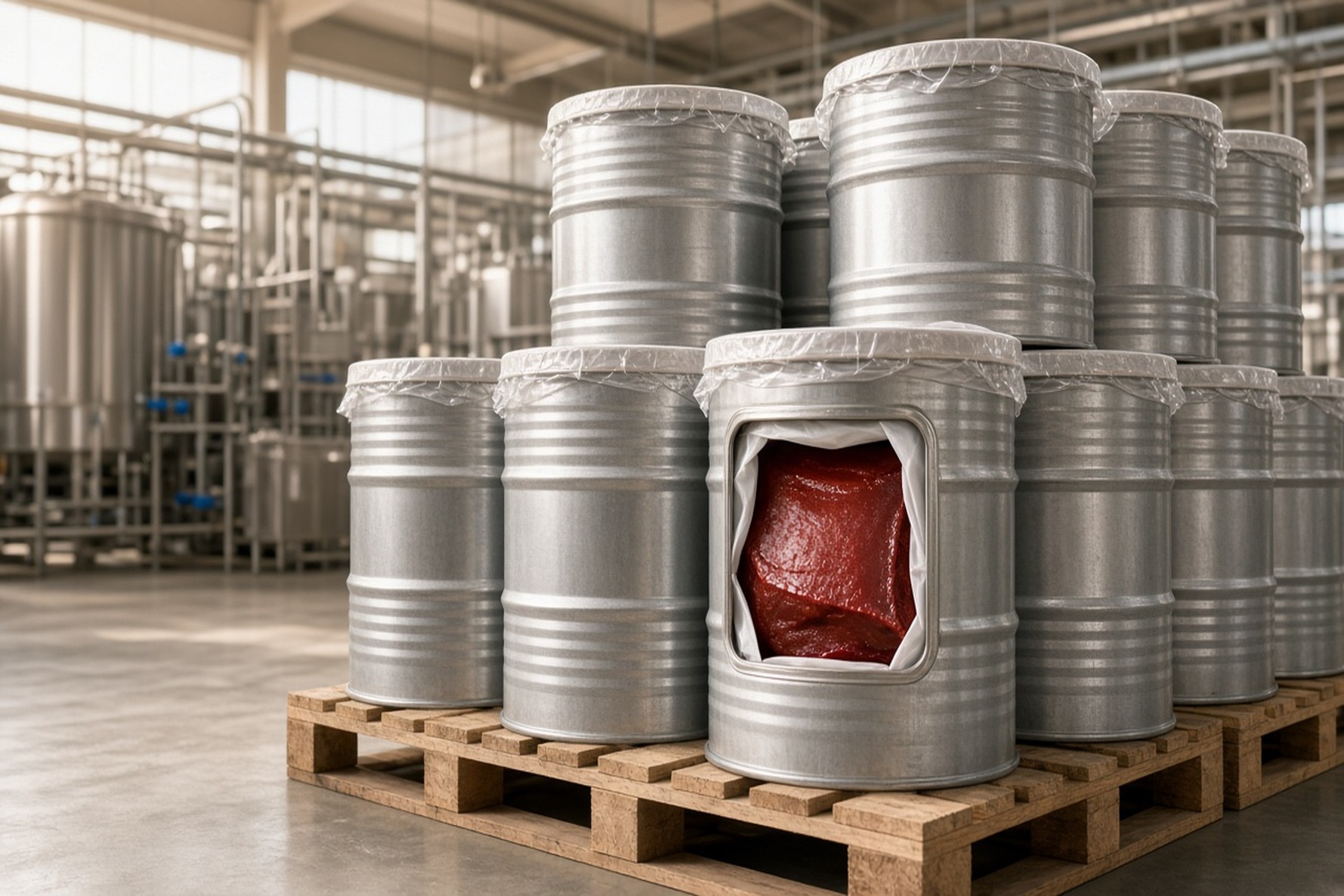
After appropriate heat treatment under controlled conditions, paste is filled into an aseptic bag and the bag is placed in a drum. This structure allows concentrated product to be stored without converting it into a consumer pack.
What the buyer must define about the pack
- target net weight per drum;
- weight tolerance;
- aseptic bag structure and supplier if required;
- drum type;
- internal drum condition;
- sealing method;
- batch number;
- production date;
- number of drums per shipment;
- palletising or direct loading method;
- industrial labelling requirements.
Here it is better not to leave pack weight as the general phrase "220 kg drum" in the contract. Actual net weight, tolerance and invoice basis must be specified.
Visual drum inspection
Before loading, drums should show no serious sign of corrosion, impact that could damage the inner bag, leakage or abnormal deformation.
The aseptic bag should also be checked at the connection point, valve, seal area and for signs of leakage.
Very small damage to the aseptic pack can destroy the advantage of the whole system. For this reason the buying factory usually does not accept swollen, leaking or fermentation-evidence drums.
Sampling: before or after loading?
Best commercial practice is to tie the approval sample to the actual production batch. Sending an excellent sample from a different production run and then loading another batch is one of the main sources of dispute in raw-material purchasing.
Batch number on the sample, its analysis certificate, packing list and drum label must be traceable.
10. Land transport from Iran to Turkey and quality management en route
For Iranian aseptic paste, land transport is one of the practical advantages of the Turkey route. Unlike fresh fruit, aseptic product does not necessarily need a classic cold chain; however, this does not mean transport conditions are unimportant.
Prolonged temperature increase can accelerate chemical change and colour loss. Leaving drums in strong sun or poor storage conditions is also undesirable.
Land transport should focus on:
- a clean truck free of foreign odour;
- no simultaneous carriage of odorous or contaminating materials;
- proper drum securing;
- prevention of movement and impact;
- protection from water and adverse conditions;
- accurate document coordination before reaching the border;
- clear net and gross weight;
- ability to trace batch numbers.
Long border delays are not only a logistics issue. The longer the product remains in uncontrolled ambient conditions, the more pressure on the factory schedule and the buyer's inventory management.
For transactions under inward processing, document alignment with the buyer's licence should be checked before the truck moves, not after arrival at customs.
11. How is aseptic tomato paste price compared for Turkey?
Real industrial paste price cannot be compared without technical specifications. Two offers with different price per tonne may differ completely in usable dry matter, colour or production yield.
Main price factors are:
| Factor | Commercial effect |
|---|---|
| Brix | Higher Brix usually carries more dry matter per transported tonne |
| Colour | Stronger colour can be worth more for some factories |
| Hot break / cold break | Changes industrial application and viscosity behaviour |
| Production season | Affects raw-material supply and factory inventory |
| Tomato quality | Affects colour, flavour, defects and yield |
| Aseptic packaging | Bag and drum type affect cost |
| Order volume | Affects production, freight and negotiation cost |
| Delivery point | Factory price is not the same as border or buyer-plant delivered price |
| Tests | A broader test panel costs more |
| Payment terms | Part of the real commercial price |
Price per tonne or price on dry-matter basis?
For an industrial buyer, comparing price per tonne alone can be misleading. If Brix differs between two shipments, the buyer receives a different amount of dry matter per tonne.
In professional orders, economic comparison should at least take actual Brix into account.
Cost of shipment rejection
Sometimes cheaper product costs the factory more because of weak colour, cooked odour, unsuitable viscosity or batch instability. The factory may have to blend with other raw material, adjust the formula or increase usage rate.
A "comparable price" therefore exists only when at least the main quality specifications of two offers are the same.
Importer pre-order checklist
- Define the final use of the paste: ketchup, sauce, ready meal, repacking or export product.
- Determine whether import is definitive or under inward processing.
- Match the declared tariff code with the code recorded in the buyer's licence.
- State target Brix and its tolerance precisely in the contract.
- Specify whether the product is hot break or cold break.
- Set the factory's acceptable minimum Hunter a/b.
- Include pH, acidity, black specks, Howard mould count and other required indices in the purchase specification.
- Clarify "no added salt" or the permitted salt level.
- Link the approval sample to the actual batch number.
- Obtain the analysis certificate for each batch before loading.
- Align colour and viscosity test methods between seller and buyer.
- Define sensory criteria for foreign odour and flavour.
- Specify aseptic pack type and net weight.
- Check drum appearance and bag integrity before loading.
- Set pesticide residue and other safety test requirements based on destination rules and buyer specification.
- Keep goods description consistent on invoice, analysis certificate, packing list and customs documents.
- Make batch number, production date and drum count traceable.
- Define delivery point and responsibility for freight and border formalities in delivery terms.
- For inward processing purchases, check licence validity and remaining capacity before shipment.
- Define in the contract in advance how laboratory or sensory non-conformance will be handled.
What information should be sent for an accurate price quote?
A request for aseptic tomato paste price is comparable only when it contains at least the following information:
- aseptic tomato paste;
- required Brix;
- hot break or cold break;
- minimum Hunter a/b;
- pH range if a specific specification exists;
- required viscosity and measurement method;
- presence or absence of added salt;
- required standard or test panel;
- net weight per drum;
- order quantity or tonnage;
- destination city or customs office in Turkey;
- transport method;
- delivery terms;
- normal import or inward processing;
- approximate delivery schedule;
- need for sample before order.
For buyers seeking aseptic tomato paste supply from Iran, these same specifications can be included in an Iranco purchase request so supply options are reviewed on the basis of real product characteristics, not merely price per tonne.
Supplying Iranian aseptic tomato paste for Turkish factories
In international tomato paste purchasing, the difference between two offers is usually not only price. One product may have similar Brix but differ in colour, viscosity, heat profile, odour, aseptic bag type or production stability from another.
For a factory using paste in ketchup, sauce or export products, these differences directly affect production cost. The purchase request should therefore first be turned into a short but precise technical specification.
Iranco can be used as the channel to submit a supply request from Iran. The buyer can include Brix, process type, colour index, order quantity, packaging specification and destination in the request so available options are reviewed on that basis.
For orders destined for Turkey, especially those linked to export production, it is better to clarify inward processing status from the outset. This helps align goods description, tariff code, quantity and delivery schedule with the buyer's import structure.
If your factory needs Iranian aseptic tomato paste, include technical specifications and approximate order volume together with destination and packaging type in the purchase request.
Summary
Exporting aseptic tomato paste to Turkey is not a simple transaction between a producing country and a consuming country. Turkey itself has a large tomato processing industry and in 2024 exported more than 177,000 tonnes of product in group HS 200290; yet in the same year it imported about 9,300 tonnes, with Iran supplying the bulk of recorded import volume.
This structure becomes understandable when paste is seen as raw material in an industrial chain. A Turkish factory may need imported paste to bridge seasons, maintain production schedules, reach colour and viscosity targets or produce export goods.
In such a transaction, four topics matter most: precise technical specifications, compliance with Turkish food regulations, aseptic packaging coordination and correct customs procedure.
On quality, Brix alone is not enough. Hunter a/b, odour and flavour, pH, acidity, black specks, Howard mould count, lycopene, viscosity and batch uniformity must all be considered in product evaluation. Turkish regulations set explicit limits for several of these indices.
On the other hand, if purchase is under inward processing, licence capacity, tariff code, permitted import quantity and the buyer's export commitment are as important as paste quality.
For an Iranian exporter, the best starting point for selling to Turkey is not a quick price quote but an offer aligned with the buying factory's specification.
Frequently asked questions
Does Turkey import tomato paste from Iran despite large domestic production?
Yes. 2024 trade data for HS 200290 show Turkey imported about 9,330 tonnes, with about 8,400 tonnes recorded from Iran. Turkey is also a major exporter in the same product group. This is consistent with imported paste serving as industrial raw material, off-season supply and input for export products.
What is the minimum Brix for tomato paste under Turkish regulations?
Under Salça ve Benzeri Ürünler Tebliği No. 2020/19, tomato paste must have a minimum Brix of 28 excluding added salt. Triple concentrate is defined as minimum 36 Brix. An industrial buyer can set a tighter and more precise Brix range in the contract.
What is the colour standard for tomato paste in Turkey?
For paste and purée, the Hunter a/b ratio is set at a minimum of 1.8. Colour testing for tomato paste is performed at 12 Brix. The buying factory may request a higher limit for a specific application, especially if the paste will be diluted and reheated again.
How is odour of export tomato paste controlled?
Paste must have the characteristic product odour and be free of foreign odour. In industrial evaluation, signs such as burnt, fermented, mouldy, chemical odour or abnormally strong cooked flavour are considered. It is better to keep a buyer-approved reference sample and include a criterion of no foreign odour or flavour in the contract.
Must paste for export to Turkey be in aseptic drums?
There is no single requirement for all applications, but for industrial trade and factory raw-material supply, aseptic bag in drum is one of the most common and practical structures. The buyer should define net weight, bag structure, drum type, batch number and sealing requirements in the order specification.
What advantage does Turkey's inward processing regime offer paste importers?
This regime is designed to supply raw materials needed for export production. Under suspension, applicable import duties and taxes are covered by guarantee and released after the export commitment is fulfilled under the rules. Under drawback, duties are paid first and refunded after export of the processed product.
Can an Iranian exporter apply for Turkey's inward processing regime directly?
In normal commercial practice, the beneficiary is an eligible company established in Turkish customs territory that carries out or organises processing. The Iranian exporter should therefore align shipment information with the Turkish buyer's licence and import structure.
Which tests matter most before buying aseptic paste?
Brix, Hunter a/b, pH, acidity, viscosity, salt, black specks and Howard mould count are among the most important product indices. Depending on the buyer's control programme, pesticide residue, contaminant and microbiological tests may also be added. The test method should be agreed between the parties before contract.
How can aseptic tomato paste be sourced from Iran?
First define Brix, hot break or cold break process type, colour limit, drum weight, order quantity, destination and delivery terms. Then match sample and analysis certificate to the purchase specification. International buyers can submit this information through an Iranco purchase request so available supply options in Iran are reviewed against their technical needs.
Featured Products


Related Articles



