 Iranco 杂志团队
从藏红花、甘草和大马士革玫瑰到设拉子百里香、阿魏和植物胶——质量、标准、包装与专业采购标准
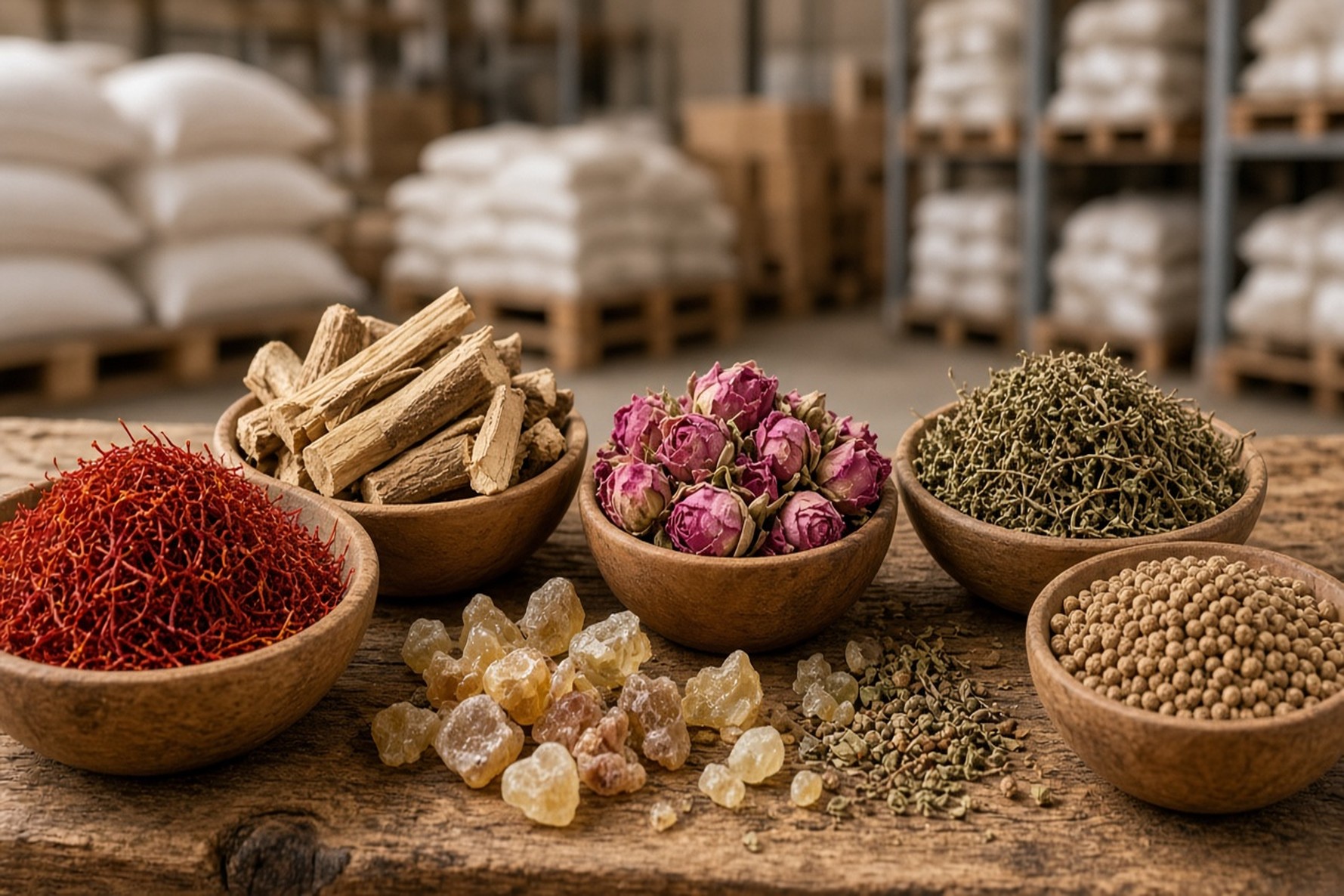
药用植物 · 出口 · HS 121190
伊朗药用植物:种类、差异与出口市场
从藏红花、甘草和大马士革玫瑰到设拉子百里香、阿魏和植物胶——产品差异、质量规格、出口市场、标准、包装与专业采购标准。
伊朗在药用和芳香植物多样性方面具有可观潜力,但商业价值取决于物种、药用部位、有效成分、采收、加工和目标市场。
1. 多样性地位
伊朗位于西亚重要生物多样性区域。
商业分组:花、叶、根、种子、胶、精油、提取物。
呼罗珊是藏红花中心。
2. 主要药用植物
不能仅凭通用名比较。
| Product | Plant part | Trade forms | Buyer criterion | Main use |
|---|---|---|---|---|
| Saffron | Stigma | Threads, powder, extract | Colour strength, aroma, purity | Food, extract, supplements |
| Licorice | Root | Whole, cut, powder, extract | Botanical ID, glycyrrhizin | Pharma, food |
| Damask rose | Flower & bud | Dried bud, petals, rosewater, oil | Aroma, oil profile | Fragrance, food, cosmetics |
| Shirazi thyme | Aerial parts | Dried, powder, oil | Oil profile, cleanliness | Food, pharma |
| Asafoetida | Oleo-gum resin | Lump, tear, powder | Odour, resin, purity | Spice, pharma |
| Galbanum | Oleo-gum resin | Raw & refined gum | Purity, odour, resin profile | Fragrance |
| Tragacanth | Astragalus gum | Ribbon, flake, powder | Colour, swelling, viscosity | Pharma, food |
| Green cumin | Seed | Whole & powder | Purity, aroma | Food & extract |
藏红花 ISO 3632,税号 091020。
甘草看甘草酸;设拉子百里香为 Zataria multiflora。
3. 买方规格
「一级百里香」不足以构成国际合同。
学名是买方第一道防线。
| Parameter | Example spec | Importance |
|---|---|---|
| Plant name | Common & scientific name | Prevent species mix-up |
| Plant part | Leaf, root, flower, seed, gum | Define product identity |
| Source | Cultivated or wild-harvested | Traceability & sustainability |
| Product form | Whole, cut, powder, extract | Define end use |
| Moisture | Per product standard | Mould control |
| Foreign matter | Botanical & non-botanical | Purity assessment |
| Active compounds | Species-specific | Industrial value |
| Pesticide residues | Per destination market | Safety & clearance |
4. 质量评估
质量控制从植物鉴定开始。
合同中应规定最大水分。
农残、重金属依市场而定。
5. 出口市场
HS 121190:2023年印度、土耳其、德国为主要买家。
藏红花市场不同:西班牙、中国等。
德国为高标准市场。
| Market | Product group | Demand profile |
|---|---|---|
| India | Herbs & plant parts | Processing & raw trade |
| Turkey | Dried herbs & parts | Regional market |
| Germany | Medicinal herbs & gums | High QC requirements |
| Pakistan | Dried herbs & seeds | Regional bulk trade |
| Spain | Saffron | Repacking & trade hub |
| China | Saffron & botanicals | Consumption & processing |
6. 税则编码
常见错误是用一个税号涵盖所有草药。
报价前明确学名与形态。
| Product group | HS code | Description |
|---|---|---|
| Saffron | 091020 | Saffron |
| Medicinal herbs & plant parts | 121190 | Perfumery, pharma & similar uses |
| Natural gums & resins | 130190 | Natural gum, resin & gum-resin |
| Plant extracts | 130219 | Other vegetable saps & extracts |
| Essential oils | Chapter 3301 | Essential oils |
7. 准入标准
法规取决于最终用途。
EMA 2025年修订 GACP。
植物检疫证书依目的地而定。
8. 出口包装
包装须防潮防污染。
| Product form | Suitable packaging | Main risk |
|---|---|---|
| Whole dried herb | Bag or carton with inner liner | Moisture & breakage |
| Dried leaf & flower | Low-pressure protective carton | Breakage & colour loss |
| Dried root | Multi-layer industrial bag | Soil & moisture |
| Herbal powder | Moisture-barrier multi-layer bag | Moisture uptake |
| Gum/resin | Food/pharma grade bag or carton | Impurity & moisture |
| Essential oil | Impermeable container | Light, air & reaction |
玫瑰花蕾不可过度挤压。
批次标签须含学名与批号。
9. 运输储存
水分、热、吸味为主要风险。
海运、陆运、空运依产品选择。
10. 价格因素
无规格则无有效价格。
甘草根与提取物为不同商品。
| Factor | Price impact |
|---|---|
| Botanical species | Defines identity and raw value |
| Plant part | Root, flower, leaf, seed & gum differ in value |
| Active compounds | Critical for industrial buyers |
| Purity & moisture | Affects real dry weight & processing cost |
| Product form | Whole, cut, powder, extract |
| Testing & certificates | Full panel adds cost |
| Order volume & Incoterms | Affects prep & freight cost |
11. 竞争格局
须按产品比较竞争。
伊朗优势:多样性、藏红花、玫瑰、树胶。
12. 价值链
价值链:原料→分选→切段→粉末→提取物。
制药厂重视批次一致性。
进口商订购前检查清单
- Record exact plant name and scientific name.
- Specify plant part (root, flower, leaf, seed or gum).
- Define source (cultivated or wild-harvested).
- Specify form (whole, cut, powder, extract or oil).
- Obtain a representative sample.
- Define required actives or chemical profile.
- Put moisture and foreign-matter limits in the contract.
- List required tests (pesticides, metals, microbiology).
- Set acceptance limits for breakage and impurities.
- Require a certificate of analysis per batch.
- Specify packaging type and net weight.
- Verify batch numbering and traceability.
- Assess supplier's annual capacity.
- Align HS code with destination customs broker.
- Check destination phytosanitary rules.
- For large orders, sample before loading.
- Define delivery terms with Incoterms.
- Submit a purchase request on Iranco with these specs.
获取准确报价需哪些信息?
- Product name and scientific name
- Plant part and product form
- Grade, moisture and expected actives
- Foreign-matter limits and required tests
- Order quantity, packaging and destination country
- Delivery port, shipping mode and Incoterms
FAQ
Which Iranian medicinal herbs export most?
No single ranking exists due to different HS codes. Saffron, licorice, rose products, cumin, natural gums and dried herbs are all visible in trade.
How does export product differ from domestic market?
Mainly standardisation: scientific name, controlled moisture, limited foreign matter, traceability, proper packaging and test results.
Which countries buy Iranian medicinal herbs?
HS 121190: India, Turkey, Germany, Pakistan; saffron: Spain, China, Italy, Gulf states.
Are all herbs under HS 121190?
No. Saffron is 091020; gums, extracts and oils fall in other chapters.
What matters for licorice quality?
Species and part, root cleanliness, moisture, foreign matter and glycyrrhizin for industrial use.
Key tests for EU export?
Botanical ID, pesticides, heavy metals, microbiology; GACP and pharmacopoeial specs for pharma API.
Wild-harvested vs cultivated?
Neither is universally better; wild may have chemistry advantages but weaker traceability; industry buyers want batch consistency.
How to source from Iran?
Define purchase specs, review sample and COA, submit request on Iranco.
总结
伊朗约2300种药用植物的价值通过标准化在国际贸易中实现。