 Iranco 杂志团队
产品选择、质量控制、食品安全与标签、FoSIM 进口登记、海关手续及伊朗干无花果在马来西亚清关的实用指南
出口指南 · 无花果干 · 马来西亚
干无花果出口马来西亚:进口卫生法规与港口清关
产品选择、质量控制、食品安全与标签、FoSIM 进口登记、海关手续及伊朗干无花果在马来西亚清关的实用指南
干无花果在马来西亚市场介于两类商品之间:面向门店与电商的即食干果,以及混合干果、烘焙与食品工业的原料。
对伊朗出口商而言,主要优势是可供应从零售大果到工业级经济规格的不同等级。
在马来西亚一侧,问题不仅是海关;进口食品受 Food Act 1983 监管,并与 FoSIM 食品安全系统直接相关。
成功的出口应从链条末端设计:先确定销售渠道,再定义等级、检测、包装与标签,最后才确定价格与合同。
1. 马来西亚市场需要什么样的无花果干?
Three distinct customers must be distinguished: dried fruit importers and distributors, food repackers and industrial buyers. Acceptable specifications are not the same for all three.
In retail, product appearance matters greatly. Consumers see the pack; larger, relatively uniform, sound figs without visible mould, pest damage or mechanical injury create more value.
Retail channel
- Size uniformity
- Acceptable appearance
- Low percentage of broken or damaged fruit
- No visible contamination
- Appropriate texture — not too dry or too moist
- Packaging with adequate moisture barrier
- Label design compliant with market rules
- Option to supply under importer or private label
Export product for this channel must be defined against a purchase standard from the outset. Terms like 'grade one' or 'export quality' alone are not enough for a professional contract.
Wholesale and repacking
Some importers receive bulk packs and repack in Malaysia into smaller weights. Fig quality still matters but origin packing cost can be reduced — with clear agreement on inner bag, master carton, storage and resale timeline.
Food industry
Dried figs are used in bakery, snacks, mixed dried fruit, confectionery and other formulations. Premium appearance grade is not always economical for this customer.
| 采购渠道 | 主要优先级 | 理想包装形式 | 外观敏感度 |
|---|---|---|---|
| 高端零售 | 外观、规格与一致性 | 消费者包装 | 非常高 |
| 干果分销 | 质量与价格平衡 | 批发或零售包装 | 高 |
| 再包装 | 等级稳定与成本 | 纸箱或 bulk 袋 | 中至高 |
| 食品工业 | 安全、水分与价格 | 工业包装 | 中 |
| 切碎与加工 | 安全与可加工性 | 工业级 | 较低 |
Iranian exporters should not price retail figs and industrial figs on the same logic. Much of the price gap between offers comes from real differences in sorting and defect rates.
2. 伊朗干无花果:出口等级与选择标准
In dried fig trade, the word 'variety' is often misused for what is really a commercial grade. Buyers must define grade by observable, measurable indicators.
In Iranian export dried figs, differences usually come from size, colour, eye opening, uniformity, breakage, stains, shape and cleanliness.
Size
Larger size is usually preferred in consumer packs, but 'large' alone is not a proper contract criterion. Classification method must be agreed — e.g. count per weight unit or agreed sorting system.
Colour
Iranian dried figs range from lighter to darker brown. Colour alone is not the only quality indicator. Clear retail packs need greater colour uniformity.
Shape and fruit soundness
Fruit must be checked for mould, insect contamination, foreign matter and undesirable damage. Major defects should be defined as percentages or by agreed sampling in bulk contracts.
| 属性 | 高端零售级 | 商业级 | 加工级 |
|---|---|---|---|
| 规格一致性 | 高 | 中高 | 较不重要 |
| 颜色一致性 | 高 | 中 | 有限重要 |
| 破损果 | 应限制 | 可协商 | 更可接受 |
| 整果外观 | 非常重要 | 重要 | 次要 |
| 水分与稳定性 | 非常重要 | 非常重要 | 非常重要 |
| 污染与霉变 | 按约定标准与法律不可接受 | 相同 | 相同 |
| 用途 | 消费者包装 | 批发 | 切碎与生产 |
A lower grade does not mean unsafe product. Commercial grade can be fully food-safe but worth less in appearance, size or uniformity.
3. 马来西亚买方应在订单中列明的技术规格
A main cause of dispute between initial sample and final shipment is an vague purchase specification sheet.
In professional buying, at least the following should be fixed before requesting a commercial offer.
| 参数 | 约定选项或标准 | 对买方的重要性 |
|---|---|---|
| 产品形态 | 整粒、开口、切碎或加工专用 | 决定用途 |
| 商业等级 | 按样品与书面规格 | 价格比较 |
| 规格 | 约定分级 | 外观与价格 |
| 颜色 | 可接受范围 | 零售 |
| 水分 | 约定含量与检测方法 | 保质期与口感 |
| 破碎率 | 可接受上限 | 外观与出成率 |
| 异物 | 合同接受限 | 安全与清洁 |
| 虫污染 | 拒收标准 | 安全与清关 |
| 霉变与腐败 | 拒收标准 | 食品安全 |
| 包装类型 | 零售或 bulk | 销售渠道 |
| 净重 | 每包重量 | 定价与标签 |
| 检测 | 按进口商与法规要求 | 风险控制 |
| 剩余保质期 | 买方约定 | 库存管理 |
Why should moisture be contractual?
Moisture balance in dried figs affects texture, stickiness, stability and spoilage risk.
The acceptable level and measurement method must be written in the purchase spec — not debated after arrival as 'too dry or too soft'.
Reference sample
For bulk orders, an approved sample should be registered as the commercial reference — but a physical sample alone is not enough.
This is especially important for Malaysian buyers because transit, warehousing and distribution make small initial moisture and quality differences more visible at destination.
4. 出口前质量控制与关键检测
Quality control should operate at three levels: visual inspection, physical tests and food safety tests — aligned with buyer specs and Malaysian entry requirements.
Visual inspection
- Size uniformity
- Colour
- Abnormal stains
- Signs of mould
- Insects or remains
- Foreign matter
- Mechanical damage
- Odour change
- Abnormal stickiness
- Pack condition
Aflatoxin and other mycotoxins
Dried fruit in a poor supply chain can be exposed to mould growth. Mycotoxin control must reflect real product risk and importer requirements.
Sampling method matters more than a single test certificate. Fungal contamination can be heterogeneous; a non-representative sample gives no reliable picture of the load.
Pesticide residues
If buyer or market requires pesticide residue control, the test panel must match regulations and production history — not a random long list.
Microbiological tests
For ready-to-eat product, buyers may set microbiological specifications. Test type must match end use and applicable product rules.
Sulphur dioxide and additives
Any preservative or additive must comply with Malaysian rules and label declaration. For natural dried figs, buyers should state clearly whether additive-free product is required.
Certificate of analysis
The COA must link exactly to the batch to be loaded. A common mistake is using one batch result as a general factory quality document for several shipments.
For the importer, batch number, production or packing date, test report and shipment number must be traceable together.
5. 干无花果进口卫生法规
Commercial food import control in Malaysia operates under Food Act 1983 and regulations issued under it. Food standard, safety and labelling requirements are largely set in Food Regulations 1985.
For dried fig importers, the practical outcome is clear: product must comply with Malaysian law on composition, safety, additives and labelling before entry. Fixing problems after container arrival is usually far costlier than control at origin.
Do imported foods in Malaysia need a general import permit?
Food import under Malaysia's Ministry of Health is not generally limited to one 'general food import licence'. Commercial food entry approval at the point of entry is processed through the food import control system and FoSIM.
That does not mean no other requirements exist. Some goods may need additional documents, other agency approval or agricultural inspection.
What role does FoSIM play?
FoSIM is Malaysia's Food Safety Information System used to manage and approve imported food. Importers or their representatives must have the necessary registration before related formalities.
From 1 June 2025, Ministry of Health food safety authority approval for food declared via customs form K1 is active at 71 origins or customs stations — making correct shipment data and customs declaration alignment even more important.
Inspection and sampling
Imported food may at entry undergo document review, inspection, sampling or hold pending test results under risk-based control. A COA at origin does not guarantee clearance without destination sampling.
6. 植检要求与入境管控
Dried figs are food but also of plant origin. Food safety control and plant product control are not necessarily handled by one single authority.
In Malaysia's tariff and import restriction system, figs fall under 0804.20. Entry conditions for dried and processed products in this group must match the status registered for that code and product form.
Rules for entry via Kuala Lumpur or Port Klang must not be assumed to apply to Sabah and Sarawak without verification.
Phytosanitary certificate
Phytosanitary certificate need must be assessed by exact product nature, degree of processing and conditions stated for the import code. Dried processed product must not be treated like fresh fruit for quarantine rules.
This check is done before bill of lading issue — not when cargo has already reached port.
7. 面向马来西亚市场的标签
Labelling is one of the most common problem points in food import. A pack designed for another market is not automatically suitable for Malaysia.
Product label must comply with Food Regulations 1985 and present information clearly and without misleading consumers.
Product name
If the product is simply dried figs, the pack name must show the true food nature. A trade name cannot replace the food name.
Ingredient list
A single-ingredient product with no additives differs from product with preservative, coating or other added material.
Net weight
Declared pack weight must match the actual pack. Pre-export weight control matters — systematic gap between declared and actual weight can create compliance problems.
Country of origin
For Iranian export figs, origin must be stated correctly. If packing or processing occurred elsewhere, presentation must not mislead about product origin.
Date and storage conditions
Date format and storage text must match regulations and product characteristics. Exporters should not simply translate a domestic Iran label template.
Label language
Malaysia label design must match language rules for imported food. Final artwork should be approved by the importer and a Malaysia label compliance specialist before printing thousands of packs.
8. 税号与清关文件
Fresh or dried figs in the Harmonized System fall under HS Code 0804.20. Malaysian import declaration must use the full national code and accurate goods description.
The HS code is not only for duty calculation — it can determine which restrictions, permits or inspections attach to the goods.
Basic commercial documents
- Commercial invoice
- Packing list
- Bill of lading
- Malaysian import declaration K1
- Certificate of origin if commercially or tariff required
- Test documents and COA if requested
- Plant health related documents if required
- Additional documents demanded for shipment or import control programme
Alignment of product name, weight, pack count, container number and party details across documents is essential. Even a simple weight mismatch between invoice and packing list can slow review.
How to check the tariff?
Import duty rate must be checked against the current Malaysian tariff schedule, full national code and origin conditions at transaction time. Destination duty and tax responsibility under chosen Incoterms must be fully clear in export pricing.
9. 港口清关:从船舶到港到集装箱出场
Port Klang is the main seaport gateway for the Klang Valley and a practical entry point for food products into Malaysia. Actual clearance path depends on port of entry, carrier, declaration type, inspection level and shipment status.
The process can be reviewed in several commercial stages.
Stage 1: Pre-arrival document submission
Importer or broker should receive documents before vessel arrival. Late final invoice, packing list or B/L is an unnecessary error in food trade. Exporters should send a complete scanned document set for importer approval before vessel departure.
Stage 2: Customs declaration
Shipment data is entered in the K1 declaration. Commodity code, description, value, country of origin, weight and other fields must match original documents.
Stage 3: Food safety control
For imported food, Ministry of Health approval is processed through FoSIM and the entry-point process. Cargo may pass document review only or be selected for inspection and sampling by risk level.
Stage 4: Plant health control
If code and product form trigger agricultural authority review, that control must also be completed. Exporters should provide documents requested by the importer for this stage in advance.
Stage 5: Payment and customs release
After required approvals and payment of duty, tax or other legal charges, customs enables release.
Stage 6: Container delivery
Even after official approval, practical exit involves settlement with shipping line, terminal, domestic haulier and delivery coordination. Delay can create detention, storage or demurrage costs.
| 阶段 | 主要责任方 | 常见风险 |
|---|---|---|
| 文件准备 | 出口商与进口商 | 单证不符 |
| K1 申报 | 进口商/报关行 | 编码或描述错误 |
| FoSIM | 进口商与卫生部门 | 登记不完整或查验 |
| 植物检疫 | 进口商与主管机构 | 缺少所需文件 |
| 查验/抽样 | 政府机构 | 等待结果延误 |
| 放行 | 海关 | 欠税或审批不全 |
| 出港 | 报关行与承运人 | 滞箱费 |
Clearance management should start before container movement — waiting until vessel arrival to review regulations is high-risk in food trade.
10. 包装与海运
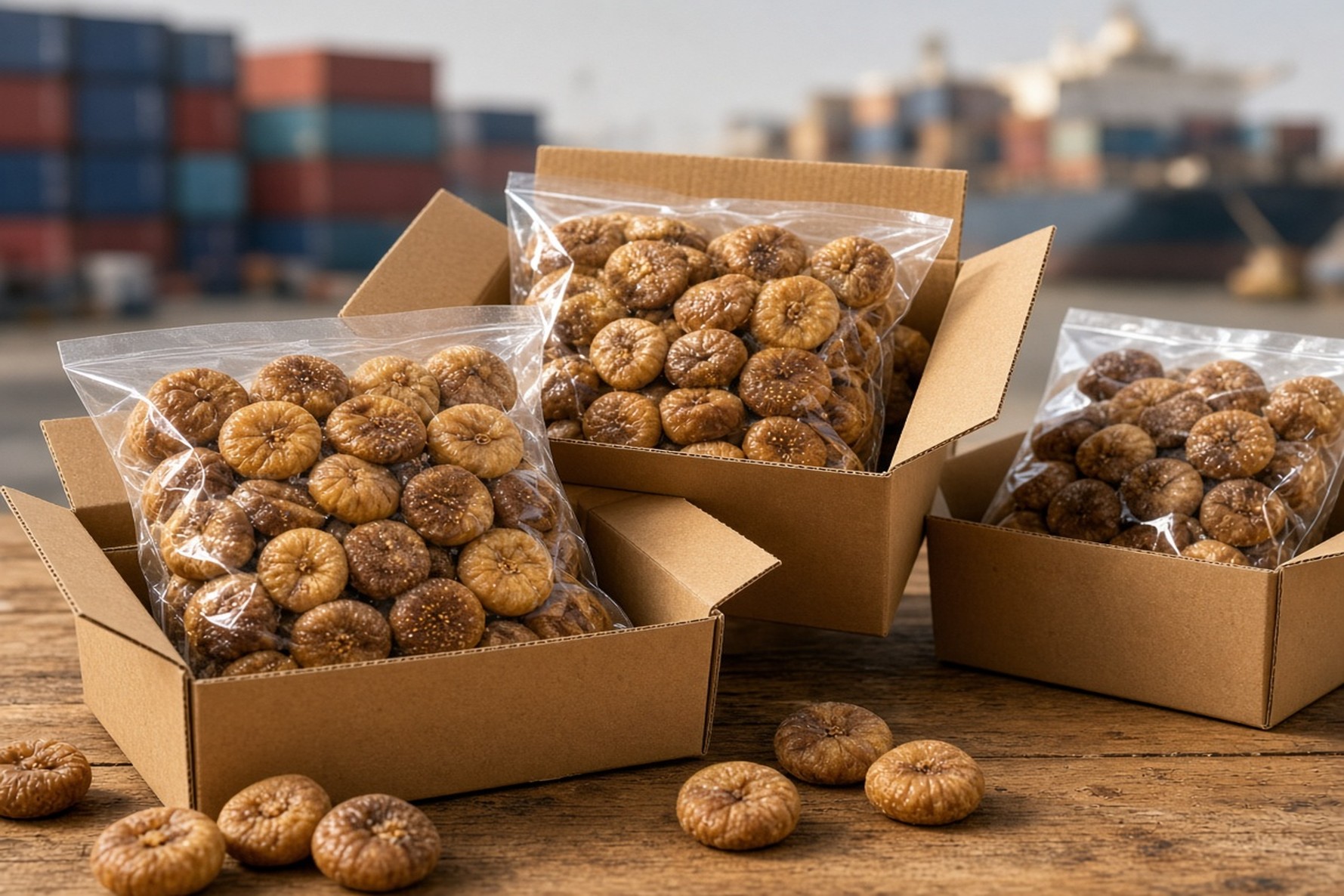
Malaysia has a hot, humid climate. Dried fig packaging must protect against moisture exchange, contamination and mechanical damage throughout transport and storage.
Bulk packaging
For bulk sale, cartons with suitable inner packs can be used. Inner layer material must be chosen for moisture protection and food contact.
Cartons need sufficient strength for palletising, container transport and warehouse conditions.
Consumer packaging
For shelf-ready product, the wrap must perform technically — water vapour transmission, seal quality, puncture resistance and food-contact compatibility — not just look good.
Dry or refrigerated container?
Dried figs are not generally tied to mandatory cold chain like fresh fruit, but container type must be chosen by product moisture, packaging, season, route, dwell time and agreed conditions.
Many dried nut cargoes use dry containers with proper moisture and stowage management. The main issue is preventing water ingress, internal condensation and contact with wet container surfaces.
Pre-load container inspection
- Dry floor
- No holes or abnormal light entry
- No odour from previous cargo
- Clean interior
- No obvious contamination or pest signs
- Sound doors and gaskets
- Suitable for food cargo
Container condensation control
Day-night temperature difference and environmental change on sea voyage can create moisture on cold surfaces. Proper packaging, stable load temperature, avoiding wet cargo and managing container airspace reduce this risk.
11. 出口价格如何形成?
There is no single 'export price' for dried figs. Two offers with the same name can differ sharply in real quality.
- Purchase season in Iran
- Appearance grade
- Size
- Uniformity percentage
- Breakage and defect level
- Moisture and product condition
- Manual or mechanical sorting
- Quality control level
- Required testing
- Bulk or retail packaging
- Order volume
- Private label
- Domestic haulage cost in Iran
- Port of exit
- Delivery method and terms
- Ocean freight rate
Malaysian buyers comparing offers must ensure the price basis is identical. Comparing per-kg premium retail pack price with commercial bulk carton fig is not useful.
Correct offer comparison
| 因素 | 报价 A | 报价 B | 为何重要 |
|---|---|---|---|
| 等级 | 必须一致 | 必须一致 | 最大价差驱动因素 |
| 规格 | 已明确 | 已明确 | 直接影响价格 |
| 缺陷容差 | 已明确 | 已明确 | 决定实际质量 |
| 包装 | 同级 | 同级 | 重要成本项 |
| 检测 | 相同 | 相同 | 成本与风险 |
| Incoterms | 相同 | 相同 | 真实价格比较 |
| 目的地 | 同一港口 | 同一港口 | 运费比较 |
Buyers evaluating several Iran supply options should register exact grade, pack weight, volume and destination on Iranco so offers are reviewed on the same need — not generic 'export fig'.
下单前进口商核对清单
Before issuing purchase order, a Malaysian importer should finalise:
- 确定产品形态:整粒无花果、零售级或适合加工的产品。
- 用规格定义等级:不可使用无 measurable 标准的“特级”等词。
- 获取真实样品:样品须代表可发运批次。
- 确认规格与一致性:双方应明确分选方法。
- 在合同中记录目标水分。
- 设定外观缺陷上限:破碎、污渍、损伤果与异物。
- 在最终生产或包装前确定检测计划。
- 将 COA 与批次号关联。
- 在马来西亚系统中确认 0804.20 税号状态。
- 装运前审查卫生部与 FoSIM 要求。
- 确认具体产品形态的植检要求。
- 大批量印刷前审查标签文件。
- 确认内包装与主箱类型。
- 明确托盘或非托盘装载条件。
- 在合同中列入交货条件与 Incoterms。
- 装运前确定目的港与报关代理。
- 正式签发前核对运输单据草稿。
- 书面记录到港验收标准。
This checklist should be part of the buying process — not action taken after cargo arrival.
获取准确报价需要哪些信息?
In a dried fig price request for Malaysia, specify at least:
- Product form and commercial grade
- Target size
- Preferred colour or appearance range
- Target moisture if technical spec exists
- Maximum breakage and defect tolerance
- Special testing requirements
- Weight per pack
- Consumer or bulk pack
- Total order quantity or weight
- Private label requirement
- Label language and specifications
- Destination port in Malaysia
- Delivery terms
- Sea or air freight
- Approximate required delivery time
Without this information, two received prices are not necessarily comparable. Buyers can enter the same details in an Iranco purchase request.
从伊朗供应马来西亚市场的路径
In international dried fig buying, the real difference between suppliers is not price per kilo alone.
The right approach is to prepare a written purchase specification first, then compare samples and commercial offers against that sheet.
Iranco lets buyers and importers submit dried fig supply requests with grade, size, order volume, packaging and destination country so available Iran options are reviewed on that basis.
For Malaysia, the same request should specify destination port, sales model and whether product is for retail packing, repacking or industrial processing — to refine grade and pack type selection.
总结
Dried fig export to Malaysia becomes reliable when three matters are managed together: real product quality, regulatory compliance and clearance readiness. Focus on purchase price alone can create hidden costs later as quality disputes, label rework, sampling, container detention or document mismatch.
For professional buyers, the first decision is product use. Figs chosen for clear retail packs are not the same grade as chopping or industrial use.
On regulations, Food Act 1983, Food Regulations 1985, the FoSIM process and requirements linked to code 0804.20 are the import review foundation.
Because dried figs are both food and plant-origin product, importers must verify health and agricultural control status for the exact product form and entry point before shipment.
The key practical rule is simple: clearance does not start when the container arrives — it starts when purchase specifications are set. When grade, testing, labelling, documents and commodity code are aligned before loading, supply prices become more comparable and Malaysia entry risk drops significantly.
常见问题
马来西亚进口干无花果的税号是什么?
鲜或干无花果在协调制度中归类为 HS Code 0804.20。在马来西亚申报须在海关系统中核对完整本国子目与准确产品描述。仅凭国际基础编码不足以确定所有税费与进口限制。
进口干无花果到马来西亚是否需要卫生许可?
商业进口食品受马来西亚卫生部与食品安全法监管,入境批准通过 FoSIM 机制办理。除食品管控外,还须核实植物产品法规及与具体商品编码相关的要求。
伊朗干无花果是否适合在马来西亚商店直接零售?
可以,前提是等级、包装、安全与标签按零售设计。较大且规格一致的果实通常在透明包装中更吸引人,但外观并非唯一标准。水分控制、无腐败污染、封口质量与标签合规对即食产品至关重要。
出口干无花果哪些检测最重要?
检测应按产品风险与进口商要求确定。水分、微生物状况、霉菌毒素、农药残留及所用添加剂或防腐剂是重要审查领域。霉菌毒素等检测须对批次进行代表性抽样。
海运干无花果到马来西亚的最佳包装是什么?
包装须有足够防潮屏障并在马来西亚湿热环境下保持稳定。 bulk 订单通常用合适内包装加固纸箱;零售则更看重薄膜质量与密封完整性。
采购干无花果时水分为何重要?
水分影响口感、黏性、稳定性与储存表现。过干可能缺乏消费者吸引力,过高则增加储存风险。买方应在采购规格中设定目标值与检测方法。
干无花果是否必须用冷藏集装箱运输?
没有像鲜果那样的普遍要求。许多干果货物在包装、产品水分与箱况受控时可用合适干货箱运输。两种情况下主要风险均为湿度与结露管理不当。
采购伊朗干无花果应向卖方提供哪些信息?
买方应说明等级、规格、目标颜色、缺陷容差、水分、包装类型、包装重量、订单量、所需检测、目的地与交货条件。自有品牌销售还须加入标签规格。
批准样品是否足以控制装运质量?
不够。参考样品有用,但仍需数值与书面标准。规格、水分、破碎率、缺陷、异物等关键参数须在采购规格中定义。