 Iranco Magazine Team
Review of the UAE food import basket, opportunities for Iranian products, entry ports and borders, customs and tax costs, product registration, labelling, health control, cold chain and practical importer requirements
Market Report · UAE
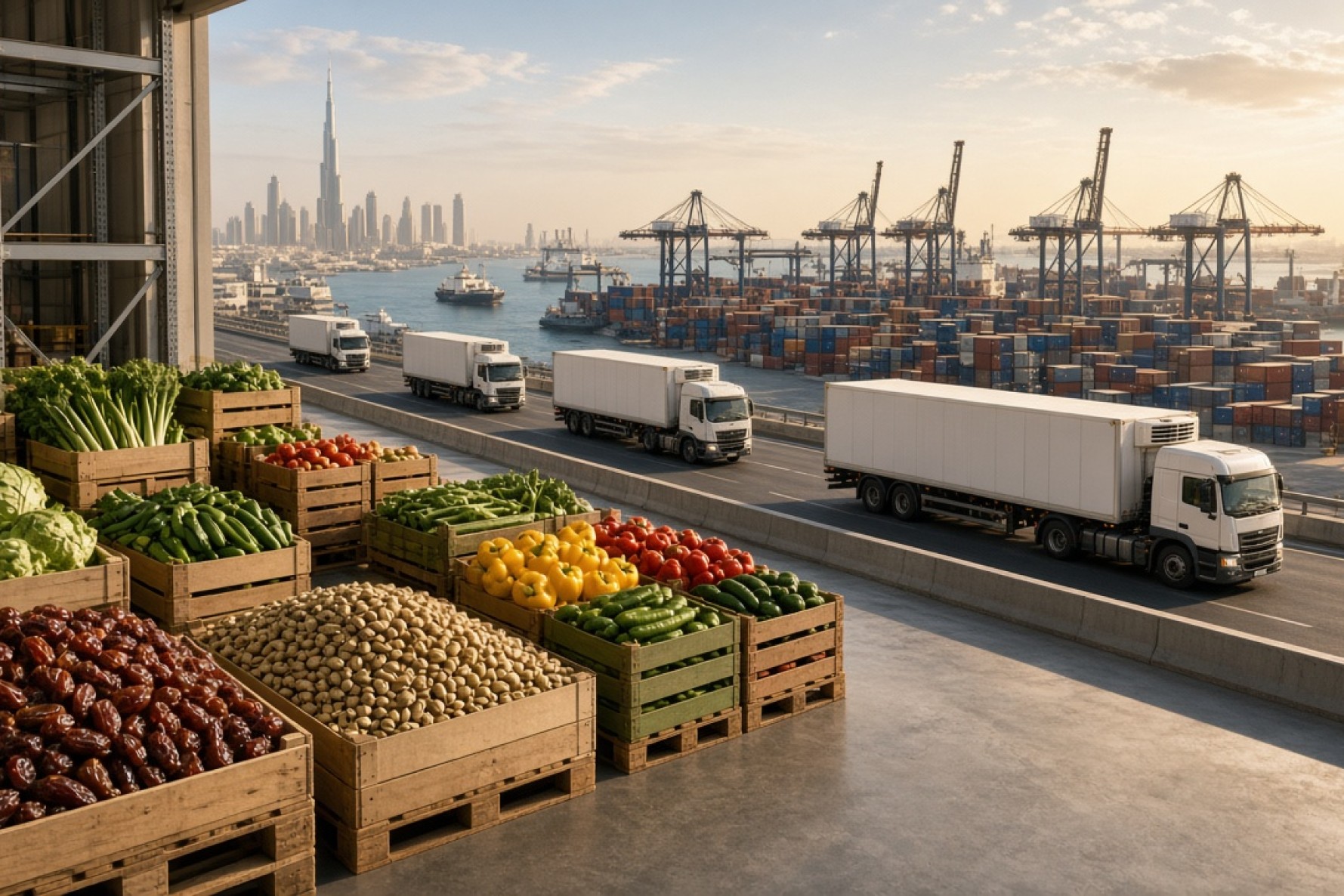
UAE Food Imports; Products, Routes, Costs & Regulations
Review of the UAE food import basket, opportunities for Iranian products, entry ports and borders, customs and tax costs, product registration, labelling, health control, cold chain and practical importer requirements.
Analytical introduction
The UAE food market should not be measured by resident population alone. A significant share of demand comes from tourism, hotels, restaurants, food-service companies, retail chains, processing plants and extensive re-export activity. Goods entering Dubai, Abu Dhabi or a free zone are not necessarily consumed only in the UAE; after warehousing, repacking or consolidation they may move on to GCC states, East Africa or other markets.
Demographic diversity has made demand highly varied. Arab, South Asian, Southeast Asian, European and other migrant communities follow different dietary patterns. A UAE importer may therefore serve buyers of rice, meat and poultry, dairy, fresh fruit and vegetables, nuts, spices, ready meals, bakery products and industrial food raw materials at the same time.
For Iranian exporters, geographic proximity is a real advantage — but not sufficient on its own. In 2024 trade data, UAE recorded imports from Iran of roughly USD 174.85 million in fruit, nuts and related products, and about USD 74.72 million in vegetables and edible roots. Dairy, eggs, honey and similar items, seafood, fruit and vegetable preparations, and coffee, tea and spices also appear in bilateral trade statistics.
The real opportunity in the UAE is not simply "sending cargo". Exporters who supply to importer specifications, with packaging suited to a hot climate, complete documents, approved labels and a predictable transport plan have a stronger chance of success.
1. Which Food Products Attract UAE Importers Most?
The UAE food import market is multi-layered. Part of demand covers staples such as wheat and rice; another segment is animal protein and dairy; a further share includes fresh fruit, nuts, processed foods and raw materials for food industry.
In 2024 consumer agricultural imports reached about USD 16.2 billion. Leading groups included dairy at roughly USD 2 billion, beef and products at about USD 1.4 billion, poultry and products at about USD 1.3 billion, fresh fruit at about USD 1.2 billion, and tree nuts at about USD 927 million.
| Food group | Recorded import market size | Demand profile |
|---|---|---|
| Dairy | ~$2B | Retail, hotel, restaurant and food industry |
| Beef & products | ~$1.4B | Food service, retail and hotels |
| Poultry & products | ~$1.3B | Household, restaurant and industrial kitchens |
| Fresh fruit | ~$1.2B | Retail, hotels and wholesale |
| Tree nuts | ~$927M | Retail, confectionery, chocolate and re-export |
| Bakery products | ~$856M | Retail and food service |
| Soups & food preparations | ~$832M | Retail and food industry |
Cereals, rice and staple foods
The importance of cereals in the UAE market extends beyond packaged consumer statistics. Published 2026 forecasts put UAE wheat imports in marketing year 2026/27 at about 2 million tonnes, with rice imports still running at roughly one million tonnes per year. Domestic cereal production is very limited, making imports a structural part of food security.
Despite the market size, these groups are not necessarily the easiest opportunity for Iranian exporters. Wheat and rice trade usually relies on large contracts, globally competitive pricing, continuous supply and regular bulk or container logistics.
Meat, poultry, dairy and seafood
This market is attractive in value terms but among the strictest on health certificates, temperature control, origin approval and, where applicable, halal requirements. Importers typically ask about the production plant, slaughterhouse, slaughter method, storage temperature, production date, remaining shelf life, net weight and frozen status before buying.
Fresh fruit and vegetables
Fresh produce is one area where Iran's proximity to the UAE market can create a logistics advantage. Tomatoes, lettuce, cabbage, cucumbers, apples, grapes, dates, stone fruit and other Iranian orchard products have trade history between the two countries. In 2024 the UAE recorded about USD 20.31 million of fresh or chilled tomatoes and over USD 12 million of lettuce and chicory from Iran. Recorded imports of apples, pears and quinces from Iran were about USD 27.17 million.
In this market, visual quality matters as much as price. Uniform size, colour, firmness, absence of cracks, spots, rot and mechanical damage, carton condition and shelf-life retention directly affect shipment acceptance.
Nuts, dates and dried fruit
The UAE is both a consumption market and a major redistribution centre for these goods. This group is especially important for Iran, as pistachio, raisins, dates, dried figs and other dry products are well-known Iranian exports. Competition is intense — in UAE pistachio trade, suppliers such as the United States and Turkey have a strong presence. Iranian exporters should define advantage through measurable traits such as size, kernel percentage, moisture, uniformity, aflatoxin control, processing type and packaging — not product reputation alone.
2. What Does a UAE Buyer Really Want from a Supplier?
A UAE trader does not usually buy on product name alone. They assess sell-through potential and total transaction risk.
- Quality consistency between sample and main shipment
- Capacity to supply across several consecutive loads
- Packaging suited to wholesale or retail channels
- Ability to supply the buyer's private label
- Sufficient remaining shelf life on arrival
- Label compliance with UAE regulations
- Required health and laboratory documents
- Regular, predictable transport
- Stable net weight
- Transparency on country of origin and producing factory
- Acceptance of pre-loading quality-control criteria
For fresh goods, arrival time and the cold chain directly affect purchase decisions. For dry, shelf-stable products, packaging quality, moisture control, microbiological contamination, aflatoxin or pesticide residues can be decisive.
| Product group | Buyer-sensitive criteria |
|---|---|
| Fresh fruit & vegetables | Uniformity, firmness, visual condition, pesticide residues, carton and transport conditions |
| Nuts & dried goods | Moisture, aflatoxin, breakage, size uniformity, aroma and taste |
| Dairy | Cold chain, shelf life, fat, composition, packaging |
| Meat & poultry | Health certificate, halal, plant and slaughterhouse, storage temperature |
| Packaged foods | Label, ingredients, allergens, nutrition, dates and product registration |
| Industrial raw materials | Technical specs, COA, batch-to-batch stability, industrial packaging |
For Iranian products, providing a precise technical specification sheet before price negotiation is far more effective than sending a general product list. The buyer must know exactly what product, quality level and pack format they will receive.
3. Iran's Role in Supplying the UAE Food Market
2024 trade data show food products account for a significant share of UAE recorded purchases from Iran. Total recorded UAE imports from Iran that year were about USD 545 million, with fruit and edible nuts at roughly USD 174.85 million — the largest recorded commodity group in Iran's exports to this market.
| Imported group from Iran | Approximate recorded value |
|---|---|
| Fruit, nuts and related products | $174.85M |
| Vegetables and edible roots | $74.72M |
| Dairy, eggs, honey and similar | $29.72M |
| Fish, crustaceans and seafood | $20.80M |
| Fruit, vegetable and nut preparations | $18.37M |
| Coffee, tea and spices | $14.99M |
This mix shows Iran's opportunity in the UAE lies mainly in fresh agricultural and orchard products, nuts, fruit and vegetable preparations, and some protein categories.
Fresh product — opportunity with risk
Iran's shorter distance to southern UAE ports can reduce time in the transport chain, but the distance advantage is preserved only when pre-cooling, sorting, packing and port transfer are done correctly. Fruit that enters an Iranian port at the wrong temperature or sits for hours in a hot yard may lack competitive quality on delivery even with a short sea route.
Processed products — regulatory preparation
Tomato paste, juices, canned goods, pickles, jam, confectionery, biscuits, ready meals and other Iranian industrial foods can enter the UAE, but the more ingredients a product has, the more important label review, additives, allergens and nutrition information become. Label assessment should be done before mass printing — correcting thousands of packs after arrival costs far more than correcting the design file before production.
4. Through Which Channels Is Food Sold in the UAE?
A UAE importer may distribute through four main channels: retail, hotels and restaurants, food-processing plants and re-export.
Retail chains and shops
In this channel packaging, design, nutrition information, consumer pack size and supply stability matter greatly. Goods must be shelf-ready.
Hotels, restaurants and food service (HORECA)
Larger packs, suitable unit pricing and specification stability carry more weight here. A restaurant cares less about retail pack appearance but cannot tolerate wide variation in size, weight, taste or product performance.
Food-processing plants
The UAE has more than 570 food and beverage processing units that rely heavily on imported raw materials. Output in this sector runs to several million tonnes per year. This market is significant for nuts, flours, oils, concentrates, flavourings, dairy products, proteins and other inputs.
Re-export
The UAE's port position and free zones mean part of food trade is aimed at redistribution. Re-export buyers focus more than domestic retailers on cargo consolidation, master-carton strength, origin documents, warehousing capacity and logistics cost.
- Retail: Lulu, Carrefour, Spinneys, Al Meera — consumer packaging and product registration
- HORECA: Five-star hotels, airline catering and chain restaurants
- Factories: Processing, repacking and raw-material production
- Re-export: JAFZA, free zones and regional distribution hubs
5. Main Food Import Routes and Borders into the UAE
For most bulky and containerised food cargoes, sea freight is the main economic route. Road transport is used more for intra-GCC trade and inbound loads from Saudi Arabia and Oman. Air freight serves highly sensitive, high-value or urgent goods.
Jebel Ali — primary hub
Jebel Ali is the UAE's most important container hub and one of the main food entry points. Published data attribute about 73% of food and beverage trade value to this port. Total container throughput in 2024 reached about 15.5 million TEU. Before Ramadan, imports of rice, onions, garlic, nuts and beverages through Jebel Ali rise noticeably.
Khalifa Port
Khalifa Port in Abu Dhabi is important for importers whose warehouse or distribution network sits in Abu Dhabi and surrounding industrial areas. It also provides agricultural and veterinary quarantine services.
Khorfakkan and Fujairah
Eastern-coast ports play a complementary role; access without a vessel first entering the inner Gulf can create an operational advantage on some sea routes. In 2026 mechanisms were introduced to move some containers discharged at Khorfakkan and Fujairah to Jebel Ali via customs transit.
Al Ghuwaifat border
Al Ghuwaifat in western Abu Dhabi is the main land crossing with Saudi Arabia — important for trucks from Saudi Arabia or the GCC road network. Pre-arrival declaration and truck passage permits apply so shipment data are registered before the vehicle arrives.
Oman borders
Khatm Al Shakla, Mezyad, Hili and the Hatta route are land connection points with Oman for regional and truck trade.
Airports
Dubai International, Al Maktoum and Zayed International are major air-cargo entry points — typically for highly sensitive fresh produce, commercial samples, high-value foods or orders where delivery time outweighs freight cost.
| Route | Best for | Main advantage | Main limitation |
|---|---|---|---|
| Jebel Ali | Dry, reefer, frozen containers and raw materials | Wide shipping and logistics network | Dwell cost if clearance is delayed |
| Khalifa Port | Container and Abu Dhabi cargoes | Link to Abu Dhabi industrial network | Route must match warehouse location |
| Khorfakkan & Fujairah | Some sea routes | Eastern-coast access | May require extra inland haul |
| Al Ghuwaifat | Inbound trucks from Saudi Arabia | Direct road transport | Border formalities and truck scheduling |
| Oman borders | Oman–UAE trade | Regional road corridor | Depends on actual cargo origin |
| Air freight | Sensitive and high-value goods | Speed | Much higher cost than sea |
For Iranian exporters, sea freight from southern Iranian ports to UAE ports is usually the natural route for commercial shipments. Destination port choice should be based on the buyer's warehouse location, shipping line, reefer availability and clearance cost — not geographic distance alone.
6. Main Laws and Stages for Food Entry into the UAE
Food entry into the UAE combines federal regulation, customs rules and local authority control in the destination emirate. The Federal Food Safety Law, national food registration rules and GCC technical standards form the main framework.
Importer licence
The importer must hold a commercial licence appropriate to food import and trading activity and be registered with the relevant systems and authorities in the emirate of operation. A foreign exporter usually cannot replace the local importer at this stage — the receiving company's licensed food categories must be confirmed before shipment.
Product registration
Under the national food accreditation and registration system established through Ministerial Decision No. 239 of 2018, imported foods, locally produced foods and products whose composition or label changes must be registered in the relevant system before market placement. In Dubai, food product registration, evaluation and label assessment are provided through the municipality. Imported product also requires a food consignment release process for local market sale.
Food labelling
The main Gulf reference for packaged food labelling is GSO 9:2022, with technical amendments published in 2025. Depending on the product, the following must be correctly shown:
- Product name and ingredient list
- Allergens
- Net weight or volume
- Manufacturer or packer information
- Production and expiry dates or minimum durability, per product rules
- Batch number or traceability information
- Storage conditions and nutrition information where required
- Country of origin where required and usage instructions
- Arabic for mandatory information; additional languages are permitted
One of the costliest exporter mistakes is printing final packaging before the importer and relevant authority approve the label text.
7. Special Requirements for Fresh, Animal and Halal Products
A common mistake is assuming one fixed document set for all foods. Fresh fruit documents differ from canned goods, frozen meat or biscuits.
Fresh fruit and vegetables
For release of fresh agricultural products such as fruit and vegetables, a phytosanitary certificate issued by the competent authority in the exporting country is a core document. Shipping documents, invoice or contents list and, where required, pesticide-residue documents are also reviewed. Consignments may undergo visual inspection and, if needed, laboratory testing at the entry point. The announced federal fee for a referred agricultural consignment release request to the ministry is AED 200.
Meat and animal products
Animal products are subject to veterinary control, health certificates and special origin requirements. For some groups, an import permit must be obtained before shipment. Meat, poultry or animal-origin product purchase contracts should therefore not be finalised before factory, slaughterhouse and UAE-accepted certificate status are verified.
Halal requirements
The UAE operates a formal halal control system. The Ministry of Industry and Advanced Technology maintains lists of registered halal certification bodies and approved slaughterhouses. Standards such as UAE.S 2055-1 for general halal food requirements and UAE.S 993 for Islamic slaughter sit within this framework. For meat exporters, a domestic halal certificate alone is not always enough — the issuing body's acceptance under the UAE system must be verified.
8. Customs Duties, Tax and the Real Cost of Food Import
The cost of bringing a food consignment into the UAE is not freight alone. A professional importer calculates landed cost from purchase price to destination warehouse.
Customs duty
The general rate for many imports from outside the GCC customs union is 5% of CIF value — goods value plus freight and insurance to the entry point. Final tariff assignment must be based on the exact HS code, as some goods may have a different tariff status.
Value-added tax
The standard VAT rate is 5% and applies to goods and services, including imports, except where zero-rating or a specific exemption applies.
Sweetened beverages — important change from 2026
From 1 January 2026, excise tax on sweetened beverages in the UAE is calculated by total sugar content per 100 ml:
| Sugar content | Excise tax |
|---|---|
| 8 g or more per 100 ml | 1.09 AED/L |
| 5 to less than 8 g | 0.97 AED/L |
| Less than 5 g | Zero |
| Artificial sweeteners only per prescribed classification | Zero |
100% natural juice without added sugar or sweeteners does not fall under this sweetened-beverage definition. Energy drinks remain subject to separate excise rules.
| Cost item | Description |
|---|---|
| Goods price | Per agreed delivery terms |
| Inland haul in Iran | Factory or cold store to port |
| Export charges | Loading, documents, formalities and port services |
| Sea or air freight | By route, container and season |
| Insurance | Where included in contract |
| Customs duty | Often 5% CIF for many goods |
| VAT | 5% where applicable |
| Excise tax | For covered groups such as some beverages |
| Food registration and control | By product and emirate |
| Laboratory | On sampling or where required |
| Port services | Discharge, handling and delivery |
| Reefer container | Power, monitoring and related services during dwell |
| Warehousing | If exit is delayed |
| Demurrage and detention | If free time is exceeded |
| Inland haul in UAE | Port to warehouse, DC or cold store |
A single fixed figure for "cost of food import to the UAE" is not reliable. Two consignments with the same goods value can differ materially because of HS code, reefer use, laboratory sampling, port dwell and delivery terms.
9. Tariff Codes and Why Correct Classification Matters
There is no single tariff code for "food". Two products with similar trade names may fall in different chapters depending on processing level, composition or presentation form.
| HS chapter | Group |
|---|---|
| 02 | Meat and edible offal |
| 03 | Fish and crustaceans |
| 04 | Dairy, eggs and honey |
| 07 | Vegetables and some roots |
| 08 | Fruit and edible nuts |
| 09 | Coffee, tea and spices |
| 10 | Cereals |
| 16 | Meat and fish preparations |
| 19 | Cereal, flour and bakery products |
| 20 | Vegetable, fruit and nut preparations |
| 21 | Other food preparations |
| 22 | Beverages |
Classification must reach the level required for customs declaration. A wrong code can change duty rate, required permits and the controlling authority.
10. Packaging and Logistics — Where Deal Profit Is Preserved or Lost
The UAE's hot climate makes packaging and temperature control especially important. The issue is not only temperature inside the container — stages before and after the container matter too.
Dry and shelf-stable products
Nuts, spices, pulses and powders must be protected from moisture, foreign odours, insects and mechanical damage. In bulk export, a suitable inner liner, strong cartons and correct palletisation reduce tearing and moisture uptake.
Fresh fruit and vegetables
Cartons need both compression strength and adequate ventilation. Loading warm product directly into a reefer container can break the cold chain.
Frozen and chilled goods
Origin cold-store capacity, product temperature at loading, container condition, temperature logging and a fast port-exit plan must be fixed in advance. The main reefer risk arises when cargo has arrived but clearance is delayed because of document gaps or product registration — quality falls and power, dwell and warehousing costs rise.
Seasonal timing
Some food groups see a marked import rise before Ramadan. Jebel Ali data show average rice imports rising about 25%, onions and garlic about 35%, and nuts about 15% versus a normal month in the pre-Ramadan period. Exporters should negotiate earlier; arrival after the bulk-buying peak can erase seasonal price advantage.
11. Quality Control and Common Clearance Problems
A professional importer must distinguish three control levels: pre-loading product inspection, document control and official control in the UAE.
- Label mismatch with registered product
- Actual composition differing from registered information
- Missing health or phytosanitary certificate
- Halal certificate from a body not accepted in the destination market
- Insufficient remaining shelf life
- Inappropriate storage conditions
- Packaging damage
- Microbiological or chemical contamination
- Pesticide residues above accepted limits
- Net weight discrepancy
- Missing batch number or traceability data
- Manufacturer change without registration update
Pre-loading inspection
A sound inspection programme should include at least:
- Match product to purchase order
- Check net weight
- Inspect packaging and print
- Verify batch number and dates
- Review laboratory documents
- Check pallet integrity
- Inspect container condition
- Photograph cargo before sealing
- Record seal number
- Send full document set to importer before shipment moves
For buyers comparing several Iranian supply options, Iranco can serve as the place to register product specifications, required quantity, packaging and destination so supply review is based on the actual order need.
12. Importer Checklist Before Placing an Order
Before issuing a purchase order for UAE food, the following should be clear:
- Exact product name and processing form
- Proposed HS code reviewed with customs broker
- UAE product registration status confirmed
- Final label file approved before printing
- Actual manufacturer and country of origin identified
- Technical specifications and COA requested
- For fresh product: sort and size standard defined
- For animal product: plant approval and required certificates verified
- For halal-covered goods: certificate-body validity checked
- Required shelf life on arrival stated in contract
- Net weight and tolerance fixed
- Pack type and master carton specified
- Storage and transport conditions written
- Sample reviewed before bulk order
- Final-shipment sampling method agreed
- Shipment rejection criteria stated in contract
- Destination port or airport fixed in advance
- Delivery terms defined per Incoterms
- Responsibility for port, inspection and dwell charges clarified
- Capacity for second and third orders assessed
What Information Is Needed for an Accurate Quote?
A price request without precise specifications makes seller offers hard to compare. Buyers should provide at least:
- Product name and form: fresh, frozen, dry, canned or processed
- Required grade or quality level
- Unit size or weight
- Main technical characteristics
- Order quantity and weight per pack
- Consumer or bulk packaging
- Private-label requirement
- Required tests and expected shelf life
- City or port in the UAE
- Transport mode and delivery terms
- One-off or recurring purchase plan
At Iranco, purchase requests are reviewed more accurately when this information is provided from the start — especially for products with multiple quality levels or pack formats.
Sourcing Iranian Food for the UAE Market
Buying for the UAE market depends more on aligning specifications, standards, packaging and logistics than on finding the cheapest seller. In many deals, the initial price gap between two suppliers is smaller than the cost created by one non-compliant consignment at port.
The buyer should first define the target channel: retail, wholesale, hotel and restaurant, factory or re-export. Only then can quality, pack weight, label language, order volume and transport method be set.
Iranco (iranco.com) enables buyers and importers to register purchase requests for Iranian food products against these specifications — product, quantity, packaging, destination and technical requirements — so available supply options are reviewed against the actual order.
For fresh product, sort, size, carton type and transport conditions should also be stated. For processed products, composition, pack weight, private label and required documents carry more weight. If the goal is supply for the UAE market, defining the order precisely before requesting a price is the logical starting point.
Summary
The United Arab Emirates is a large, import-driven and highly competitive food market. Its appeal is not limited to domestic purchasing power; retail networks, tourism, hotels and restaurants, food industry and re-export create diverse demand.
Dairy, meat, poultry, fresh fruit, nuts, ready meals and bakery products are among the largest import groups, while cereals such as wheat and rice are imported at very large scale. For Iran, fresh fruit and vegetables, nuts, dates, some fruit and vegetable preparations, seafood, spices and processed foods are areas with real trade history with the UAE.
Logistically, Jebel Ali is the country's main food gateway, while Khalifa Port, eastern-coast ports, Al Ghuwaifat, Oman crossings and major airports play complementary roles. But market and route choice are only half the decision — product registration, correct labelling, HS code, health certificates, halal for covered products, cold chain, shelf life and full landed-cost calculation must be settled before cargo moves.
For Iranian exporters, proximity gains commercial value when matched with predictable delivery, stable quality and faultless documents. A UAE importer needs more than a cheap product — they need a supplier who can deliver the next order to the same specification.
Frequently Asked Questions
Which food products have the highest import demand in the UAE?
Dairy, beef, poultry, fresh fruit, nuts, bakery products and food preparations are among the largest consumer import groups. Cereals are also extremely important — UAE wheat and rice imports run in the millions of tonnes per year. The best export group for the UAE should be chosen on supply capacity, price, quality and entry requirements, not market size alone.
Which Iranian products have the strongest trade record in the UAE?
In 2024 statistics, fruit and edible nuts, vegetables, dairy and honey, seafood, fruit and vegetable preparations, and spices appeared in recorded Iran–UAE food trade. Fresh fruit, vegetables, dates and dried nuts are prominent areas given Iran's production structure and geographic distance.
What is the main port of entry for food into the UAE?
Jebel Ali is the UAE's main container hub, with about 73% of food and beverage trade value attributed to it in published data. Khalifa Port in Abu Dhabi and Fujairah and Khorfakkan ports also form part of the import network. Port choice should align with the importer's warehouse location and distribution network.
What is the customs duty rate on food in the UAE?
The general rate for many imports from outside the GCC customs union is 5% of CIF value. The final rate must be checked against the exact HS code, as exceptions and different classifications exist. Standard VAT is 5% unless the goods or transaction are subject to another rule.
Is a Persian label sufficient for entry into the UAE?
No. Mandatory information must comply with UAE-accepted labelling rules, and Arabic is essential for mandatory information. Packs may be multilingual, but the design file should be reviewed by the importer and registration authority before printing to avoid post-arrival label correction.
Do Iranian fruit and vegetables need a phytosanitary certificate for the UAE?
For release of fresh plant products such as fruit and vegetables, a phytosanitary certificate from the competent authority in the exporting country is a core document. Consignments are inspected on entry and may be subject to laboratory testing or pesticide-residue review where required.
Do all foods require a halal certificate?
No. Halal requirements matter most for meat, poultry and products with covered animal ingredients. The certificate must be issued by a body accepted under the UAE halal system. A halal mark on the pack does not replace verification of certificate validity.
How is the final cost of a food consignment in the UAE calculated?
It comprises goods price, inland haul, export services, international freight, insurance, customs duty, tax, port services, inspection, laboratory testing, inland UAE haul and cold-chain costs for reefer loads. Container dwell at port can create demurrage, detention and power charges — clearance speed is therefore an important cost-control factor.
How can a purchase request be registered from Iran for the UAE market?
Define exact product name, quality, quantity, pack weight, packaging type, destination and delivery terms first. For fresh product, specify sort and size; for processed product, specify composition and shelf life. This information can be submitted through an Iranco purchase request so available supply options are reviewed against order specifications.
Supply via Iranco
Iranco connects Iranian food producers with buyers and importers in the UAE and GCC — for pricing, supply and export support.
- Fresh fruit and vegetables, nuts and dates to UAE market specifications
- Processed products with GSO 9-compliant labelling
- Export documents (COO, phytosanitary, COA) and sea/air logistics to Jebel Ali, Khalifa and Dubai
- Support coordinating technical specs, packaging and samples before bulk orders
Featured Products












Related Articles



