 Iranco Magazine Team
Technical and commercial guide to grade selection, hot-break vs cold-break, lab standards, aseptic packaging and international supply-chain analysis
Industrial concentrate · Brix 36–38 · Aseptic · Bulk buying
Industrial Tomato Concentrate: Bulk Buying Guide
Specialist guide for plant buyers: Brix grades 36–38%, Hot Break and Cold Break, certificate of analysis (COA), Howard Mold Count, aseptic bag-in-drum packaging, Eurasia and Gulf markets, dry-matter pricing, and contract checklist
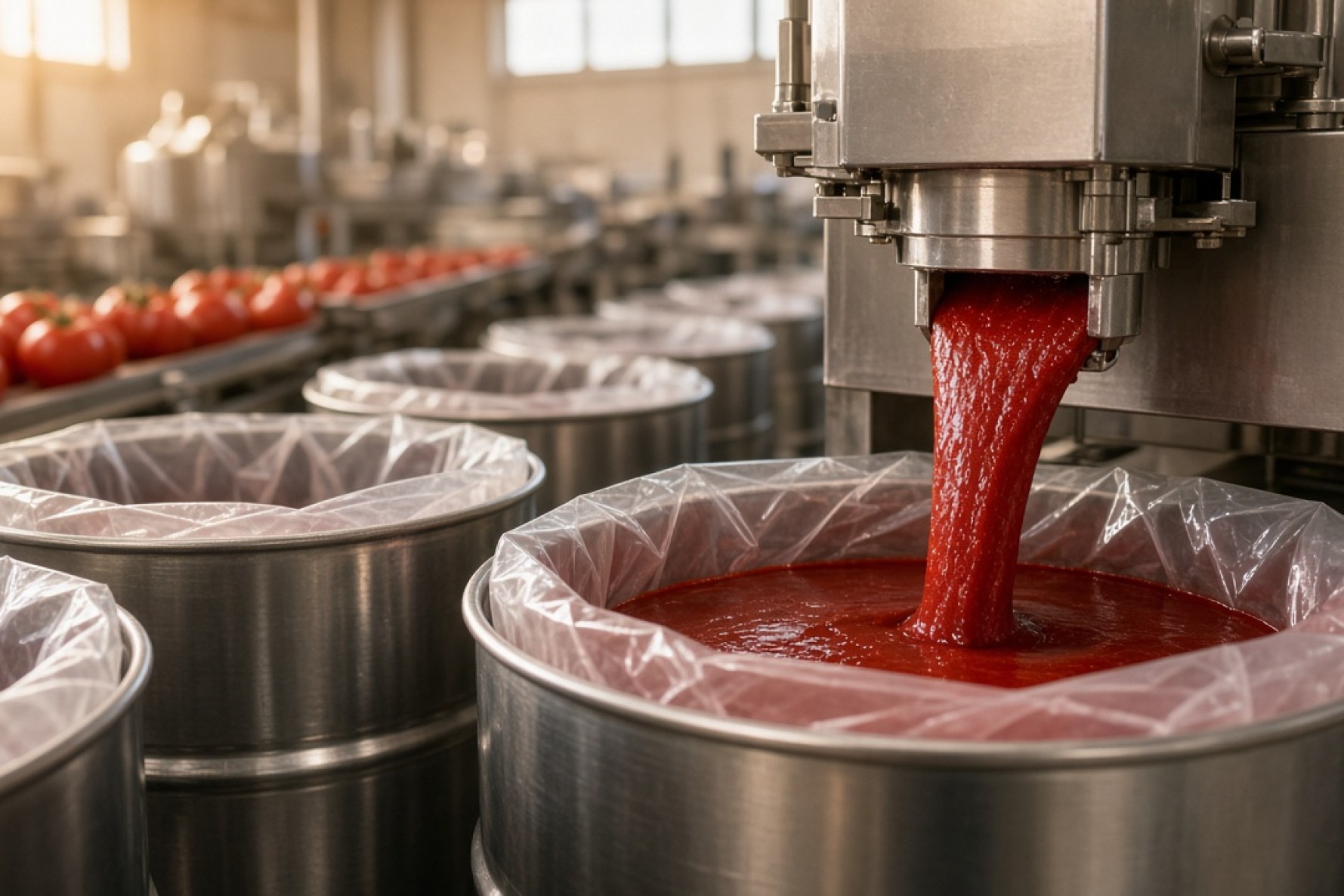
Industrial tomato concentrate (typical concentration 36 to 38 percent natural Brix) is the primary raw material for ketchup lines, pizza sauce, ready meals, meat products, and condensed soups worldwide. Unlike consumer paste in cans, this grade is traded mainly in 220-liter aseptic drums with a net weight of about 235 kg, and the buyer moves “transportable dry matter” with minimal added water. Procurement managers, formulation engineers, and B2B traders sourcing from Iran, Turkey, China, or Italy must weigh rheological indices, microbiological safety, and customs compliance alongside price per ton in a single economic model.
With annual processing capacity exceeding 1.7 million tons of industrial tomatoes, vacuum concentration lines, and aseptic filling systems, Iran is a major source of 36–38 Brix concentrate for Eurasia, Iraq, Afghanistan, and the Persian Gulf. Success in direct imports from Iran depends above all on a contract that clearly states salt-free Brix, thermal break type, Howard mold count ceiling, HunterLab color index (a/b), and tariff code HS 200290.
1. Iran’s role in industrial tomato concentrate supply
Iran’s tomato processing industry is built on climatic diversity and multi-season harvesting. Provinces such as Fars (Marvdasht and Seydan), Kermanshah, Qazvin, Azerbaijan, and Khorasan host large complexes that, besides 28–30 Brix consumer paste, run continuous concentration lines to full capacity for 36–38% concentrate during peak harvest. Access to industrial gas for evaporator steam and competitive energy costs versus many European and Turkish producers are structural advantages.
In foreign trade, most exported Iranian concentrate falls into three zones: overland neighbors (Iraq and Afghanistan), the Eurasian Economic Union (Russia, Kazakhstan, Armenia, and others), and Persian Gulf re-export hubs (UAE and Oman). In each zone, the 220-liter aseptic format and 36–38% Brix grade is the most demanded industrial SKU, because each 20-foot container moves roughly 18.4 to 18.8 tons of effective dry matter.
- Processing capacity: Industry estimates for recent seasons range from 1.7 to 2.1 million tons of industrial tomatoes; the share going to heavy concentrate depends on export contracts and domestic sauce lines.
- Logistics advantage: Southern ports (Shahid Rajaee, Shahid Bahonar) for ocean FCL; land borders Bazargan, Sarv, and Mirjaveh for 20–24 ton trailers.
- Supply risks: Raw tomato price swings, field quality (Howard), and batch uniformity across lines; professional buyers include per-batch COA and loading inspection in the contract.
| Exporting country | Approx. export volume (tons) | Share of world trade | Main advantage | Primary markets |
|---|---|---|---|---|
| China | 1,100,000–1,200,000 | ~30% | Very large scale, competitive base price | West Africa, Middle East, East Asia |
| Italy | 750,000–800,000 | ~20% | Brand value, variety of retail packaging | Western Europe, North America, Japan |
| United States | 350,000–380,000 | ~9.5% | Full mechanization and high yield | Canada, Mexico, East Asia |
| Iran | 250,000–290,000 | ~7% | High natural Brix, competitive energy, regional position | Russia and Eurasia, Iraq, Turkey, Persian Gulf |
| Spain | 250,000–280,000 | ~7% | Tariff-free access to the EU market | European Union, United Kingdom |
2. Hot Break vs. Cold Break in industrial concentrate
The thermal break applied to pulp before concentration sets viscosity, syneresis stability, and the final concentrate’s HunterLab color index (a/b). In Hot Break, natural pectin is largely preserved—ideal for ketchup and thick sauces. In Cold Break, controlled pectin hydrolysis yields higher fluidity and a brighter red—suited to some soups and color-sensitive formulas.
| Index | Hot Break | Cold Break |
|---|---|---|
| Shock temperature | 85–95°C | 65–75°C |
| Bostwick (12.5 Brix, 30 s) | 3–6 cm | 7–12 cm |
| HunterLab color index (a/b) | Deep red; contractual minimum 2.1 | Bright red; often a/b above 2.3 |
| 36–38% concentrate applications | Ketchup, pizza sauce, ready meals | Soup, some thinner sauces |
For concentrate exported to Russia and ketchup plants, Hot Break dominates. Buyers should state process type explicitly in the RFQ; mixing Hot and Cold lots in one contract without disclosure disrupts the formulation line.
3. Brix grades and commercial value of concentrate
Brix (°Brix) at 20°C is measured with a refractometer on natural soluble solids (NTSS) without salt effect. Industrial aseptic concentrate is usually traded at 36–38%; some contracts target up to 38.5%. Under Codex CXS 57, product with at least 24% NTSS falls under “tomato paste”; 36–38% is the highest commercial B2B concentration grade.
| Natural Brix | Commercial tier | Packaging | Industrial use |
|---|---|---|---|
| 28–30% | Standard industrial paste | Aseptic 220 L | Sauce, ready meals with easy pumping |
| 30–32% | Mid concentrate | Aseptic 220 L | Meat products, prepared foods |
| 36–38% | Heavy industrial concentrate | Aseptic ~235 kg | Ketchup, reprocessing with minimal water carriage |
4. Laboratory parameters on the certificate of analysis (COA)
Industrial concentrate purchase contracts should tie to the COA for each production batch. A standard or internationally recognized laboratory (SGS, Bureau Veritas, and similar) at the loading origin strengthens consignment acceptance at destination customs.
| Parameter | Contractual range | Importance to buyer |
|---|---|---|
| Natural Brix (salt-free) | 36–38% (or agreed ±0.5) | Settlement and formulation basis |
| Bostwick @ 12.5°Bx | Hot: 3–6 cm / Cold: 7–12 cm | Predict behavior on ketchup line |
| HunterLab color index (a/b) | Minimum 2.1 (premium ≥2.2) | No scorching; a/b below 2.0 rejected for export |
| pH | 4.1–4.3 (ceiling 4.4) | Microbiological safety |
| Total acidity (citric acid) | 1.5–2.5% by weight | Flavor balance |
| Salt | 0% in industrial aseptic | Avoid false Brix |
| Lycopene | 50–75 mg/100 g | Incoming tomato quality |
| Dark specks | Maximum 5–7 per 10 g | Concentration line cleanliness |
HunterLab color index (a/b) must be measured on sample diluted to 12 Brix at 20°C—the same condition cited in Turkish regulations and many Eurasian buyers. Component a reflects redness and b yellowness; the a/b ratio is the main index of thermal purity, not absolute a alone.
5. Howard Mold Count, MRL, and heavy metals
Howard test (HMC)
Howard Mold Count is run on sample at 8.5 Brix and reports the percentage of microscopic fields containing mold hyphae. Under Codex 57 and Iranian national standard 761, the permitted ceiling is maximum 40%. Sensitive destination plants (Russia, some EU buyers) may contract 30–35%. Values above 40% usually lead to detention or rejection at customs.
Pesticide residues (MRL)
- Chlorine, phosphorus, and organics controlled per Codex CAC/MRL limits and destination country rules.
- Batch sampling before loading; if in doubt, GC-MS/LC-MS at a third-party lab.
Heavy metals
- Lead (Pb): Typical ceiling 0.05–0.1 mg/kg.
- Cadmium (Cd): Per Codex limits for tomato products.
- Tin (Sn): Usually low in aseptic concentrate (no prolonged contact with tinplate); for canned consumer export, maximum 100–200 mg/kg.
6. Aseptic bag-in-drum packaging and logistics
The main B2B trade channel is aseptic bag-in-drum technology: after UHT sterilization and cooling, product is filled in a sterile environment into a multilayer bag (polymer–aluminum–polymer) and placed in a 220-liter steel drum with a ring lid. Typical net weight is 230 to 235 kg per drum.
- Shelf life: 24–36 months in moderate storage (preferably below 25°C) without refrigeration.
- 20-foot FCL loading: 80 drums on 20 pallets (4 drums per pallet); total net weight about 18.4–18.8 tons.
- Securing: Polyester strapping, container floor bracing, and air bags to prevent bag puncture against drum edges.
- Moisture: On Persian Gulf routes, hanging silica gel bags in the container reduce drum lid corrosion and condensation.
| Unit | Value |
|---|---|
| Drum volume | 220 L (nominal capacity) |
| Net product weight | 230–235 kg |
| Approximate density | 1.15–1.25 g/cm³ |
| 20-foot shipment gross weight | About 20.5 tons |
7. Export markets: Eurasia (EAEU), Turkey, and the Persian Gulf (GCC)
Eurasian Economic Union (EAEU)
Russia and EAEU members are the largest buyers of 36–38% concentrate from Iran. Entry documents include the Eurasian conformity declaration (EAC) under TR CU 021/2011 and TR CU 023/2011, CT-3 certificate of origin for preferential duty of zero to 5% (versus base 10–20%), and Howard ceiling maximum 40%. Exceeding this limit usually leads to rejection at Astrakhan or Dagestan customs. Shipment via Caspian ports (Anzali, Astara) or land transit is common.
Turkey and inward processing regime (IPR)
Turkey imports thousands of tons of aseptic concentrate annually under HS 200290 from Iran. Much of this buying runs under the inward processing regime (Dahilde İşleme Rejimi): sauce plants registered with the Ministry of Trade import Iranian concentrate under customs bond without duties and export finished product to the EU or Middle East. Uniform Brix, quota alignment with the eight-digit license code, and freedom from foreign matter are critical for Turkish buyers. Türk Gıda Kodeksi typically requires minimum HunterLab color index (a/b) 1.8 at 12 Brix; industrial buyers often specify 2.0 or higher.
Persian Gulf (GCC)
UAE, Oman, and Qatar use GSO standards as the baseline. Jebel Ali is a re-export hub for aseptic concentrate to Africa and South Asia. Halal certificate, valid COA, and MRL control are required for clearance. Both 28–30% consumer cans and 36–38% aseptic appear in this market.
| Destination | Format | Brix | Notes |
|---|---|---|---|
| Russia / EAEU | Aseptic 220 L | 36–38% | EAC, Howard ≤40% |
| Turkey | Aseptic / bulk | 36–38% | a/b ≥1.8 at 12 Brix |
| UAE / GCC | Aseptic | 36–38% | GSO, halal |
| Iraq | Cans + aseptic | 28–30% and 36% | COSQC |
8. Customs classification (HS Code)
In international trade statistics, tomato paste and concentrate fall under chapter 20 and six-digit code 200290 (“tomatoes prepared or preserved otherwise than by vinegar, whole or in pieces”). National subheadings differ:
- 20029010: Common in Iran customs for paste/concentrate with high dry matter (often above 30%).
- 20029090: Other concentrated derivatives with lower Brix or different purées.
- 20021000: Whole or pieces canned tomatoes—outside industrial concentrate scope.
9. Industrial processing applications for 36–38% concentrate
Heavy concentrate lowers freight cost per kilogram of dry matter because of high solids and is diluted on the destination line:
- Ketchup and tomato sauce: Hot Break 36–38%; control Bostwick after dilution.
- Pizza and pasta sauce: Blended with spices, oil, and water; color stability with suitable a/b.
- Ready meals and canned meat: Natural acidity and color source.
- Soup and culinary bases: Sometimes Cold Break for brighter color.
- Processed protein products: Sausage, cocktail sausages, industrial burgers.
Formulation engineers should factor mixing time, concentrate addition temperature, and reheat effect on HunterLab color index (a/b) into true raw-material cost.
10. Dry-matter-based pricing (economic analysis)
Comparing two price offers on “dollars per ton” alone is misleading. The professional method normalizes price by contractual Brix percent—equivalent to cost per Brix point per ton:
After this normalization, add ocean or land freight, inspection, insurance, and dilution at the destination line. 38.5% concentrate may look higher on FOB but can win on “dollars per kilogram of usable solids”—provided COA confirms Brix and viscosity for both batches.
| Offer | Price USD/t | Brix | Index (÷ Brix) |
|---|---|---|---|
| A | 840 | 36% | ~23.33 |
| B | 880 | 38.5% | ~22.86 |
11. Twelve-point checklist for industrial buyers
Before advance payment or opening a documentary credit, record these twelve items in writing and make them contractually binding:
- Thermal break type: Hot Break or Cold Break (no mixed batches)
- Salt-free natural Brix with lab tolerance (e.g. 36–38% ±0.5)
- Bostwick at 12.5°C and 20°C Brix
- Minimum HunterLab color index (a/b)—usually ≥2.1
- Howard Mold Count (HMC) ceiling—standard ≤40% or strict 35%
- pH and total acidity ranges
- Zero salt in industrial aseptic (or specified ceiling)
- Packaging: aseptic 220 L, net weight 230–235 kg, intact bag and drum lid
- COA from accredited lab per batch + MRL and heavy metals if destination requires
- HS code and identical description on all documents (200290 / national subheading)
- Third-party loading inspection (SGS and similar) and container seal
- Incoterms, delivery time, damages, and destination clearance rules (EAC, GSO, Türk Gıda)
12. RFQ fields for industrial concentrate
A quote request without technical specs leads to unexecutable prices. Include these fields in the RFQ:
- Hot Break / Cold Break
- Target Brix (36–38% or 38.5%)
- Bostwick @ 12.5
- Minimum HunterLab a/b (measured at 12 Brix)
- HMC (Howard Mold Count) ceiling
- Format: 220 L aseptic drum, expected net weight
- Number of drums or 20-foot FCL count
- Drum branding (plant / private label)
- Incoterms (FOB southern port, CIF destination, border delivery)
- Destination country and customs office
- Need for certificate of origin, health, halal, EAC
- Delivery window and payment terms (LC, advance, tenor)
13. Sourcing industrial concentrate from Iran with Iranco
Buying 36–38% concentrate from Iran requires aligning technical specs with real line capacity. Iranco connects international buyers with reputable Iranian tomato processing plants; your request is reviewed for Hot/Cold Break, Brix, Bostwick, Howard ceiling, and aseptic volume, and options matched to the destination market (Eurasia, Turkey, GCC) are proposed.
Before finalizing a contract you can arrange factory samples and review reference COAs through Iranco. Send a complete RFQ so normalized dry-matter price and realistic freight terms can be calculated.
Summary
Iranian industrial tomato concentrate at 36–38% Brix, in 220-liter aseptic drums weighing about 235 kg, is an economical answer to ketchup and sauce plant demand in Eurasia and the Persian Gulf. Deal success depends on a contract that clearly states salt-free Brix, HunterLab color index (a/b), Bostwick, Howard ≤40%, MRL, and code HS 200290, and compares price using the normalized index (price divided by Brix).
Frequently asked questions
1. How does 36–38% concentrate differ from 28–30% paste in industrial buying?
Heavier concentrate carries less water and moves more dry matter per container; it is diluted on the destination line. 28–30% paste suits direct pumping in some sauces but freight cost per solid is usually higher.
2. How is the HunterLab color index (a/b) measured and interpreted?
Sample is diluted to 12 Brix at 20°C and read on a HunterLab spectrophotometer. The a/b ratio (redness to yellowness) is commonly at least 2.1 for export; a/b below 2.0 indicates scorching or excessive heat in concentration.
3. What is the permitted Howard Mold Count ceiling for exported concentrate?
Under Codex 57 and national standard 761, maximum 40%. Many Eurasian buyers contract 35% or lower.
4. How many 220-liter aseptic drums fit in a 20-foot container?
Usually 80 drums on 20 pallets (4 drums per pallet), with concentrate net weight about 18.4 to 18.8 tons.
5. Why can 880 USD at 38.5% Brix be more economical than 840 USD at 36%?
Dividing price by Brix: 840÷36≈23.33 versus 880÷38.5≈22.86—lower cost per Brix point per ton if COA quality is equal.
6. What is the customs code for tomato concentrate?
Internationally HS 200290; in Iran subheading 20029010 is often used for high dry-matter paste/concentrate.
7. What documents are needed for export to the Eurasian Union?
EAC conformity certificate, labeling per TR CU 022, COA including Howard and residues, health certificate, and preferential duty under the Iran–Eurasia agreement when applicable.
8. How do I order concentrate with technical specs through Iranco?
Via Iranco’s contact form, send Hot/Cold Break, Brix, Bostwick, a/b, Howard ceiling, drum count, and Incoterms so sourcing from qualified plants can be reviewed.
Featured Products




Related Articles



