 Iranco Magazine Team
Crystallography assessment, spectroscopic testing of natural saffron colour, international standards and wholesale buying process
Export Guide · Saffron Rock Candy · Quality & Standards
Saffron Rock Candy: Quality, Colour and Commercial Buying Guide
Crystallography assessment, spectroscopic testing of natural saffron colour, international standards requirements and the wholesale commercial buying process — published in the Iranco magazine.
| Key indicator | Value or technical identifier |
|---|---|
| International customs tariff code (HS Code) | 170490 |
| National product standard reference | Iran National Standard No. 739 |
| Annual production volume in Iran | Over 220,000 tonnes |
| Maximum allowable moisture in crystal tissue | 2.0% by weight |
This specialist guide examines the technical specifications, physicochemical variables and commercial indicators of saffron rock candy for export markets. Trade managers, distribution companies and international importers gain full command of laboratory methods to separate saffron crocin from chemical dyes, crystallisation engineering, moisture-barrier packaging standards and wholesale contract protocols.
From a food-conversion technology perspective, saffron rock candy results from supersaturation, nucleation and growth of sucrose crystals in the presence of bioactive compounds and pigments from saffron stigmas. Over recent decades the product has moved beyond a traditional sweet into a specialised sweetener with distinctive medicinal and sensory traits and a durable place in the food-export value chain. Combining Iran’s absolute advantage in saffron production with sugar-refining infrastructure creates favourable conditions for converting base sugar into a high value-added article.
The central issue in international trade is assuring the authenticity of natural saffron extract, maintaining crystal clarity over time and controlling physical defects such as stickiness and secondary sugar bloom across destination climates. Illegal use of cheap azo synthetic dyes in traditional workshops sharply raises the risk of shipment seizure at ports and entry points. This report, analytical and standards-based, sets out the technical, chemical, logistics and commercial dimensions needed to manage the saffron rock candy supply chain optimally.
1. Market structure, production capacity and Iran’s geoeconomic position in saffron rock candy trade
Iran is the world’s largest base for saffron cultivation and processing and has developed an extensive industry converting beet and cane sugar into rock candy crystals. Annual production of rock candy types in licensed industrial plants and workshops is estimated at over 220,000 tonnes. Razavi Khorasan province and the Mashhad urban hub, as the industry’s main pole, produce more than 50,000 tonnes of first-grade saffron rock candy each year using the latest crop from Qaenat and Torbat-e Heydarieh saffron fields. Beyond Khorasan, Isfahan, Yazd and Tehran also form part of national industrial capacity through confectionery tradition and modern crystallisation plants.
Geography of actual commercial markets
International demand has both regional and extra-regional character. In neighbouring markets, long-standing black-tea culture and familiarity with traditional medicinal uses of rock candy sustain continuous pull. Iraq, taking more than 5,000 tonnes of Iranian rock candy a year valued at USD 7–9 million, is the largest actual importer. Steady pilgrimage tourism and aligned food preferences in Baghdad, Najaf and Karbala keep this market first among export destinations. In the same geography, GCC members — Oman, UAE, Kuwait and Qatar — have become primary outlets for luxury stick rock candy and gift-pack formats.
On the eastern borders, Afghanistan and Pakistan, with high green- and black-tea consumption, demand bulk branch and board rock candy at economical sourcing cost. Direct road haulage via Dogharoun, Milak and Mirjaveh gives Afghan and Pakistani buyers a lasting advantage.
From traditional markets to modern international demand
The distinction between actual and potential markets lies in the product valuation model. Current markets mainly buy bulk or basic carton packs, while broad potential demand is forming in foodservice chains, five-star hotels, international cafés and airlines across Europe, North America and East Asia. These segments see saffron rock candy not merely as sugar but as a “dissolvable saffron stirrer” with natural and organic attributes. Successful entry requires moving from workshop patterns to mechanised crystallisation lines, global safety approvals and impermeable moisture barriers.
| Value-added chain of saffron rock candy | |
|---|---|
| Traditional market (actual) | Modern market (potential) |
| Bulk carton supply | Single-serve OPP film packaging |
| Focus on weight and price | Focus on colour grade and aroma |
| General household use | HoReCa and luxury chains |
| Consumption in neighbouring countries | Penetration of international markets |
2. Sucrose crystallography and structural distinction of rock candy types
Sucrose crystallisation is a mass- and heat-transfer process in which disordered sugar molecules in a supersaturated liquid phase form a stable, three-dimensional, transparent monoclinic lattice. Syrup position, thread or stick orientation and cooling rate in the warm room produce different physical types.
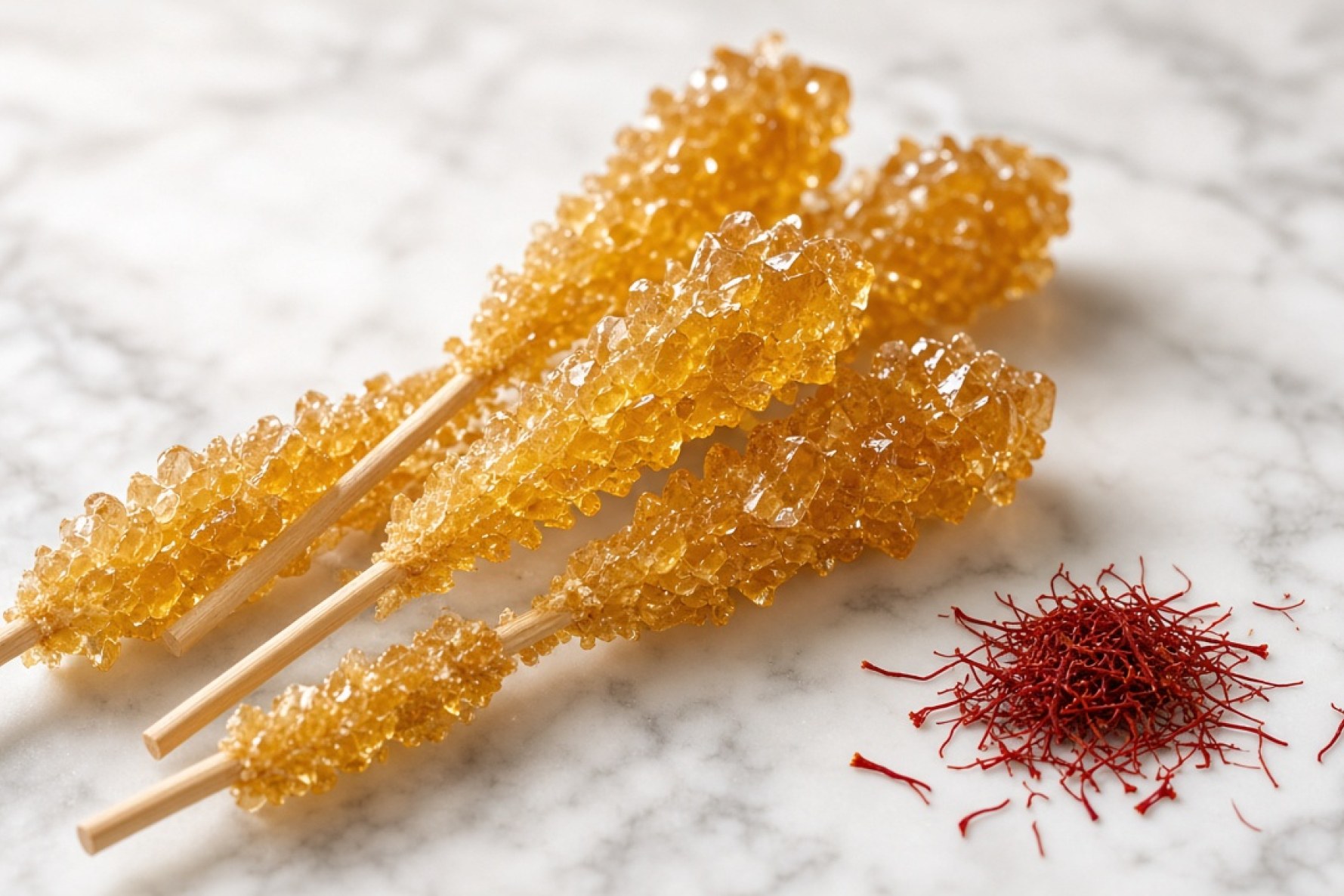
Saffron stick rock candy
Crystals deposit around a symmetrical wooden core. Advanced lines use sanded, lint-free, sterile, flavour-neutral poplar or spruce sticks. Microscopic surface roughness anchors primary sucrose nuclei. Crystal density is high; ease of individual serving without spoons or hand contact drives strong acceptance in hotels, airlines and cafés.
Saffron branch rock candy
Pure cotton threads free of synthetic fibres hang at set intervals in crystallisation pans. After supersaturation, primary crystals seat on the thread and grow radially. Branch crystals have longer faces and larger size than stick candy and dominate traditional retail and gift-box formats.
Saffron rock candy veil (sheet)
Gradual water evaporation at the liquid–air interface creates a critical supersaturated surface layer with very fast sheet crystallisation. Lower-density crocin pigments and aromatic safranal fats rise to the surface, trapping the highest saffron load. The veil is very crisp, sheet-like and brittle (2–5 mm), with peak aroma and extremely fast solubility.
Bowl and board rock candy
Crystals settling on the concave floor and sloping walls of traditional pans form bowl candy — dense, more opaque, thick masses under hydrostatic pressure of the upper syrup. Without a central axis they are removed as heavy plates and broken into irregular pieces. Lower unit cost suits confectionery workshops and economy packs.
Negin and crumb rock candy
On mechanised packing lines, broken crystals sorted at 10–15 mm are called negin — transparent cubic grains suited to hospitality sugar bowls as a cube-sugar alternative. Crumbs under 5 mm become aromatic saffron sugar in halvah, ice cream and dessert formulas.
| Structural feature | Saffron stick | Saffron branch | Veil | Bowl |
|---|---|---|---|---|
| Central crystallisation axis | Food-grade sterile wood | Organic cotton thread | No axis (surface) | Pan wall and floor |
| Average crystal size | 10–20 mm | 15–40 mm | 2–5 mm | Continuous mass |
| Dissolution in hot water | Moderate (3–5 min) | Slow (5–8 min) | Very fast (<1 min) | Slow (>7 min) |
| Saffron compound concentration | Homogeneous, medium | Homogeneous, medium | Very rich, surface | Heterogeneous, lower |
| Shock vulnerability | Very low (with wrap) | Medium | Very high (needs bracing) | Very low |
| Priority end market | Foodservice, cafés, modern export | Traditional chain retail | Luxury herbal-tea markets | Confectionery workshops, general use |
3. Physicochemical specifications and reference quality standards
Quality assessment rests on official standards; in Iran, National Standard No. 739 (“Rock candy — specifications and test methods”). For global trade, shipment specs must align with Codex and Gulf Standardization Organization (GSO) requirements.
Production begins by dissolving white sugar in drinking water. The syrup is boiled and colloidal foams/impurities removed with egg-white protein or physical filtration. After target Brix (usually 78–82%), standardised stigma extract is added and liquid at about 80–85 °C enters crystallisation tanks in a 35–45 °C warm room. Hold and crystallisation last 2–3 days for maximum yield.
| Chemical test parameter | ISIRI 739 range | Premium export standard | International method / reference |
|---|---|---|---|
| Sucrose on dry matter | Min 99.0% w/w | Min 99.6% w/w | Brunswick polarimetry (ICUMSA GS2/3-1) |
| Free & volatile moisture | Max 2.0% w/w | Max 0.9% w/w | Vacuum oven drying at 70 °C |
| Reducing sugars (invert) | Max 1.0% w/w | Below 0.4% w/w | Lane-Eynon titration |
| Sulphated ash | Max 0.15% w/w | Max 0.05% w/w | Calcination at 550 °C (ICUMSA GS2/3-17) |
| Residual sulphur dioxide | Max 15 mg/kg | Below 10 mg/kg | Pararosaniline colorimetry |
| Artificial food colours | Completely negative | Absolutely zero | TLC and HPLC |
| Lead | Max 0.5 mg/kg | Below 0.1 mg/kg | Graphite-furnace AAS |
| Arsenic | Max 0.5 mg/kg | Below 0.05 mg/kg | Hydride-generation AAS |
4. Physical defects, rheological behaviour and crystal pathology
Pre-loading commercial assessment requires precise identification of structural crystal faults. Each visual defect signals deviation in cook, crystallisation or drying thermodynamics.
Cloudiness and opacity
Standard crystals should shine like glass or quartz. Opacity arises when early warm-room cooling is too fast — thermal shock drives sudden microcrystal nucleation instead of gradual layer growth. Incomplete syrup clarification and residual ash or soluble gums also cloud the tissue.
Stickiness, viscosity and weeping
Rock candy is inherently stable in dry air, but invert sugar (equal glucose and fructose) upsets the balance. Fructose is strongly hygroscopic. Excess heat or uncontrolled acidity during long cooks hydrolyses sucrose and raises invert. The product then absorbs ambient moisture even at low RH and the surface turns sticky — irreversible quality loss in the buyer’s warehouse.
Secondary sugar bloom (white powdery crystals)
After draining uncrystallised syrup, product must drain and dry in filtered air. Incomplete drying leaves a thin syrup film that powder-crystallises under dry-air shock, forming a chalk-like halo on the golden colour that overseas buyers may mistake for mould or chemical spoilage.
Crystal detachment from the stick
Separation of the sugar mass from the wooden stem is common when sticks are polished, initially damp, or exposed to abrupt storage temperature swings. Grade-one lots dry-heat-treat sticks before immersion and design edges so tensile bond strength exceeds 20 N.
| Physical defect | Thermodynamic / process cause | Commercial measurable index | Export contract tolerance |
|---|---|---|---|
| Surface stickiness | High invert sugar and thermal hydrolysis | Critical relative-humidity test | Zero percent at 20 °C |
| Crystal opacity | Cooling shock and trapped microbubbles | Solution turbidity index at 560 nm | Below 2% of shipment weight |
| Surface powder bloom | Incomplete residual-syrup drainage | Visual inspection under standard white light | Max 1% of total crystal surface |
| Detachment from wood | Stick slipperiness and road vibration | One-metre drop resistance test | Below 1.5% of pieces per carton |
| Veil brittleness | Wrong thickness and direct mechanical impact | Weight share of pieces under 2 cm | Max 5% of pack weight |
5. Spectroscopy, laboratory tests and saffron colour authenticity methods
The golden-yellow to amber colour of premium saffron rock candy comes from water-soluble saffron glycosides centred on crocin, completed by bitter picrocrocin and aromatic volatile safranal. The large price gap between pure saffron and industrial chemical dyes strongly tempts illicit azo colour use.
Synthetic dye risks and legal bans
Tartrazine (E102), Sunset Yellow (E110) and Quinoline Yellow (E104) are the most persistent illegal artificial colours. Azo bonds give high heat stability and tiny doses produce brilliant colour, yet proven clinical effects include childhood hyperactivity, respiratory disorders, urticaria and liver/kidney functional harm. Under national standard rules and all international health protocols, offering chemically coloured candy as “saffron rock candy” is fraud and triggers destruction and heavy penalties.
Thin-layer chromatography (TLC)
Under Iran National Standard 2634, TLC is the legal screening method in customs labs. Sample is dissolved in distilled water and acidified; pigments adsorb on white wool or polyamide resin, then desorb in dilute alkali, spot on silica gel and develop. Spot positions are compared with pure tartrazine and Sunset Yellow standards — any aligned tartrazine spot proves adulteration.
HPLC and spectrophotometry
The most precise quantitative approach follows ISO 3632. Five grams dissolved in demineralised water, filtered at 0.45 µm, injected on reverse-phase C18 HPLC with DAD: pure crocin absorbs at 440 nm; safranal at 330 nm; tartrazine shows a sharp peak at 426 nm easily separated from multi-branch crocin spectra. If the 440/250 nm absorbance ratio falls outside the saffron standard range, illegal chemical intervention is confirmed.
| Colour compound | Origin | λmax | Legal status in saffron rock candy |
|---|---|---|---|
| Crocin | Natural (saffron stigma) | 440 nm | Only permitted standard colour |
| Safranal | Natural (volatile saffron oil) | 330 nm | Permitted (guarantees natural aroma) |
| Tartrazine (E102) | Synthetic (coal-tar derivative) | 426–428 nm | Fully banned |
| Sunset Yellow (E110) | Synthetic (petroleum azo) | 480–485 nm | Fully banned |
| Quinoline Yellow (E104) | Synthetic (quinoline sulfonate) | 411–415 nm | Fully banned |
6. Hygiene requirements, international certificates and target-market entry standards
Secure trade requires exact alignment with origin and destination hygiene rules. Producers need an IFDA manufacturing hygiene licence and mandatory national standard mark. Internationally, ISO 22000 and HACCP demonstrate control of biological, physical and chemical contamination through cook, cooling and packing.
GCC (GSO) requirements
Gulf standards apply strict confectionery rules. Halal certificates from IHAF-recognised bodies or UAE ESMA are mandatory for all sweet food shipments, assuring no haram animal-origin additives, stabilisers or mould release agents. GSO 1016 on prepackaged food labelling requires durable bilingual Arabic/English print of: exact product name; ingredients in descending weight; manufacturer name, full commercial address and national ID; official importer details, origin (Iran) and licence number; net weight excluding wood/thread; Gregorian production/expiry dates; and nutrition table per serving.
EU and North American rules
For European export, pesticide MRLs on source saffron are checked under RAPEX. Exceeding heavy-metal limits (cadmium, lead, arsenic) or detecting toxic mycotoxin derivatives triggers immediate seizure and return.
7. Customs tariff classification and international clearance procedures
Correct HS Code registration is a financial and legal chokepoint; neglect can bring legal consequences, under-declaration accusations or destination seizure.
Heading 1701
(Raw and refined sugar)
- Treated as a staple commodity
- Severe export restrictions
- Mismatch with the finished processed product
Heading 1704 — correct
(Sugar confectionery without cocoa)
- Correct code for saffron rock candy
- Subheading 170490 (hard candy)
- Accepted in international customs
Accepted international base for rock candy is heading 1704 — cooked and crystallised confectionery without cocoa powder. Subheading 170490 covers hard candy, crystallised confectionery sugar and flavoured rock candy. Many national eight-digit tables set 17049030 for flavoured sugar candy / rock candy. Declaring under 1701 (refined sucrose) is a common beginner error rejected at origin and destination: rock candy has undergone secondary heat, engineered crystallisation and plant extract addition. In Iran, white-sugar export is often banned or heavily taxed due to preferential FX and domestic need, while finished rock candy under 1704 with a standard licence is fully exportable.
Mandatory clearance documents with the bill of lading:
- Valid international bill of lading (air, sea, rail or road)
- Commercial invoice and packing list by carton with gross and net weights
- Certificate of origin from Iran’s Chamber of Commerce
- Health certificate from the Ministry of Health Food & Drug authority
- Official COA confirming physicochemical parameters and absence of synthetic colours
8. Comprehensive export-market analysis and regional consumer behaviour
Demand structure and sales channels are not uniform worldwide. In Oman, Kuwait and UAE, saffron rock candy carries traditional prestige — gifts for Eid, diwaniya service and pairing with Arabic coffee or black tea; buyers favour single-serve stick candy in premium boxes. Iraq is a large market with fast road access; much volume is pilgrimage souvenirs toward branch candy with rich saffron veils and economy cartons. Central Asia and the Caucasus sustain bulk bowl and branch in 10–12 kg cartons. Diaspora markets in Europe and North America judge quality by crystal clarity, authentic aroma and known brands.
| Country / region | Annual imports (t) | Preferred pack | Preferred saffron grade | Price sensitivity | Dominant channel |
|---|---|---|---|---|---|
| Iraq | 5,000–7,000 | 5 & 10 kg bulk cartons | Sargol with coarse stigmas | High | Traditional wholesalers, pilgrimage markets |
| Oman | 800–1,200 | Luxury crystal & wood gift boxes | Super Negin, concentrated extract | Low | Hypermarkets, confectionery boutiques |
| UAE | 800–1,200 | Wrapped singles, 100-count cartons | Super Negin, no suspended particles | Low | Restaurants, hotels, duty-free |
| Pakistan | 1,000–1,500 | Bulk cardboard cartons with inner PE | Medium Sargol | Very high | Spice & sugar wholesale markets |
| Kuwait | 500–700 | Premium hardboxes & metal tins | Negin, high crocin grade | Very low | Luxury chain stores |
| European Union | 200–400 | Metallised zip pouches with window | Certified organic | Low | Ethnic & organic retail |
9. Export packaging engineering and moisture/oxidation control
Packaging is critical to quality stability. Crystalline sucrose above ~60% RH at room temperature undergoes surface phase transition — water vapour plasticises and breaks ordered lattices, yielding a saturated, sticky, mould-prone layer. Crocin also photodegrades under UV, turning amber gold to dull yellow, grey or white.
Stick candy needs bilayer BOPP laminated to CPP at least 35–45 µm; tropical luxury lots benefit from metallised aluminium-coated film. Branch and veil use food-grade GPPS crystal injection pots. Master cartons should be five-ply BC-flute heavy kraft with pharmaceutical-food silica gel (min 50 g per 10 kg carton).
10. International logistics, dry/cold chain and dew-point control in container shipping
Ocean containers face “container rain”: cargo loaded in mild weather meeting hot humid seas causes trapped air to hit dew point; condensate drips onto cartons, softening cardboard and collapsing lower tiers while accelerating crystal dissolution.
- Thermal liner: floor, walls and roof of 20/40 ft dry vans lined with multi-layer aluminium foil and PE bubble insulation.
- Hanging desiccants: at least 6–8 calcium-chloride/starch hangers (up to 300% dry-weight absorption) along the container.
- Reefer: for distant destinations or May–September Middle East heat, set 18–20 °C with ventilation ~15 m³/h.
| Logistics environment | Origin plant warehouse | Sea container | Destination warehouse | Critical damage limit |
|---|---|---|---|---|
| Storage temperature | 18–22 °C | 15–20 °C | 18–24 °C | Above 28 °C |
| Relative humidity (RH) | Below 45% | Below 50% | Below 55% | Above 65% |
| Daily temperature swing | Max 3 °C | Max 5 °C | Max 4 °C | Swing over 10 °C |
| Max pallet stacking | 2 high | Single pallet (no overlap) | 2 high | Excess weight |
11. Cost structure, pricing variables and market volatility
Pricing depends on chemical, process and agricultural-supply variables. Unlike industrial confectionery with fixed formulas, this article swings with sugar and saffron rates.
- Refined sugar: ≥99.8% purity sugar forms over 95% of dry rock candy weight; exchange-discovered prices set the base.
- Premium saffron: 1–2 mithqal (~4.6–9.2 g) premium Sargol stigmas per 100 kg input sugar in top grades.
- Crystallisation yield: typically 65–72% of input sugar; residual syrup sold cheaper to alcohol, vinegar or local confectioners.
- Packaging materials: spruce sticks, multilayer films, GPPS pots and five-ply export cartons account for 15–30% of final cost.
| Pricing variable | Share of final price | Quote source | Buyer risk cover |
|---|---|---|---|
| Official sugar rate | 40–50% | Iran Mercantile Exchange daily trades | Price-stability band by purchase volume |
| Premium saffron price | 20–25% | Mashhad & Torbat-e Heydarieh saffron index | Specify stigma grade & dose on COA |
| Crystallisation-line efficiency | 10–15% | Plant equipment productivity | Choose suppliers with modern warm rooms |
| Packaging type & structure | 15–20% | Polymer & imported kraft board prices | Agree print type & wrap weight tolerance |
| Logistics & container tariff | 5–10% | Carrier freight & marine insurance | Use FOB Incoterms |
12. International competitiveness and novel industrial uses
Iran is unmatched in saffron-flavoured crystallised sugar, yet competes in broader rock candy with India (“mishri” — cheap cane sugar, usually irregular white untinted crystals) and China (“bing tang” — automated lines focused on plain white/yellow sugar). Iranian saffron rock candy competes in the luxury segment with large prismatic crystals, brilliant natural colour and superior sensory value.
| Producer country | Main competitive advantage | Challenge ahead |
|---|---|---|
| Iran | Saffron aroma & colour | Continuous packaging |
| India | Low sugar cost | No premium saffron |
| China | Automated lines | Focus on plain sugar |
| Germany & Belgium | HoReCa branding | Very high price |
Novel uses beyond household serving
- International aviation and rail — single-serve stick candy in business-class service
- Hotels and ethnic restaurants (HoReCa)
- Herbal tea and infused tea-bag formulas with negin grains
- Traditional pharmacy — carrier for bitter herbal actives
Importer checklist before placing an order
- Define exact geometry/model (stick, branch, veil, negin) in the proforma.
- Ban artificial colours (E102, E104, E110) with termination and full damages if lab-positive.
- Require accredited COA with invert below 0.5% and sucrose above 99%.
- Specify saffron grade (Sargol or Super Negin) and dose per 100 kg candy.
- Require fully finished, odour- and lint-free spruce sticks; ban polymer/recycled bases.
- Select primary and secondary packaging (heat-seal polymer wrap, clear pots, five-ply carton).
- State true net weight excluding wood or thread.
- Align bilingual labels, Gregorian dates and nutrition facts with destination law.
- Set Incoterms and marine insurance / container insulation responsibility.
- Require independent pre-shipment inspection (e.g. SGS).
Information needed for a price quote
- Exact model: stick, branch, veil, negin or board
- Saffron extract specs and dose
- Physical axis (11–13 cm round wood or pure cotton thread)
- Consumer pack weight/shape and master carton structure
- Total tonnage and delivery schedule
- Delivery point and Incoterms
- Destination legal requirements (halal, embassy health, heavy metals)
Export supply of saffron rock candy to buyer specifications
In cross-border saffron rock candy deals, profit versus loss hinges on exact match of technical and packaging specs to customs standards. Loss of crystal brilliance, poor wooden bases or even traces of synthetic dyes at border labs can seize an entire shipment.
Iranco gives importers and international distributors a structured path to register purchase requests on transparent technical parameters. The platform identifies accredited plants with mechanised crystallisation lines in the main production hubs (Khorasan and Isfahan) and evaluates supply options against budget, destination hygiene rules and packaging specs. Oversight of authentic saffron extract, invert-sugar control, pre-loading quality inspectors and official COAs makes access to quality Iranian product transparent and durable.
Conclusion
Saffron rock candy blends long Iranian confectionery craft with the engineering of sucrose crystallisation. Export success rests on three pillars: absolute control of illegal colours with reliance on natural crocin; crystallisation management for invert below 0.5% to eliminate stickiness; and packaging isolated from moisture and UV. Understanding container sweat in sea freight, GSO labelling compliance in Gulf markets and correct HS 170490 registration protect traders’ capital in this growing market.
Frequently asked questions
What is the best saffron rock candy model for Europe and the GCC?
Single-serve stick candy in metallised or matte BOPP/CPP wrap is best — strong hygiene standards, easy café/hotel service and low transit damage. Zero chemical colour is mandatory for these markets.
How can authentic saffron rock candy be told from artificially coloured samples?
Authentic product shows mild amber to golden yellow, saffron aroma and natural stigmas in the crystal; colour releases gradually in warm water. Tartrazine fakes flash bright lemon yellow on contact. Definitive methods are TLC or HPLC in an accredited lab.
What is standard shelf life and how is it preserved?
Under standard storage (below 22 °C, RH below 50%) shelf life is 24 months, requiring five-ply cartons, impermeable inner PE, silica gel and protection from direct sun to preserve crocin bonds.
Why does the surface become sticky in storage?
High reducing (invert) sugars from overheating the syrup cook make the product hygroscopic. Premium candy should keep invert below 0.5%.
How does the veil differ qualitatively from branch candy?
The veil is a surface sheet trapping maximum aroma and crocin and is very crisp; branch candy has thicker crystals, more stable structure and far better resistance to road and container shock.
What information is needed to get a price from Iran?
Model (stick, branch, negin), pack weight, packaging type/shape, approximate saffron dose, total tonnage and international delivery term. The same data can be registered as a quote request on Iranco.
What role does residual moisture play in sea-shipment durability?
If residual moisture exceeds 1.5% w/w, container sweat during long ocean transit liberates moisture, dissolving crystal faces, dulling clarity and causing caking. Drying to below 1% protects the cargo.
How can guaranteed-spec saffron rock candy be sourced from Iran?
Choose plants with ISIRI 739, ISO 22000 and official hygiene licences. International buyers can send these specs via Iranco as a purchase request so available Iranian supply options are matched to need.
Featured Products


Related Articles



