 Iranco Magazine Team
Complete guide to quality analysis, international standards, technical grading and bulk damask-rose hydrosol sourcing
Cosmetic rose water · Hydrosol · GC-MS · EC 1223/2009
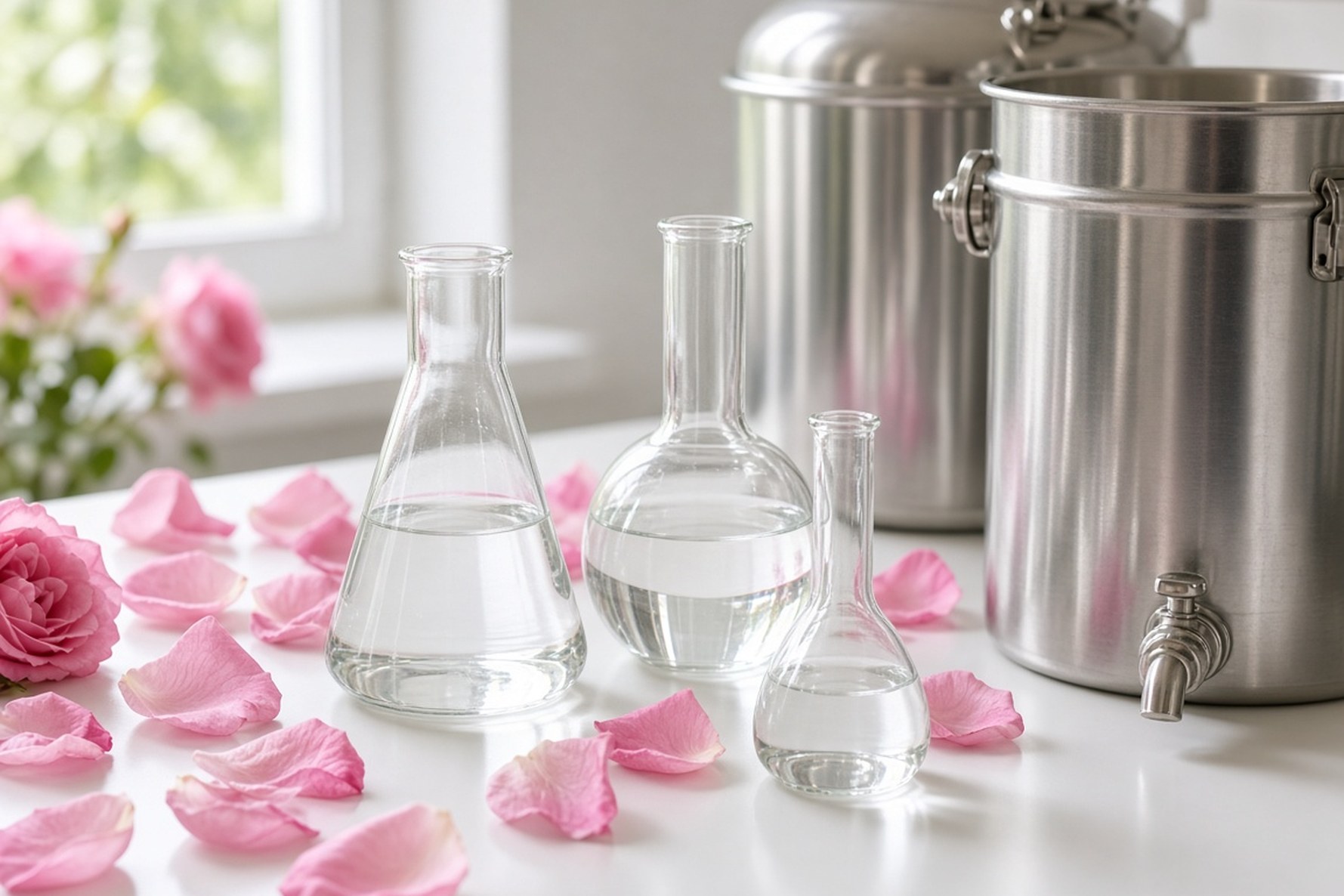
Rose Water for Cosmetics & Personal Care: Specs Wholesale Buyers Need
A complete guide to quality analysis, international standards, technical grading and bulk damask-rose hydrosol sourcing requirements.
This specialist report is a comprehensive guide for procurement managers, formulation engineers and international traders sourcing bulk pure damask rose water and hydrosol (Rosa damascena) from Iran. It evaluates physicochemical specs, gas-chromatography profiles, EU regulatory requirements and IFRA fragrance rules, microbial load tests, bulk packaging practices, adulteration tracing methods and order workflows based on standard documentation.
The global beauty market’s lasting shift toward nature-compatible products—and the replacement of industrial solvents with active distillate waters—has pushed plant hydrosol demand higher. Damask rose water is more than a fragrance; it is a foundational active aqueous phase in micellar cleansers, facial mists, repairing creams, anti-ageing serums and anti-inflammatory blends.
Unlike traditional food buyers, personal-care factories judge rose water against strict laboratory criteria. Batch-to-batch odour consistency, chemical stability, terpene alcohol concentration, microbiological purity and allergen thresholds are acceptance preconditions for every shipment.
Iran holds the world’s largest damask-rose planted area and produces tens of thousands of tonnes of fresh petals annually, giving it unmatched continuous hydrosol supply capacity. Highland plateaus and temperate foothills drive exceptional phenylethyl alcohol and aromatic ester levels. Because Turkey and Bulgaria focus on essential oil (Rose Otto), Iranian hydrosol’s share in multinational supply chains must be redefined around precise technical standards.
1. Iran’s commercial and climatic position in industrial rose water
Iran’s damask-rose agronomy creates a structural advantage for plant distillates at very large scale. Official horticulture data put annual petal production above 60,000 tonnes—versus roughly 20,000 tonnes from competitors such as Turkey and Bulgaria.
Geographic spread across biomes stretches harvest over several months: picking starts in early May (Ordibehesht) on the temperate plains of Darab and Meymand (Fars), moves mid-season to Kashan (Isfahan), and continues into July on the high slopes of Lalehzar (Kerman). Distilleries can therefore run on fresh flowers through spring and stabilise industrial bulk orders.
- Kashan (Qamsar, Barzok, Niasar, Joshaghan, Camu): About 1,800 traditional workshops and 50 industrial units yield over 15,000 tonnes of rose water a year. Light foothill soils, cold winters and sunny springs balance monoterpene alcohols and volatiles.
- Meymand & Layzangan Darab (Fars): Largest rain-fed and organic damask plantings; high phenylethyl alcohol gives a soft, velvet, long-lasting odour and strong alignment with organic audits.
- Lalehzar Bardsir (Kerman): Cultivation above 2,500 m; lower atmospheric pressure and sharp day–night swings maximise actives in the finished hydrosol.
2. Structural difference: cosmetic hydrosol vs edible rose water
In general trade, “rose water” covers all damask distillates—but hygiene-process engineers draw a hard line between edible rose water and cosmetic hydrosol. Edible grades target taste and intense aroma for confectionery and home use. Cosmetic hydrosol must be a fully uniform, clear, transparent phase free of undissolved fat, gums or colloidal sediment so cream and serum emulsions stay stable.
Excess steam temperature or severe petal contact with heat in unstirred traditional stills triggers cellulose thermal breakdown, forming furfural and burnt aldehydes that cloud and yellow emulsions and can irritate skin. Quality cosmetic hydrosol relies on gentle steaming so hydrophilic alcohols—especially phenylethyl alcohol—remain in the aqueous phase in natural balance.
Copper stills are traditional, yet hygiene standards limit copper ion carry-over because of skin-lipid oxidation risk. Cosmetic hydrosol lines must be food-grade stainless steel—preferably 316—with online temperature and pressure monitoring.
3. Types, assays and technical grades in wholesale trade
Wholesale classification is defined by fresh flower weight per distillate volume and the weight concentration of dissolved essential oil per unit volume. Vague labels such as “grade one” have no contractual force; buyers must specify numeric grades.
- Industrial heavy: About 30–35 kg fresh petals per 100 L distillate; total oil typically 12–18 mg/100 ml — default for micellar water, toners and hand/face creams.
- Industrial light: 10–15 kg flowers per 100 L water; assay 5–9 mg/100 ml — rinse-off shampoos and washes with a mild scent.
- Industrial double-distilled (do-atashé): Fresh petals distilled with rose water instead of water; assay 30–40 mg/100 ml — anti-ageing serums, repairing lotions and luxury hydrating sprays.
- Direct steam hydrosol: Dry steam through layered petal beds without boiling immersion; highest physical uniformity and lowest non-volatile impurities.
| Grade | Flowers / 100 L | Total oil | pH | Typical use |
|---|---|---|---|---|
| Industrial light | 10–15 kg | 5–9 | 5.0–6.2 | Liquid soap, shampoo |
| Industrial heavy | 30–35 kg | 12–18 | 4.2–5.2 | Toner, micellar, day cream |
| High-concentration premium | 40–50 kg | 20–28 | 4.0–4.8 | Hydrogel masks, repair cream |
| Industrial double-distilled | 50–70 kg total | 30–40 | 3.8–4.6 | Youth serums, dense mists |
| Direct steam | 30–40 kg dry bed | 15–22 | 4.5–5.5 | Sensitive-skin mist |
4. Physicochemical specs and Certificate of Analysis (COA)
A COA is non-negotiable in international trade of cosmetic ingredients and must accompany every batch, documenting physical, chemical and GC-MS results.
- Acidity (pH): Natural rose water 4.0–5.5; results above 5.8–6.0 warn of dilution or early microbial spoilage.
- Relative density at 20°C: 0.995–1.005 g/cm³; deviation suggests oily solvents, polysorbates or glycerin.
- Refractive index at 20°C: Typically 1.3330–1.3350; a rapid rise screens for glycol adulterants.
- Total oil assay: Volatile oil dissolved per unit volume via sequential organic-solvent extraction.
GC-MS profile and key alcohols
Hydrosol chemistry is driven by aromatic and monoterpene alcohols—unlike rose otto, which is rich in insoluble chain hydrocarbons:
- Phenylethyl alcohol: 40–80% of total volatiles; fresh rose odour and natural antimicrobial activity.
- Citronellol: 5–25% — soft, lasting rose note.
- Geraniol: 10–25% — penetrating floral note.
- Nerol: 3–10% — freshness and green finish.
| Test | Cosmetic standard range | Plant relevance |
|---|---|---|
| Appearance | Clear, colourless, particle-free | No spray-nozzle clogging |
| pH at 20°C | 4.0–5.5 | Matches acid mantle |
| Relative density | 0.995–1.005 | Detect hidden emulsifiers |
| Refractive index | 1.3330–1.3350 | Screen co-solvents |
| Total oil | 12–35 mg/100ml | Efficacy & scent longevity |
| Phenylethyl alcohol | > 45% of volatile oil | Proves natural water–petal distillation |
5. Regulatory requirements, international standards and allergens
Domestically, Iran National Standard INSO 5759 sets rose-water properties and test methods. Export lots need stricter destination frameworks.
EU Cosmetics Regulation (EC 1223/2009)
Any ingredient entering skin-care formulas requires a Product Information File (PIF) and human safety assessment. Methyl eugenol is critical: in leave-on products it is capped at 0.0002% (2 ppm). Exporters must supply methyl-eugenol assays precise to 0.1 ppm so formulators can set allowed rose-water dose in finished products.
IFRA standards
Citronellol, geraniol, linalool and eugenol are mandatory label allergens. Producers must declare exact percentages on a split analysis sheet so buyers calculate category dose ceilings.
- Technical Data Sheet (TDS)
- Safety Data Sheet (MSDS/SDS)
- Batch COA from an ISO 17025 laboratory
- Cruelty-free declaration
- Organic or Non-GMO statement and internationally recognised Halal certificate
6. QC protocols, microbiology and adulteration detection
Pure hydrosol without added alcohol or synthetic preservatives is >99% water and highly prone to bacterial and mould growth. Buyer QC labs usually run microbial tests immediately on receipt.
ISO 17516 thresholds
- Category I (eye area, damaged skin, children): TAMC < 100 CFU/ml and TYMC < 10 CFU/ml
- Category II (other adult skin products): TAMC max 1,000 and TYMC max 100 CFU/ml
- Indicator pathogens: Absolute absence of Pseudomonas aeruginosa, Staphylococcus aureus and Candida albicans in 1 ml
Heavy metals and pesticides
- Lead (Pb) max 2.0 mg/kg · Arsenic (As) max 1.0 mg/kg
- Cadmium (Cd) max 0.5 mg/kg · Mercury (Hg) max 0.1 mg/kg
- Organophosphate and insecticide residues below analytical LOQ
Common fraud includes adding synthetic fragrance oils to distilled water or dissolving petrochemical phenylethyl alcohol to inflate assay. Advanced labs verify natural origin via isotope-ratio mass spectrometry (IRMS) and citronellol-to-geraniol ratios on GC-MS.
| Defect | Sign | Acceptance |
|---|---|---|
| Turbidity / haze | Colloidal sediment, clouding | Reject |
| Burnt odour | Caramel / sharp aldehyde note | Unacceptable for cosmetics |
| Abnormal pH | Cloudy deposit, spoilage | Reject for cream/toner lines |
| Synthetic markers | Unnatural terpene ratios | Full lot rejection |
| High bioburden | Sour smell, gassing | Hold until re-filtration |
7. Industrial uses in cosmetic and personal-care formulas
Modern formulators replace plain deionised water with plant distillates to strengthen physiological claims and support “100% plant-active base” positioning. Damask hydrosol at pH 4.0–5.2 balances the skin acid mantle without synthetic acids; water-soluble flavonoids and polyphenols calm inflammatory pathways—useful for rosacea, post-sun redness and sensitive skin.
| Product group | Use rate | Suggested grade |
|---|---|---|
| Pore-cleansing toner | 60–95% | Industrial heavy |
| Eye-area cleanser | 20–40% | Direct steam |
| Micellar water | 30–70% | Industrial heavy |
| Anti-wrinkle / repair cream | 10–30% | Double-distilled or high assay |
| Makeup-setting mist | 75–95% | Light or direct steam |
| Aftershave balm/gel | 15–40% | Refined heavy |
8. Export target markets and competitive comparison
Bulgaria and Turkey dominate Rose Otto exports; their aqueous distillates are secondary. Iran’s traditional and factory structure has long treated rich rose water as the primary product—so Iranian hydrosol typically carries higher water-soluble actives, more noticeable odour depth and a lower cost per tonne than European peers.
- European Union (France, Germany, UK): Bulk lots with guaranteed assay and pesticide-free certificates; methyl eugenol compliance with EC 1223/2009 is an entry condition.
- GCC (UAE, Oman, Qatar, Saudi Arabia): Drums and totes for re-packing or body lotions; Dubai is the regional hub.
- East Asia (South Korea, Japan): High sensitivity to bacterial contamination and clinical claims for waterless beauty ranges.
| Country | Core advantage | Price position |
|---|---|---|
| Iran | Growing diversity, raw volume, odour persistence | Competitive / cost-effective |
| Bulgaria | Brand equity and EU regulatory dossiers | Very high |
| Turkey | Logistics proximity, plant modernisation | High to mid |
| Morocco | Trade history with southern Europe | Mid to high |
9. HS codes, industrial packaging and logistics
- 33019011: Damask rose water (Iran eight-digit national code)
- 33019012: Other traditional herbal distillates
- 33019000: Hydrosols and aqueous essential distillates in international systems
Personal-care factories usually take food-grade UV-resistant HDPE drums (25 and 200 L), palletised 1,000 L IBC totes, or sterile multilayer Bag-in-Box (5–20 L). Ideal storage is 15–25°C; for sea transit from southern Iranian ports through tropics, refrigerated containers with data loggers are essential to keep temperature below 30°C.
10. Drivers of bulk pricing and B2B contracts
- Total oil assay and fresh-flower ratio (assays above 25–30 mg raise feedstock cost)
- Contract season; May–June harvest months offer the best pricing window
- Process technology and equipment alloy (316 stainless vs traditional copper)
- Audit, GC-MS, methyl eugenol, isotope and organic certificate overhead
- Incoterms: EXW, FOB Bandar Abbas or CIF destination port
11. Importer checklist before placing an order
- Define leave-on vs rinse-off use in the formula
- State allowed pH band (e.g. 4.2–5.2) in the contract
- Set a numeric minimum total-oil assay (e.g. >15 mg/100ml)
- Require GC-MS and match key alcohol percentages
- Obtain a methyl-eugenol ceiling commitment for the destination market
- Agree ISO 17516 microbial ceilings in writing
- Specify phthalate-free food-grade drums or sealed IBCs
- Clarify preservative policy (fully natural vs allowed cosmetics preservatives)
- Request a pre-shipment sample from the loaded tank
- Align quarantine, phytosanitary, certificate of origin and destination labelling
12. Data required for an accurate proforma (RFQ)
- Product type and grade (light, heavy, double-distilled or direct steam)
- Minimum total-oil assay in mg/100 ml
- Order volume (kg/L) and delivery lot schedule
- Packaging: 25 L, 200 L or 1,000 L IBC
- Accepted preservative system
- Mandatory analytical certificates (GC-MS, heavy metals, pesticides, methyl eugenol)
- Incoterms and final port or city
13. Export supply of industrial rose water via Iranco
In cosmetic-ingredient foreign trade, offers are not just proforma numbers. Essential-oil stability, physical clarity, microbiological cleanliness and regulatory compliance decide profitability versus costly failures.
Iranco lets international procurement teams register industrial rose-water and hydrosol demand with engineering detail—product type, target assay, bulk packaging and required lab documents—so capable plants in Kashan, Meymand and Kerman can be evaluated. The network supports documented samples, COA verification, packaging integrity checks and clearance/logistics coordination.
Summary
The shift of personal-care industries toward plant-active bases has moved damask hydrosol from a traditional distillate to a key aqueous phase in hygiene formulas. Professional entry requires laboratory parameters—natural pH, aromatic-alcohol balance on GC-MS, allergen monitoring and cold-chain care in container shipping. With the richest damask plantations across Kashan, Fars and Kerman climates, Iran is the world’s leading long-term hub for bulk hydrosol supply.
Frequently asked questions
Why does natural rose-water pH matter in hygiene products?
Authentic rose water sits at pH 4.0–5.5, matching the skin acid mantle and supporting preservative performance. Values above 5.8–6.0 suggest microbial fermentation or dilution with tap water.
What is the shelf life of preservative-free hydrosol?
In original sealed, light-resistant packaging at 15–25°C, nominal life is 12–24 months. Once opened and exposed to air, bacterial spoilage risk rises over time.
What is the marker compound on rose-water GC-MS?
Phenylethyl alcohol (2-phenylethyl alcohol) typically accounts for more than 45–80% of total aromatic volatiles, completed by citronellol and geraniol.
How is EU methyl eugenol controlled?
Under Cosmetics Regulation 1223/2009, leave-on products are limited to 0.0002% methyl eugenol. Exporters must supply a precise assay so formulators can calculate allowed rose-water dose.
Copper traditional stills vs industrial stainless distillation?
Copper stills may transfer copper ions that accelerate oxidation. Food-grade 316 stainless lines distill in a hygienic environment with precise steam-temperature control.
IBC totes vs polyethylene drums?
1,000 L IBCs with metal cages improve container fill efficiency and lower packaging cost per litre. 25 or 200 L drums suit smaller workshop volumes.
How can cosmetic-grade rose water be sourced directly from Iran?
Define oil assay, volume, bulk packaging and end uses, then send them via Iranco’s purchase request so hygiene-compliant industrial units can be screened.
What must be stated for an official quotation?
Include grade, oil assay, tonnage, preservative terms, container type, analytical certificate requirements and Incoterms so quality options can be compared.
Featured Products


Related Articles



