 Iranco Magazine Team
Technical analysis of INSO 1525 grades, GC-MS authenticity tests, industrial applications and export trade requirements
Kashan rose water · INSO 1525 · B2B sourcing
Kashan Rose Water: Direct Sourcing Guide for Traders and Food Industry
Technical analysis of INSO 1525 grades, GC-MS authenticity tests, industrial applications and export trade requirements
This comprehensive guide explains the technical and commercial dimensions of bulk Kashan rose-water procurement for traders and food-plant managers. From total essential-oil titer and purity monitoring by chiral chromatography to customs rules, industrial packaging and fraud detection, the key data needed to cut supply-chain risk and lock in quality are assembled here.
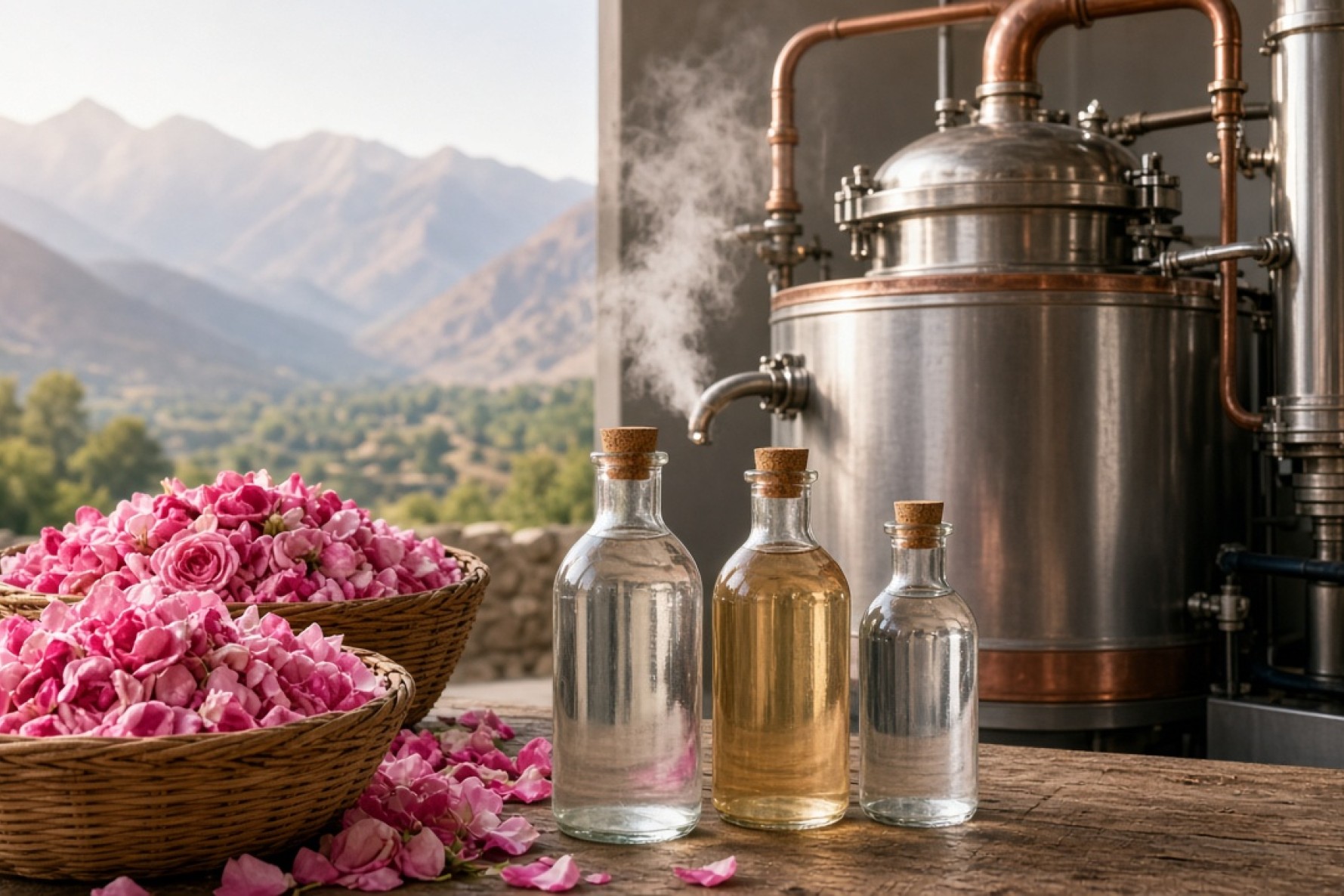
Beyond a traditional fragrant liquid, rose water holds a strategic place on modern confectionery, chocolate, dairy, functional-beverage and personal-care lines worldwide. Damask rose (Rosa damascena), with deep roots on the Iranian plateau, reaches an uncommon balance of secondary-metabolite synthesis in Kashan’s climate — yielding a scientifically distilled raw material with a rich aroma and strong functional performance.
Still, large industrial buyers entering direct Kashan sourcing face technical and quality risks: varied distillation methods, volatile-oil swings, synthetic adulteration and weak validation literacy. This report unifies agronomy, process engineering, national and international standards and customs practice into a decision-ready format. For a broader view of Iran’s rose-water chain, see the Iranian rose water wholesale and export guide.
1. Kashan agronomy and the Karkas foothill climate
Sitting on the edge of Iran’s central desert and the eastern foothills of the Karkas range, Kashan enjoys microclimates ideal for aromatic compound synthesis in damask rose. Elevation runs from about 850 m on northern plains to more than 2,200 m in mountain zones.
Strong day–night temperature swings curb early night-time evaporation of volatile monoterpenes from petal tissue. Petals picked in the first morning hours before sunrise retain the highest aromatic hydrocarbons and terpene alcohols. Because of altitude differences, harvest in Kashan County stretches over several months:
- Low desert-edge zones (Nushabad, Yazdel, Aran va Bidgol): harvest from mid-Farvardin (early April); bushes enter reproductive phase sooner; volume often goes to light rose water or primary extraction.
- Foothill and mid zones (Qamsar, Niasar): 1,500–1,700 m; historic cradle of traditional distillation; harvest from early to late Ordibehesht (April–May) with a favourable aromatic-alcohol balance.
- High mountain zones (Barzok, Joshaghan-e Qali, Kamoo): up to 2,400 m; harvest from early Khordad to mid-Tir (May–July); over 1,200 ha and the highest total-oil content in raw petals.
Standard Kashan damask fields average about 4.2 t/ha, producing roughly 10,000 t of fresh flowers a year. Most of that crop is converted in more than 1,600 traditional workshops and about 50 licensed industrial lines into 20–40 million litres of graded rose water — letting food plants source through spring without stockpile or quality-collapse risk.
2. Commercial grades under Iran National Standard 1525
Commercially, rose water is obtained exclusively by hydrothermal (water–flower) distillation or steam distillation of clean fresh Rosa damascena petals with potable water. INSO 1525 is the legal and quality reference for separating grades by flower load and total essential-oil concentration. Vague trade names in contracts are a leading cause of buyer–seller disputes.
Premium (heavy) rose water
The core industrial and export grade. Per 100 L of charged water, 30–35 kg of fresh petals are used. Minimum 35 mg total oil per 100 mL (350 mg/L). Known for lasting aroma, mild sharpness and natural bitterness — the backbone of advanced food formulations.
Light (second-grade) rose water
Flower load drops to 12–15 kg per 100 L water. Minimum total oil 15 mg/100 mL (150 mg/L). Suited to weak top-note formulas, traditional confectionery and household use; lower commercial value than premium.
Double-distilled (do-atasheh)
Redistillation: premium rose water replaces potable water with fresh flowers. Total oil rises to 60–100 mg/100 mL. Strong bitterness and astringency; used in specialty drinks, pharma formulas and luxury confectionery.
Spent wash (pas-ab) and non-conforming lots
Total oil below 15 mg/100 mL. Sale under the name “rose water” is prohibited; it lacks sensory stability and food-flavouring value.
| Grade | Flowers (kg/100 L) | Min. oil (mg/100 mL) | Conc. (mg/L) | Sensory profile | Target industry use |
|---|---|---|---|---|---|
| Premium (heavy) | 30–35 | 35 | 350 | Strong fresh-flower note, lasting astringent bitterness | Dairy, industrial confectionery, cosmetics |
| Light | 12–15 | 15 | 150 | Mild aroma, very low bitterness | Dilute drinks, syrups, household |
| Double-distilled | Distilled with prior rose water | 60–100 | 600–1,000 | Intense bitterness and astringency | Pharma, luxury extracts, specialty pastry |
| Spent wash | Repeated pomace distillation | < 15 | — | Cooked note, watery, shallow | Non-standard; QC reject |
3. Physicochemical parameters and critical lab indicators
Industrial evaluation is not limited to smell. QC and procurement must treat Certificate of Analysis (COA) physicochemical specs as the basis for financial settlement. More test detail is covered in the herbal distillates QC standards guide.
Clarity and appearance
Authentic rose water at 20°C must be fully clear, free of suspended particles, sediment, cloudy haze or floating fat droplets. Turbidity signals filtration defects, advanced microbial spoilage or emulsifiers used to dissolve synthetic oils.
Acidity, specific gravity and refractive index
Standard pH at 20°C is 4.5–6.5. Values above 6.5 suggest dilution with alkaline water; below 4.0 suggests microbial fermentation. Specific gravity should stay within 0.995–1.005 g/cm³; abnormal swings flag sugars, glycerin, propylene glycol or industrial heavy alcohols.
| Parameter | Test method | Limit | Buyer relevance |
|---|---|---|---|
| Total essential oil | Liquid–liquid extraction (INSO 1487) | Min. 35 mg/100 mL (premium) | Effective dose and commercial value |
| pH at 20°C | Calibrated electrode potentiometry | 4.5–6.5 | Prevent casein precipitation in dairy |
| Specific gravity | Pycnometry at 20°C | 0.995–1.005 | Screen aqueous-phase adulteration |
| Methanol | HS-GC-FID | Max. 100 mg/L | Safety and global market access |
| Lead | GFAAS | Max. 0.1 mg/kg | Heavy-metal food limits |
| Cadmium | ICP-OES | Max. 0.05 mg/kg | Product safety monitoring |
| Copper | Flame AAS | Max. 2.0 mg/kg | Control migration from copper stills |
4. Chemical fingerprint, GC-MS and methanol biochemistry
The most precise tool for purity and ecological origin is GC-MS fingerprinting. Four actives drive sensory quality:
- Citronellol: fresh, green, foundational rose note.
- Geraniol: sweet, lasting terpene alcohol; aroma depth.
- Nerol: cis isomer of geraniol; citrus-like freshness.
- 2-Phenylethyl alcohol: highly water-soluble; the core of rose-water mouthfeel.
Methanol formation and control
Methanol in rose water is not from sugar fermentation; it is released when pectin methylesterase (PME) acts on petal cell-wall pectin. Compressing petals in non-breathable bags and holding them warm accelerates anaerobic respiration and methyl-ester hydrolysis. The national standard caps methanol at 100 mg/L. Advanced Kashan plants use ventilated crates and distill within four hours of picking, typically holding methanol below 30 mg/L.
5. Common adulteration detection and synthetic oil segregation
- Foam-stability test: after 10 seconds of hard shaking, natural rose water bubbles collapse in 2–5 seconds; persistent foam indicates surfactants (polysorbate 20/80).
- C/G ratio: departure from 1.2–2.8 signals added synthetic oil.
- Chiral GC: damask rose biosynthesises almost exclusively (S)-(-)-citronellol (>99% optical purity); the dextrorotatory enantiomer indicates petrochemical derivatives.
- Geranium or lemongrass blending: isomenthone or atypical citrals reveal non-damask origin.
6. Industrial uses in food and beverage
In modern processing, rose water balances flavour, softens fat perception and helps texture stability. Success depends on thermal behaviour and emulsion phases.
Confectionery, chocolate and halva
Heat above 100°C drives off light volatiles. Industrial practice: concentrated double-distilled grade, dosed during cool-down below 60°C (tempering).
Ice cream and dairy
Inlet pH should not fall below 5.5; excess acidity neutralises casein micelle charge, causing curdling and pasteurizer fouling. Sterile premium grade prevents this industrial defect.
Carbonates, syrups and malt drinks
Inject as a top note after HTST; membrane filtration to remove undissolved fats is mandatory to avoid neck rings and shelf haze.
| Industry | Process challenge | Suggested grade | Injection timing / temperature |
|---|---|---|---|
| Pastry / sohan | Early volatile loss at high heat | High-titer double-distilled | Cooling below 60°C |
| Ice cream / dairy | Casein precipitation and souring | Premium with controlled pH | Ageing tank before freezing |
| Syrup / beverages | Fat ring and bottle haze | Ultrafiltered premium | Final blend at ambient |
| Bakery | Alcohol oxidation in the oven | Concentrated rose-water base | Dough stage or post-bake |
7. Customs tariff classification and export clearance
- 33019011: rose water obtained from damask rose — basis for bulk and bottled edible export.
- 330129: natural volatile oils (rose otto, concrete, absolute) — fragrance use.
- 12119091: fresh or dried damask rose flowers and petals.
Required documents typically include a phytosanitary certificate, official COA, Halal certificate for Islamic markets, and a certificate of origin for tariff preferences.
8. Global market comparison: Iran vs Turkey vs Bulgaria
Bulgaria focuses on luxury rose otto; rose water is a limited by-product. Turkey’s Isparta cluster produces concrete and absolute with EU customs-union logistics. Iran’s Kashan hub holds the largest acreage and highest edible hydrosol capacity; phenylethyl-alcohol richness plus competitive energy and labour costs make it the economical choice for premium tonnage.
| Country | Core export | Primary markets | Firm structure | Key advantage | Price level |
|---|---|---|---|---|---|
| Iran (Kashan) | Premium & double-distilled rose water, dried buds | GCC, Subcontinent, EU | Traditional + mechanised mix | Volume capacity, PEA richness | Competitive / economical |
| Bulgaria | Otto, concrete | France, USA, Japan, Germany | Advanced agribusiness | Luxury fragrance branding | Premium / expensive |
| Turkey | Concrete, oil, cosmetic hydrosol | Germany, UK, France, UAE | Export-oriented holdings | Road logistics & EU rules | Mid to high |
9. Target export markets for Kashan rose water
Persian Gulf rim
Largest tonnage importer. UAE and Qatar prefer heavy and double-distilled grades in bilingual glass with Halal; Iraq focuses on PET bottles and cheap bulk.
European Union
Skin toners, organic flavour houses and specialty pastry; methanol often capped below 50 ppm, pesticide residues and Non-GMO claims matter; mostly industrial bulk (IBC and food-grade jerrycans).
Indian Subcontinent and Southeast Asia
Core for gulab jamun, puddings and traditional pharmacy; price-sensitive demand for light and economical premium grades.
| Destination | Preferred grade | Packaging | Decision drivers | Distribution |
|---|---|---|---|---|
| UAE | Premium & double-distilled | Glass 500–1000 mL | Aroma authenticity, luxury branding | Chains, spice traders, Horeca |
| Iraq | Premium & light | PET 1 L & 20 L jerrycan | Competitive price, heat resistance | Wholesalers, pastry workshops |
| Germany | Premium with COA | 1000 L IBC & food-grade cans | Methanol < 50 ppm, metals | Organic cosmetics, pharma extractors |
| Qatar | Double-distilled & heavy | Gift glass | Premium design, Halal marks | Hotels, luxury retail, pastry |
10. Industrial packaging, warehousing and container logistics
Rose water is sensitive to photo-oxidation and thermal evaporation. Optimal storage and transit temperature is 15–20°C; refrigerated containers on long summer routes protect aroma.
- Amber/green glass: chemically inert, UV control; premium retail.
- Food-grade PET with UV absorbers: light and impact-resistant; supermarket and wholesale.
- HDPE 20–25 L jerrycans: tamper seals and silicone gaskets.
- 220 L drums with food epoxy or SS316: pharma and fragrance export.
- 1000 L IBC: direct plant feed and container loading.
| Format | Nominal volume | Material | Advantage | Use case |
|---|---|---|---|---|
| Glass bottle | 500–1000 mL | Neutral silicate glass | Full inertness, oxidation control | Premium retail, Horeca |
| Food-grade PET | 400–1500 mL | Sanitary PET | Lower weight, shatter safety | Volume supermarket |
| Industrial jerrycan | 20 L | HDPE | Stable palletising, crush resistance | Pastry workshops |
| IBC tank | 1000 L | Polymer + galvanised cage | Direct process connection | Dairy, ice cream, beverages |
11. Wholesale pricing structure and cost drivers
- Fresh petal day price: 60–75% of finished cost; climate and picking wages swing in Ordibehesht–Khordad.
- Delivered oil titer: the gap between 35 and 50 mg/100 mL premium is rational; buying without a titer number is paying for scented water.
- Process technology: SS316 continuous stills with vapour recovery cut losses; traditional copper stills raise fuel cost and titer error.
- Incoterms: Kashan EXW does not include final packing, clearance, palletising, Bandar Abbas FOB or destination CIF.
12. Buyer checklist before placing an order
- State grade (premium, light or double-distilled) and minimum total oil on the proforma.
- Obtain a sealed ≥1 L sample from a named batch.
- Run total-oil assay per INSO 1487.
- GC analysis with C/G ratio in the 1.2–2.8 window.
- Methanol test: <100 mg/L general; <50 ppm for pharma export.
- Microbial, yeast and mould counts.
- Verify food-grade containers and polymer migration compliance.
- Contract rejection tolerance if oil titer falls more than 5%.
- Confirm single-tank delivery for flavour uniformity.
- Cold-chain clauses and international insurance for heat stress and leakage.
Direct Kashan rose-water supply with Iranco
Industrial tonnage carries hidden technical risks: oil-titer drift, covert synthetics and workshop-to-workshop inconsistency can destabilise finished flavour. Iranco connects wholesale buyers, traders and processing-plant managers with licensed industrial producers in the Kashan cluster.
If you need authentic Kashan rose water at scale for processing lines or export cargoes, submit technical specs, volume and delivery terms via the Iranco contact form so supplier evaluation, lab matching and contract drafting can proceed on technical criteria.
Closing
Kashan rose water combines Karkas-foothill soil and climate, Iranian-plateau damask genetics and historic distillation skill. Procurement decisions must rest on physicochemical data, GC ratios, methanol limits and cold-chain integrity — not undocumented trade claims.
Frequently asked questions
What is the best rose-water grade for ice cream and dairy?
Premium (heavy) grade meeting INSO 1525 with at least 35 mg/100 mL total oil and controlled pH between 5.5 and 6.5 protects milk protein micelles and prevents casein curdling during pasteurisation.
What mainly sets the day wholesale price?
Total essential-oil titer by INSO 1487 is the decisive factor; petal day price, container type and Incoterms then refine the landed cost.
What is the definitive test for chemical/synthetic adulteration?
GC-MS with a chiral column: C/G in the 1.2–2.8 range and >99% optical purity of (S)-(-)-citronellol; any measurable dextrorotatory enantiomer is conclusive evidence of synthetics.
How long does rose water keep in industrial tanks?
In opaque, airtight containers away from sunlight at a stable 15–20°C, 18–24 months. Above 25°C, alcohol oxidation and sour off-notes accelerate.
How can export-grade Kashan rose water be bought directly?
Submit technical specs (grade, titer, packaging and mandatory COA) through Iranco as a sourcing request so standard options in the Kashan cluster can be compared.
Why does methanol appear in rose water?
PME releases methanol from pectin methyl esters; up to 100 mg/L is allowed. Warm compressed petal storage raises it; fast distillation of fresh flowers keeps it low.
What is the official HS code for rose water?
Eight-digit code 33019011 for damask-rose distillate; distinct from 330129 (volatile oils) and 12119091 (dried petals).
How do traditional copper stills differ from industrial stainless lines?
Copper stills may migrate copper ions (max. 2.0 mg/kg). SS316 lines have no ionic migration and meet export hygiene requirements more cleanly.
Featured Products


Related Articles



