 Iranco Magazine Team
Complete guide to technical specs, lab standards, processing, quality control and export logistics for Kashan rose derivatives
Kashan Damask rose · Wholesale · Export
Kashan Damask Rose: Direct-Sourcing Guide for Wholesale Buyers
A comprehensive guide to technical specifications, laboratory standards, processing, quality control and export logistics for Kashan damask rose derivatives
This specialist report is a practical guide for importers and food, pharmaceutical and cosmetics plants seeking direct purchase of Kashan damask rose as dried buds, petals, industrial rose water and rose otto. It analyses quality-control markers, international standards, tariff codes, laboratory evaluation methods, pricing formulas and a target-market comparison matrix in actionable form.
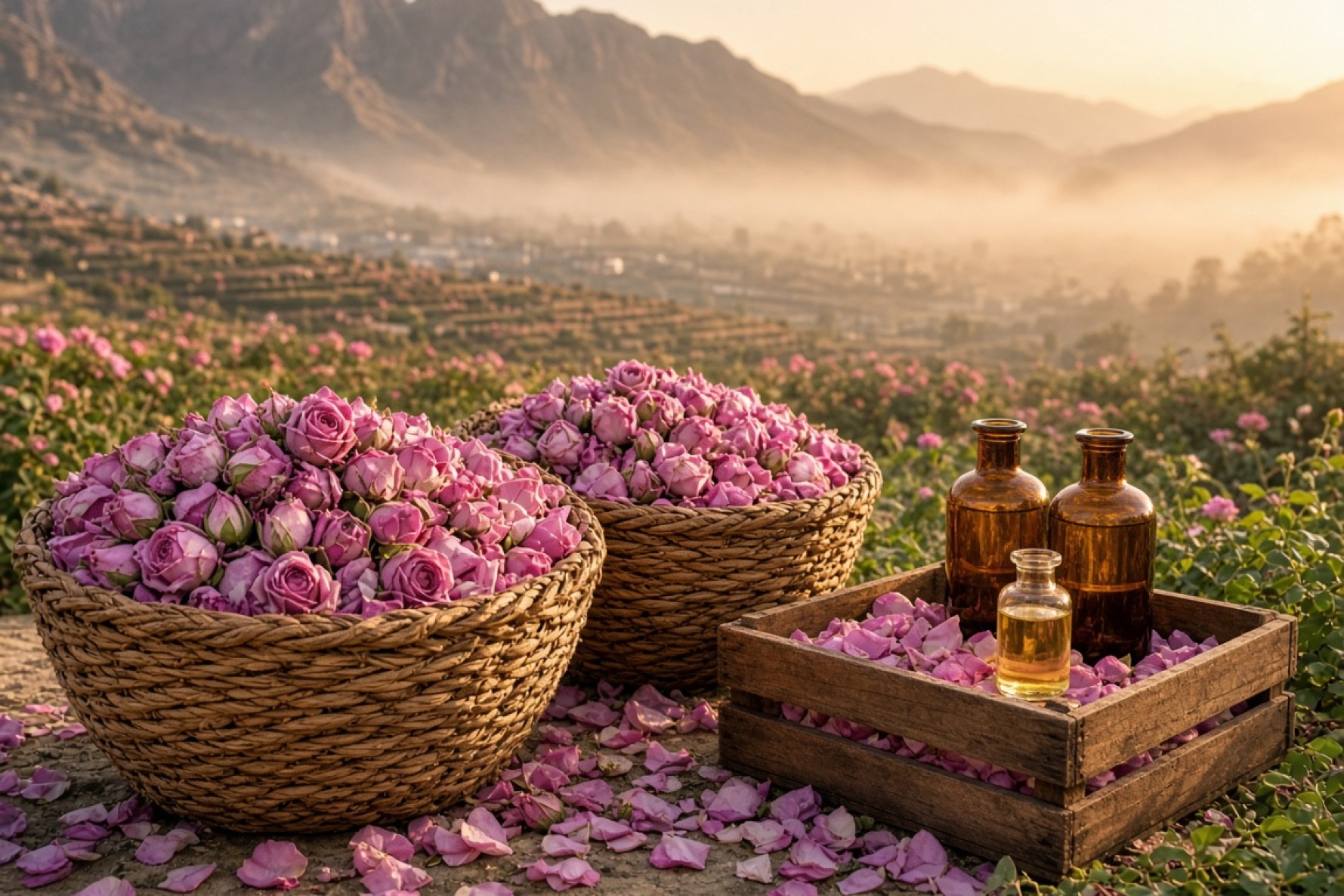
Damask rose, botanically Rosa damascena, is Iran’s most strategic medicinal and aromatic crop and has a long bond with Kashan’s mountain–desert ecosystem. Because of exceptional climate diversity, light sandy soils with good drainage, cool nights during bloom and marked elevation differences in the foothills, Kashan County ranks first nationally for mean yield per hectare and concentration of active oil constituents. Agricultural data place the Kashan region — centred on Barzok, Qamsar, Niasar and affiliated districts — as the Middle East’s largest traditional and industrial hub for damask rose derivatives.
Despite Iran’s large share of global rose plantings, international wholesale buyers and procurement managers still face uneven lot quality, oil-composition swings in traditional distillation, commercial adulteration and packaging that fails long-haul transit rules. The shift in global pharma and fragrance markets toward certified, traceable natural materials has raised the bar for procurement standards. A resilient supply chain demands knowledge of production microclimates, harvest calendars, gas chromatography–mass spectrometry profiles, warehouse conditions that protect actives, and customs requirements. This guide takes an analytical, data-led approach and gives traders and manufacturers the operational tools to cut out intermediaries and manage transaction risk.
1. Production geography and climatic advantages of the Kashan districts
Kashan County sits on the eastern slopes of the Karkas range beside the central desert and hosts multiple microclimates that directly shape bloom timing and active-compound concentration. Environmental heterogeneity means damask rose production is not confined to one locality or one calendar window. Major producing areas — Barzok, Qamsar, Niasar and higher villages such as Kamu, Vadeqan, Van and Joshqan Qali — differ structurally in soil and air conditions.
The supply chain cannot be understood without the harvest sequence. Picking near Niasar (about 1,650 m above sea level) starts in late March / early April. The wave then reaches the Qamsar elevations (mean about 1,900 m). Finally, the mountain lands of Barzok above 2,050 m, then the high belts of Kamu and Joshqan Qali above 2,200 m, peak from mid-April through late May / early June. This staggered window of up to two months keeps industrial plants and wholesale buyers continuously supplied with fresh flowers and prevents process-line stoppages.
The key climatic driver of secondary metabolites in Kashan damask rose is the sharp day–night temperature swing while flowers open. Cold nights on the Karkas slopes store and stabilise durable terpene alcohols such as beta-citronellol and geraniol in petal secretory glands. After dawn, sunlight and rising air temperature evaporate and disperse light, low-molecular-weight volatiles; therefore picking on every Kashan farm must finish exclusively in pre-dawn darkness before sunrise (roughly 04:30–08:00). Flowers harvested under sun or in warm hours lose more than 40% of volatile oil volume and olfactory richness.
| District | Approx. elevation | Planted area | Commercial focus |
|---|---|---|---|
| Barzok | > 2,050 m | ≈ 1,320 ha | Raw flowers & industrial dried petals |
| Qamsar | ≈ 1,900 m | ≈ 587 ha | Traditional/modern distillation, premium rose water |
| Niasar | ≈ 1,650 m | ≈ 402 ha | Season opener; rose water & extracts |
| Kamu / Joshqan Qali | > 2,200 m | Affiliated highland belts | Late-season bloom peak |
2. Classification of commercial damask rose products and derivatives
Commercial products from Kashan damask rose fall into two broad groups: physically dried goods and processed distillates/extracts. Differentiating these items is the foundation of buyer correspondence.
Export dried buds
Premium dried buds come from harvesting before petals open and from engineered shade drying or industrial fluid-bed dryers with indirect warm air. Foreign buyers in this grade care about uniform bud size (1–2 cm), fully closed petal layers, a bright purple–magenta colour and intact four-lobed green sepals attached to the receptacle. Any bleaching, yellowing from delayed drying, or scorching above 40°C sharply cuts lot value.
Whole dried petals
This product is obtained by separating petals from open flowers before wilting and colour change. Dried petals are used mainly in tea-bag plants, blended medicinal infusions, gaz and loukoum confectionery, and as feedstock for solvent extraction in fragrance houses. Primary grade markers are absence of powdery breakage, high purity without wood, thorns or sepals, and stable moisture below 10%.
Traditional and industrial rose water
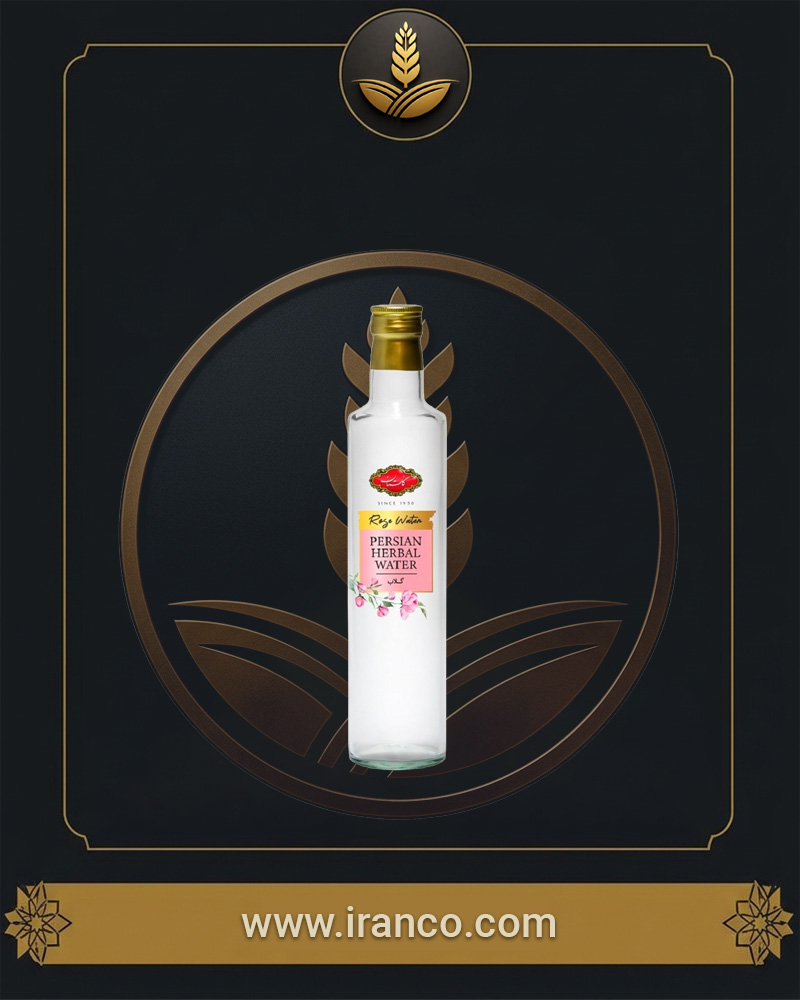
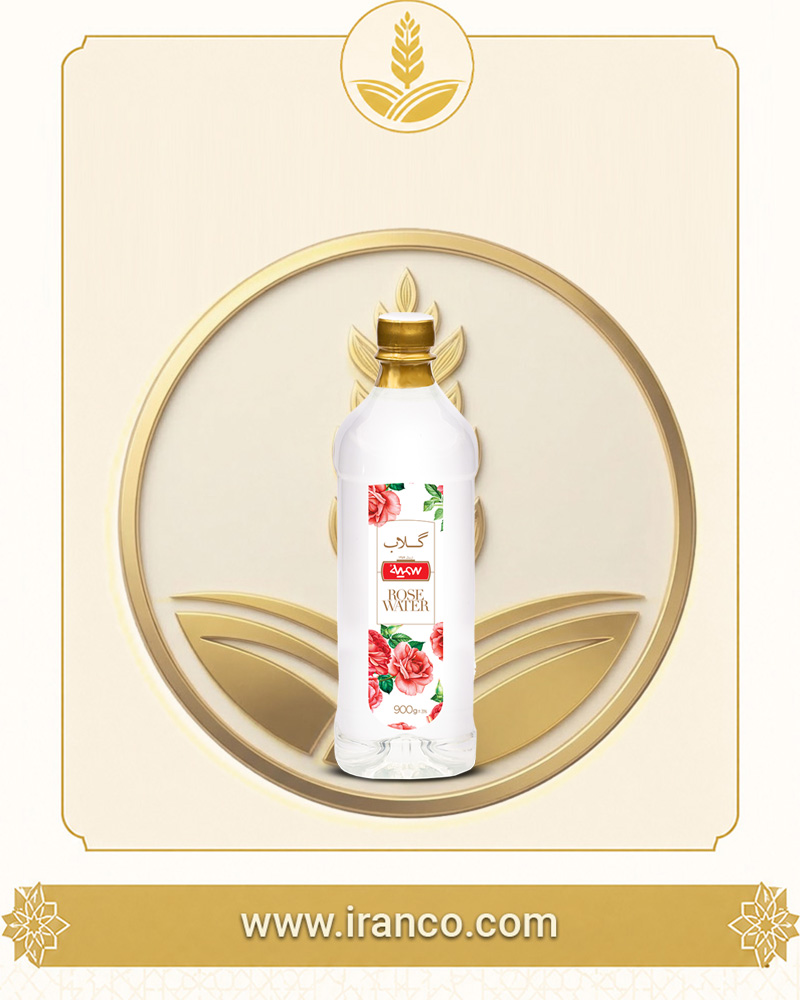
Rose water is a clear aromatic hydrosol from distillation of fresh flowers with water. Flower load and distillation stages define commercial grades:
- Premium (heavy) rose water: produced with at least 30–35 kg fresh flowers per still for every 40 L finished rose water. Minimum dissolved oil in this grade is 35 mg/100 ml.
- Double-distilled (do-atasheh): after a standard distillation cycle, the hydrosol is returned onto a fresh flower charge instead of water and the still is reloaded and distilled again. The result has a strongly astringent, slightly bitter taste and a dense, lasting aroma with high export value.
- Ordinary / light rose water: obtained with 10–15 kg fresh flowers per still charge; used mainly in household and general confectionery applications.
Rose otto, concrete and absolute
These derivatives are the high-value end of the damask rose chain:
- Rose Otto (hydrodistilled essential oil): obtained by hydrodistillation or indirect steam distillation of freshly picked flowers. At room temperature, waxy and paraffinic fractions make it a translucent pale-yellow semi-crystalline mass — commonly called rose oil.
- Rose concrete: extracted from fresh flowers with non-polar solvents such as food-grade n-hexane at ambient temperature. Concrete is a thick, waxy, dark green–brown paste holding waxes, oils and pigments.
- Rose absolute: produced by washing concrete with pure food-grade ethanol, freeze-defatting at very low temperature to precipitate waxes fully, then evaporating ethanol under vacuum. It is a clear, dense liquid with the true, unaltered scent of the living flower and forms the cornerstone of global luxury perfumery.
| Finished product | Input material | Physical form & appearance | Reference quality marker | Primary end market |
|---|---|---|---|---|
| Export dried buds | Unopened pre-dawn buds | Closed conical flower, bright magenta | Moisture < 9%; uniform laser sort | Infusions, luxury tea, premium retail |
| Whole dried petals | Petals of open dawn flowers | Vivid pink flakes, unbroken | 99% purity; acid-insoluble ash < 1% | Confectionery, pharma, flavoured tea |
| Premium (heavy) rose water | 30–35 kg flowers per 40 L | Clear, fully colourless liquid, no particles | Oil > 35 mg/100 ml | Dairy, ice cream, baklava, beverages |
| Export double-distilled rose water | Fresh flowers + first-distillate hydrosol | Clear liquid; astringent; deep lasting aroma | High volatile esters; concentrated actives | Middle East spice trade, culinary seasoning |
| Rose Otto (essential oil) | Continuous steam distillation of fresh flowers | Pale yellow crystallising oil | Full compliance with ISO 9842 | Fine fragrance; calming pharma formulas |
| Rose concrete | Fresh flowers + hexane solvent | Dense pasty wax; fragrant; amber | Odour purity; no harmful residual solvent | European & US absolute manufacturers |
| Rose absolute | Concrete washed with ethanol | Viscous orange-to-red liquid | Phenylethyl alcohol > 50%; authentic floral odour | Niche perfumery; anti-ageing cosmetics |
3. Technical identity card and chemical markers buyers expect
Large pharma and fragrance trades are assessed only against gas chromatography–mass spectrometry certificates. Kashan damask chemistry shows a defined balance of terpene hydrocarbons, aromatic alcohols and esters.
Biochemical profile of Kashan rose otto
- Beta-citronellol (Citronellol): 30–48% of total volatiles — the principal molecule behind the rose base note.
- Geraniol: 6–25%. A stabilising terpene that supports the sweet rose heart note.
- Nerol: 3–12%. The milder-spreading isomeric complement of geraniol.
- 2-Phenylethyl alcohol (Phenylethyl Alcohol): marker of living-petal scent.
- Saturated waxy hydrocarbons: nonadecane 10–20% and heneicosane 2–7%. These alkanes form the non-odorous stearoptene fraction that crystallises in the cold.
- Rose oxide: an extremely low-odour-threshold compound that, below 0.5%, reconstructs the diffusion of fresh flowers.
- Methyl eugenol: a natural alkylbenzene in the oil, typically below 2%.
Citronellol-to-geraniol ratio
The citronellol/geraniol (C/G) ratio is the compass for authenticity and odour stability of rose oil. In oil from Kashan fields (especially Qamsar and Niasar) the index sits between 1.2 and 2.5. An unnatural upward spike signals addition of cheap synthetic citronellol; a fall below 1.0 indicates dilution with inexpensive geranium or palmarosa oil.
Phenylethyl alcohol solubility in distillation versus extraction
Phenylethyl alcohol is highly soluble in hot water. During steam distillation it travels with the vapour phase but, on condensation, preferentially enters the aqueous phase (rose water) and leaves the oily otto. In Kashan hydrodistilled otto its share is at most 1–3%, whereas it dissolves heavily in the hydrosol and in premium rose water is the main driver of space-filling aroma. By contrast, in solvent extraction for concrete and absolute, phenylethyl alcohol dissolves fully in the organic phase and in Kashan rose absolute exceeds 45–60% of total volatiles.
Safety limits for methyl eugenol
Methyl eugenol is monitored by international health bodies and the EU as a metabolic-sensitivity / allergen concern. European cosmetics buyers seek oils with the lowest practicable methyl eugenol. Natural otto from the cool highlands of Barzok and Qamsar typically stays below 2%, allowing low-risk entry into personal-care formulas.
| Physicochemical marker | Test methodology | Acceptance — premium rose water | Acceptance — rose otto | Commercial importance for QC |
|---|---|---|---|---|
| Density at 20°C | Precision digital pycnometry | 0.995–1.000 | 0.848–0.880 | Blocks heavy carrier oils |
| Refractive index at 20°C | Abbe refractometry | 1.3330–1.3360 | 1.450–1.470 | Molecular structure & terpene purity |
| Optical rotation at 20°C | Optical polarimetry | 0 to −1° | −1 to −5° (negative deviation) | Separates natural oils from synthetics |
| Total acidity (as acetic) | Acid–base titration | < 0.05% | Acid value < 3.0 | Flags bacterial fermentation of raw flowers |
| Dissolved total oil | Solvent distillation (Clevenger) | Min. 35 mg/100 ml | 100% pure, solvent-free | Foundation of pricing and commercial grade |
| Freezing / wax crystallisation point | Laboratory cold bath | Negative (water freeze point) | 16–22°C | Confirms intact natural stearoptene |
4. Quality control, laboratory evaluation and adulteration detection
Because of high commercial value, the damask rose market is continuously exposed to professional fraud. Wholesale buyers and clearance experts should run control protocols on three layers: physical, microbial and physicochemical.
Rose-water adulteration often involves synthetic oils on propylene-glycol bases or chemical surfactants such as polysorbate so cheap oil dissolves in water and artificially boosts perceived strength. HPLC readily identifies carrier solvents and optical-spectrum anomalies. Another common fraud is blending natural rose oil with Indian geranium oil, detected by chiral-column GC and enantiomeric ratios. Unlicensed workshops sometimes reboil first-distillation marc and spike it with a drop of oil, raising acidity and producing cooked, sour notes.
In rose otto, dilution with liquid paraffin, odourless heavy esters, jojoba oil or heavy alcohols occurs. These manipulations change density, refractive index and natural-wax freeze time and show large deviations in freeze-point tests.
INSO 168 requirements for dried buds and petals
- Moisture: maximum 9–10% by weight. Higher moisture in dense packs causes biological heat, internal mould and sour odour from microbial activity.
- Total ash and acid-insoluble ash: total ash max 8%; acid-insoluble ash max 1.5%. Higher figures prove mud, sand and environmental dust from unhygienic picking and spreading on bare soil.
- Organic and inorganic foreign matter: unrelated plant parts (stems, thorns, yellowed leaflets, weeds) and grit must not exceed 2% of the lot.
Heavy-metal limits
- Lead (Pb): max 3.0 mg/kg
- Cadmium (Cd): max 0.2 mg/kg
- Arsenic (As): max 0.5 mg/kg
- Mercury (Hg): max 0.05 mg/kg
Microbiology protocols
- Total aerobic count max 105 CFU/g; mould/yeast max 103 CFU/g (common export limits)
- Escherichia coli: negative per gram
- Salmonella: negative in each 25 g sampled
| Likely adulteration | Target product | Laboratory detection | Physical or olfactory symptom |
|---|---|---|---|
| Synthetic oil with solvent | Premium / heavy rose water | HPLC and spectrometry | Fatty sediment layer; harsh bitterness; throat burn |
| Blend with geranium oil | Rose otto & absolute | Chiral GC; depressed C/G ratio | Sharp grassy note; unstable odour over time |
| Dilution with paraffin or alcohol | Otto & concrete | Densitometry, refractive index, freeze point | No freeze at 16°C; reduced viscosity |
| Re-distillation of marc (after-water) | Industrial rose water | Acid value & volatile-acid titration | Sour cooked-fodder smell; rapid haze |
| False moisture weight gain | Dried buds & petals | Oven at 105°C (loss on drying) | Soft tissue; blackened sepals; mould risk |
| Dyeing aged petals | Dried flakes & old buds | TLC and synthetic-dye extraction | Instant deep-red bleed in cold water |
5. Standards framework, legal requirements and customs documents
International trade in Kashan damask derivatives is governed by Harmonized System codes and national/cross-border quality certificates. Correct HS allocation on proformas and bills of lading prevents customs penalties at entry ports.
Harmonized System (HS) codes
- 12119091: dried flowers and fresh damask rose petals under Iran’s export–import schedule
- 121190: global heading for plants, plant parts and aromatic flowers used dried or fresh in pharma and fragrance
- 33019011: rose water obtained from damask rose (processed aromatic distillate waters)
- 33012941: rose otto essential oil (Rose Otto)
National and international standards
- INSO 168: Agricultural products — dried damask rose petals — specifications and test methods
- INSO 5759: Rose water — specifications and test methods (revised editions)
- INSO 10245: Damask rose essential oil — specifications and GC-based test methods
- ISO 9842: Oil of rose (Rosa damascena Miller) — comprehensive physicochemical specifications
- ISO 211: Essential oils — general labelling and container marking requirements
Mandatory commercial and health documents
- Phytosanitary Certificate: issued by the Plant Protection Organisation in Isfahan Province or Kashan Agricultural Jihad, confirming dried bud and petal lots free of arthropods, storage mites and quarantine fungi.
- Health Certificate: issued by the Ministry of Health Food & Drug Authority for edible rose water, oils and industrial extracts.
- Certificate of Analysis (COA): covering chromatography, physicochemical, microbial and pesticide-residue results from ISO 17025-accredited laboratories.
- Certificate of Origin: issued by the Iran Chamber of Commerce confirming Kashan production origin.
- Halal Certificate: identity document easing clearance in Islamic ports and halal-oriented markets.
- Commercial Invoice, Packing List and international transport documents aligned with Incoterms.
6. Export target markets and international demand patterns
Demand for damask derivatives is segmented by downstream industry infrastructure worldwide. Exporters and buyers must align shipped goods with local consumption patterns.
GCC market
GCC countries led by the UAE, Saudi Arabia, Kuwait and Oman are traditional consumers of heavy rose water and luxury buds. Use spans dessert cooking, traditional sweets, Arabic confectionery, scenting religious gatherings and cafés, and blended spice mixes. These markets buy luxury double-distilled bottles in cut clear glass and dense dried buds with deep magenta colour. Demand peaks before Ramadan and major religious holidays.
European Union market
France, Germany, Italy and the UK buy organic dried buds for tea-bag industries and seek rose otto and absolute for fragrance houses and skincare brands. Germany demands pesticide-free organic buds as a wellness-infusion base. France, the capital of fine fragrance, buys concrete and otto with stable composition and minimal methyl eugenol.
East Asia and China
China has become the fastest-growing market for Kashan damask buds for direct infusion. In traditional Chinese medicine, rose is seen as regulating “qi”, improving circulation and soothing the stomach. The Chinese market is highly bud-sensitive: small, round, firm, uniform velvet-red buds that open in boiling water to a pink translucence command the highest prices. Japan also consumes standardised pharma extracts and purity-certified oils for energy drinks and nutraceuticals.
Indian subcontinent and Pakistan
India and Pakistan are historic buyers of dried petals and rose water for sandalwood-based attar, Unani and Ayurvedic medicine, and subcontinental confectionery. Demand focuses on high-tonnage lots at competitive prices.
| Target market | Highest-demand product | End-consumer focus | Buyer’s key quality criterion | Preferred packaging |
|---|---|---|---|---|
| UAE & Oman | Heavy rose water, double-distilled, buds | Luxury retail, confectionery, home use | Intense natural aroma; olfactory persistence | 300–500 ml glass; crystal vessels |
| Germany & Netherlands | Organic dried buds; infusion flakes | Wellness tea packs; herbal pharma | No chemical pesticides; low microbial load | Multilayer kraft vacuum bags; food-grade cartons |
| France | Rose Otto; absolute | Grasse & Paris perfume houses | Standard C/G ratio; methyl eugenol control | Sealed aluminium under inert gas |
| China & Hong Kong | Small uniform dried buds | Tea houses; home infusion packs | Buds unopened; vivid red; green sepals | Vacuum aluminium foil in sturdy 5 kg cartons |
| India & Pakistan | Bulk rose water; whole dried petals | Traditional attar workshops; spice; Ayurveda | Low landed cost; high aromatic strength | 20 L food-grade jerrycans; compressed PP sacks |
7. Comparative competitive position of Kashan versus global rivals
On the world rose map, Kashan (Iran) forms a triangle with Bulgaria’s Kazanlak Valley of Roses and Turkey’s Isparta region. Knowing each hub’s relative strengths and limits helps procurement managers decide.
- Iran (Kashan): largest volume of fresh flowers and rose water (over 90% of world rose-water output).
- Bulgaria (Kazanlak): leader in European luxury markets for standardised hydrodistilled Rose Otto with a long-established brand.
- Turkey (Isparta): strong in industrial solvent extraction of concrete and absolute for global cosmetics.
Kashan’s fundamental edge versus Bulgaria and Turkey is lower raw-material cost from Iranian farm and labour economics. The dry climate and elevation range raise base metabolite concentration in plant tissue. Bulgaria, with continuous industrial stills and heat-recovery technology, has recorded higher otto extraction yields. Historically most Kashan flowers went into edible rose water, with smaller volumes of otto and concrete offered abroad. New industrial extraction units in Kashan are narrowing that technology gap.
| Competing country | Strengths & relative advantages | Weaknesses & challenges | Price structure | Dominant product quality | Traditional stable markets |
|---|---|---|---|---|---|
| Iran (Kashan) | Land scale, microclimate diversity, competitive price, aroma richness | Otto exports below full potential | Fully economical and competitive | High-oil rose water; organic buds | GCC, China, subcontinent, spice markets |
| Bulgaria | Heritage branding; full EU compliance | Picker labour shortage; limited land expansion | World’s highest priced | Standardised hydrodistilled Rose Otto | French, UK, US fragrance houses |
| Turkey | Advanced solvent lines; fast overland logistics | Cost swings from inflation and energy | Mid to upper | Pasty concrete & liquid absolute | Western Europe & North America cosmetics |
8. Packaging engineering, warehousing and cold-chain standards
Heat-sensitive bond breakage, photo-oxidation of anthocyanins and loss of volatile alcohols threaten rose-product quality in storage. Strict warehouse and packaging rules are the only way to lock in shelf performance.
Dried bud and petal packaging standards
Sunlight bleaches petals from vivid pink to dull brown. Dried-flower packs must be impermeable to light and moisture. Multilayer metallised aluminium foil with food-grade polyethylene, sealed under partial vacuum and nitrogen flush, performs best. To protect against static pallet loads, bags go into high-grammage five-ply king-size cartons. Net weight per carton should not exceed 5–10 kg so lower-row buds are not crushed.
Commercial rose-water packaging standards
Rose water holds aromatic alcohols that penetrate polymers. Ordinary PET bottles gradually absorb rose scent and release plastic odour. For bottled orders, amber or matte-green glass that blocks UV is the gold standard. For industrial tonnage, 316 stainless tanks with silicone seals or three- to five-layer food-grade jerrycans with an EVOH barrier are used. Headspace above the liquid must stay minimal (< 2% of total volume) to limit surface oxidation.
Otto, concrete and absolute packaging standards
Damask otto has high dollar value; contact with oxygen or oxidisable metals destroys quality. Seamless aluminium bottles with food-grade epoxy resin lining are the industrial standard. Before sealing, dry nitrogen is injected to displace air. Caps are sealed with essential-oil-resistant PTFE liners and a security lead seal is applied.
Warehousing and storage requirements
- Dried-flower warehouse: continuous 15–18°C and relative humidity below 50%.
- Otto and absolute warehouse: dark, cool refrigerated storage (2–8°C) to protect protective waxes and monoterpene ratios.
- Pallet layout: sanitised plastic or wood pallets at least 15 cm off the floor and 50 cm from walls for healthy air circulation.
9. Transport, logistics and international transit risk management
Preserving quality from the Kashan plant to the buyer’s warehouse requires a logistics path designed around product physics.
Reefer container sea freight
For large dried-flower or rose-water shipments to Asia or Europe from southern ports, refrigerated containers are mandatory. Ordinary containers crossing the Persian Gulf, Sea of Oman and the equator push internal metal-box temperatures above 55°C. That thermal shock cooks dried buds in the pack, evaporates oil and breaks aromatic esters in rose water. Reefers with active ventilation held at 12–15°C for dried flowers protect the cargo.
Regional road freight
To Russia, Central Asia, Turkey and Iraq, road haulage uses covered curtain trailers or reefers. Stack height for bottled rose-water cartons must not exceed five layers. The road waybill should include heat- and shock-protection clauses.
Air freight for high-value oils
Limited-weight, high-value otto and absolute always move by fast air freight from Imam Khomeini Airport, Tehran. Given aromatic-alcohol chemistry, shipments travel with Safety Data Sheets (SDS) in double-layer packaging resistant to cabin pressure change.
| Transport mode | Compatible products | Controlled temperature | Logistics sensitivity | Route risk range |
|---|---|---|---|---|
| Sea reefer container | Premium dried buds; palletised rose water | 12–15°C | Periodic ventilation; humidity control | Heat shock in Persian Gulf & Red Sea |
| Stainless tank container | Bulk industrial premium rose water | Ambient with thermal insulation | Standard tank wash; no prior contamination | Reaction with non-standard walls or deposits |
| Road reefer trailer | Rose water, dried buds & petals | 15–18°C | Engineered stacking; road-shock restraint | Winter freeze on cold transit corridors |
| Fast air freight | Otto, concrete, absolute | Cargo-hold temperature (typically 15–20°C) | Pressure-tight packaging; SDS documents | Sudden cargo-hold pressure changes |
10. Cost structure and wholesale pricing formula components
Wholesale prices for Kashan damask rose and its derivatives are dynamic and driven by several variables. Understanding this cost structure enables real landed-cost calculation in commercial talks.
Drivers of the final price
- Farm-gate fresh-flower rate: raw flower cost underpins every derivative. Because pre-dawn picking is fully manual, more than 40% of fresh-flower price is local labour. Labour shortages in April/May trigger sudden spikes.
- Climate swings and late frost: unexpected cold in March/April or early heat above 28°C on the Karkas slopes during bloom lowers oil grade in tissue and cuts extraction yield.
- Export packaging materials: amber glass, imported aluminium foils, food-grade nitrogen and five-ply cartons feed directly into pack cost.
- Energy and distillation equipment: high urban-gas use for still heating, demineralised water for distillation and stainless-line depreciation form another cost block.
- Oil grade and lab compliance: premium rose water above 35 mg oil per 100 ml, or otto with an ideal citronellol/geraniol ratio, commands higher commercial value than lots without precise identity papers.
| Finished extract | Fresh-flower input required | Average process yield | Process notes affecting cost |
|---|---|---|---|
| 1 kg dried buds | 5–6 kg fresh buds | 16–20% by weight | Stem-separation losses & dryer efficiency |
| 1 kg dried petals | 6.5–8 kg open flowers | 12–15% by weight | Drying speed to prevent oxidation |
| 1 L premium (heavy) rose water | 0.8–1 kg fresh flowers | Roughly 1:1 with input distillate water | Distiller skill wages & burner fuel |
| 1 L export double-distilled | 1.6–2 kg fresh flowers | Requires two full distillation cycles | Doubled still time and energy use |
| 1 kg rose otto | 3,000–4,000 kg fresh flowers | 0.025–0.033% by weight | Second-water (cohobation) recovery efficiency |
| 1 kg waxy concrete | 350–450 kg fresh flowers | 0.22–0.28% by weight | Solvent (hexane) recovery cost and loss |
11. Industrial applications and grades for downstream industries
Different industries need different damask grades; the wrong grade can damage finished-product quality or inflate production cost.
Confectionery, chocolate and industrial bakery
Middle Eastern sweets, halvah, gaz, loukoum and baklava typically use double-distilled or heavy rose water. High-oil hydrosol prevents dough and syrup from watering out and preserves syrup body. Sorted whole petals free of fines and twigs decorate export cakes and biscuits.
Dairy and ice cream
Premium traditional ice cream and high-fat milk desserts use heavy rose water or soluble otto drops. Low-grade hydrosol forces large water volumes into the mix for flavour, which forms undesirable ice crystals in the cream at freezer temperatures.
Beverages and blended teas
Infusion packers and international black/green tea brands prefer small, well-formed buds with firm sepals so structure survives in sachets or clear tins. Natural soft-drink and flavoured-water plants use sterile aromatic distillates as a sugar-free beverage base.
Pharma, supplements and functional foods
Standardised rose extracts serve as actives in antidepressant formulas, herbal calming capsules, antitussive syrups and mild paediatric laxatives. Pharma plants require heavy-metal certificates, microbiology panels and total flavonoid/polyphenol percentages.
Cosmetics, skincare and fine fragrance
Natural toners, rejuvenating lotions, alcohol-free cleansers and antioxidant creams use first-distillation rose hydrosol and absolute directly. Phenylethyl alcohol in absolute supports cellular repair, and its deep floral notes enter top-tier perfume formulas.
12. Importer and wholesale-buyer checklist before placing an order
To complete a successful commercial purchase without losses from lots that diverge from the evaluated sample, follow this protocol:
- Define product type and grade precisely: state dried buds, petals, premium rose water, double-distilled, rose otto or absolute in the purchase contract.
- Obtain and review a sealed reference sample: request at least 500 g dried flowers or 100 ml rose water from the actual trading lot and seal half in the buyer’s presence.
- Require GC-MS reports: analyse citronellol/geraniol ratio and phenylethyl alcohol share in otto or absolute at an accredited lab.
- Contract moisture and physical impurity limits: max 10% moisture and organic impurity below 2% for dried buds.
- Set pesticide-residue ceilings: organophosphate and organochlorine panels matching destination customs law at an accredited lab.
- Review biological and microbial tests: confirm Salmonella and E. coli negative and total mould/yeast within limits.
- Agree packaging specs clearly: five-ply cartons, light-barrier food-grade films, nitrogen flush or amber glass bottles.
- Include independent international inspection: quantity and quality inspection at Kashan origin before loading by a recognised body.
- Define transit and cold-chain terms: reefer containers at 12–15°C on sea legs in the shipping documents.
- Validate supplier health licences and standards permits: confirm authenticity of plant operating licences and hygienic manufacturing permits.
- Insert non-conformity price-drop or penalty clauses: financial discount or return mechanism if the lot diverges from the sealed reference.
- Structure payment against shipping documents: final settlement contingent on official international B/L, phytosanitary certificate and customs clearances.
Mandatory fields in a request for quotation (RFQ)
To receive a real, unambiguous quote from Kashan growers and processors, the inquiry must include all technical and logistics detail. Vague RFQs cannot be evaluated accurately.
- Exact product requested: e.g. shade-dried sorted buds / premium rose water with oil > 35 mg/100 ml / rose otto compliant with ISO 9842.
- Net order volume: kilograms or tonnes for dry goods; litres or kilograms for rose water and oils.
- Packaging requirements: container type (aluminium-foil vacuum carton with nitrogen, amber glass, food-grade PE jerrycan, sealed aluminium) plus net weight per unit.
- Dedicated lab limits: max moisture, microbial ceilings or acceptable GC windows.
- Private-label need: artwork, label language and custom barcode rules.
- Destination country and discharge port: exact customs name for quarantine and entry pre-checks.
- Transport mode and Incoterms: ex-works Kashan plant, FOB Bandar Abbas, or CFR/CIF destination with insurance and freight.
On export orders, buyers can register grade, packaging, weights and destination so lot verification can begin before final supply.
Conclusion
Trade in Kashan damask rose is a durable opportunity for wholesale buyers and processing plants worldwide. Backed by acreage in Barzok, Qamsar and Niasar, elevation diversity and growers’ mastery of pre-dawn picking, Kashan offers the highest aromatic richness and raw-material price advantage. Success still requires moving past traditional methods: instrument tests such as GC-MS, compliance with ISO 9842, moisture under 10% for dried buds and a cool chain on sea freight. Clear order forms and specialist origin inspection checklists remove quality risk and secure strong economic returns in this high-demand market.
Frequently asked questions
Why does Kashan damask rose oil grade outperform other origins?
Marked elevation on the Karkas slopes, dry sunny days and cold nights during bloom create ideal conditions for synthesising durable terpene alcohols such as beta-citronellol and geraniol, yielding olfactory stability and oil richness.
What is the fundamental difference between premium, ordinary and double-distilled rose water?
Premium grade boils at least 30–35 kg fresh flowers per 40 L output and carries high oil. Ordinary grade uses 10–15 kg flowers. In double-distilled (do-atasheh), fresh flowers are charged into first-distillate hydrosol and distilled again, producing a sharp, astringent, dense aroma.
What is the best annual calendar for wholesale dried buds and fresh rose water in Kashan?
Picking starts in early April near Niasar and continues through late May / early June in the Barzok and Kamu mountains. The best window to order new-crop dried buds and freshly distilled rose water is June through early July each year.
Does sea freight of damask rose buds require a reefer container?
Yes. On long sea legs, ordinary containers in tropical waters exceed 50°C, cooking dried buds, browning petals and evaporating oil. A reefer at 12–15°C preserves lot quality.
What is the most common commercial fraud in wholesale rose water, and how is it detected?
Dissolving cheap chemical oils or geranium oil with solvents into light distillate water. Detection uses HPLC to trace carrier solvents and chiral GC to measure natural enantiomers.
How can damask rose and its derivatives be sourced directly from Kashan?
Commercial buyers should define grade, volume, packaging, laboratory tests and destination country. On Iranco these details can be submitted as a purchase request so available farm and plant options in Kashan are screened.
Why is phenylethyl alcohol far lower in hydrodistilled otto than in absolute?
Phenylethyl alcohol is highly water-soluble and during steam distillation preferentially enters the aqueous phase (rose water), leaving the oily otto. In organic-solvent extraction for absolute it is retained in the waxy phase and can exceed 45%.
What information is needed for an accurate Kashan damask rose proforma invoice?
The buyer must state exact form (buds, petals, rose water or oil), order volume, pack weight and type, laboratory standards, destination country and Incoterms. On Iranco, RFQs are reviewed against the same factors so realistic offers can be issued.
Featured Products


Related Articles



