 Iranco Magazine Team
From gaz and sohan to qottab, baklava, dry pastries, biscuits, wafers and chocolate products — technical specs, quality, packaging, HS codes and export markets compared
Iranian Sweet Varieties · Differences · Export Markets
What Types of Iranian Sweets Exist, How Do They Differ, and Which Countries Import Them?
From gaz and sohan to qottab, baklava, dry pastries, biscuits, wafers and chocolate products — a comparison of technical specifications, quality, packaging, tariff codes and Iran's confectionery export markets.
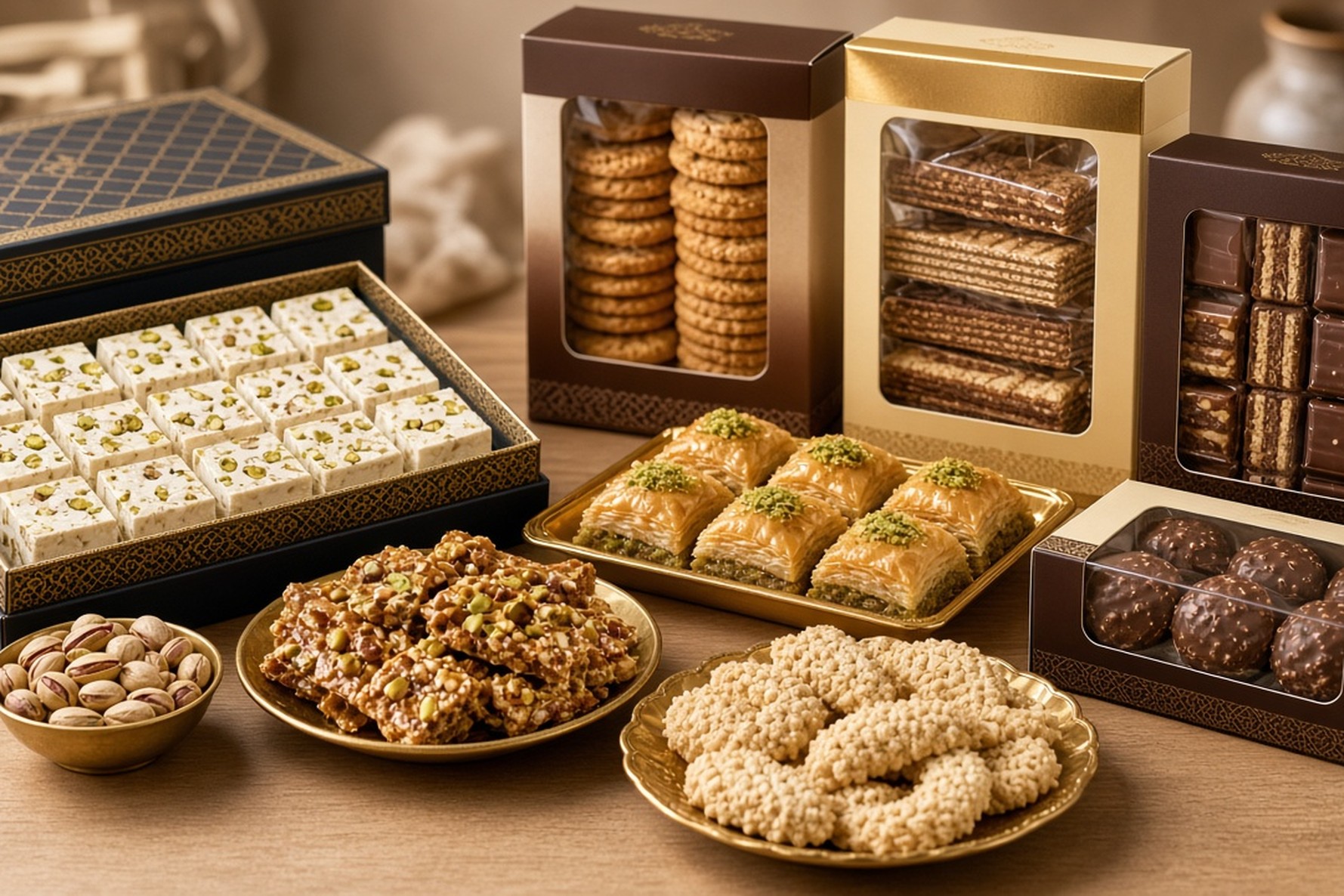
Iranian confectionery is not limited to well-known traditional products such as gaz, sohan, qottab and baklava. Iran's sweets and bakery industry spans nut-based traditional sweets through to biscuits, wafers, hard candy and chocolate products that differ sharply in composition, texture, shelf life, shipping sensitivity, packaging and export market fit. This guide helps buyers and importers choose product based on commercial application and destination-market requirements.
Introduction
The diversity of Iranian sweets reflects two distinct structures. The first is traditional and regional confectionery whose identity is tied to city, recipe, raw materials and consumption culture — Isfahan gaz, Qom sohan, Yazd qottab, Kermanshah nan-e berenji, northern koloocheh, Kerman kolompeh and many other local sweets fall in this group. Historical sources link gaz to Isfahan and nan-e berenji to cities such as Kermanshah, while Yazd heritage documents describe qottab as a native regional sweet.
The second is Iran's modern confectionery and chocolate industry — factories producing biscuits, wafers, enrobed products, candy, toffee, chocolate and packaged bakery items. From a foreign-trade perspective this distinction matters greatly. Customs does not classify goods under a single heading called "Iranian sweets". Gaz may fall in sugar confectionery depending on formula and specification; biscuits in bakery products; and cocoa-containing products in the cocoa chapter.
That is why the question "which countries import Iranian sweets?" is incomplete without specifying the product group. Partner-country import data show Iraq, Azerbaijan, Yemen, Oman, Bahrain, Uzbekistan and some European markets as observed destinations for different groups of Iranian sweets, biscuits, wafers and chocolate products. Canada, Australia, Kazakhstan, Qatar, Jordan and some African markets also appear in trade data for certain groups.
For a professional buyer, the sweet name is only the starting point. Nut percentage, fat formula, sweetener, moisture, water activity, breakage rate, packaging method, product stability, allergens and destination-market requirements can separate two apparently similar products completely in quality and price.
1. Main Iranian Sweet Types and How They Differ
To understand the export market, Iranian sweets should be classified by product structure, not local name alone. For buyers, the main differences lie in primary ingredients, fat and nut content, flour- or sugar-based structure, sensitivity to moisture and heat, and suitability for industrial packaging.
Gaz
Gaz is one of Iran's best-known traditional sweets and a historic product of Isfahan. Its traditional structure is built on sweetener, egg white and pistachio or almond. Angabini gaz and industrially produced variants differ in sweetener, nut content, softness, texture and price. Historical sources describe the use of pistachio or almond in gaz structure.
For export buyers, the most important gaz attributes are not the product name alone but nut percentage, nut type, nut distribution uniformity, stickiness, surface condition, piece size and resistance to heat in transit.
Sohan
Sohan is a fattier, more brittle product, and Qom is especially associated with it. Bite-size, honey-style and other sohan variants are produced across the Iranian market. Fat and nut content make raw-material quality and oxidation control critical. Sohan exposed too long to heat, oxygen or light may lose aroma and flavour before any microbiological issue appears.
Qottab
Qottab is a recognised Yazd product with a flour-based shell and nut filling. Yazd heritage sources describe it as a local walnut-filled sweet. Shell structure, filling amount and composition, oil level, powdered-sugar coating and piece resistance in transit are key export purchase criteria. Qottab is more fragile than products such as hard candy, and the right inner tray or divider can reduce breakage.
Baklava
Baklava is produced in several Iranian regions and has a layered or dough-based, sweet, nut-filled structure. Differences among producers may lie in layer thickness, nut type, syrup amount, aromas such as cardamom and rosewater, and product moisture. Drier, packaged baklava is generally easier to manage on long routes than fresh, very syrupy versions. Buyers should specify whether product is for retail shelf, Iranian grocery, gifting or food-service use before ordering.
Nan-e berenji and dry pastries
Nan-e berenji is a traditional flour-based Iranian sweet, and Kermanshah is one of its recognised historic centres. Historical sources note its high fragility and need for physical protection in packaging. Nan-e nokhodchi, bereshtook, Qazvin dry sweets and many Nowruz pastries are commercially low-moisture products. The main issues are maintaining crispness, preventing moisture uptake and reducing breakage.
Koloocheh and kolompeh
Nut-filled koloocheh and kolompeh are commercially closer to baked goods. Moisture percentage, filling amount, fat composition, shell thickness and packaging type directly affect shelf life. Some products, because of softer texture than dry sweets, need tighter shelf-life testing control.
Poulaki, rock candy and sugar confectionery
This group is technologically closer to sugar products. Compared with flour sweets, the main issues are usually moisture control, preventing stickiness and preserving crystalline or glass-like structure.
Biscuits, wafers and factory products
This is one of the most visible groups in Iran's foreign trade. Products may be plain, cream-filled, nut-filled, enrobed or multi-layer. Their commercial advantage for importers is standardised weight, packaging, mass production and wide chain-store distribution.
Chocolate and cocoa-containing products
This group behaves differently in transit from dry sweets. High temperature and thermal swings can affect surface appearance, texture and quality. For exports to hot regions, real route stability testing matters especially.
| Product group | Main structure | Key sensitivity | Export advantage | Main buying note |
|---|---|---|---|---|
| Gaz | Sugar sweet, egg white, nuts | Heat, moisture, stickiness | Iranian identity and added value | Nut % and nut type |
| Sohan | Sugar, fat, wheat germ, nuts | Oxidation and breakage | Gift and retail product | Fat and nut freshness |
| Qottab | Flour shell and nut filling | Crushing, moisture uptake | Traditional sweet market | Shell-to-filling ratio |
| Baklava | Dough, nuts and syrup | Moisture and texture change | Ethnic and gift market | Nut and syrup level |
| Nan-e berenji and dry sweets | Flour, oil, sugar | Breakage and moisture | Relatively easy shipping | Crispness and piece strength |
| Koloocheh and kolompeh | Nut-filled baked product | Shelf life and moisture | Everyday consumption | Filling and shell quality |
| Candy, poulaki and rock candy | Sugar structure | Moisture uptake and stickiness | Good shelf life | Surface integrity and pack |
| Biscuits and wafers | Industrial baked product | Moisture and crushing | High export scale | Formula, weight and pack |
| Chocolate | Cocoa fat or compound formula | Heat and temperature swings | Wide product range | Transit conditions and formula |
2. Traditional vs Industrial Sweets from the Buyer's Perspective
For importers, the main difference is not simply whether a product looks traditional or factory-made. The real difference is standardisability and specification control.
In industrial biscuits and wafers, net weight per pack, piece size, formula, units per carton, production date and packaging specification are usually controlled through repeatable production lines. In traditional sweets, especially products from smaller workshops, batch-to-batch variation is more likely. Defining acceptance criteria before ordering therefore matters more.
Traditional nut sweets also usually contain a larger share of costly raw materials such as pistachio, almond, walnut, saffron and cardamom. Changes in raw-material quality can create a marked difference in final price and quality.
Two distinct export strategies exist. One importer may sell traditional product as premium, gift or specialty Iranian and Middle Eastern grocery item. Another may seek economical biscuits and wafers for wholesale networks. Order specifications for these two models are completely different.
| Criterion | Traditional nut sweet | Dry flour sweet | Industrial biscuit/wafer | Chocolate product |
|---|---|---|---|---|
| Raw-material importance | Very high | High | Medium to high | Very high |
| Breakage sensitivity | Medium to high | High | Medium | Medium |
| Heat sensitivity | Product-dependent | Usually lower | Depends on cream/coating | High |
| Oxidation control need | Important in nut products | Fat-dependent | Formula-dependent | Important |
| Private-label suitability | Suitable | Suitable | Very suitable | Very suitable |
| Typical market | Gift, ethnic, premium | Retail and ethnic | Mass retail | Retail and gift |
3. Technical Specifications That Must Be Fixed in an Iranian Sweet Order
One of the most common buying mistakes is requesting a price using phrases such as "pistachio gaz" or "Iranian sweets". Such descriptions are not enough to compare two offers. Buyers should convert product into measurable parameters. The larger the order, the more important this becomes.
| Parameter | What to define | Why it matters |
|---|---|---|
| Exact product name | Gaz, sohan, qottab, biscuit, wafer, etc. | Sets commercial group |
| Main ingredients | Full ingredient list | Quality, allergens and labelling |
| Nut used | Pistachio, almond, walnut or blend | Price and quality |
| Nut share | Agreed % in formula | Prevents quality disputes |
| Unit weight | Weight per piece or pack | Pricing and weight control |
| Shape and dimensions | Bite-size, sheet, moulded, etc. | Packaging and display |
| Texture | Soft, crisp, brittle or chewy | Sensory acceptance |
| Moisture or water activity | For sensitive products | Stability and shelf life |
| Visible defects | Breakage, colour change, stickiness | Acceptance criteria |
| Allergens | Nuts, gluten, egg, milk, soy, etc. | Legal compliance |
| Packaging | Material, weight, units per carton | Shipping and sales |
| Shelf life | Based on test and producer declaration | Distribution planning |
| Storage conditions | Product-defined conditions | Transit and warehousing |
| Label information | Language and destination requirements | Clearance and retail |
In products such as gaz, sohan and baklava, nut percentage should be recorded in purchase specifications because two products with the same name can differ greatly in nut content and therefore price. For industrial products, buyers should also specify cocoa coating, cream filling, sweetness level, pack weight, units per carton and retail design requirements.
Buyers reviewing several Iranian supply options can enter this information in an Iranco purchase request at iranco.com so offers are compared on identical specifications, not product name alone.
4. Export Confectionery Quality Control: Which Tests Matter?
Confectionery quality control should follow the product's actual composition. One fixed test panel for all sweets is not logical.
Moisture and water activity
Water activity is an important indicator for assessing stability in many confectionery and bakery products. Packaging studies of sugar products show different groups — from hard candy to nougat and chocolate — have different water activity; moisture transfer between product and environment can change texture. For crisp sweets, rising moisture may cause softening. In chewy or soft products, moisture loss can reduce texture quality.
Nut quality
In gaz, sohan, baklava, qottab and other nut sweets, pistachio, almond or walnut quality matters especially. Beyond freshness and flavour, fungal contaminants in raw-material supply must be controlled. EU Regulation 2023/915 sets maximum aflatoxin B1 at 8 µg/kg and total regulated aflatoxins at 10 µg/kg for pistachio and almond supplied for final consumption. In practice, European importers should include incoming-nut aflatoxin control and final-product compliance in their supply programme.
Fat oxidation
Sohan and nut sweets are sensitive to oxidation because of oil and fat content. Nut oxidation can create off odours and flavours. In professional buying, oil- or fat-oxidation indicators should be reviewed according to product formula and the producer's quality-control programme.
Microbiological testing
Very dry, high-sugar products generally differ from moist sweets in microbial growth conditions; however raw materials, process, post-bake handling and packing environment still matter. Codex General Principles of Food Hygiene CXC 1-1969 emphasises hazard control through hygienic practice and HACCP systems. Microbiological test type should align with sweet type, production process and destination-country regulations.
Sensory evaluation
For many traditional sweets, laboratory testing alone does not define quality. Colour, aroma, crispness, softness, stickiness, nut uniformity, stale flavour and aftertaste should be recorded in sample evaluation. For bulk orders it is better to keep an approved reference sample so final shipment can be compared against it at inspection.
5. Which Countries Import Iranian Sweets?
The answer depends on product group. International trade data show biscuit and wafer destination markets are not necessarily the same as sugar confectionery or chocolate markets. Customs data also do not report names such as "Isfahan gaz" or "Qom sohan" separately.
Sweet biscuits, wafers and waffles
In 2024 data for recorded imports from Iran under group 190530, Iraq at about $75.28M was the largest reported market. Azerbaijan at about $8M, Yemen at about $3.97M, and then the EU, Côte d'Ivoire, Oman, Jordan, Bahrain, Uzbekistan, Canada and Australia also appear. In Azerbaijan, Iran supplied about 8.48 million kg of this group in 2024. By import value, Turkey and Russia ranked above Iran, but recorded volume for Iran was still significant.
Sugar confectionery
In group 170490, recorded 2024 markets for Iranian products include Iraq, Azerbaijan, Uzbekistan, Bahrain, EU countries, Oman, Kazakhstan, Australia, Canada and Qatar. Iraq recorded about $6.45M, Azerbaijan about $3.72M and Uzbekistan about $3.22M of imports from Iran in this group. This group can include various sugar products and should not all be treated as equivalent to gaz or one specific traditional sweet.
Chocolate products
In subheading 180690, Iraq recorded more than $33M of imports from Iran in 2024. Azerbaijan, Oman, Armenia, Bahrain and Jordan were also reported destinations for this group.
| Commercial group | Some recorded markets for Iran | Demand character |
|---|---|---|
| Biscuits and wafers | Iraq, Azerbaijan, Yemen, Oman, Jordan, Bahrain, Canada, Australia | Mass consumption and retail |
| Sugar confectionery | Iraq, Azerbaijan, Uzbekistan, Bahrain, Oman, Kazakhstan, Qatar | Candy and other sugar products |
| Chocolate products | Iraq, Azerbaijan, Oman, Armenia, Bahrain, Jordan | Retail and general consumption |
| Traditional sweets | Depends on product classification in trade data | Ethnic, gift and specialty retail |
| Market | Biscuits and wafers (190530) | Sugar confectionery (170490) | Chocolate (180690) |
|---|---|---|---|
| Iraq | $75.28M | $6.45M | $33.15M |
| Azerbaijan | ~$8M | ~$3.72M | — |
| Yemen | ~$3.97M | — | — |
| Uzbekistan | — | ~$3.22M | — |
These figures are based on destination-country import reports for calendar year 2024. HS codes do not split traditional sweet types separately; total volume under 170490 should not be treated as equivalent to gaz or sohan alone.
Iraq: a major market for Iranian confectionery
Iraq is one of the most prominent observed destinations for Iran across several product groups. In Iraq's 2024 import data for statistical code 190530, Iran accounted for $75.28M of that country's reported $108.97M total imports — a very important position. In sugar confectionery group 170490, Iraq also reported $6.45M of imports from Iran, with Iran among the main sources in that year's import data. For supply to Iraq, competitive price, heat-resistant packaging, appropriate destination-market wording, sellable consumer weights and distribution network all matter strongly.
Azerbaijan and the Caucasus
Azerbaijan is a different market. In biscuits and wafers, Turkey and Russia are serious competitors for Iran; in sugar confectionery, Russia, Ukraine and Turkey also hold significant market share. Competition here is not price alone. Pack design, quality consistency, brand, retail weight and ability to supply regularly can influence importer choice.
Europe, Canada and Australia
Iranian product presence in these markets is smaller in volume than nearby markets, but demand character differs. Iranian, Middle Eastern and ethnic grocery stores are natural markets for traditional sweets, while broader general retail entry requires tighter label, allergen, additive, contaminant, packaging-quality and product-document compliance.
6. Standards, Food Safety and Export Confectionery Labelling
Confectionery is a composite product. Flour, nuts, milk, egg, soy, sesame, cocoa and other ingredients may each create different on-pack declaration requirements.
Codex General Standard for the Labelling of Prepackaged Foods CXS 1-1985 provides a framework for food name, ingredient list and allergen declaration. In the European Union, Regulation 1169/2011 covers mandatory food information including food name, ingredient list, allergens, net quantity, best-before or use-by date, storage conditions, food-business operator details and nutrition declaration.
For GCC markets, GSO 9:2022 is an important technical regulation for prepackaged food labelling, and export packs must also align with the destination country's implementing rules.
For a nut sweet, the label must reflect the actual formula. Using a generic phrase such as "nuts" without checking destination rules can create problems. Wheat, egg, milk, pistachio, almond, walnut, sesame or soy presence must be included in allergen assessment. Producers should not simply use domestic Iran packaging for export and assume a small added sticker is enough.
Label space, information order, language, nutrition table, date, importer name and other items should be approved by the importer before final printing. In Iraq, Arabic labelling with trade name, ingredients, net weight, production/expiry date, importer name and country of origin are common requirements. Arabic spelling errors or inconsistency with the customs file can cause clearance delays.
- Commercial invoice and packing list
- Certificate of origin and bill of lading
- Health certificate or destination-required sanitary document
- Laboratory report (COA) linked to batch
- Product specification, formula and batch traceability records
- Food-safety system documents if requested
7. How Is the Tariff Code for Iranian Sweets Determined?
Tariff-code selection is a sensitive point in trade. The word "sweet" alone is not enough to determine HS code. Composition and production method are decisive.
| HS code | General group | Example use |
|---|---|---|
| 170490 | Other sugar confectionery without cocoa | Some candies and sugar products |
| 1806 | Chocolate and cocoa-containing preparations | Chocolate and cocoa products |
| 190531 | Sweet biscuits | Packaged biscuits |
| 190532 | Waffles and wafers | Wafer types |
| 190590 | Other bakery products of this chapter | Some baked products |
On some trade platforms using older HS 1988/92 classification, code 190530 is seen jointly for sweet biscuits, waffles and wafers; in newer classifications, sweet biscuits are split as 190531 and waffles/wafers as 190532. This difference matters for statistics analysis. For gaz, sohan, qottab, baklava or any traditional sweet, code selection should be based on ingredients, product form and destination customs classification rules. Commercial name or city of origin alone does not determine code.
8. Suitable Packaging for Confectionery Export
Packaging should be chosen according to how the product loses quality. Using one similar pack for gaz, sohan and biscuits will not produce the same result. Confectionery and bakery packaging studies identify moisture, oxygen, oxidation and microbiological contamination as factors affecting quality and shelf life.
| Product | Main trait | Suitable packaging | Logistics note |
|---|---|---|---|
| Gaz | Sensitive to moisture and stickiness | Individual pack, moisture-barrier wrap | Prevent direct pressure |
| Sohan | Brittle, fatty and nut-rich | Tin with inner divider | Protect against oxygen and heat |
| Qottab and dry sweets | Brittle and crisp | Inner tray, strong carton | Prevent pallet pressure transfer |
| Nan-e berenji | Very fragile | Protective wrap, rigid box | Preserve crispness; block moisture |
| Biscuits and wafers | Moisture-sensitive | Flowpack with moisture barrier | Uniform seal and master carton G.W. |
| Chocolate | Heat-sensitive | Insulated pack or temperature chain | Route temperature control |
Gaz
Gaz must be protected against moisture uptake, texture change and stickiness. Individual packs, wraps with suitable moisture barrier and a box preventing direct pressure are worth reviewing for export. For premium nut product, visible product can be a marketing advantage, but a transparent window should not weaken protective pack performance.
Sohan
Sohan is both brittle and fat- and nut-rich. Besides mechanical resistance, protection against oxygen and heat matters. Loose pieces without proper restraint in a large tin can increase breakage in container transit. Dividers, inner trays or shape-matched pack design can reduce this risk.
Nan-e berenji, qottab and dry sweets
This group needs physical protection. Master cartons should be chosen so pallet pressure is not transferred to consumer packs. The main goal of inner wrap is also preventing moisture ingress and preserving texture. For Kermanshah nan-e berenji, a rigid box with shock-absorbing inner layer is a common export pattern. For Yazd qottab, an inner divider tray inside the box can greatly reduce crushing.
Baklava
Drier, packaged baklava is generally easier to manage on long routes than fresh, very syrupy versions. The pack should prevent syrup leakage and environmental moisture uptake. In export orders, defining target moisture and maximum acceptable syrup in the contract is recommended.
Biscuits, wafers and chocolate
In biscuits and wafers, uniform sealing and moisture barrier in wrap are important. Wafers are very sensitive to moisture change, and weak pack seals can reduce crispness. For chocolate, distribution temperature control matters more. The choice between ambient transport, thermal insulation or temperature-controlled container should be based on season, route, product formula and stability study.
9. Shipping, Pricing and Competition for Iranian Sweets in Export Markets
A large share of Iran's dry and industrial sweets can move by land or sea without cold chain, provided the producer has confirmed storage conditions for that route. The same rule cannot be applied to all chocolate products or fresh sweets.
In land transport to Iraq, the Caucasus and some regional markets, shorter routes can create practical advantage. In sea export to more distant countries, time in container, route temperature, humidity and carton strength matter more. For fragile products, pallet-pattern testing is very important. Breakage is not usually caused by poor sweet quality alone; excessive carton height, empty space inside boxes, vibration and pallet compression can also cause damage.
What drives export confectionery price?
- Amount and type of nuts used and quality of pistachio, almond or walnut
- Use of saffron, cardamom, rosewater and aromatics
- Fat and sweetener formula, piece weight and shape
- Acceptable waste and breakage level
- Consumer packaging type — metal tin, cardboard box or economy pack
- Private label, printing cost, order volume and required tests
- Master carton, pallet, delivery terms, destination and transport mode
Comparing "price per kilogram" without reviewing product formula can be misleading. High-nut gaz in gift boxes and individual packs cannot be compared with economy bulk product on kilo price alone.
Iran's competitors
Competition differs by market. In Azerbaijan, for example, Turkey and Russia have been major suppliers in biscuits and wafers, and Russia, Ukraine and Turkey in sugar confectionery. Iran's potential advantage in traditional sweets lies more in product differentiation, use of Iranian nuts and flavours and cultural identity. In biscuits and wafers, competition shifts toward price, production scale, packaging and distribution network. Export gaz strategy therefore should not be copied exactly for economical wafers.
10. Importer Checklist Before Placing an Iranian Sweet Order
Before confirming an Iranian sweet order, the following should be clear:
- State the exact product name. "Iranian sweets" is not enough for professional pricing.
- Obtain the ingredient list. Full formula is needed for allergen review, classification and labelling.
- Define nut percentage for nut products. This indicator should be part of contract specifications.
- Obtain a real production sample. Exhibition or handmade samples may not represent the main production line.
- Keep an approved reference sample. This becomes the basis for shipment comparison.
- Define acceptable defects. Specify breakage %, stickiness, colour change and incomplete pieces.
- Set the test programme. Tests should relate to product composition and destination country.
- Review the label before final printing. Check product name, ingredients, allergens, weight, date and destination-market information.
- Request documented shelf life from the producer. Expiry date should not be chosen only by market convention.
- Test shipping packaging. Fragile product may be fine in sample but damaged on pallet.
- Record storage and transport conditions. Especially for chocolate and high-fat products.
- Specify units per carton and cartons per pallet.
- Review production capacity and lead time.
- Define destination documents before production.
- Include delivery terms in the price offer. Ex-factory, border delivery and port delivery are not directly comparable.
What information is needed for an accurate price quote?
- Exact sweet name, ingredients or desired formula
- Nut type and share in product
- Weight per piece or pack and consumer-pack net weight
- Packaging model, approximate order quantity and private-label requirement
- Label language and specifications, destination country and delivery city or border
- Preferred transport mode, requested tests and certificates
- Consumption market: wholesale, chain store, ethnic grocery or gift
A request for "one container of gaz" cannot be priced accurately. But "pistachio gaz with defined nut share, defined pack weight, individual packs, export cartons and delivery for the Iraq market" enables real supplier comparison.
Supply Path for International Iranian Sweet Buyers
In confectionery export buying, the gap between two offers usually comes from formula, raw materials and packaging differences, not seller margin alone. A sohan with more nuts and export-resistant packaging, an economy gaz, an ethnic-grocery qottab and a mass-produced biscuit are four different commercial goods.
The best approach is for the buyer to convert product specifications into a purchase document before requesting price: product name, ingredients, nut share, weight, pack model, order volume, destination market and required tests should all be clear. Samples and supplier offers should then be compared on those same specifications.
Iranco (iranco.com) allows buyers and importers to submit supply requests for Iranian food-industry products with product details, packaging, order quantity and destination country so suitable supply options can be reviewed. For products such as gaz, sohan and other traditional sweets, sending nut, pack-weight and product-shape details makes review more precise.
If you need Iranian sweets for your market, include technical specifications, approximate volume, packaging model and destination in your purchase request so supply can be reviewed against those criteria.
Conclusion
"Iranian confectionery" is not one commercial group. Gaz, sohan, qottab, baklava, nan-e berenji, koloocheh, sugar products, biscuits, wafers and chocolate differ fundamentally in composition, structure, sensitivity, shelf life and tariff code. That difference should be the basis for product choice and purchase negotiation.
Trade data show Iraq as one of the most important observed markets for several Iranian confectionery groups. Azerbaijan also matters for biscuits, wafers and sugar confectionery, and markets such as Yemen, Oman, Bahrain, Uzbekistan, Kazakhstan, Qatar, Jordan, Canada, Australia and some European countries appear across different groups.
But for premium traditional products, import demand in a country alone is not enough. Stable quality, accurate nut and ingredient declaration, allergen control, aflatoxin management in nut raw materials, resistant packaging, shelf-life study and full label compliance with destination regulations determine whether a product can stay in market sustainably.
For importers, the main principle is converting product name into measurable specifications. "Pistachio gaz" or "export sohan" are not purchase specifications. Nut share, weight, texture, breakage criteria, pack, tests, shelf life and destination must be defined before price comparison. With that approach, Iranian sweets move from souvenir goods to a product manageable in professional food trade.
Frequently Asked Questions (FAQ)
Which Iranian sweets are best suited to export?
Gaz, sohan, qottab, dry sweets, nan-e berenji, koloocheh, biscuits, wafers, candy and chocolate products can all be exported, but target markets differ. Traditional sweets suit Iranian grocery, gift and premium channels; biscuits and wafers suit wider mass retail. Choice should follow destination market, shelf life and shipping conditions.
What is the main difference between gaz and sohan for buyers?
Gaz has a softer or chewier structure based on sugar sweetener, egg white and nuts; sohan is fattier, more brittle and more sensitive to oxidation. In gaz buying, nut share, stickiness and texture matter greatly. In sohan, besides nut amount, fat freshness, aroma, breakage and pack resistance matter more.
Which countries import Iranian sweets most?
Destination depends on product group. 2024 data for biscuits and wafers show Iraq, Azerbaijan, Yemen and several regional and European markets. In sugar confectionery, Iraq, Azerbaijan, Uzbekistan, Bahrain, Oman and Kazakhstan appear. Iranian chocolate products have also entered markets including Iraq, Azerbaijan, Oman, Armenia and Bahrain.
Do gaz and sohan share the same tariff code?
Not necessarily. Tariff classification depends on composition, nature and product form, and traditional sweet name alone is not enough. Sugar confectionery without cocoa, baked product and cocoa-containing preparation can fall in different chapters and lines. Final code should be checked against exact product specification and destination tariff system.
What is the most important test for nut sweets?
There is no single test for all products. In nut sweets, pistachio, almond or walnut quality, aflatoxin and oxidation status matter. Moisture or water activity, microbiological tests and sensory evaluation may also be needed depending on product. The test programme should align with sweet formula and destination-market regulations.
Why do two similar-looking gaz products have very different prices?
Nut amount and quality, sweetener, piece weight, aromatic quality, packaging model, order size and destination market can all change price. To compare two offers, nut share, net weight, packaging, quality specification and delivery terms must match. Comparing kilo price alone usually does not give an accurate picture of real product value.
What matters most when exporting sweets to Europe?
Allergen control, ingredient list, nutrition information, contaminants and EU label compliance matter strongly. In sweets containing pistachio or almond, incoming-nut aflatoxin control must be taken seriously. Packaging and shelf life should also suit transit time and distribution period in the destination market.
How can we source Iranian sweets directly for import?
First define product name, ingredients, nut share, pack weight, order volume, destination country, packaging model and required tests. Then evaluate samples from several producers against identical specifications and keep the approved sample as reference. International buyers can also submit this information through an Iranco purchase request so available supply options are reviewed against the same need.
For Iranian confectionery export advice — gaz, sohan, biscuits, wafers and chocolate — and connection to suppliers
Contact Irancoinfo@iranco.com · WhatsApp: +98 913 104 4182 · Telegram: @irancofood
Related Articles



