 Iranco Magazine Team
From technical specifications to quality control, packaging and successful export delivery
Export Nuts · Grading · QC · Packaging
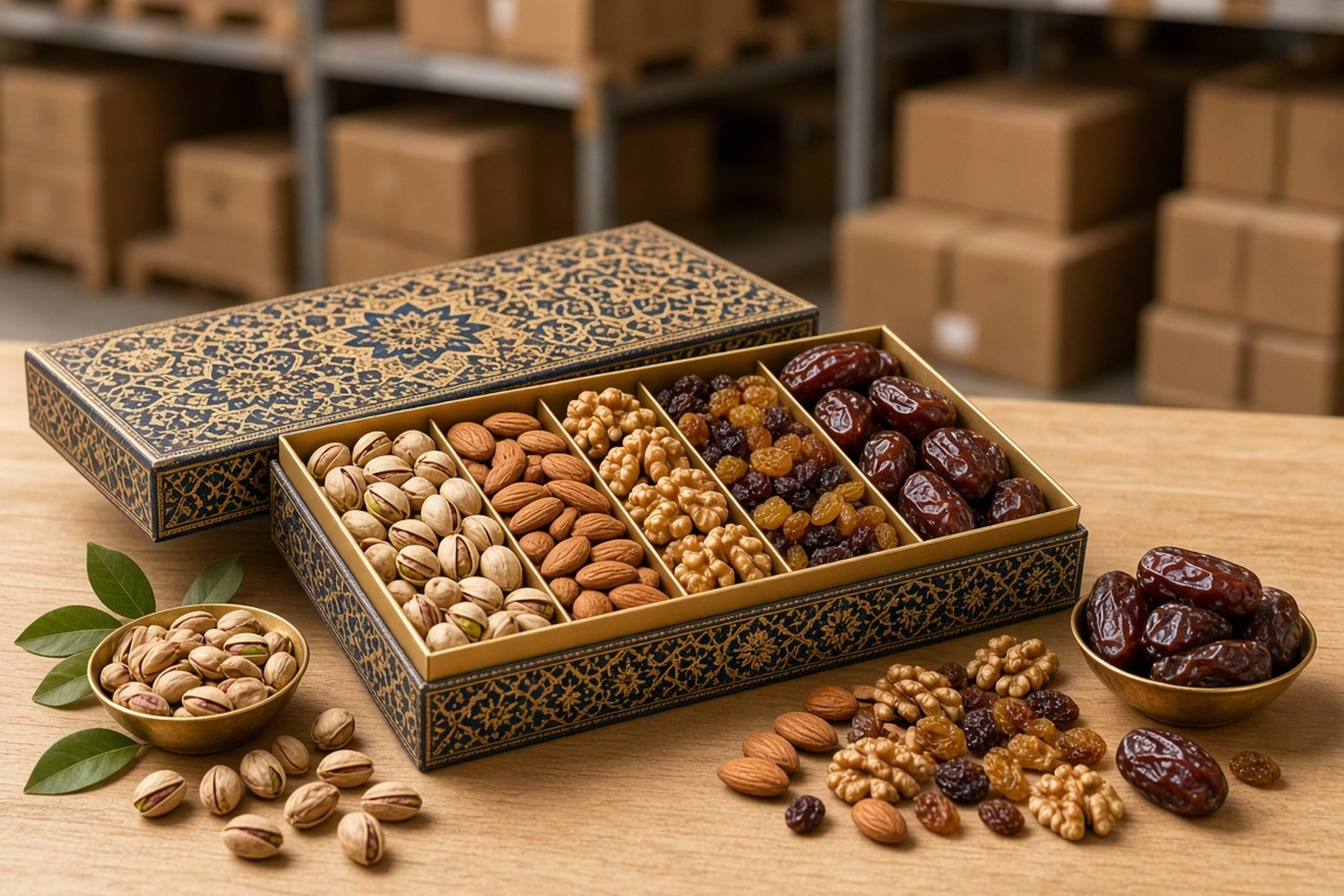
Importer's Guide to Sourcing Sweet & Decorative Nuts from Iran: From Inquiry to Delivery
From technical specifications to quality control, packaging and successful export delivery — the professional buying path for importers, procurement managers and food distributors.
The global nuts and dried-fruit market has shifted toward more specialised purchasing. Importers no longer seek only competitive prices — they evaluate technical, commercial and quality criteria when selecting suppliers. For sweet and decorative nut blends sold in premium retail, gift packs, food manufacturing, hotels and hospitality channels, even minor differences in size, colour, flavour, freshness or appearance can materially affect the final consignment value.
Iran is among the world's best-known origins for certain dried fruits and nuts. However, successful sourcing requires understanding the difference between bulk commodity product, standard export grade and retail-ready merchandise. Many commercial disputes in dried-fruit trade arise not at production stage but at order-definition stage.
1. Market Position of Sweet & Decorative Nuts
Unlike bulk dried fruit, sweet and decorative nut blends are higher value-added products where appearance matters as much as eating quality. Colour harmony, size uniformity, kernel integrity, product cleanliness and packaging quality directly influence end-consumer purchase decisions.
Key differences in export-grade nuts
- Consistent quality across shipments
- Defined product grading
- Controlled visual defects
- Target-market packaging
- Technical specification sheets
- Production and packaging traceability
| Application | Buyer priority | Key specs |
|---|---|---|
| Gift packs | Appearance & uniformity | Colour, size, premium packaging |
| Retail stores | Quality consistency | Exact weight, shelf life, appearance |
| Food industry | Production performance | Size, processing, competitive price |
| Hotels & catering | Sensory quality | Freshness, flavour, appearance |
2. Defining Product Specifications Before Price Inquiry
Prices are not comparable without technical specifications. Before contacting a supplier, importers should define the exact blend, component percentages, size, acceptable breakage, packaging type, unit weight, quantity, destination country and delivery terms.
| Parameter | Required detail |
|---|---|
| Product type | Export-grade sweet mixed nuts |
| Composition | Percentage of each nut or dried fruit |
| Visual quality | Colour and size uniformity |
| Moisture | Per agreed specification |
| Packaging | Weight, material and pack type |
| Application | Retail, gift or industrial |
| Destination | Country and delivery city |
3. Export Grades and Selection Criteria
| Feature | Premium | Commercial | Industrial |
|---|---|---|---|
| Appearance | Critical | Important | Lower priority |
| Uniformity | High | Medium | Application-dependent |
| Main use | Direct retail | Wholesale | Food manufacturing |
| Price sensitivity | Lower | Medium | Higher |
4. Pre-Purchase Quality Control
Quality control must be completed before shipment. An approved reference sample should be registered as the contractual benchmark, including sufficient quantity, written specifications, approval date, packaging details and agreed test results.
- Size and natural colour uniformity
- Mould, spoilage and excessive breakage checks
- Foreign matter and product freshness
- Final blend quality
5. Laboratory Tests Before Loading
| Parameter | Importance |
|---|---|
| Moisture | Shelf life and spoilage prevention |
| Sensory attributes | Taste, aroma, colour and consumer acceptance |
| Foreign matter | Product cleanliness assurance |
| Food safety tests | Destination market compliance |
The Certificate of Analysis (COA) should include product identity, sample number, test results, test date and laboratory credentials. Moisture must be defined as a contractual parameter — not merely described as "dry and fresh".
6. Choosing Appropriate Packaging
| Pack type | Typical use |
|---|---|
| Multi-layer bags | Bulk and wholesale export |
| Vacuum packs | Enhanced protection, reduced air contact |
| Food-grade containers | Retail shelf products |
| Private-label packs | Direct sales in destination market |
7. Export Markets and Destination Selection
In consumer markets, appearance and packaging dominate. In industrial markets, supply stability, competitive pricing, fixed technical specs and available volume matter more. Blend composition should align with destination consumer preferences.
8. Documentation, Standards and Market Entry
- Commercial invoice, packing list and certificate of origin
- Agreed quality certificates and shipping documents
- Labelling: product name, ingredients, net weight, production and expiry dates
- ISO 22000 and HACCP quality management systems
9. Pricing Factors
| Factor | Impact |
|---|---|
| Product type & grade | Value and quality differentiation |
| Blend composition | Higher-cost components raise price |
| Packaging & volume | Final cost and commercial terms |
| Destination | Freight cost and import requirements |
10. Transport, Storage and Delivery
Moisture, ambient temperature, warehouse conditions and stacking can all affect final quality. Delivery terms should be agreed before the transaction; Incoterms clarify each party's responsibility for costs, carriage and transfer risk.
Importer Pre-Order Checklist
- Define exact nut type and blend composition
- Specify end market and required grade
- Obtain samples before bulk order
- Record quality acceptance criteria and blend percentages
- Define packaging type and unit weight
- Review required laboratory test results
- Match sample to contract specifications
- Agree delivery terms and export documentation
Supplier Comparison and Iran's Position
| Country | Advantage | Limitation |
|---|---|---|
| Iran | Product diversity and production heritage | Requires rigorous export process management |
| USA | Strong export infrastructure | Higher production cost in some categories |
| Turkey | Proximity to certain markets | Intense competition |
| India | High production capacity | Quality variation across producer groups |
Conclusion
Sourcing sweet and decorative nuts from Iran is a multi-stage process for professional importers. Success depends on precise order definition, quality control and commercial detail management. A successful purchase aligns four factors: the right product, an evaluable supplier, transparent technical specifications and disciplined export process management.
Frequently Asked Questions
What is the best sweet nut type for export?
The best choice depends on target market and application. Retail channels prioritise appearance and packaging; food manufacturing prioritises technical specs and supply stability.
Should I receive a sample before a bulk order?
Yes. An approved reference sample should be registered as the quality benchmark to reduce discrepancy between sample and final shipment.
Which quality tests are most important?
Moisture, sensory attributes, product integrity, foreign matter and — where required — food safety tests are the core quality controls.
How can I source sweet nuts directly from Iran?
The process begins with defining product specifications. International buyers can submit these via Iranco as a structured purchase request.
Featured Products






Related Articles



