 Iranco Magazine Team
Technical specs, lab analysis standards, quality grades, supply-chain management and international trade opportunities for rose water
Rose water · Wholesale · INSO 5759 · Export
Iranian Rose Water: Wholesale Buying, Grading and Export Guide
Technical specifications, laboratory analysis standards, quality-grade segregation, supply-chain management and international trade opportunities for rose water.
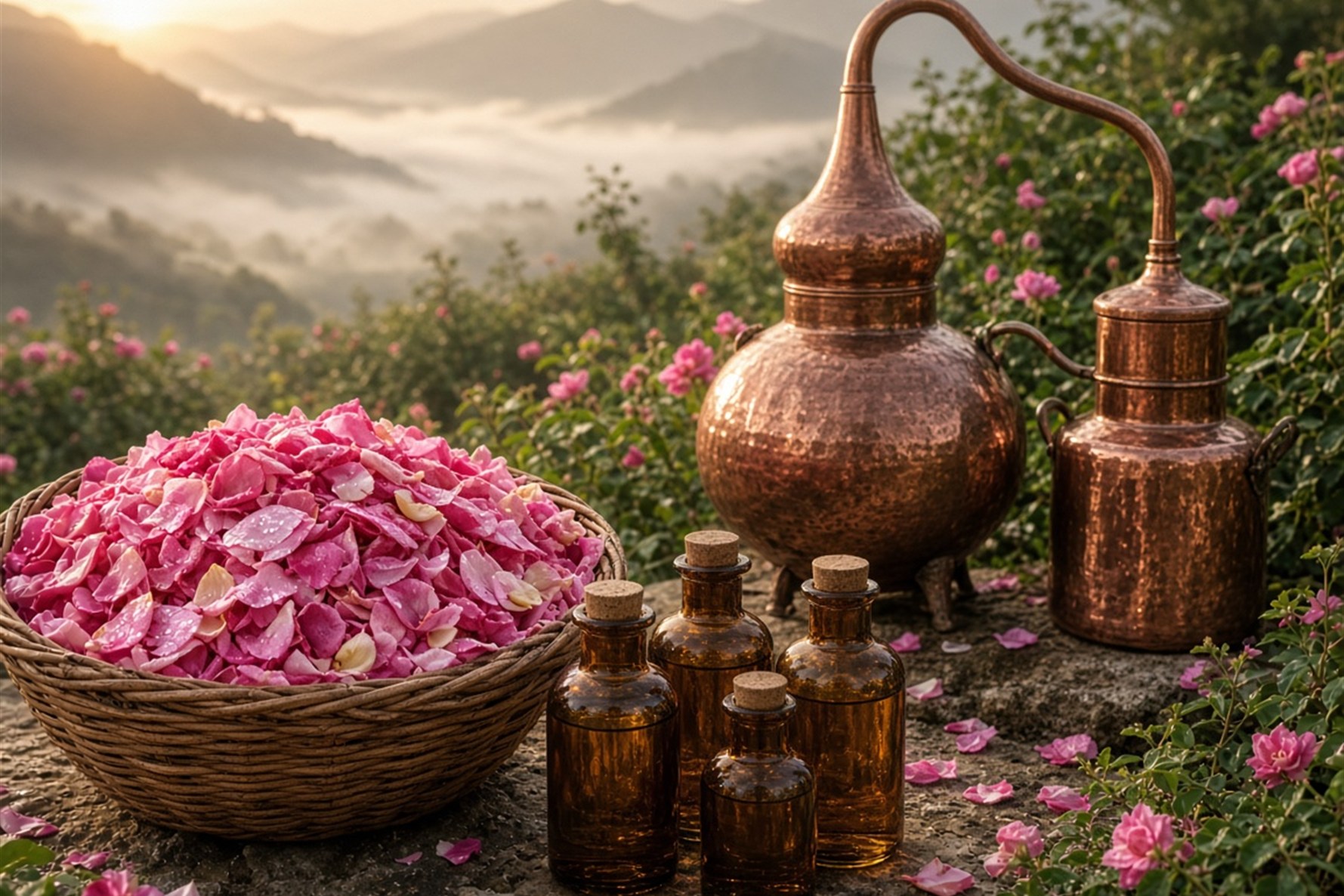
Rose water from traditional and industrial distillation of damask rose in Iran is among the world’s most strategic plant hydrosols for food, pharma and cosmetics. This report covers authenticity criteria, Iran National Standard INSO 5759, adulteration detection, packaging requirements, customs classification and wholesale procurement for international traders.
Cultivation of Rosa damascena in Iran spans more than a thousand years. The central plateau and Zagros–Alborz foothills create mild moisture stress and day–night temperature swings that drive high accumulation of terpenes and aromatic alcohols in petals. Global demand for natural preservatives and flavourings has elevated rose water from a local seasoning to a strategic input for beverages, confectionery, pharmaceuticals and skincare.
Iran holds some of the world’s largest damask-rose plantings and supplies a major share of hydrosol demand. Yet differing distillation methods, fluctuating total-oil grades, synthetic-oil adulteration and vague commercial definitions create risk for wholesale buyers. Professional procurement cannot rest on aroma alone or a seller’s verbal reputation — buyers need GC-MS markers, microbial and chemical limits, process grades and destination customs rules.
1. Geopolitical position, climate hubs and production cycle
Aromatic synthesis peaks in the hours before sunrise; direct sun accelerates loss of light volatiles such as citronellol and geraniol. Cool nights and misty dawns yield richer-oil hydrosols.
Kashan — Qamsar, Niasar and Barzok
Kashan is the historic and industrial distillation hub of the Middle East. Elevations from 1,100 to 2,200 m stretch harvest over 50–60 days (late March/April through late May/June). Calcareous, well-drained soils favour stearoptene accumulation, and the region hosts Iran’s largest mechanised distilleries and hygienic warehouses.
Fars — Meymand, Darab and Firuzabad
Darab’s Layzangan plain grows rain-fed roses above 2,000 m — smaller petals but higher actives and aroma intensity per unit weight. Meymand starts distillation early and feeds southern Iran and GCC markets.
Lalehzar Bardsir — Iran’s highest rose belt
At 2,500–2,900 m, lower temperature and pressure minimise petal-oil evaporation. Lalehzar hydrosols often show among the highest natural phenylethyl alcohol levels; distillation continues into mid-July, extending fresh supply.
East Azerbaijan and emerging hubs
Khosroshah, Osku, Azarshahr and Sahand foothills produce cooler, milder florals suited to skincare toners and modern beverages.
| Region | Elevation (m) | Distillation calendar | Suggested use |
|---|---|---|---|
| Kashan (Qamsar, Niasar, Barzok) | 1,100–2,200 | May–June | Premium food, commercial export |
| Fars (Darab, Meymand) | 1,400–2,400 | April–mid May | Pharma extracts, traditional use |
| Kerman (Lalehzar) | 2,500–2,900 | June–mid July | Modern cosmetics, fragrance, EU |
| East Azerbaijan | 1,400–1,800 | Late June–July | Skin toners, novel drinks |
2. Commercial grades and process categories
Commercial grading is based on flower-to-water ratio and re-heating cycles. Translating local terms into quantitative specs is a prerequisite for any formal contract.
Premium heavy rose water (Grade 1)
About 30–35 kg fresh petals with 80 L water yield a 40 L heavy unit. Under INSO 5759, total essential oil must not fall below 35 mg/100 ml (350 ppm). Taste shows controlled natural bitterness and astringency. This grade is the backbone of reputable food plants and international distribution.
Light commercial (Grade 2)
Flower load drops to 10–15 kg; minimum oil is 15 mg/100 ml. Aroma is pleasant but thinner — economical for low-cost retail packs, home syrups or mild ambient scenting.
Double- and triple-distilled (do-atasheh / se-atasheh)
Double distillation reloads 30–35 kg flowers with 40 L heavy rose water instead of water; total oil reaches 60–85 mg/100 ml with a sharp, burning palate — ideal for high-heat confectionery (halva, gaz). Triple distillation is scarce and costly, used mainly in clinical, lab and luxury fragrance niches.
After-water (pas-ab) vs standard product
Re-distilling spent “bon-gol” marc yields a dilute liquor below 10 mg/100 ml with cooked/scorched notes. It has no food-export value under rose-water grade and shipping it as edible rose water is a commercial violation.
| Grade | Flowers / 40 L | Min. oil | Target market |
|---|---|---|---|
| Premium heavy | 30–35 kg | 35 mg/100ml | Food industry, FCL export |
| Light grade 2 | 10–15 kg | 15 mg/100ml | Retail, economy syrups |
| Double-distilled | 30 kg in 40 L rose water | 60–85 | Thermal confectionery, pharma |
| Triple-distilled | 30 kg in double-distilled | > 90 | Clinical, luxury aroma |
| After-water | Marc + water | < 10 | Non-food / non-export |
3. Physicochemical specs and INSO 5759
Pure damask hydrosol is an aqueous monoterpene and phenylpropanoid solution with no additives, suspended oil or chemical emulsifiers. INSO 5759 is the mandatory quality reference.
GC-MS and marker volatiles
Phenylethyl alcohol, being polar, typically forms 60–78% of the volatile fraction in natural rose water and drives the deep, sweet rose note. Below 50% suggests poor heating, wrong phase separation or dilution. Citronellol (10–20%), geraniol (5–15%) and nerol (3–8%) build cool floral notes; a natural citronellol–geraniol balance characterises Iran’s highland farms.
- Brix: near zero (no free sucrose)
- Relative density at 20°C: 0.995–1.001 g/cm³
- pH: 4.5–6.5; values above 7 indicate dilution or spoilage
- Total acidity (as acetic acid): max 0.05 g/100 ml
- Methanol: negative or < 10 mg/L
- Copper < 5 and lead < 0.1 mg/kg; preservatives: absolute zero
4. Adulteration, microbiology and contaminants
Purity and hygiene are non-negotiable in international hydrosol trade. Common frauds include petrochemical synthetics (often with DPG), geranium oil to inflate geraniol, and undeclared benzoate/sorbate.
Sensory checks
Authentic rose water releases pleasant bitterness and coolness that clears after rinsing the palate twice. Persistent burning bitterness or chalky/soapy aftertaste signals emulsifier or synthetic oil. Visually it must be colourless, clear, free of floaters, sediment and surface oil rings.
Microbial and residue limits
- Aerobic mesophile count: within national maximums
- Coliforms: zero in 1 ml; E. coli: negative in 25 ml
- Yeast and mould: below standard limits
- Pseudomonas and Staphylococcus: absolute negative in 100 ml
- Pesticide residues via LC-MS/MS; heavy metals via AAS
5. Expected technical matrix in commercial contracts
| Attribute | Acceptance limits |
|---|---|
| Botanical name | Rosa damascena Mill (100%) |
| Grade | Premium heavy, continuous distillation |
| Total oil | 35–40 mg/100 ml |
| Phenylethyl alcohol | > 65% of total oil |
| Appearance | Clear, bright, no haze or sediment |
| Packaging | Food-grade IBC or dark glass |
| Shelf life | 18–24 months in cool storage |
6. HS codes and clearance documents
- 33019011: Iran’s 8-digit code for “rose water obtained from damask rose”
- 330190: 6-digit destination line for aromatic distillate waters
- 330129: other essential oils (pure rose otto) — do not confuse with hydrosol
Required paperwork typically includes phytosanitary certificate, food health certificate, chamber certificate of origin, accredited COA (total oil, pH, microbes, heavy metals), commercial invoice and packing list. For GCC, Malaysia and Indonesia, Halal certification and multilingual labels with Rosa damascena Flower Water, licence number, production/expiry dates, batch and Made in Iran are essential.
7. Packaging engineering and quality stability
Volatile oils are sensitive to UV, heat and oxidation. Poor packaging can downgrade heavy rose water below light-grade performance.
- 1,000 L IBC: food-grade PE with galvanised cage and sealed valve — industrial cost leader
- 220 L drums: new closed-head PE, plastic-odour free — excellent container safety
- 20 L jerrycans: induction-foil seal for mid-volume workshops in Iraq and UAE
- Amber glass: chemically inert, UV protection up to 24 months; higher weight and breakage risk
- Tinted PET: light and retail-friendly; thicker walls recommended for hot climates
8. Logistics, temperature control and containerisation
Rose water does not need frozen reefers, but the ideal band is 15–22°C. Prolonged exposure above 35°C accelerates monoterpene oxidation and souring. For China, Japan or North America use multilayer thermal liners; in winter to Russia and Central Asia avoid freezing with reefers set near +10°C.
- Wooden pallets compliant with ISPM 15
- Glass cartons max five layers with board separators
- Shrink film ≥ 25 µm plus PP strapping and edge protectors
| Route | Transit (days) | Main risk |
|---|---|---|
| Iran → Jebel Ali | 3–6 | Quayside heat shock |
| Iran → Iraq (road) | 2–4 | Road vibration damage |
| Iran → Hamburg/Rotterdam | 18–25 | Mediterranean temperature swings |
| Iran → Shanghai/Shenzhen | 25–35 | Equatorial quality fade |
9. Export market geography
Demand splits into traditional food–ritual markets and modern skin-health markets. The GCC is the steadiest destination for heavy grades; Iraq takes high tonnage with price elasticity toward light grades; the EU seeks Clean Label hydrosol in IBCs; East Asia and North America focus on aromatherapy and vegan drinks.
| Destination | Grade | Packaging | Key requirement |
|---|---|---|---|
| UAE, Kuwait, Qatar | Heavy & double-distilled | Luxury glass / 20 L | Halal, GSO |
| Iraq | Light & economy heavy | PET 500–1000 ml | Border health certificate |
| Germany & France | Organic heavy hydrosol | IBC / drums | GC-MS, MRL, metals |
| China & Japan | Kashan & Lalehzar premium | 220 L drums | Batch-by-batch COA |
10. Iran versus Turkey and Bulgaria
Turkey’s Isparta cluster (e.g. Gülbirlik) prioritises otto, concrete and absolute, then markets hydrosol as high-value skincare toner. Bulgaria’s Kazanlak valley supplies luxury pharmaceutical Rose Otto. Iran’s advantage is distillation designed for rich aqueous hydrosol — not a by-product of oil stripping — delivering unmatched flavour depth in cooking and competitive landed cost with year-round tonnage capacity. The main gap is unified branding and export packaging.
11. Industrial applications on modern lines
| Industry | Suggested grade | Typical dose | Wrong-grade risk |
|---|---|---|---|
| Confectionery & halva | Heavy / double-distilled | 1.5–3% w/w | Aroma flash-off in heat |
| Ice cream & dairy | Pasteurised heavy | 2–5% | Early microbial spoilage |
| Beverages & syrups | Filtered heavy / standard light | 0.5–1.5% v/v | Neck oil ring in bottle |
| Skin toners | Lalehzar / Kashan premium | 10–95% aqueous phase | Irritation from synthetics/residues |
| Pharma & supplements | Double / triple-distilled | Variable | Pharmacopoeia test failure |
12. Wholesale pricing drivers and importer checklist
Fresh petals account for 50–60% of heavy-grade cost; plant energy efficiency, packaging (glass can add ~30% vs bulk) and ISO 17025 lab panels also shape the final rate.
Pre-order checklist
- Specify grade precisely (heavy 35, light 15 or double-distilled) — avoid vague “grade one”
- Require INSO 5759 compliance with oil, pH and acidity limits
- Sealed 500 ml sample from the dedicated batch + retain half as reference
- GC-MS for phenylethyl alcohol > 65% and absence of synthetics
- Full microbial panel and heavy metals (Pb, Cu)
- Approve packaging format and printed label artwork
- Define tolerance and claim settlement at discharge port
- Independent pre-shipment inspection (SGS or accredited lab)
Essential RFQ fields
- Grade and minimum total oil
- End-use industry (dairy, beverage, confectionery, cosmetics, retail)
- Total volume and schedule (single FCL vs monthly programme)
- Container format (glass, PET, jerrycan, drum, IBC)
- Branding: bulk, factory brand or private label
- Test panel and Incoterms (FOB Bandar Abbas / CFR–CIF destination)
Conclusion
Iranian rose water is a cultural hallmark and a leading natural distillate in world markets. Buyer success depends on matching grade to the production line, monitoring chemical markers by GC-MS, controlling microbial load with mechanised filling and respecting port logistics standards. With origin technical controls and specialist sourcing platforms, Iranian export rose water can be a stable, profitable purchase.
Frequently asked questions
How does heavy rose water differ from light?
Heavy grade uses 30–35 kg flowers per 40 L output with at least 35 mg oil per 100 ml. Light grade uses 10–15 kg flowers with at least 15 mg oil. Heavy grade has pleasant bitterness and dense aroma and is the main choice for food industry and professional export.
What lab test confirms authentic rose water?
GC-MS is decisive. In pure rose water, phenylethyl alcohol should be 60–78% of volatiles, with natural citronellol–geraniol–nerol ratios. Industrial solvent or synthetic oil peaks indicate adulteration.
What is bulk rose water shelf life and storage?
Sterile sealed product typically holds 12–24 months. Store away from direct sun at 15–22°C in a dry environment. Open lids allow oxygen ingress and gradual oil evaporation.
Which grade for high-heat confectionery?
For baklava, halva, gaz and cookies above 100°C, use premium heavy or double-distilled. Light grades flash off in the kettle and lose flavouring power.
What causes authentic rose water bitterness?
Mild bitterness comes from geraniol and aromatic alcohols dissolved during condensation. It should fade within seconds. Persistent burning bitterness or plastic taste signals chemical oils.
Is a refrigerated container required for export?
No — but avoid prolonged exposure above 35°C at tropical ports. On long sea legs, multilayer thermal liners are recommended.
What information is required for a price inquiry?
Quality grade, minimum oil, packaging type, total volume in tonnes or litres, Incoterm and destination port. On Iranco you can submit these details in the request form.
How can buyers source export-grade rose water directly from Iran?
Define precise technical specs, approve lab samples, verify health documents and supervise container loading. Importers can send specs and volumes via Iranco so vetted producers are screened against the order.
Featured Products


Related Articles



