 Iranco Magazine Team
A comprehensive guide to international market analysis, technical specs, hygiene requirements, export packaging and the Iranian rose water supply chain
Rose water · Export · Food industry · Target markets
Iranian rose water exports: target markets and opportunities in food and beverage industries
A comprehensive guide to international market analysis, technical specifications, hygiene requirements, export packaging, and the supply chain for Iranian rose water.
Analytical introduction
Expanding Iranian rose water exports into global markets requires a precise understanding of quality indicators, destination-country standard requirements, and demand structure across food, beverage, pharmaceutical, and cosmetic industries. This analytical report explains in detail the export rose water value chain in Iran, quality grading by concentration (grade), microbiological and chemical standards, export packaging methods, pricing strategies, and the status of key target markets for exporters, importers, and trade managers.
Shifting consumption patterns in the global food and beverage sector have led to a sharp rise in demand for fully natural extracts, flavorings, and aromatics. Among these, rose water—one of the most valuable products from distillation of Damask rose—holds a special place in worldwide food, pharmaceutical, and cosmetic supply chains. With its unique dry and semi-arid climate, high-altitude cultivation areas, and a long history of distillation technology, Iran is one of the main hubs for producing rose water with high concentrations of active chemical compounds at an international level. The day–night temperature difference in Iran’s foothill regions means volatile essence levels in Iranian Damask rose petals are significantly higher than in many other growing regions.
However, successful and sustained presence in international markets requires more than traditional product supply. Bulk buyers, trading companies, and quality control managers at multinational plants apply strict criteria for purity, essence grade, quality consistency, absence of microbiological and chemical contaminants, and compliance with packaging and logistics rules. Lack of awareness of these specialized requirements can lead to shipment rejection or heavy financial losses. By examining every commercial, technical, and legal dimension of rose water export, this article maps a comprehensive roadmap for professional exporters and importers.
1. Market and climatic position of rose water production in Iran
Iran is the primary homeland of Damask rose (Rosa damascena), and both traditional and industrial distillation have deep roots in this land. Iran’s diverse climate creates varied conditions for Damask rose cultivation. Foothill areas with cool nights and intense daytime sun provide the best environment for storing volatile essences in petals.
Main production regions and climatic traits
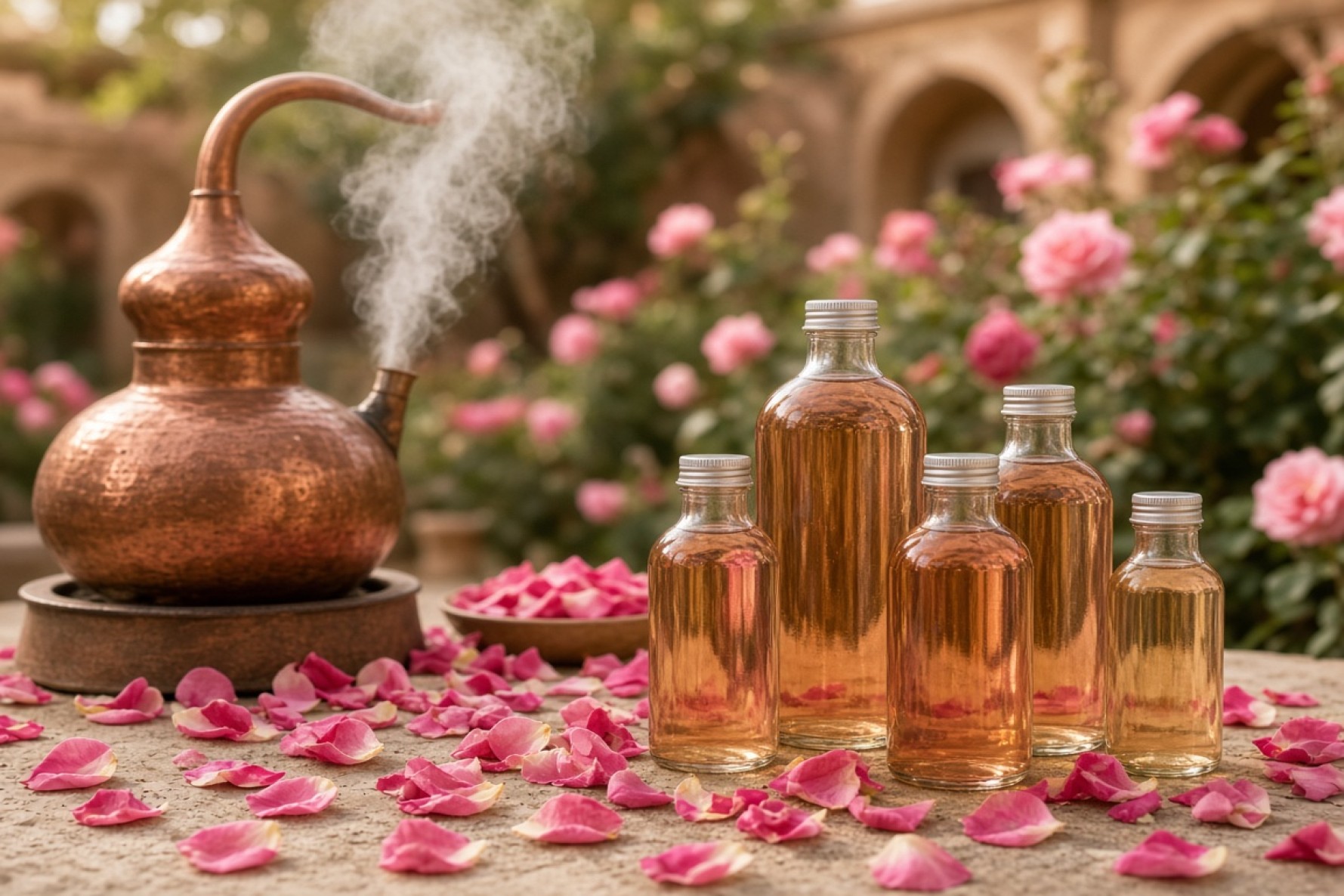
The Kashan region—including Qamsar, Niasar, Jushqan, and Barzok—is recognized as Iran’s most prominent rose water production hub. Use of copper distillation pots alongside modern industrial units has made this region’s rose water a quality benchmark in the market. In Fars Province, areas such as Meymand and Firuzabad hold large rain-fed and irrigated Damask rose acreage; rose water from these zones is widely used in pharmaceutical and food applications thanks to its astringent taste and suitable concentration.
High-altitude Lalazar areas in Kerman Province, at more than 2,500 meters above sea level, also produce rose water with very high essence percentages, making them exceptionally suitable for essence extraction and concentrated export-grade rose water. Khorasan Razavi Province and the city of Kashmar likewise play an important role in production of herbal distillates and export rose water.
Harvest and distillation season
Damask rose harvest in Iran begins in early Ordibehesht (April–May) in warmer areas and continues through late Khordad (May–June) in higher mountain zones. Planning export shipments should align with this season, because freshly distilled rose water in this period has the highest freshness and aromatic compound concentration.
2. Types and quality classification of export rose water by grade
Commercial rose water quality is measured by the ratio of Damask rose weight used to the volume of distilled liquid—in trade terms, the “grade” or concentration. Bulk buyers choose one of the categories below based on industrial need or target market.
- Light rose water: From distilling about 10 to 15 kg of Damask rose per 100 liters of water. Milder aroma and taste, economical price, and use in household or small-scale cosmetic liquid bases.
- Heavy (premium) rose water: From distilling 30 to 35 kg of rose per 100 liters of water; the main export standard for food use, with lasting aroma and slightly bitter taste.
- Double-fired (do-atish) rose water: Second distillation using fresh petals (about 40 to 60 kg) with first-stage rose water instead of water; very concentrated, intense aroma, and persistent bitter, astringent taste.
- Triple-fired (se-atish) rose water: Third distillation on double-fired rose water with fresh flowers; extremely high concentration, mainly custom orders for pharmaceuticals and perfumery.
| Rose water type | Rose per 100 L | Aroma and taste | Primary use | Export grade |
|---|---|---|---|---|
| Light | 10–15 kg | Mild aroma, no harsh bitterness | Retail, cleansers and toners | Economy |
| Heavy (premium) | 30–35 kg | Strong aroma, slightly bitter and astringent | Food and beverage industry | Export standard |
| Double-fired | 40–60 kg | Very heavy aroma, bitter and astringent | Pharmaceuticals, specialty skincare | Premium / luxury |
| Triple-fired | > 60 kg | Extremely dense, long-lasting aroma | Pharmaceutical and custom perfumery | Custom |
3. Technical specifications and chemical composition expected by international buyers
Industrial buyers and reputable international plants base purchases on laboratory analysis sheets (Certificate of Analysis, COA). Essence dissolved in rose water includes aromatic organic compounds that define product purity and authenticity.
Key chemical compounds in Iranian rose water essence
- Phenylethyl alcohol: 69.7% to 81.6% — responsible for the main sweet rose scent
- Citronellol: 1.8% to 7.2% — lemon- and rose-like floral note
- Geraniol: 0.9% to 7.0% — geranium-like odor
- Linalool: 1.5% to 3.3% and nerol: 0.2% to 4.2% — balanced natural notes
| Technical parameter | Range / value | Importance |
|---|---|---|
| Tariff code (HS) | 33019011 / 33019000 | Customs declaration and duties |
| Appearance and color | Clear, colorless, no sediment | No physical contamination |
| Acidity (acetic acid) | 0.005–0.015% | Stability and absence of souring |
| pH | 4.0–4.5 | Skin and beverage compatibility |
| Essence level (grade) | 12–35 mg/100ml | Concentration and value measurement |
| Synthetic essence / additives | Zero (prohibited) | Natural authenticity |
| Heavy metals | National Standard 5759 | Food safety |
4. Quality, common defects, and how to identify premium rose water
Traits of premium rose water
- Natural bitter and astringent taste: Pure, concentrated export rose water is bitter and astringent at the back of the throat; this bitterness comes from natural essence and fades after a few seconds.
- Mild, lasting aroma: Authentic scent is pleasant; sharp industrial odor or sourness indicates adulteration or spoilage.
- Clarity: No suspended particles, sediment, or separate oily layer.
Common defects and causes
- Cloudiness: Inadequate filtration or initial microbiological contamination
- Mold and fungus: Non-sterile container or air ingress
- Sour taste: Fermentation of sugars due to high temperature or poor distillation hygiene
- Aroma loss: Unsuitable polymer containers or poor cap sealing
5. Testing, quality control, and hygiene standards
Reference standards in Iran
- National Standard 1500: Physicochemical and sensory test methods and properties of rose water
- National Standard 5759: Maximum limits for contaminants and heavy metals in food products
- Standards 5272 and 1011: Microbiological testing of water and food liquids
Microbiological parameters
- Total plate count (TPC): maximum 100 CFU/ml
- Enterococcus: negative in 100 ml
- E. coli and thermotolerant coliforms: fully negative in 100 ml
- Mold and yeast: less than 10 CFU/ml
6. Industrial applications in food, beverage, pharmaceutical, and cosmetic sectors
Beverages
- Herbal syrups, aloe vera drinks, juices, and ready-to-drink (RTD) iced tea
- Carbonated drinks with citrus-rose flavor profiles
Confectionery and pastry
- Baklava, Turkish delight, masghati, gaz, and halva
- Scenting creams and cake fillings instead of artificial vanilla
Dairy and ice cream
- Luxury ice cream with double-fired rose water
- Fereni, pudding, rice-milk dessert, and flavored yogurt
Cosmetics and pharmaceuticals
- Natural toner with pH 4.0 to 4.5
- Eye drops and mouth and gum rinses
7. Analysis of key export markets and demand structure
Persian Gulf (UAE, Saudi Arabia, Qatar, Oman, Bahrain): The largest market for direct food consumption and traditional hospitality. The UAE is a re-export hub to Africa and South Asia; Saudi Arabia and Qatar demand premium and double-fired rose water in upscale glass bottles.
European Union (Germany, France, UK, Italy): Demand for organic, pesticide-free products; uptake by hygiene and beverage industries. Germany and France import industrial aseptic jerrycans and drums in larger volumes.
Regional markets (Iraq, Turkey, Azerbaijan): Iraq is a high-volume buyer of food-grade rose water in economical PET; Turkey absorbs Iranian premium rose water because of its confectionery and baklava industry.
| Country | Demand volume | Preferred grade | Common packaging | Sales channel |
|---|---|---|---|---|
| UAE | Very high | Premium and double-fired | 500/1000 ml glass · drums | Wholesale, re-export |
| Saudi Arabia | High | Double-fired and luxury heavy | Decorative glass | Hypermarkets, religious use |
| Germany | Medium | Organic premium | 20 L jerrycan / aseptic | Cosmetics and beverages |
| France | Medium | Premium, high essence | Aseptic / metal drum | Perfumery and hygiene |
| Iraq | Very high | Light and food premium | 500–1500 cc PET | Retail network, baking |
| Turkey | Medium | Heavy and double-fired | 20 L jerrycan / glass | Confectionery and baklava |
8. Competitor analysis (Iran, Bulgaria, Turkey, India)
| Country | Main advantage | Limitation | Price level | Target market |
|---|---|---|---|---|
| Iran | Superior climate, high grade, competitive price | Packaging and sanctions | Competitive | Persian Gulf, Europe, neighbors |
| Bulgaria | Strong branding, EU standards | Limited production volume | Very high | Europe, USA, Japan |
| Turkey | Logistics and preferential tariffs with Europe | Higher production cost | Medium to high | Europe, Middle East |
| India | Production volume and low labor cost | Variable quality | Economy | South Asia, UK |
9. Legal requirements, customs regulations, and clearance documents
- HS code 33019011: Rose water obtained from Damask rose
- HS code 33019000: Other herbal distillates
- Phytosanitary certificate (Plant Protection Organization)
- Food and drug hygiene certificate
- Certificate of origin and halal certificate
- Quality analysis sheet (COA) from an accredited laboratory
Labeling requirements
Labels must be bilingual (English and Arabic or the destination country language) and include product name and grade, producer and exporter details, ingredient list, production and expiry dates (Gregorian), health license and batch number, net volume, the phrase “Product of Iran,” and storage conditions (away from direct sunlight).
10. Export packaging, logistics, and temperature management
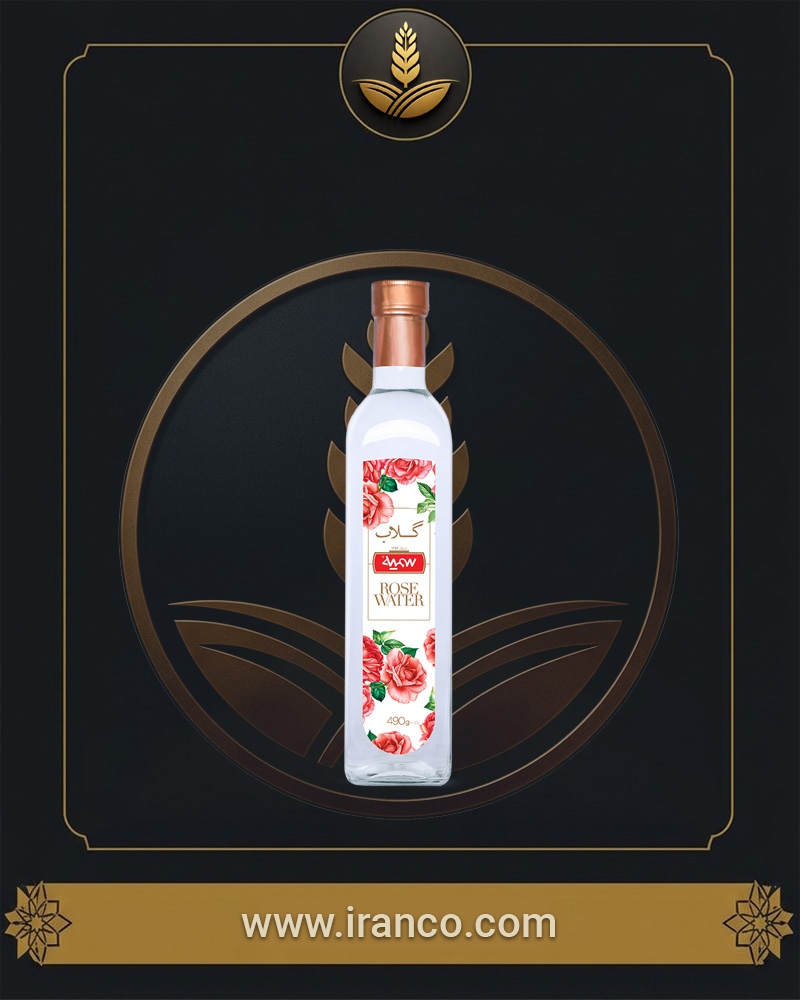
- Dark or clear glass: Best container for aroma retention in 250, 500, and 1000 ml sizes
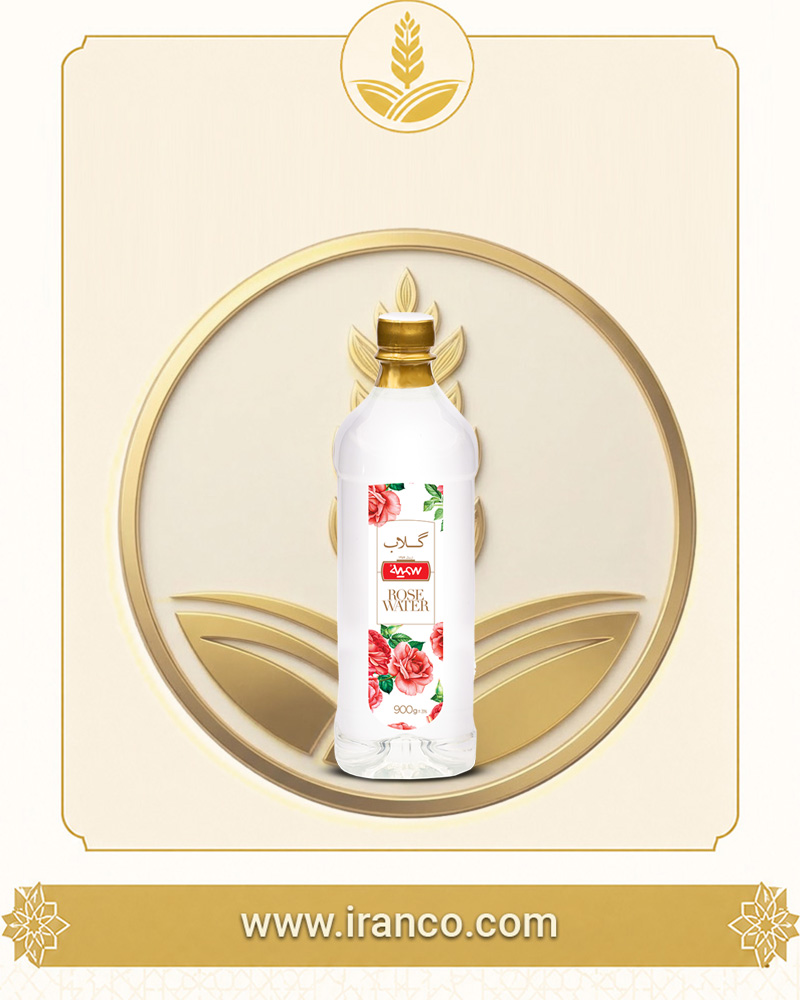
- Food-grade PET: Economical regional markets
- HDPE jerrycans and aseptic drums: 10 and 20 liters and 200 L drums with food-grade epoxy lining for bulk export
- Container shipping: FCL or LCL; temperatures above 40°C degrade aromatic compounds — reefer at 15 to 22°C or insulated container recommended
- Palletizing: Glass master cartons on pallets, stretch-wrapped
11. Pricing factors and commercial models
- Grade and amount of rose used (heavy and double-fired cost more)
- Packaging type (glass with aluminum cap vs. PET)
- Order volume and Incoterms (EXW, FOB, CFR, CIF)
- Pesticide residue testing costs for Europe
12. Importer checklist before placing a bulk order
- Define exact industrial or food application
- Specify grade and minimum requested essence level
- Obtain samples and run sensory and chemical tests
- Match the analysis sheet (COA)
- Review microbiology results (coliform and E. coli negative)
- Confirm absence of pesticide residues (MRL)
- Agree on bottle, jerrycan, and palletizing materials
- Approve bilingual label artwork
- Set shipping method and transit temperature
- Define tolerance for broken-container damage
Export rose water supply from Iran through Iranco
In international rose water purchasing, price differences are not only about exporter margin; they tie directly to rose water grade, filtration quality, packaging container type, and shipment hygiene certificates. International buyers and importers can submit purchase requests on Iranco with precise technical specs such as grade, packaging type, order volume, and destination country so available supply options in Iran can be evaluated on that basis.
To submit a supply request or receive specialized rose water export advice, use the Iranco contact page.
Conclusion
Iranian rose water exports rest on superior climate, high essence grade, and historical expertise. Sustainability in global markets requires compliance with modern standards, accurate analysis sheets, pesticide residue control, and insulated packaging. As worldwide demand grows for natural products in food and cosmetics, upgrading the supply chain and managing logistics clears the path for Iran to expand its share in international markets.
Frequently asked questions
What is the main difference between heavy and double-fired export rose water?
Heavy rose water comes from direct distillation of 30 to 35 kg of fresh rose with water, while double-fired rose water is obtained by redistilling first-stage rose water with fresh flowers (40 to 60 kg). Double-fired has higher essence concentration, a more bitter taste, and a higher price.
What is the best rose water packaging to preserve aroma during export?
Dark glass bottles (amber or green) perform best. For bulk industrial export, food-grade HDPE jerrycans or metal drums with epoxy lining and aseptic bags are standard.
What is the shelf life of export rose water?
Pure, sterile rose water in sealed glass containers lasts about 2 to 3 years and should be stored dry, cool, away from light, and below 25°C.
What are EU hygiene requirements for importing rose water?
No pesticide residues (MRL below 0.01 mg/kg per Regulation 396/2005), no heavy metals, negative microbiological contamination, and a COA from an accredited laboratory.
How can authentic rose water be distinguished from adulterated product?
Authentic rose water has a natural bitter, astringent taste that fades after a few seconds; mild, lasting aroma; and a fully clear liquid. Artificial products often have sharp perfume odor, chemical taste, or cloudiness.
What is the customs HS code for export rose water?
The specific code for Damask rose water is 33019011; code 33019000 is used for general herbal distillates.
How can I arrange export rose water supply from Iran?
Specify technical details including grade, packaging, volume, certificates, and destination, then submit your request on Iranco so qualifying supply options can be reviewed.
Featured Products


Related Articles



