 Iranco Magazine Team
Expert analysis of carcass traits, quality grading, premium breeds, biochemical requirements, hygiene standards and export logistics
Export Guide · Animal Protein · Middle East
Iranian Lamb Meat; Quality Specs and Wholesale Buying Guide
Expert analysis of carcass traits, quality grading, premium breeds, biochemical requirements, hygiene standards and export logistics
This comprehensive commercial and technical guide is a practical reference for international procurement managers, importers, protein trading companies and meat distribution networks that intend to source Iranian lamb meat in wholesale volumes. The article examines carcass physiology, breed quality ranking, rigor mortis monitoring, laboratory standards, modern packaging methods, Middle East market analysis and customs procedures — providing a precise framework to reduce transaction risk and support successful purchasing.
Lamb meat holds a strategic economic position in the Middle East animal-protein supply chain. Sheep farming in Iran rests on rich foothill pastures, diverse wild medicinal plants and a long pastoral tradition. These geographic and climatic conditions give Iranian lamb carcasses uniform intramuscular fat, fine muscle fibres, low free tissue water and a pleasant aroma and flavour. In Gulf markets the product trades as a recognised commercial category and, owing to superior sensory traits, shows higher demand elasticity and unit value than intensively farmed Australian or New Zealand meat.
Entering high-tonnage wholesale deals nonetheless requires precise knowledge of many technical variables. Slaughter management, muscle glycogen depletion timing, acidity control, microbiological supervision, pre-chill protocols and strict cold-chain discipline all affect commercial shelf life and shipment economics directly. A professional wholesale importer cannot rely on base price alone: tissue integrity, fat-tail dressing method, sanitary status and alignment with veterinary quarantine standards determine margin and end-consumer satisfaction. Mastery of meat breeds, air and container transport rules, and official market-entry documents is a prerequisite for profitable decisions in this market.
1. Market Analysis, Production Capacity and Climate Advantages of Iranian Lamb
Annual red meat production in Iran is estimated at 850 to 940 thousand tonnes, most of it sheep and lamb. The national livestock structure rests on a flock of more than 45 million sheep and lambs, raised mainly in traditional grazing systems, mobile pastoralism and semi-industrial fattening units.
The Zagros and Alborz ranges, north-western plains and steppe pastures of eastern and western Iran are the principal light-livestock production zones. Kurdistan, West Azerbaijan, East Azerbaijan, Kermanshah, Lorestan, Zanjan, Razavi Khorasan and Fars contribute the largest shares of quality lamb. Pastures in these climates are rich in aromatic plants such as astragalus, wormwood and mountain thyme; grazing on these flora shifts muscle fatty-acid profiles toward unsaturated acids and distinguishes flavour without chemical flavourings.
Seasonal Supply Fluctuations and Production Cycle
Iranian lamb supply follows a clear biological cycle that wholesale buyers must understand when timing contracts:
- Spring to early summer: Weaning of winter-born lambs and supply of young pasture lambs. Light carcasses (12–15 kg) with tender texture peak in this window.
- Autumn and winter: Supply of fattened lambs that have completed grain-based finishing in feedlots and reached target finish weight. Carcasses are heavier with more established fat cover.
Iran’s geopolitical proximity to the largest red-meat importers in the Gulf enables fast air and sea logistics. While chilled Oceania product requires 20 to 30 days of sea transit, Iranian chilled lamb carcasses can reach UAE, Kuwaiti or Qatari buyers within 12 to 24 hours of slaughter. That speed limits fat oxidation flavour and natural weight loss.
2. Premium Iranian Meat Lamb Breeds and Carcass Morphology
Iranian sheep breed diversity is the product of centuries of adaptation to varied climates. Unlike Western intensive systems concentrated on a few breeds, Iran hosts more than twenty native breeds. Each has distinct body structure, dressing percentage, muscle texture and fat-tail volume. In the meat trade the terms “type” or “breed” are standard; agronomic labels unrelated to livestock should be avoided.
Heavy Breeds with High Lean Meat Yield
These breeds are raised mainly on plains and in concentrated feedlots and record the highest daily gain:
- Afshari: Native to Zanjan Province and adjacent areas of West Azerbaijan and Kurdistan. Elongated frame, strong limbs, high daily gain (200–260 g under finishing) and carcass yield of 50–53%. Medium intramuscular fat with high lean distribution in leg and loin.
- Shal: Native to Buin Zahra on the Qazvin plain — the heaviest Iranian sheep breed. Young lambs gain weight rapidly; meat is exceptionally tender with minimal dryness. Yield reaches 52–54%.
- Mehraban: Main origin Hamadan Province. Broad-bodied with ridged fat-tail and dense muscling; high economic efficiency for industrial meat and large kitchen use. Cold-carcass yield about 48–51%.
Mountain and Steppe Breeds with Fine Muscle Fibre
Animals from high elevations develop denser muscle with less compact subcutaneous fat because of long walking distances and mountain vegetation:
- Sanjabi: Native to Kermanshah Province and tribal western Iran — the most respected and sought-after Iranian meat breed in Gulf export markets. Light pink colour, fine longitudinal fibres and mild aroma. Heart-shaped, proportional fat-tail; yield 49–52%.
- Kurdi: Origin mountain Kurdistan, Ilam and northern Khorasan. Raised in harsh climates; meat known for muscularity and juiciness after cooking.
- Ghezel: Native to Sahand foothills in East Azerbaijan. Red or brown coat colour; highland feeding gives high healthy myoglobin concentration and very tender texture.
| Sheep Breed | Geographic Origin | Avg Finished Live Weight (kg) | Cold Dressing % | Fat-Tail Form / Volume | Preferred Market Use |
|---|---|---|---|---|---|
| Afshari | Zanjan & West Azerbaijan | 48 – 56 | 50 – 53 | Medium to large | Chain retail, hotels and premium portioning |
| Shal | Buin Zahra (Qazvin) | 52 – 62 | 51 – 54 | Broad and compact | Specialty cut packing, loin steak, industrial processing |
| Sanjabi | Kermanshah | 42 – 48 | 49 – 52 | Medium, heart-shaped | Premium carcass export to Arab markets; fine catering |
| Kurdi | Kurdistan & North Khorasan | 44 – 50 | 48 – 51 | Compact and elongated | Wholesale distribution, day-butcher carcass, traditional kebab |
| Ghezel | East Azerbaijan | 43 – 49 | 48 – 51 | Medium spindle-shaped | Restaurant cooking, traditional stews, household use |
| Baluchi | Khorasan & Sistan | 36 – 42 | 45 – 49 | Small and very light | Markets seeking leaner, lower-cost carcasses |
For buyers who need Iranian lamb matched to destination consumer taste, the Iranco commercial platform enables precise review of sourcing options by breed and fattening region.
3. Carcass Technical Specs, Quality Grades and Commercial Cut Anatomy
In wholesale lamb trade, carcass conformity with physical and anatomical standards is the decisive criterion for foreign-currency settlement and port inspection. A sheep carcass is the complete slaughtered body after skinning, removal of the head at the atlanto-occipital joint, removal of feet at the carpal/tarsal joints, and full emptying of abdominal and thoracic viscera.
Age Classification and Commercial Carcass Grades
Industrial abattoir quality grading is based on bone development, dentition and connective-tissue thickness:
- Premium (milk-fed / suckling lamb): Under 4 months; chilled carcass under 12 kg. Extremely soft texture, very pale pink muscle, very thin surface fat and milky aroma — mainly luxury consumption.
- Grade 1 (young finished male lamb): 6–9 months; chilled carcass 14–18 kg. No permanent teeth; vertebral cartilage fully flexible; bright red muscle and even white fat cover. This grade forms the bulk of international trade.
- Grade 2 (yearling lamb): 10–12 months; carcass 18–22 kg. First permanent tooth pair may be erupting. Greater fat-tail and flank fat; firmer meat fibres.
- Industrial (mature sheep): Over 1 year; carcass above 23 kg. Dark red meat, firm texture, dense calcified bone and distinct mutton fat odour — mainly for sausage, salami and burger manufacture.
Cut Anatomy and Specialist Carcass Portions
Efficient distribution requires carcass breakdown to national and international cutting standards:
- Leg and chump: Densest muscle block — about 32–35% of carcass weight. Includes leg, rump and hind shank; minimal connective tissue and fat make it the highest-value cut for kebab, slow cook and premium stews.
- Shoulder and full forequarter: About 25–28% of carcass weight. Deeper extract flavour and semi-fatty texture from animal movement — suited to moist cooking and tas-kebab styles.
- Loin and fillet: Finest, least-worked muscles along the spine — about 10–12% of weight. Ideal for shishlik, barg and lamb steak.
- Flank and ribs: Layered meat and fat covering thorax and abdomen — about 18–20%. Used directly for koobideh mince and restaurant products.
- Neck: Cervical vertebrae and collagen-rich gelatinous muscle — about 7–9%; highest demand for soups and traditional abgoosht.
| Technical Parameter | Preferred Wholesale Spec | Contract Tolerance | Commercial Importance |
|---|---|---|---|
| Net chilled carcass weight | 14–18 kg | ±0.5 kg per side | Match consumer demand; control landed cost |
| Subcutaneous fat cover | 2–4 mm thickness (grades 2 and 3) | Max 5 mm | Protects muscle from drying in storage |
| Fat-tail dressing | Remove 60–100% of fat-tail | Per written request | Removes weight of little value to foreign buyers |
| Deep leg core temperature | +1 to +3°C | Above +4°C not accepted | Controls psychrotrophic bacterial growth |
| Ultimate pH | 5.5–5.7 | 5.4–5.8 | Water-holding capacity; prevents biochemical spoilage |
| Viscera cleaning | Full removal of lung, heart, trachea, oesophagus | Zero residue | Veterinary quarantine red lines |
4. Muscle-to-Meat Biochemistry, pH Monitoring and Rigor Mortis Management
Conversion of living muscle fibres into edible meat is a sensitive post-slaughter biochemical process. When blood flow stops, tissue oxygenation ceases and aerobic cellular respiration pathways are disrupted. For real shipment quality monitoring, muscle acidity (pH) is the most scientific and reliable control index.
Post-Mortem Glycolysis and Lactic Acid Formation
In living animal muscle, glycogen is the energy store. After slaughter, without oxygen, glycogen is hydrolysed by anaerobic fermentation to lactic acid. Accumulation acidifies the muscle environment. Acidity falls from an initial 7.0–7.2 at slaughter to 5.4–5.8 within 18–24 hours in the pre-chill hall. That range relatively densifies myofibrillar proteins, brightens red meat colour and — most importantly — fully suppresses pathogenic and spoilage bacteria.
Quality Defects and Biochemical Carcass Faults
Poor pre-slaughter science and incorrect chilling cause two serious damages:
- Dark, firm, dry meat (DFD): Occurs when animals face prolonged road-transport stress, feed and water deprivation or sudden temperature change before entering the kill line. Glycogen stores deplete in the living muscle; after slaughter insufficient lactic acid forms and ultimate pH remains above 6.0. Result: dark purple colour, dry sticky surface, very firm texture and very short bacterial shelf life.
- Cold shortening: Occurs when hot carcass muscle temperature falls below 10°C under severe cold shock before pH drops below 6.2 and before rigor is complete. The sarcoplasmic reticulum releases high free calcium into the cytoplasm, causing catastrophic actin–myosin contraction. Sarcomere length can fall by up to 50%; meat becomes rock-hard and remains tough even after long cooking.
Correct abattoir practice in Iran rests on resting animals for at least 12–24 hours in lairage with access to fresh water, then staged carcass pre-chilling. Carcasses are first held for 6 hours at 8–12°C for rigor to develop, then moved to holding rooms at 0–2°C.
5. Hygiene Protocols, Veterinary Oversight and Laboratory Quality Control
Lamb export from Iran operates under full supervision of the Iran Veterinary Organization (IVO). All consignments must pass ante-mortem and post-mortem inspection by official veterinary officers so organ health is confirmed free of pathological lesions, hydatidosis, sarcocystis and caseous lymphadenitis.
Standard Microbiological Indicators for Lamb Carcasses
Hygiene assessment of carcass surfaces and deep tissue follows national standards and international reference guidelines:
- Total Viable Count (mesophilic aerobic bacteria): Baseline cleanliness index for the kill line and hygiene during hide removal. Surface swab limit must be below a maximum of 105 CFU/cm².
- Escherichia coli: Direct indicator of faecal contamination during evisceration. On export-grade consignments it must stay below a maximum of 102 CFU/cm².
- Salmonella spp.: Non-negotiable pathogen — must be absolutely negative in random 25 g muscle tissue tests under all regional standard codes.
- Staphylococcus aureus: Indicator of worker hand contact and personal hygiene failure; maximum limit 102 CFU/cm².
- Psychrotrophic bacteria: Main determinant of spoilage during chilled transport; accumulation signals defective chill-room cooling.
Drug Residues, Antibiotics and Heavy Metals
For international export health certificates, carcasses are monitored for drug compounds and chemical contaminants against Maximum Residue Limits (MRL):
- Antibiotics: Especially tetracyclines, beta-lactams and aminoglycosides; slaughter only after the registered withdrawal period.
- Antiparasitic residues: Organophosphate and organochlorine compounds from farm and housing spraying.
- Heavy metals: Lead and cadmium by atomic absorption spectrophotometry — muscle tissue must be below 0.1 mg/kg.
| Quality Control Test | National / Regional Limit | Reference Lab Method | Commercial Interpretation |
|---|---|---|---|
| 24-hour pH | 5.4–5.8 | Direct penetrating contact electrode | Tissue acceptance, juiciness and final tenderness |
| TVC | Max 105 CFU/cm² | Pour-plate culture at 30°C | Processing line and abattoir equipment hygiene |
| E. coli | Max 102 CFU/cm² | Chromogenic selective medium | Worker hygiene and evisceration practice |
| Salmonella | Negative in 25 g meat | Pre-enrichment and selective culture | Mandatory for clearance at entry points |
| TVN (volatile nitrogen bases) | <15 mg / 100 g | Kjeldahl distillation and titration | No onset of protein breakdown / ageing |
| Lead & heavy metals | <0.1 ppm | Graphite-furnace atomic absorption | Alignment with global food-safety codes |
Wholesale buyers can coordinate with Iranco specialists to activate independent random sampling at the active abattoir before container loading and receive official test results.
6. Regional Target Markets, Demand Structure and Competitor Comparison
Gulf littoral states — Kuwait, the UAE, Qatar and Oman — together with Iraq are traditional historical destinations for Iranian light livestock and sheep meat. In local family food baskets, sheep meat is a table staple. “Iranian lamb” is rated a distinct premium good versus competitors because of marbled texture, thin fat layers and appealing flavour.
Destination Market Structure and Buyer Preferences
- Kuwait: The most traditional and strictest Iranian lamb buyer. Importers insist on light milk-tooth male lambs (12–15 kg) from Sanjabi and Kurdi breeds. In Shuwaikh and Safat markets, Iranian lamb routinely trades at a 20–35% premium over Australian and Sudanese carcasses.
- UAE: A developed dual market — Dubai wholesale seeking whole chilled carcasses of 14–17 kg, and supermarket / luxury food-service networks needing labelled packed portions.
- Qatar: Demand centred on young lamb carcasses of 13–16 kg. Buyers prefer cook quality and tenderness over price; daily air cargo links the two countries.
- Oman: Active shipping between southern Iranian ports and Shinas, Khasab and Suwaiq makes Oman a buyer of both chilled carcasses and finished live animals.
- Iraq: Extensive western land borders make Iraq the largest buyer of heavier finished carcasses (16–22 kg). Buyers in Baghdad, Najaf, Karbala and Basra clearly prefer fresh Iranian sheep meat over Brazilian frozen product.
| Destination | Preferred Consignment | Carcass Weight (kg) | Main Distribution Channel | Dominant Transport |
|---|---|---|---|---|
| Kuwait | Whole chilled young male lamb carcass | 12 – 15 | Traditional markets, premium butchers | Direct freighter / fast dhow |
| Qatar | Chilled carcass in stockinette | 13 – 16 | Hypermarkets, Arab restaurants | Doha cargo airlines |
| UAE | Chilled sides and vacuum portions | 14 – 18 | Hotel catering, retail chains | Daily air freight to Dubai |
| Oman | Whole chilled carcass and live animals | 15 – 19 | Urban abattoirs, butchers | Refrigerated sea vessels |
| Iraq | Whole warm and chilled carcass | 16 – 22 | Traditional meat markets, restaurants | Road refrigerated trucks |
Iran’s Competitive Position Versus Extra-Regional Exporters
Iran does not compete in Middle East red-meat trade as a low-price commodity supplier; it occupies the luxury and organic-style supply niche:
- Australia: Largest volume exporter; sheep meat in container scale at lower landed cost. Fibres are denser for Middle Eastern palates and fat often carries a strong industrial-pasture odour.
- New Zealand: Focused on frozen bone-in and boneless cuts. Long logistics distance prevents serious competition with Iran in same-day chilled carcass trade.
- Sudan, Somalia and Kenya: Exporters of very light, lean, low-price carcasses. Very low fat and dry texture place this meat in lower-income and labour consumption tiers — not comparable with finished Iranian product.
- Turkey: Iran’s main regional quality competitor. Turkish breeds (e.g. Awassi) are close to Iranian genetics, but higher feed and farming costs keep Turkish final prices above Iranian product in shared markets.
7. Customs Tariff Codes, Legal Standards and Clearance Documents
Smooth export and clearance of perishable consignments at origin and destination customs depends on correct declaration under Harmonized System (HS Code) codes in Chapter 02. Even a small mismatch in eight-digit codes can leave a container in unsuitable temperature and spoil the goods.
HS Codes for Sheep and Lamb Meat
- 0204.10.00 (HS 02041000): Carcasses and half-carcasses of lamb, fresh or chilled.
- 0204.21.00 (HS 02042100): Carcasses and half-carcasses of other sheep, fresh or chilled.
- 0204.22.00 (HS 02042200): Other bone-in cuts of sheep, fresh or chilled.
- 0204.23.00 (HS 02042300): Boneless sheep meat, fresh or chilled.
- 0204.30.00 (HS 02043000): Carcasses and half-carcasses of lamb, frozen.
- 0204.41.00 (HS 02044100): Carcasses and half-carcasses of other sheep, frozen.
- 0204.42.00 (HS 02044200): Bone-in sheep meat cuts, frozen.
- 0204.43.00 (HS 02044300): Boneless sheep meat, frozen.
Code 0204.10.00 specifically covers young lamb meat, fresh or chilled, and records the highest customs unit value among these subheadings.
Documentary Requirements and Legal Clearance Procedures
Entry of lamb consignments into Gulf littoral countries requires a complete approved document pack:
- Veterinary Health Certificate: Issued by the IVO Quarantine and Biosecurity Directorate, confirming slaughtered animals were free of contagious animal diseases and killed in authorised industrial abattoirs.
- Halal Certificate: Seal and signature of the official religious representative and abattoir Sharia supervisor confirming Islamic slaughter, Qibla orientation and full blood exit.
- Certificate of Origin (COO): Issued by Iranian chambers of commerce to establish geographic identity.
- Air Waybill / Ocean Bill of Lading (AWB / BL): Aligned with perishable cargo rules, stating storage temperature 0 to +2°C.
- Commercial Invoice & Packing List: Gross and net weight breakdown, carcass count and sanitary lead-seal serials.
- Pre-shipment Inspection (PSI): On buyer request, international inspection firms at loading perform organoleptic checks, deep-leg temperature control and container door sealing.
8. Modern Packaging, Wrapping Technologies and Carcass Shelf-Life Extension
After pre-chill ends, carcass quality depends heavily on protective materials. Meat remains biologically active after slaughter; surface water evaporation, myoglobin respiration and oxygen contact must be controlled by engineered packaging.
Whole-Carcass Covering Systems
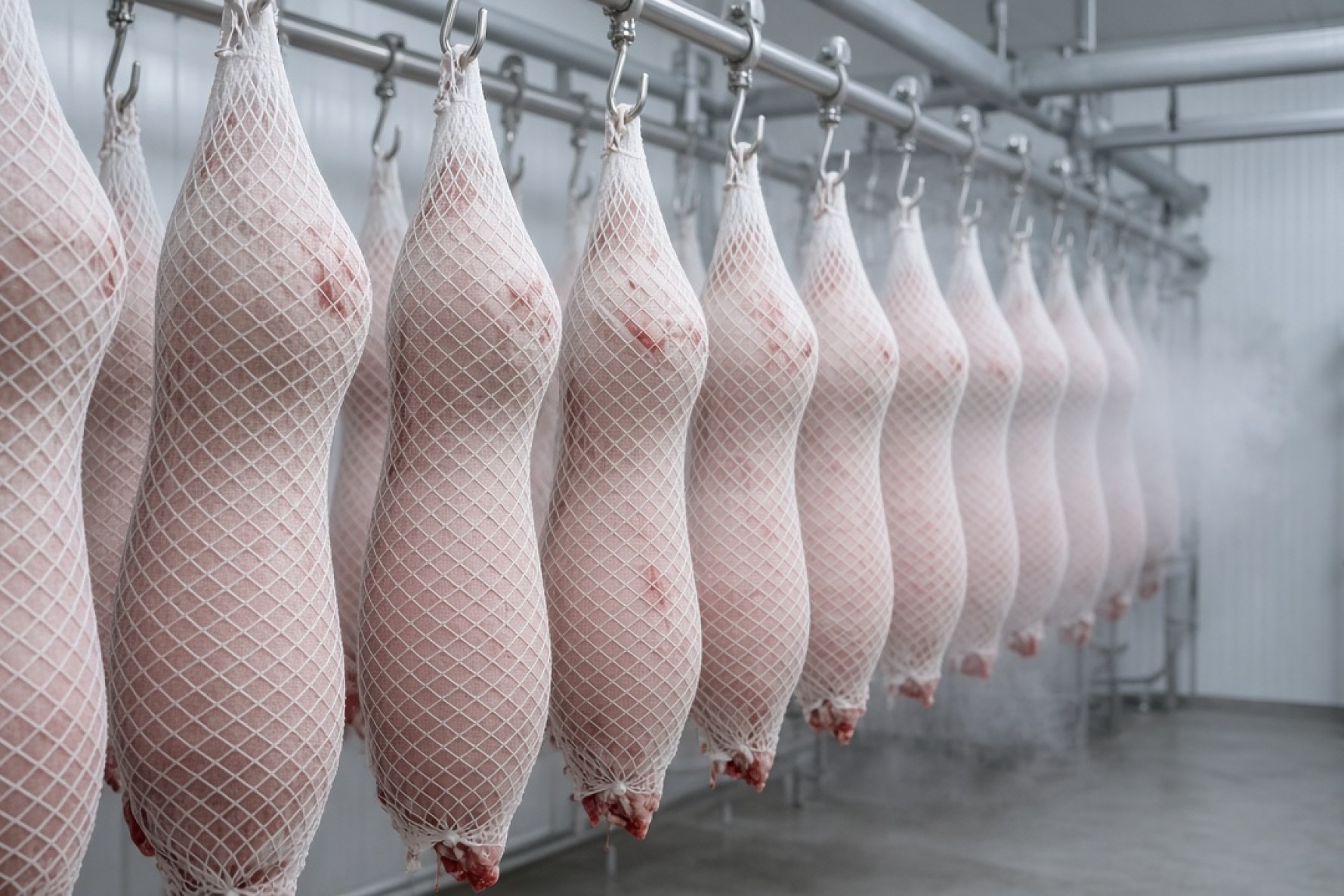
- Breathable pure cotton stockinette / mutton cloth: The most traditional yet standard cover for whole lamb carcasses. Odour-free cotton fibre socks protect the surface from dust and airborne microbial load. Open weave lets free surface moisture evaporate and prevents sweating and sliminess.
- Secondary ventilated PE bag: On air freight, a sanitary matte nylon bag with ventilation apertures is drawn over the fabric stockinette so drip does not contaminate other packs and evaporative weight loss is minimised.
- Tamper-evident identity tags: Each carcass carries two security seals with 2D barcodes on fore and hind shanks showing abattoir name, exact slaughter date, quality grade and quarantine supervision code.
Specialist Portion Packaging Technologies
- Modified Atmosphere Packaging (MAP): Retail cuts such as loin, leg or boneless sides are placed in impermeable polymer trays and air is replaced with gas mix. Optimal formula for fresh lamb: 70–80% oxygen (to stabilise oxymyoglobin and bright red colour) plus 20–30% carbon dioxide (to penetrate bacterial membranes and slow growth).
- Vacuum Skin Packaging: Chamber air is fully evacuated and a multilayer oxygen-barrier film sits like a second skin. Lipid oxidation stops and chilled shelf life can extend to about 30 days. Colour may shift purple from deoxymyoglobin, returning to light pink within about 15 minutes after opening and oxygen exposure.
Expiry Dating and Destination Labelling Standards
Gulf regulations (including GSO 150-1 and newer national rules such as Qatar QS 10050:2025) impose strict labelling requirements:
- Label text must be printed in Arabic and English without spelling errors.
- Clear slaughter date and expiry with day, month and year on every pack or carcass is mandatory.
- Maximum allowed shelf life for chilled carcasses without vacuum packing is generally 7–14 days.
- The phrase confirming Islamic slaughter, abattoir name and country of origin (Iran) is required.
9. Cold-Chain Logistics and Air, Road and Sea Transport Protocols
Organoleptic stability and keeping microbial load at the lowest level is impossible without cold-chain management. From leaving the abattoir rail to hanging in the buyer’s cold store, lamb must stay within 0 to +2°C.
Step-by-Step Origin Chilling Process
- Exit kill line and wash at about 36°C carcass temperature.
- Enter primary pre-chill at 8–12°C and 85% RH for 6 hours to prevent cold shortening.
- Transfer to final chill at 0 to +2°C with air speed about 1 m/s for 18 hours until deep femur temperature is below +4°C.
- Final weighing after natural moisture loss (about 1.5–2% of initial weight).
- Stockinette covering and immediate loading into thermally isolated compartments.
Fresh Carcass Air Cargo Features
For Kuwait, Doha, Dubai and Muscat, direct freighter flights are ideal:
- Consignments are built on aircraft pallets and sealed with thick polyethylene thermal insulation covers.
- Packaged dry ice or non-dripping gel packs are placed among packs so temperature does not drift during apron waiting.
- Flight times are 45 minutes to 2 hours; with airport formalities, product reaches destination airport cold stores in under 8 hours.
Road and Sea Logistics in Reefer Containers
For Basra, Najaf and Baghdad, transit uses refrigerated trailers via Shalamcheh, Mehran and Parviz Khan terminals. On Gulf sea routes, 40-ft high-cube reefers are used:
- Carcasses hang on longitudinal rails with at least 10 cm spacing so chilled airflow is not blocked.
- Bottom fans run at 85–90% RH so surfaces avoid freezer burn and drying.
- Continuous temperature/humidity data loggers (online satellite) are mandatory so the trader can view chamber charts in software at any time.
| Logistics Method | Chamber Air Temperature | Optimal RH | Transit Time to Destination | Critical Control Points |
|---|---|---|---|---|
| Air cargo | 0 to +2°C | 80 – 85% | 6–12 hours | Prevent apron hold under sun |
| Road reefer trailer | 0 to +2°C | 85 – 90% | 24–48 hours | Border gate speed; generator fuel |
| Sea reefer container | 0 to +2°C | 85 – 90% | 24–72 hours | Continuous vessel power; fan checks |
| Deep-freeze container | −18 to −22°C | — | 5–15 days | No compressor swing (avoid ice recrystallisation) |
10. Landed-Cost Components and Wholesale Pricing Mechanics
Iranian lamb prices in trade reflect supply–demand balance, climate shifts, global feed-grain prices, FX conversion and commercial costs. Wholesale buyers should not analyse price offers without reviewing the components below.
Carcass Cost Build-Up
- Live-weight base price: Day rate for live lambs in supplier-province livestock markets.
- Dressing yield: Ratio of dressed carcass to live weight — typically 48–53% by finish, age and breed. A 52% yield breed makes meat far cheaper per kilogram than a 47% yield breed.
- Chilling shrinkage: Natural water evaporation in the first 24 hours of pre-chill — about 1.5–2.5% of hot weight.
- Fat-tail removal cost: When contracts specify docked fat-tail, the 1.5–3 kg fat deduction per carcass is absorbed into lean meat rate.
- Industrial slaughter, packing and sanitary seal fees: Abattoir commission, packing materials, cotton stockinette, tags and sanitation.
- Laboratory and quarantine inspection: Veterinary approvals, microbial tests and Sharia certificate.
- Export logistics and formalities: Road haulage, airport or port charges, cabotage and international cargo insurance.
Inverse Relationship of Carcass Weight and Unit Price
In regional trade, price per kilogram of lamb carcass is inversely related to weight: lighter carcasses (12–15 kg) quote higher per kg than heavy carcasses (above 22 kg). Light carcasses are leaner with less fat and impose less waste on the consumer, while heavier carcasses require extensive fat trimming and waste cleaning.
For price transparency and competitive quotes from leading producers, traders can register wholesale orders on Iranco and receive realistic cost estimates against precise technical specifications.
11. Importer Checklist Before Placing an Order
To secure the deal and avoid losses on lamb consignments, wholesale buyers should complete these steps:
- Define breed precisely by destination taste (e.g. Sanjabi for Gulf markets)
- Set allowed chilled carcass weight range in the contract (e.g. 14–17 kg with a stated swing ceiling)
- Specify fat status and fat-tail method (full fat-tail, half-docked or fully docked)
- State delivery temperature (chilled 0 to +2°C or frozen −18°C)
- Define packing material (pure cotton breathable stockinette plus ventilated PE overwrap)
- Require bilingual official labels to importer-country standards with slaughter date
- Set TVC ceiling and absolute Salmonella-negative requirement on origin samples
- Set laboratory muscle pH requirement of 5.4–5.8 to reject DFD consignments
- Choose precise Incoterms (e.g. origin airport, destination airport, or FOB vessel)
- Cap transport and evaporative weight loss (max 1.5–2% of initial weight)
- Require continuous temperature/humidity data loggers with formal chart reports at destination
- Appoint an independent international inspection firm before loading to verify weight, tag counts and deep meat temperature
12. What Information Should Be Sent to Obtain an Accurate Price?
Calculating landed export lamb quotes needs full order detail. Vague enquiries cannot be priced accurately. A professional importer’s RFQ should include:
- Carcass form: Whole with head and feet, whole without head and feet, split sides, or vacuumed primal portions.
- Breed or morphology: Finished male lambs from western breeds (e.g. Sanjabi, Afshari) or other types.
- Weight range per carcass: Exact kg band (e.g. 12–15, 14–17 or 18–22 kg).
- Fat control status: Natural organic fat-tail, commercially trimmed, or fully docked.
- Total volume and shipping calendar: Overall tonnage, weekly/monthly shipment count, and minimum tonnage per shipment.
- Thermal state: Warm/chilled at 0–2°C, or deep-frozen at −18°C.
- Requested transport: Air from international airports, refrigerated road, or sea container transit.
- Destination customs/port: Exact airport, commercial port or land border of clearance.
- Pack and labelling: Cloth wrap type, secondary cartons, bilingual label specs and required languages.
- Inspection and payment: Acceptance of standard certificates, buyer inspector presence and settlement method.
With these data, applicants can lodge a formal enquiry on the Iranco commercial platform so landed-cost analysis is prepared against real capacity of selected industrial abattoirs.
13. Export Lamb Supply Path from Iran via Iranco
International sourcing of raw animal products is sensitive and bound by strict sanitary, veterinary and chill-chain standards. The gap between a successful contract and a loss-making deal lies in breed match, pre-chill quality, microbial control and airport formality speed. Iranco — as a specialist sourcing platform for Iranian food products and processing industries — builds a secure structured channel linking foreign buyers to the national meat production chain.
The system lets wholesale buyers and trade managers register exact order specifications including breed, weight class, cutting requirements and packing protocols. Iranco identifies modern industrial abattoirs with export veterinary supervision codes, reviews active sanitary licences, and evaluates matching supply options. Coordination of kill-line inspection, Sharia standard oversight, muscle pH monitoring in pre-chill halls, international certificate issuance and supervision of container or aircraft loading are processes steered within this commercial service framework. Traders seeking continuous lamb supply with stable quality, full sanitary guarantees and fair rates can register and track purchase details through the platform.
14. Conclusion and Final Decision Framework
Iranian lamb, grounded in mountain ecosystems, pasture diets and uncommon meat-breed diversity, holds a durable advantage in Middle East quality protein products. Profitability in wholesale import nonetheless depends on systematic carcass quality management and avoidance of purchases without a technical identity sheet.
Selecting breed to match destination priorities (e.g. Sanjabi and Kurdi preference in Kuwait and Qatar), insisting on muscle pH in the 5.4–5.8 range to avoid slaughter-stress quality loss, supervising proper rigor without cold shortening, and maintaining an unbroken chill chain from abattoir to destination terminal are the indices that protect commercial productivity. Investors and distributors that write contracts on laboratory parameters, set clear weight tolerances and work with credible sourcing systems will contain quality and customs risk and secure a reliable position in the regional competitive market.
15. Frequently Asked Questions
1. What is the main textural and sensory difference between Iranian lamb and Oceania competitors?
Iranian lamb has finer muscle fibres, higher dry-matter content and a mild flavour without sharp sheep odour. Australian and New Zealand sheep are mostly pasture breeds with denser fat layers and a distinctive fat smell that fits Middle Eastern slow and traditional cooking less well.
2. What is the standard pH of a sound carcass and why is it critical?
After 24 hours of pre-chill, sound carcass pH should stabilise between 5.4 and 5.8. If pH remains above 6.0, the carcass shows dark, firm, dry (DFD) defect from pre-slaughter fatigue and stress, leading to rapid microbial spoilage.
3. What is the ideal carcass weight range for export to Kuwait and the UAE?
The preferred band for these markets is 12–16 kg chilled carcass. These weights belong to young milk-tooth finished male lambs with least excess fat-tail and highest tissue tenderness.
4. How long does chilled lamb last in the distribution chain?
For whole carcasses in stockinette at 0 to +2°C, standard shelf life is 7–14 days from slaughter. With vacuum or MAP packed cuts, life can extend to about 21–30 days.
5. What causes cold shortening and how is it prevented?
If a hot lamb carcass is exposed to severe cold below 10°C before pH falls under 6.2, calcium ions release in muscle and sarcomeres contract sharply, making meat very tough. Prevention is holding the carcass for 6 hours at 8–12°C before deeper chill.
6. Why do Gulf markets prefer the Sanjabi breed?
Sanjabi from Kermanshah has compact muscling, a proportional heart-shaped fat-tail, light bone and outstanding eating quality. During cooking it releases juicy texture and pleasant aroma that best match native Gulf culinary styles.
7. What is the proper path to request pricing and buy Iranian lamb wholesale?
First define technical order specs — breed, grade, weight range, packing, transport and destination. Through the Iranco platform the enquiry is routed to industrial abattoirs with export codes and supply options are reviewed and proposed directly to the buyer.
8. Does clearance of Iranian chilled meat at destination airports need special certificates?
Yes. Original IVO international health certificate, halal slaughter certificate, certificate of origin, packing list with carcass tag numbers, and transport document stating 0 to +2°C are mandatory for customs clearance.
Featured Products


Related Articles



