 Iranco Magazine Team
Iran’s place in global walnut trade, target markets, buyer quality specs, export standards, packaging, storage and ways to raise export value
Technical & Trade Analysis 2026
Iran Walnut Export: Market Opportunities, Packaging and Export Standards
Iran’s place in global walnut trade, target markets, quality specs buyers expect, export standards, packaging, storage and ways to increase export value
Iranian walnuts rank among the country’s major orchard crops by volume and are exported mainly as in-shell walnuts and walnut kernels. Success in export markets depends on quality uniformity, moisture and aflatoxin control, kernel colour, breakage rate, packaging that resists oxidation, and matching the destination market to the product grade.
2023 production figures show Iran produced roughly 381,000 tonnes of walnuts, ranking third worldwide after China and the United States, with about 9.5% of recorded global output. The tariff code for in-shell walnuts is HS 080231 and for walnut kernels HS 080232; separating these two groups in the contract, packaging and export documents matters directly.
Introduction
Exporting Iranian walnuts is not limited to selling a single orchard product. In international trade, walnut value is strongly driven by post-harvest quality, lot uniformity, kernel colour, fat integrity, kernel yield, size, breakage, moisture and storage conditions. The price gap between a top-grade shipment and ordinary commercial walnuts can be significant; export profit therefore depends less on volume alone than on the exporter’s ability to standardise and segregate grades.
Iran holds an important production position. Walnuts are grown across many regions, which creates access to products with different appearance and quality traits. Hamadan, Azerbaijan, Kerman, Fars, Kurdistan, Lorestan, Chaharmahal and Bakhtiari, Khorasan and parts of the Alborz range are well-known production centres. Export value appears when walnuts from different orchards are sorted, dried, graded and packed in a controlled way.
Global trade structure also creates a clear opportunity. One stream is in-shell walnuts, where buyers assess size, shell appearance, kernel yield and ease of cracking. The other is walnut kernels — a higher-value segment more sensitive to colour, freshness, oxidation, breakage and food safety.
For Iranian exporters, the key decision is not to sell a generic commodity. Export walnuts must be offered with clear contract specifications so the buyer knows the grade before ordering, the share of sound halves and broken pieces, kernel colour level, moisture percentage, which tests were run and how the product will be packed for delivery.
1. Iran’s global walnut position and the real export opportunity
The world walnut market has two distinct flows: in-shell trade and kernel trade. The international tariff code for fresh or dried in-shell walnuts is HS 080231 and for walnut kernels HS 080232. Splitting these groups matters because destination countries differ on unit price, packaging method, freight cost and quality criteria.
Iran produced about 380,999 tonnes of walnuts in 2023. Global output that year was close to four million tonnes; China led with about 1.4 million tonnes and the United States with about 748,000 tonnes. Iran, with roughly one tenth of world production, ranks among major producers.
Production rank alone is not export power. Countries such as the United States, Chile, China and Mexico gain much of their edge from post-harvest standardisation, mechanical sorting, steady supply, colour control and precise commercial contracts. Developing Iran’s export capacity therefore depends above all on turning heterogeneous orchard output into a repeatable export product with defined specifications.
Iran’s current market
2024 trade data show Turkey as the leading recorded destination for Iranian in-shell walnuts. That year Turkey imported more than 4.3 million kilograms of in-shell walnuts from Iran worth about USD 3.37 million. For kernels, Turkey also imported more than 1.34 million kilograms of Iranian product worth about USD 2.15 million.
These figures highlight an important commercial point: Iran’s nearest active export market is largely centred on Turkey. Expanding into higher-value markets, especially in Europe, requires more uniform product, stronger laboratory control and more professional packaging.
Large potential markets
Potential market must not be confused with Iran’s current outlets. In 2024 Germany imported about 47.8 million kilograms of walnut kernels; Spain, the Netherlands, Japan, South Korea and Italy were also among major importers. For in-shell walnuts, Turkey, Italy, India, Mexico and Morocco ranked among the world’s large importers.
Broad entry into these markets for Iran means competing directly with industrial, standardised suppliers. The main advantage should be built on correct grade selection, appropriate pricing, acceptable flavour, fresh supply and the ability to meet detailed buyer specifications.
2. Commercial walnut forms and choosing the right export product
A common export mistake is offering walnuts only as “Iranian walnuts.” That label is not enough for a professional buyer. The importer must know exactly which product form they receive. Iranian export walnuts can be grouped into several main commercial types.
| Product form | Main characteristic | Suitable market |
|---|---|---|
| Dried in-shell | Better shelf life and shipping resilience | Wholesale, repacking, traditional trade |
| Halves | Sound appearance and higher value | Retail, mixed nuts, premium confectionery |
| Three-quarter and large pieces | Mid price with wide use | Pastry and economy packs |
| Broken kernels | Appearance less critical | Confectionery, cakes, bakery and food industry |
| Ground walnut | Processing raw material | Creams, pastes and industrial products |
In-shell walnuts
In this group, walnut size, uniformity, sound shells, staining, closed shell seams, kernel weight relative to the whole nut and ease of extracting the kernel matter. A professional buyer often opens a sample of dozens or hundreds of nuts to assess real kernel yield. Large appearance alone does not set value. A large nut with low kernel content can be worth less commercially than a medium nut with high yield.
Walnut kernels
In kernel trade, colour is one of the first pricing criteria. Light, uniform kernels usually command more for consumer packs and mixed nuts. Darker kernels or more broken material tend to go to industrial channels.
Standard DDP-02 for walnut kernels also separates commercial forms such as halves, three-quarter pieces, quarters, large pieces and broken pieces. Maximum kernel moisture under this standard is 5%, and product is classified into Extra, Class I and Class II.
3. Technical specifications the buyer should fix before ordering
A professional walnut purchase request must be measurable. Phrases like “excellent quality,” “first grade” or “light kernel” without technical definition create disputes between seller and buyer.
| Parameter | Option or recordable criterion | Importance for buyer |
|---|---|---|
| Product form | In-shell, halves, pieces, broken | Sets market and price |
| Quality class | Extra, Class I, Class II or contract specs | Defines defect limits |
| Kernel colour | Light, light brown, darker per reference sample | Direct effect on value |
| Moisture | Specified percentage | Shelf life and mould control |
| Sound halves (%) | By weight | Important for premium packs |
| Broken pieces (%) | By weight | Defines product use |
| Defects | Limits for mould, pests, shrivel, foreign matter | Lot acceptance criteria |
| In-shell size | By diameter and defined range | Pack uniformity |
| Kernel yield | By sampling | True value of in-shell walnuts |
| Crop year | Specified | Freshness assessment |
| Pack type | Vacuum, nitrogen flush, inner bag, carton | Protection in transit |
| Net weight | Weight per pack | Sales and warehouse planning |
| Tests | Moisture, aflatoxin, pesticide residues and other agreed items | Acceptance at destination |
The sample approved before the contract must truly represent deliverable goods. The best approach is to record numerical specs on a technical sheet and set final acceptance against that basis. For buyers sourcing walnuts from Iran, capturing these details in the purchase request is essential. At Iranco, requests can be structured by product form, grade, kernel colour, packaging, order volume and destination so supply options are reviewed against defined criteria.
4. How export walnut quality is assessed
High-quality export walnuts must first be fresh, sound and free of stale taste or bitterness from oxidation. Walnut fat is rich in unsaturated fatty acids, which raises nutritional value but makes the product sensitive to oxygen, light and heat.
Kernel colour
Colour is one of the main commercial attributes but should not be the only criterion. A light kernel with oxidised flavour is not high quality. The lot should be uniform in colour. Wide mixing of very light and dark kernels reduces pack appearance and is unacceptable for retail buyers.
Taste and odour
Musty smell, rancid oil notes or abnormal bitterness are important signs of quality loss. Sensory evaluation should be done after opening the pack and when the product reaches a suitable temperature.
Texture
Fresh kernel has a relatively crisp texture. Unusual softness may relate to moisture uptake, poor storage or staleness.
Shell
For in-shell walnuts, the shell should be sound and reasonably uniform. Widespread breakage, surface contamination, green hull residue and pest damage reduce commercial value.
Kernel yield
This criterion has major economic importance for in-shell purchases. A representative sample from the lot is weighed, kernels are separated and weighed, and the ratio of kernel weight to initial weight creates a comparable index across offers.
5. Laboratory control and food safety
Professional walnut export is incomplete without a laboratory quality programme. Even visually premium product can fail food safety tests.
Moisture
High moisture speeds spoilage and mould growth. DDP-02 sets maximum kernel moisture at 5%. For in-shell walnuts, complete drying after harvest is also fundamental. Over-drying is not always ideal; product should reach a point with adequate shelf life without damaging sensory quality and texture.
Aflatoxin
Aflatoxin is among the most serious risks in dried-nut trade. These toxins are produced by certain moulds; control runs from orchard and harvest through drying and storage.
In the European Union, Regulation 2023/915 for tree nuts such as walnuts sold for direct consumption or as food sets maximum aflatoxin B1 at 2 µg/kg and total aflatoxins at 4 µg/kg. For product intended for sorting or physical processing before final sale, different limits of 5 and 10 µg/kg apply. This distinction is very important. The contract must state whether product is delivered for direct consumption or for later sorting and processing.
| Product use at destination | B1 limit (µg/kg) | Total limit (µg/kg) |
|---|---|---|
| Direct consumption / food ingredient | 2 | 4 |
| Sorting or physical processing before sale | 5 | 10 |
Pesticide residues and microbiology
Destination countries may apply different limits for plant protection residues. In the EU, MRLs are defined specifically for active substance and food product. Residue testing should therefore be designed for the target market, not one fixed list for all countries. Walnuts are a dry product, but dryness does not eliminate all microbiological risk. Industrial buyers and large packers may request tests for microbiological agents and hygiene indicators.
Oxidation indicators
For sensitive lots or industrial customers, peroxide value, free fatty acids and related oxidation markers can be used to assess fat freshness. These tests are especially useful when kernels will be stored or shipped for a long period.
6. Target markets for Iranian walnuts and differing buyer expectations
Walnut export strategy should not rest on a single market. In-shell, light kernels, broken kernels and industrial raw material each have different outlets.
| Market | Demand profile | Fit for Iran | Competition level |
|---|---|---|---|
| Turkey | Significant in-shell and kernel imports | Existing market and land access | High |
| European countries | Focus on safety, uniformity and documents | Standard kernels and professional packs | Very high |
| Persian Gulf states | Mixed nuts, retail and food service | Light kernels and varied packaging | High |
| Iraq | Wholesale and general consumption | In-shell and commercial kernels | Medium to high |
| Central Asia | Regional dried-nut trade | Various bulk grades | High |
| Food industry | Steady demand for pieces | Broken kernels with stable specs | Contract-based |
Turkey
Turkey is both a walnut producer and a major importer. In 2024 its in-shell walnut imports exceeded 83 million kilograms, with a large share from the United States and China. Iran exported more than 4.3 million kilograms of in-shell walnuts to Turkey the same year. Iran’s advantage in this market is shorter haul and land trade options. Iranian product still competes with standardised US walnuts and competitive Chinese supply.
Europe
Europe is a large market especially for kernels. Germany imported about 47.8 million kilograms of walnut kernels in 2024. The United States, Chile, China, the Netherlands and Moldova are major suppliers. Entry for Iran requires focus on testing, traceability, uniform colour, defect control and packaging with adequate oxygen barrier.
Regional markets
Nearby markets matter for freight cost and flexibility in order size. Even regionally, professional buyers move toward sorted product, clean packs and measurable specifications. Iran’s main opportunity is offering several separate grades instead of selling everything at one quality level.
7. Export standards, tariff codes and documentation
Walnut export standards cannot be reduced to a single certificate. Three layers must be kept separate: commercial product standard, destination food safety rules and the buyer’s private specifications.
Standard DDP-01
This UNECE standard for in-shell walnuts sets a framework for commercial quality, product soundness, defects, moisture, size, uniformity and marking. The 2025 edition is listed in the official UNECE dried-fruit standards catalogue.
Standard DDP-02
This standard applies to walnut kernels. Kernels must be sound, clean, free of sharp or spoiled taste, free of live pests and meet expected commercial class traits. Maximum moisture in this framework is 5%, and product forms are defined explicitly.
Tariff codes
- HS 080231: Walnuts in shell, fresh or dried
- HS 080232: Shelled walnuts, fresh or dried
Correct tariff code choice matters directly for customs declaration, destination duty calculation and document preparation.
Commercial documents
- Commercial invoice
- Packing list
- Certificate of origin
- Transport documents
- Health certificate or destination-related certificates
- Phytosanitary certificate where required
- Laboratory report
- Technical specification sheet
- Weight certificate
- Insurance documents per contract terms
For bulk packs, minimum information such as product name, net weight, country of origin, batch number, packer or exporter details and traceability data matters. For consumer packs, destination market rules apply. Mandatory label information, allergen declaration, dates, storage conditions and label language should be checked before final printing.
8. Export packaging — the main line of defence against oxidation
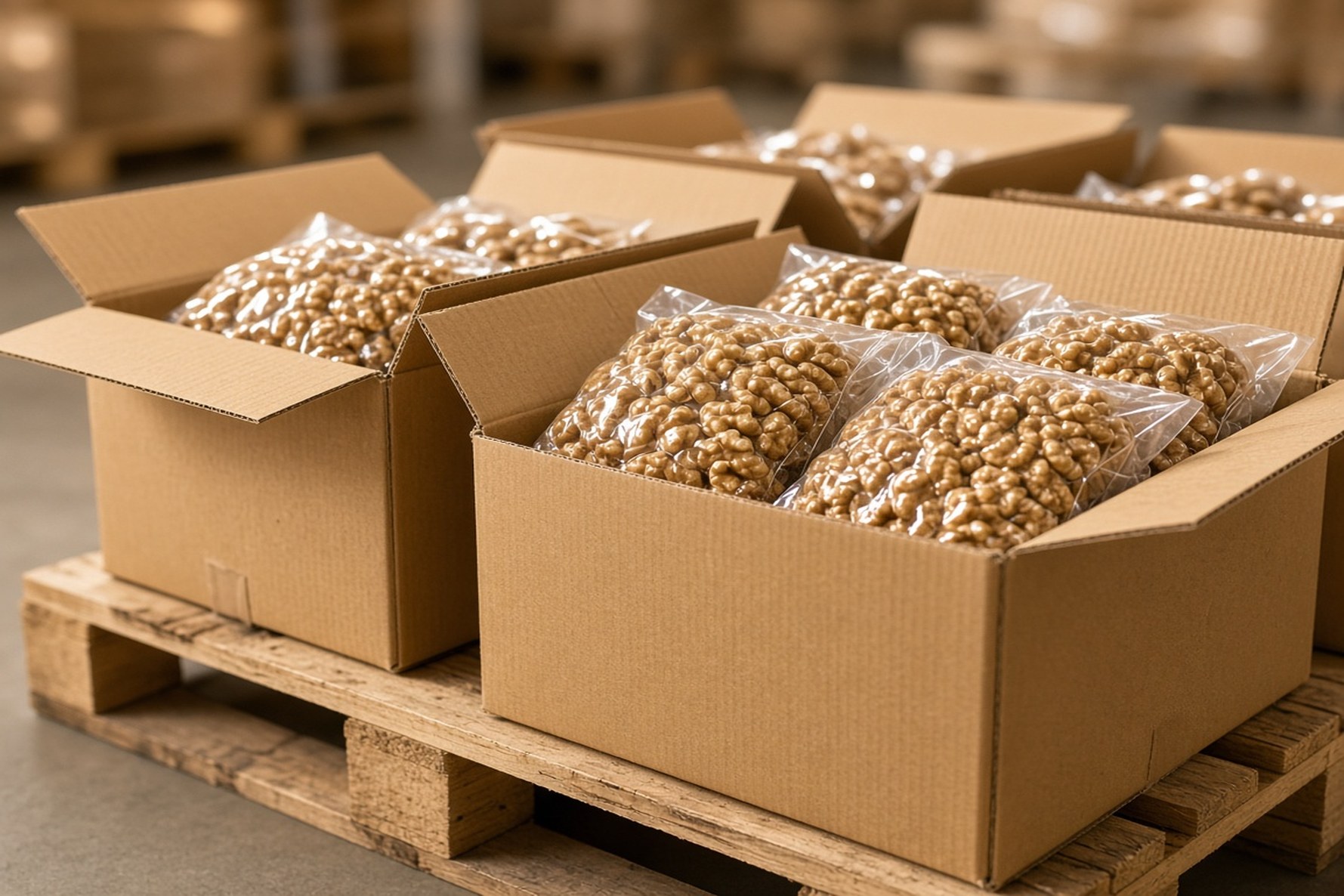
Kernel packaging is not merely a shipping container. It must slow contact between product and ambient oxygen, light and moisture. Fat oxidation is the main driver of flavour loss during storage. Walnut storage research shows temperature and oxygen ingress are primary quality factors. Strong oxygen-barrier packs combined with nitrogen can noticeably extend quality life compared with simple bags.
| Packaging method | Suitable use | Main advantage | Control point |
|---|---|---|---|
| Inner bag in carton | Bulk in-shell | Cost-effective | Moisture control |
| Multi-layer vacuum bag | Bulk kernels | Reduced oxygen | Puncture resistance |
| Nitrogen flush | Premium kernels | Lower oxidation | Low film permeability |
| Small multi-layer retail pack | Retail | Protection and appearance | Light and oxygen |
| Large food-grade bag | Industrial kernels | Suited to factory use | Cool storage needed |
In-shell packaging
The shell itself is a natural barrier to oxygen and light, so this product is more resilient than kernels. Cartons must still resist stacking pressure and product must enter the pack dry. Packaging that traps moisture inside can increase mould risk.
Kernel packaging
Kernels are more sensitive to oxidation. For high-value shipments, low oxygen-permeability multilayer film with vacuum or nitrogen atmosphere is a logical choice. For industrial orders, 5 kg, 10 kg or contract weights in master cartons are common. Retail pack weight follows the destination sales structure.
9. Storage, transport and quality management on the export path
Walnuts are not frozen goods and most trade does not require refrigerated containers, but temperature control still affects quality directly. Higher storage temperature speeds fat oxidation. Storage research shows keeping in-shell walnuts around 4°C noticeably limits oxidation. For kernels, cool, dark, low-oxygen conditions best preserve quality.
Road transport
For markets such as Turkey and Iraq, road haulage is a major advantage. Shorter transit reduces time in ambient conditions. In hot seasons, cargo space temperature matters more. Long stops with trucks in direct sun can raise internal temperature and accelerate quality loss.
Sea freight
For more distant markets, sea freight is more economical but longer transit increases sensitivity to packaging and container condition. Containers must be dry, clean and free of foreign odours. Walnuts can absorb environmental smells and should not be shipped next to odorous goods.
Palletising and condensation
Cartons should be stacked so pressure does not exceed pack strength. Pallets should be dry and cartons should not sit directly on the container floor. Sharp temperature swings can cause condensation on packs or inside the container. For dried nuts this is critical; product that was dry at loading can still be damaged in humid conditions.
10. Iran’s competition with China, the US, Chile and Turkey
Iranian walnuts compete globally with suppliers that each hold different advantages. In 2024 the United States was the largest walnut kernel exporter by value, at nearly USD 790 million, followed by Mexico, China and Chile. This shows kernel market competition is built on industrial, highly organised supply chains.
| Country | Main advantage | Challenge for Iranian exporter |
|---|---|---|
| China | Very high volume and competitive price | Price pressure in regional markets |
| United States | Standardisation and industrial supply | High uniformity and strong brand |
| Chile | Export quality and Southern Hemisphere harvest window | Strong presence in premium markets |
| Turkey | Large domestic market and regional trade network | Both buyer and competitor for Iran |
| Iran | Significant production, regional diversity and land access | Need for greater standardisation |
A suitable strategy for Iran
Iran does not have to compete solely as the cheapest supplier. A more practical strategy is clear product segmentation:
- Light halves for premium markets
- Medium-colour kernels for mixed nuts and economy packs
- Large pieces for pastry
- Broken kernels for industry
- Sorted in-shell for bulk markets
That way, product with high retail value is not sold at industrial raw-material price.
11. What drives export walnut pricing?
Export walnut price cannot be compared without technical specifications. Two offers labelled “first-grade walnut kernels” may differ greatly in real quality. A professional buyer must compare price for like product. Comparing light halves with a high sound-half percentage to a mixed broken lot does not produce a valid commercial result.
| Price factor | Effect on price | Reason |
|---|---|---|
| Product form (in-shell / kernel) | High | Sets market and processing |
| Sound halves % and kernel colour | High | Retail value |
| Moisture and crop year | Medium to high | Shelf life and freshness |
| Kernel yield (in-shell) | High | Real purchase return |
| Aflatoxin result | High | Acceptance at destination |
| Vacuum or nitrogen | Additive | Packaging cost |
| Order volume and destination | Variable | Freight and delivery terms |
What information is needed for an accurate quote?
- In-shell walnuts or walnut kernels
- Required grade
- Desired kernel colour
- Expected sound halves percentage
- Breakage limit
- Maximum moisture
- Size if buying in-shell
- Order quantity
- Weight per pack
- Pack type
- Need for vacuum or nitrogen
- Required tests
- Destination country and city
- Transport mode
- Delivery terms
- Need for buyer-branded packaging
This structure makes several offers genuinely comparable.
12. Importer checklist before confirming an order
Walnut importers should start control at the sample stage, not when the shipment has already arrived.
- Make product specs numerical. Replace words like “light” or “large” with a reference sample or defined range.
- Receive a representative sample. It must be drawn from product that will actually be delivered.
- Check moisture. High moisture is a serious shelf-life risk.
- Define breakage percentage. For kernels, a few percentage points can move price.
- Contract colour. Photos alone are not enough; physical samples matter more.
- Test aflatoxin before loading.
- Check pesticide residues for the destination.
- Verify batch number and traceability.
- Confirm net pack weight.
- Review pack material. For kernels, oxygen barrier is especially important.
- Specify crop year.
- Review storage conditions at origin.
- Write lot acceptance criteria in the contract.
- Agree final inspection sampling method in advance.
- Align destination documents before loading.
- Match transport conditions to the season.
- Keep reference samples. A sealed sample with the seller and one with the buyer helps greatly in quality disputes.
13. How export value of Iranian walnuts increases
Higher export value does not necessarily mean higher production. A significant share can come from post-harvest processing.
- Accurate grade separation: If light, medium and dark kernels are mixed in one lot, the whole shipment is priced on the lower grade.
- Less breakage: Cracking and separation method directly affects the sound-half ratio.
- Controlled drying: Fast, uniform drying after harvest reduces mould and colour change risk.
- Oxygen-barrier packaging: For high-value export kernels, professional pack cost is small compared with loss from bitterness and oxidation.
- Sales by specification: An exporter who offers product with a technical sheet, test results and a standard sample moves from generic sales into contract trade.
14. Export walnut supply from Iran based on buyer specifications
In international walnut buying, the difference between two offers is not only price per kilogram. Sound halves percentage, kernel colour, moisture, defect level, size, crop year, packaging and test results can completely change real product value.
The first sourcing step must therefore be precise product definition. The buyer should decide whether in-shell or kernels are needed, which grade is intended, whether use is retail or factory, order volume and which laboratory requirements apply at destination.
Iranco lets buyers and importers set this information in a structured purchase request so supply options are reviewed against real needs. For kernel requests, colour, sound halves percentage, breakage, moisture, pack weight and destination country matter. For in-shell walnuts, size, kernel yield, shell condition and pack weight must be specified.
Receiving a sample before the main order, comparing several options against one fixed specification and confirming tests before loading are three steps that noticeably reduce purchase risk.
Summary
Iran walnut exports rest on significant production capacity, but real value appears when product moves beyond traditional, heterogeneous sales and becomes a standard item with clear technical specifications. Today’s global market does not pay for “good walnuts” in the abstract; it prices walnuts with defined colour, moisture, size, breakage rate, grade and test results.
Turkey is currently one of the most important recorded markets for Iranian in-shell walnuts and kernels. Large markets such as Germany, Spain, the Netherlands, Japan and other industrial countries offer more added value but also higher competition and requirements.
For in-shell walnuts, size, shell soundness, uniformity and kernel yield are key. For kernels, colour, sound halves percentage, breakage, freshness, moisture and resistance to oxidation matter more. Multilayer packs, vacuum or nitrogen can play a decisive role in preserving kernel quality through the export chain.
Developing Iran’s walnut exports is not about selling more volume alone; it is about a larger share of sorted, traceable, tested and properly packed product. An exporter who can repeat a defined quality across consecutive shipments can build a stable relationship with a professional importer.
Frequently asked questions
Is Iran a major global walnut producer?
Yes. In 2023 statistics, Iran’s walnut production was about 381,000 tonnes, placing the country third after China and the United States. That production base supports export development, but export share depends on sorting quality, lot uniformity, packaging and ability to meet destination market standards.
Is in-shell or kernel better for export?
The choice depends on the target market. In-shell walnuts are more resilient in transport and storage and need less processing. Kernels create more added value but are more sensitive to colour, breakage, moisture and oxidation. For export kernels, packaging and quality control become much more important.
What is the appropriate maximum moisture for export walnut kernels?
Under commercial standard DDP-02, maximum kernel moisture is 5%. Buyers may request a lower level in the contract. Moisture should be measured on a representative lot sample and recorded in pre-shipment control.
What causes kernel darkening or quality loss?
Harvest conditions, delay in drying, high temperature, oxygen exposure, light, moisture and long storage affect kernel quality. After the shell is broken, sensitivity to oxidation increases. Export kernels should therefore be kept cool and dark in suitable packs.
Which tests matter most for walnut export to Europe?
Aflatoxin, pesticide residues, moisture and safety indicators linked to the product and the buyer’s control plan matter. In the EU, aflatoxin and residue limits are enforced under specific regulations. Many industrial buyers also include their own laboratory specifications in the purchase contract.
What is suitable packaging for walnut kernels?
For high-value kernels, a multilayer pack with adequate oxygen and moisture barrier is appropriate. Vacuum or nitrogen flush can reduce oxygen contact. The pack should resist tearing and the master carton should protect against pressure and light.
How is export walnut price determined?
Price depends on product form, kernel colour, sound halves percentage, breakage, moisture, in-shell size, kernel yield, crop year, tests, packaging, order quantity and delivery terms. A quote without defined technical specs is not a sound basis for comparing suppliers.
How can I request a price for Iranian walnuts?
First specify product form, grade, colour, sound halves percentage or in-shell size, order quantity, packaging, required tests and destination. Buyers can enter the same details in an Iranco purchase request so available options are reviewed against identical specifications.
Which grade suits confectionery and chocolate factories?
Industrial use does not always require paying more for fully sound halves. Large pieces or broken kernels with suitable colour, moisture and sensory quality can be more economical. Piece size should match the production process — grinding, decoration or the final product formula.
What is the main risk when buying walnut kernels?
Quality difference between the initial sample and the final shipment is one of the biggest risks. Defining sound halves percentage, colour, moisture, defects, sampling method and test results in the contract, together with keeping reference samples, controls this risk to a large extent.
Featured Products



Related Articles



