 Iranco Magazine Team
A specialist assessment of physicochemical traits, postharvest engineering, cold-chain requirements, international packaging and southern Iran citrus trade opportunities
Export guide · Valencia · Shelf life · Cold chain
Iran Valencia Orange: Commercial Specs, Shelf Life and Export Markets
Expert assessment of physicochemical traits, postharvest engineering, cold-chain requirements, international packaging and commercial opportunities for southern Iran citrus.
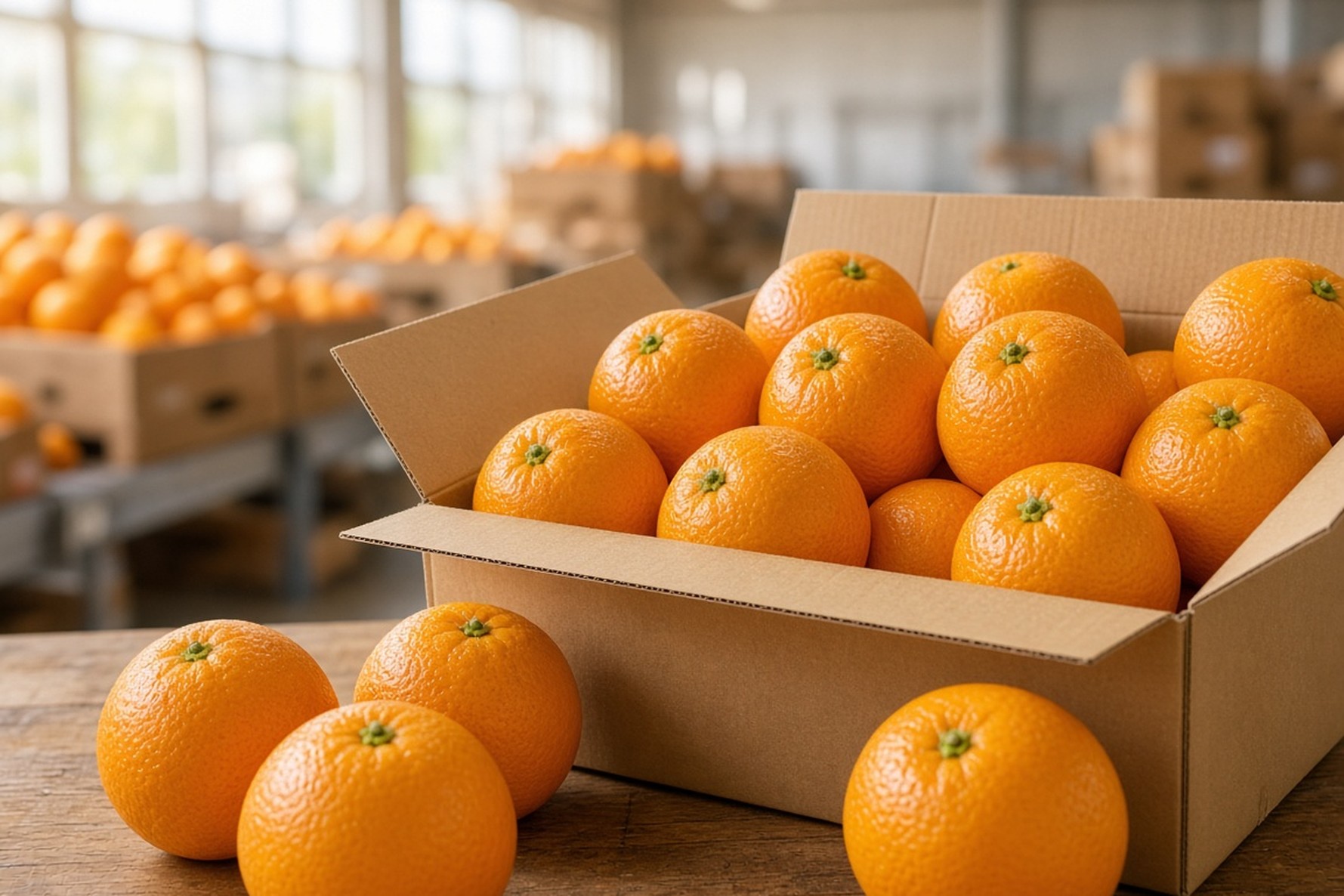
Southern Iran Valencia orange — with balanced acidity, juice yields above 50% and exceptional cold-store durability — is among the country’s most strategic horticultural products for fresh export and processing. This commercial and technical report sets out laboratory indices, industrial storage methods, packaging standards, phytosanitary barriers and international market structure for exporters, importers and food-industry managers.
When northern Iran’s harvest season ends, commercial maturity of Valencia begins across the semi-tropical southern plains. That calendar overlap keeps Iran’s citrus supply chain connected to foreign markets through Bahman, Esfand and the full spring window. Unlike mid-season autumn oranges, Valencia has a dense peel, cohesive flesh and high mechanical resistance to road and sea vibration — making it a reliable choice for long transit corridors.
The core advantage of Iranian Valencia lies in soluble sugar and favourable organic-acid concentration. That biological balance keeps flavour fresh for table use and industrial juicing lines. Continuous sunshine in Jiroft, Kahnuj, Darab and Jahrom orchards builds cell cohesion in the pulp and limits puffiness and sponginess.
Successful entry into high-demand markets in the Russian Federation, Central Asia and the Gulf requires uniform grading standards, hygienic fungicidal washing, food-grade edible wax and temperature control in refrigerated containers. Assessing Valencia’s commercial, physicochemical and pathological profile lets buyers and international trading firms base wholesale purchases on measurable scientific and economic criteria.
1. Production geography and calendar advantage of Valencia orange in Iran
Valencia cultivation in Iran is concentrated in the semi-tropical, arid southern belt. These climates feature clear day–night temperature swings, controlled relative humidity during ripening and long sunshine hours. Those conditions complete sugar–acid metabolism and prevent excessive watery flesh or hollow pulp.
Main production hubs in the south
Southern Kerman Province is Iran’s undisputed Valencia hub. The fertile plains of Jiroft, Anbarabad, Kahnuj, Manujan and Rudbar-e Jonubi alone produce more than 130,000 tonnes of commercial-quality Valencia annually. Jiroft Agro-Industrial Company orchards — the region’s largest mechanised citrus complex — alongside leading growers apply advanced irrigation and mineral nutrition. That agronomy yields high juice percentage, bright peel and minimal physiological waste.
Fars Province is the second strategic planting hub. Orchards in Darab, Jahrom, Qir and Karzin, Kazerun and Fasa supply a large share of Valencia with very smooth peel and excellent colouring to domestic and export markets. Complementary production comes from Hajiabad, Rudan and Minab in Hormozgan, and Dezful in Khuzestan, under similarly favourable climates.
Harvest calendar and off-season supply opportunity
Valencia is Iran’s latest commercial citrus. Picking starts in Bahman and runs through late Farvardin; in some foothill zones it continues into mid Ordibehesht. That window is a strategic advantage: autumn northern Iran and Mediterranean orange stocks are exhausted or tissue-aged by then.
Iranian suppliers can therefore ship freshly picked, aromatic fruit at large commercial scale into markets facing a seasonal citrus gap. The calendar advantage markedly strengthens bargaining power in Gulf markets and Eurasian Economic Union destinations.
2. Tissue structure, morphology and comparison with other commercial cultivars
Recognising biometric and tissue differences between Valencia and other citrus is the foundation for trade managers and QC specialists. Botanically, Valencia belongs to sweet orange (Citrus sinensis).
Morphology and appearance
Fruit form is symmetrically spherical to mildly oval. The peel surface is smooth with dense oil glands and very fine embossing. Peel adhesion to pulp is medium to high — Valencia ranks among harder-to-hand-peel citrus, which also limits moisture loss in storage. At commercial maturity peel colour is bright to deep orange. Flesh is composed of fine, juicy, uniform vesicles; segments are separated by thin but resilient membranes. Peel thickness is 3–5 mm, providing a protective structure against physical impacts in the logistics chain. Valencia is low-seeded to seedless; under standard southern Iran climates, zero to six seeds per fruit are typical.
| Parameter | Valencia | Thomson navel | Blood orange |
|---|---|---|---|
| Commercial harvest window | Bahman–Ordibehesht (late) | Aban–Dey (mid-season) | Dey–Esfand (mid-season) |
| Stem-end structure | Continuous sphere; no navel depression | Prominent navel with spongy distal tissue | Full sphere; no navel |
| External peel thickness | 3–5 mm (dense and firm) | 5–8 mm (spongy and thick) | 3–5 mm (semi-firm) |
| Juice extraction yield | 48–56% by weight | 35–42% by weight | 40–46% by weight |
| Delayed bitterness after juicing | None after processing | Rapid bitterness (high limonin) | No secondary bitterness |
| Transit mechanical resistance | Very high (dense peel) | Medium; navel end crush-prone | Medium to high |
Fundamental difference in limonin biochemistry
Valencia’s technological edge over navel oranges appears in juice behaviour after extraction. Navel fruit such as Thomson contain high levels of limonoate A-ring lactone precursor. When tissue is crushed, natural fruit acids hydrolyse this compound into intensely bitter limonin — a flavour defect that challenges industrial navel-juice processing. Valencia carries very low levels of this bitterness precursor. Its juice therefore retains clarity and natural sweetness after pasteurisation, vacuum concentration and aseptic packing, and remains the preferred raw material for beverage plants worldwide.
3. Physicochemical indices and buyer quality standards
Citrus trade is priced on measurable laboratory values. Professional buyers write explicit analytical tolerances into commercial contracts.
Brix, acidity and maturity ratio
Total soluble solids (TSS) are measured as degrees Brix — the concentration of sugars and soluble nutrients in juice. Export-standard southern Iran Valencia reaches a minimum of about 10.5° Brix early in the pick and, with full physiological maturity in Farvardin, settles in the 11.5–13.5° band. Titratable acidity (TA), expressed as citric acid, typically sits between 0.8 and 1.25 g per 100 ml of juice.
The flavour or sugar-to-acid ratio (TSS/TA) is the key maturity scale. For export Valencia it should fall at least in the 8.5–12.5 range. Values below 8.5 indicate immature, harshly sour fruit; ratios above 14 signal acidity collapse, loss of tissue freshness and shorter shelf life.
| Parameter | Commercial minimum | Optimal export range | Standard test method |
|---|---|---|---|
| Total soluble solids (Brix) | 10.0° | 11.0–12.8° | Temperature-corrected digital refractometry |
| Titratable acidity (TA) | 0.7% by weight | 0.85–1.1% by weight | Acid–base titration with 0.1 N NaOH |
| Brix/acid (TSS/TA) | 8.0 | 9.0–12.0 | Direct ratio calculation |
| Juice extraction yield | 45% by weight | 50–55% by weight | Filtered mechanical extract on fresh weight |
| Ascorbic acid (vitamin C) | 40 mg / 100 g | 50–65 mg / 100 g | Iodometric titration or spectrophotometry |
| Flesh firmness | 4.5 kg/cm² | 6.0–8.0 kg/cm² | Penetration test with standard fruit probe |
Diameter grading under international standards
Size separation follows UNECE FFV-14. Mixing diameter calibres in one commercial pack is treated as a clear quality failure and invites importer price claims.
| Calibre | Equatorial diameter (mm) | Mean unit weight (g) | Count / 15 kg carton |
|---|---|---|---|
| Calibre 1 | 87–100 | 310–380 | 40–44 |
| Calibre 2 | 84–96 | 270–320 | 48–52 |
| Calibre 3 | 81–92 | 230–275 | 56–60 |
| Calibre 4 | 77–88 | 195–240 | 64–72 |
| Calibre 5 | 73–84 | 165–210 | 76–88 |
| Calibre 6 | 70–80 | 140–175 | 90–100 |
| Calibre 7 | 67–76 | 120–150 | 104–112 |
| Calibre 8 | 64–73 | 100–125 | 116–128 |
Wholesale demand in markets such as Russia and the UAE concentrates on calibres 3, 4, 5 and 6. Calibres 1 and 2 usually face narrower demand due to thicker peel; calibres 7 and 8 mainly go to self-service juicing or beverage plants.
4. Postharvest physiology, storage technology and cold chain
Citrus is non-climacteric: ripening stops after harvest, and endogenous ethylene production and starch-to-sugar conversion cease. Any delay moving fruit into cooling, or humidity collapse after harvest, causes irreversible loss of quality and tissue freshness.
Wash, disinfection and protective wax
Export lots must enter wash and disinfection lines immediately after leaving the orchard. Wash water should contain approved fungicides such as imazalil or thiabendazole at precisely controlled doses to neutralise postharvest pathogen spores. After cleaning, food-grade carnauba or natural shellac wax is an engineering necessity. This micron-thin film blocks peel breathing pores, cuts surface evaporation by up to 70%, prevents shrivel and adds lasting visual gloss.
Temperature, relative humidity and chilling-injury prevention
Valencia is highly sensitive to near-freezing temperatures. Chilling injury appears below 4°C as brown peel depressions, oil-gland cell damage and internal souring.
- Cold-store temperature: Hold a stable 5.0–7.0°C with at most ±0.5°C tolerance.
- Relative humidity: Keep atmosphere uniformly at 88–92% RH. Below 85% RH, tissue water migrates to air and net carton weight falls; above 95% RH, condensation and fungal germination are favoured.
- Shelf life: With pre-cooling and continuous conditions as above, southern Iran Valencia easily holds 8–16 weeks in cold store without measurable drop in Brix, calyx freshness or flesh firmness.
Ethylene sensitivity and active ventilation
Although Valencia produces little ethylene, ambient ethylene from climacteric fruit (e.g. bananas) or forklift exhaust accelerates tissue ageing. Ethylene turns the green calyx black or causes full calyx drop — and a green calyx is the international freshness cue. Cold-store ventilation should allow 25–35 full air exchanges per day to prevent CO₂ and ethylene build-up.
5. Storage pathology, physiological defects and sorting rules
Lot uniformity requires pathological and physiological monitoring at grading stations. Quality defects fall into three groups.
Pathological and biological defects
- Green mould (Penicillium digitatum): The most common postharvest infection; starts at mechanical peel wounds and forms olive-green powdery masses with a white margin.
- Blue mould (Penicillium italicum): Faster-spreading fungal infection that moves fruit-to-fruit by contact and produces dark blue mould masses.
- Sour rot (Geotrichum candidum): Occurs under very high humidity and poor ventilation; vinegar odour with total fruit-structure collapse.
Physiological and tissue defects
- Creasing: Separation of albedo from flavedo, giving a wrinkled peel appearance.
- Chilling injury: Sunken ring-shaped brown epidermal spots from storage below 4°C.
- Spring regreening: Late spring heat can drive chlorophyll back into Valencia peel. It does not mean sour fruit, but it needs sales-side visual management.
Mechanical and visual defects on the sorting line
- Clipper cuts, nail punctures, drop bruising and thrips scarring must be fully removed on mechanised lines.
- Maximum tolerance for total non-pathogenic visual defects is 5% by weight for Class I export and 2% for Extra Class. Fungal-infected fruit in an export carton has zero tolerance and is non-negotiable.
6. Packaging engineering standards and palletising
Citrus packaging must absorb hydrostatic fruit weight, transit vibration and high cold-store humidity without deforming.
Export carton and crate types
Valencia export cartons are five-ply boards combining heavy kraft with moisture-resistant adhesives. Weak boxes rapidly lose edge crush strength at 90% RH and collapse.
| Pack type | Net load (kg) | Standard size (L × W × H, cm) | Board / material | Main destinations |
|---|---|---|---|---|
| Two-piece telescopic carton | 15.0 | 50 × 30 × 30 | Five-ply moisture-resistant kraft, heavy flute | Russia, Belarus, Kazakhstan |
| Open-top handled carton | 9.0–10.0 | 40 × 30 × 22 | Five-ply with white printable liner | UAE, Qatar, Kuwait |
| Single-layer luxury carton | 6.0–7.0 | 50 × 30 × 12 | Three-ply with foam cell separators | Premium Oman & Bahrain chains |
| Reinforced polymer crate | 12.0–14.0 | 50 × 33 × 28 | Durable polypropylene with foam base sheet | Iraq wholesale fruit markets |
Palletising, restraint and ventilation rules
Cartons stack on standard 100 × 120 cm wooden pallets that are ISPM 15 heat-treated and officially stamped. Typical patterns place 5–10 cartons per layer across 8–10 height layers.
- All external pallet corners must be protected with compressed cardboard corner boards at least 5 cm face width and 4 mm thick.
- Polypropylene strapping is mandatory — three horizontal and two vertical lines.
- If stretch film is used, it must be perforated breathable film. Wrapping a pallet solid with ordinary nylon film blocks refrigerated airflow and drives condensation and mould.
7. Logistics protocols, reefer transit and pre-cooling
Fresh Valencia export requires an unbroken cold chain from orchard origin to destination warehouse.
Pre-cooling
Fruit holds high internal heat immediately after picking. Loading oranges at 25–30°C straight into a reefer is the largest logistics error — transit container systems cannot dump sensible heat from such a dense mass fast enough. After sorting, fruit needs at least 24 hours in forced-air pre-cool rooms until geometric-centre flesh temperature falls below 7°C.
Reefer container set-points
- Set point: Lock refrigeration at exactly 6.0°C. Settings below 4°C risk chilling damage, especially in cartons beside the cold-air outlet.
- Relative humidity: Lock at 90% RH.
- Fresh-air vent: Open for 20–25 m³/h to purge respiratory CO₂.
- Data loggers: Place at least two independent units among cartons — one forward in the cargo depth and one in rear door-side rows — for temperature history and insurance claims.
8. Target export-market structure for Iranian Valencia
Iranian Valencia has built a strong commercial position across Eurasia and West Asia thanks to pulp quality and peel thickness.
Russian Federation and Belarus
Russia is among the world’s largest orange importers. Iranian Valencia sees strong demand from Esfand through Ordibehesht in chains such as Magnit and Pyaterochka. Non-bitter juice chemistry and tough peel suit long transit into northern Russia. Rosselkhoznadzor’s strict MRL and quarantine-pest rules require continuous monitoring. Preferred packaging is 15 kg telescopic cartons in calibres 4, 5 and 6.
Gulf markets (UAE, Oman and Qatar)
The UAE is both a domestic consumer and a regional re-export hub. It buys hand-selected, visually premium fruit in 10 kg open-top cartons. Oman and Qatar also take Valencia for hotel and restaurant juicing. Short sea transit from Bushehr and Bandar Abbas (under 48 hours) preserves calyx freshness.
Iraq
By weight, Iraq is Iran’s largest citrus buyer. Wide land borders and preferential tariffs move Valencia quickly. Demand focuses on bulk economy packs in polymer crates or plain cartons, while Erbil, Sulaymaniyah and Baghdad show rising appetite for graded Class fruit and luxury cartons.
| Destination | Preferred pack | Popular calibres | Key mandatory certificates | Distribution priority |
|---|---|---|---|---|
| Russian Federation | 15 kg closed telescopic carton | 4, 5, 6 | Phytosanitary with residue test reference | National hypermarket chains |
| United Arab Emirates | 10 kg white open-top carton | 3, 4, 5 | Certificate of origin & health analysis | Re-export and regional hypermarkets |
| Iraq | Polymer crate or 12–14 kg carton | 5, 6, 7 | Border quarantine clearance | Wholesale fruit & vegetable markets |
| Kazakhstan | Palletised 15 kg telescopic carton | 4, 5, 6 | Eurasian free-zone customs documents | Fruit wholesalers and local networks |
| Oman | 10 kg closed carton with foam sheet | 3, 4 | Health certificate & bilingual label | Catering, hotels and supermarket |
Buyers intending to source this product from Iran can use Iranco to review available options and submit purchase requests against their required specifications.
9. International competition matrix: Iran’s strengths and challenges
In international markets Iran faces three major orange competitors, each with distinct commercial traits.
| Country | Core competitive advantage | Structural / logistics weakness | Relative price level | Main target markets |
|---|---|---|---|---|
| Egypt | Very high output, direct state support, low landed cost | Sharper acidity than Iranian Valencia; periodic MRL risk | Cheap and aggressive | Russia, all Europe, Middle East |
| Turkey | Mechanised sorting standards, excellent packaging, fast road logistics | Sharp lira volatility; narrower Valencia focus vs mandarin | Mid to high | Russia, Eastern Europe, Iraq |
| South Africa | Highly uniform commercial quality; Southern Hemisphere counter-season | Long sea transit; very high freight to West Asia | Luxury / high | Middle East, Europe, East Asia |
| Iran | Rich flavour, high Brix, premium juice yield, neighbour geography | Limited dedicated modern reefer fleet; sorting upgrade still needed | Highly competitive | Russia, Iraq, Gulf, Eurasia |
Iranian Valencia offers a more balanced flavour and higher Brix than Egyptian fruit. Early-season Egyptian orange often tastes harshly tart for Gulf fresh eating. Iran’s other strategic edge is direct land adjacency to Russia and Central Asia via Astara and Caspian corridors — cutting delivery to about six days and protecting tissue freshness.
10. Customs rules, HS code and phytosanitary requirements
Valencia orange export is governed by international plant-health law and transparent customs codes.
Harmonised System (HS) code
Fresh or dried oranges are declared and cleared worldwide under the eight-digit heading:
- 08051000: Oranges, fresh or dried
This code covers commercial types including Valencia, Thomson and blood oranges.
Mandatory exit documents and plant-health standards
- Phytosanitary certificate: Legal document from the Plant Protection Organisation (Ministry of Agriculture) certifying freedom from Mediterranean fruit fly (Ceratitis capitata) and citrus canker bacteria.
- MRL certificate: GC/LC laboratory report proving pesticide residues and heavy metals do not exceed destination limits.
- Certificate of origin (CO): Issued by chambers of commerce documenting Iranian product identity.
- Certificate of analysis / inspection (COA): Confirmation by international inspection firms at container loading.
Export pack labelling rules
All cartons must carry bilingual information (English and the destination’s official language):
- Product name: Valencia Orange
- Quality class (Class I or Extra)
- Calibre code and count per pack
- Net weight in kilograms
- Packing-house name and production-batch traceability number
- Harvest and disinfection dates
- Country of origin: Product of Iran
- Storage instruction: “Store at 5–7°C”
11. Industrial processing and Valencia value-added chain
Valencia underpins beverage, pharmaceutical and natural-additive industries worldwide.
Concentrate and not-from-concentrate (NFC) juice
Juice yields above 50% by weight make Valencia the most economical cultivar for concentrate lines. Standard 65° Brix concentrate shows clear orange colour and strong natural aroma. Because the variety lacks limonin bitterness precursors, concentrate needs no costly debittering before ready-to-drink juices, nectars and smoothies. Valencia NFC also commands the highest supermarket demand internationally.
d-Limonene and peel essential oil
Southern Iran Valencia peel, fully sun-fed, holds abundant aromatic oil glands. Cold pressing on industrial lines yields pure orange oil whose core active is d-limonene at >95% purity. Applications include:
- Food: Natural flavouring for soft drinks, confectionery, jelly and bakery.
- Pharma & cosmetics: Drug carrier, cologne fragrance and skin creams for strong antioxidant properties.
- Industrial: Biodegradable solvent and cleaner replacing chlorinated and petroleum solvents.
Dried peel and pomace, rich in pectin, also feed high-gelling pectin production and nutrient-dense animal feed.
12. Practical buyer guide: checklist and quote RFQ fields
Commercial Valencia buying needs clear protocols to avoid legal and commercial claims at destination customs.
Importer checklist before firm order
- Calibre: Specify equatorial diameter in millimetres; ban approximate visual sizing.
- Pre-cooling: Require flesh-centre temperature below 7°C before container loading.
- Lab indices: Write minimum Brix (e.g. 11) and allowed acidity into the purchase contract.
- Carton: Agree five-ply board rated for 90% RH cold-store humidity.
- Pallets: Require ISPM 15 heat-treated wooden bases.
- Wax & fungicide: Agree wax type and confirm destination-approved fungicides.
- Mechanical defects: Cap peel scratch / bruise tolerance at 3–5% by weight.
- Fungal decay: Zero tolerance for green or blue mould at delivery.
- Data loggers: At least two digital units with serial numbers recorded on the transit bill of lading.
- Calyx: Export lots must show attached, live green calyxes.
- Labelling: Carton labels must match customs declaration and destination language.
- Incoterms: Define ownership transfer and temperature-custody responsibility along the route.
What information is needed for an accurate price?
Valencia price per tonne is a function of technical order parameters. Buyers should state the following in a formal RFQ:
- Product and growing region: export southern Iran Valencia (Jiroft or Fars)
- Size / diameter calibre (e.g. calibres 4–5 or 73–88 mm)
- Minimum requested Brix (e.g. 11 or 12+)
- Pack type and capacity: 15 kg telescopic, 10 kg open-top or polymer crate, with exact gross and net weights
- Pallet and restraint: cartons per pallet, strapping and corner-board specs
- Order volume: number of 40′ reefer FCL or total tonnage
- Exact delivery point under Incoterms (e.g. Astara border, FOB Bandar Abbas, or final delivery Dubai / Moscow)
- Mandatory laboratory and inspection certificates at origin
In export orders, precise product definition matters. On Iranco you can register a purchase request with product, packaging and destination details so supplier review follows the same brief.
Sourcing Valencia orange from Iran with Iranco
In Valencia foreign trade, price gaps between sellers often hide differences in calibration accuracy, protective-wax quality, carton mechanical strength in cold store and commitment to an unbroken cold chain. The smallest shortfall at any stage can expose a cargo to heavy legal and financial claims at destination customs.
Iranco lets buyers, distributors and international importers register purchase requests against precise technical details — target calibre codes, minimum Brix, moisture-resistant carton type, total volume and preferred port or customs point — so supply capacity in southern Kerman and Fars Valencia hubs can be coordinated to respond.
If you need continuous Iranian Valencia for regional or long-haul markets, enter technical specs, pack type and approximate volume as a buying request on Iranco so review and sourcing can begin.
Summary
Southern Iran Valencia is one of the country’s most valuable horticultural advantages in export markets. A unique Bahman–Ordibehesht harvest calendar, juice yields above 50%, rich sugar and flavour stability in industrial processing — thanks to the absence of limonin bitterness — set it apart from regional rivals.
Holding and growing share in Russia, Central Asia and the Gulf depends on moving beyond traditional packing and implementing scientific cold-chain requirements. Strict diameter calibration, orchard-origin pre-cooling, five-ply moisture-resistant cartons, store RH at 88–92% and temperature stability at 5–7°C are the fundamentals that minimise waste risk and secure lasting success for exporters and buyers in target markets.
FAQ
Why is Valencia better than other citrus for industrial juicing and concentrate?
Unlike navel cultivars, Valencia carries very little limonin bitterness precursor (limonoate A-ring lactone), so juice does not turn bitter after heat processing or over time. Juice yield exceeds 50% by weight, and lively acidity keeps concentrate flavour natural and clear.
What are the optimal cold-store temperature and shelf life for Valencia?
Ideal storage is 5.0–7.0°C with 88–92% RH. Below 4°C, peel chilling injury develops. With pre-cooling and hygienic wax, southern Valencia holds commercial quality for 8–16 weeks.
Which countries are the main export destinations for Iranian Valencia?
Primary outlets are the Russian Federation, Iraq, the UAE, Kazakhstan, Oman and Qatar. Russia demands closed telescopic cartons and strict phytosanitary standards; the UAE prefers 10 kg open-top luxury visual packs; Iraq absorbs large volumes of economy packaging.
What is Valencia peel regreening and how does it affect sales?
In late Farvardin and Ordibehesht picks, rising air temperature can pump green chlorophyll back into the peel. It is a natural physiological response and does not change sugar or maturity, but export sorting lines separate or discount these fruit for visual preference.
What information is required for an accurate Valencia price from Iran?
Citrus pricing tracks quality specs. Buyers should define requested calibre, required Brix, carton type and physical strength, net weight per box, palletising method, total tonnage and the border or port for delivery. The same fields can be registered on Iranco so matching suppliers are compared.
How can Valencia be sourced directly from southern Iran suppliers?
Direct buying requires evaluating sorting lines, residue testing oversight and cold-chain compliance. International buyers can send these specifications through Iranco as a purchase request so available Iranian supply options are reviewed against their needs.
Featured Products


Related Articles



