 Iranco Magazine Team
Technical review of Brix, hot-break vs cold-break, lab standards, aseptic packaging and target-market entry strategy
Bulk buying · Brix · Hot break · Aseptic · Export
Iranian Tomato Paste: Bulk Buying, Brix, and Export Guide
Technical review of Brix, hot-break vs. cold-break differentiation, laboratory standards, aseptic packaging, and market-entry strategy for target destinations
This practical guide analyzes the technical variables that shape bulk procurement and export of Iranian tomato paste, covering Brix, viscosity, thermal processing technologies, and market-entry requirements across regional destinations. Procurement managers, food-industry operators, and international traders can use the data in this report to structure contracts, select product grades, and evaluate export shipments with confidence.
International trade in tomato derivatives rests on precise engineering of soluble solids, polysaccharide chemistry, and textural stability. The global industrial tomato market, with annual turnover near 40 million tons of raw fruit, ranks among the most dynamic segments of agricultural processing. Within this market, Iran—backed by four-season climates, direct solar radiation, and modern vacuum concentration systems—has locked in annual processing capacity exceeding 2 million tons of industrial tomatoes.
Annual Iranian tomato paste exports have fluctuated between 110,000 and more than 200,000 tons, generating foreign-exchange revenues of USD 135 million to over USD 200 million. Sustainable profitability in target markets, however, goes beyond headline pricing. Major buyers and sauce and ready-meal plants in Russia, Iraq, the Gulf states, and Central Asia assess shipments against laboratory indices such as natural soluble solids, Bostwick consistency, pH, and Howard mold count.
Commercial losses or border detention of consignments most often stem from mismatch between hot-break and cold-break process types, Brix drift, or packaging damage in transit. This report examines the scientific dimensions, laboratory standards, and commercial procedures so that bulk buyers and trade managers can place orders against verified technical specifications.
1. Production geography and industrial tomato processing capacity in Iran
Iran holds a stable position among the world’s top ten tomato producers and supplies a substantial share of consumer and industrial demand in neighboring countries. Climatic diversity enables multi-stage harvests across the year—a rare advantage that keeps industrial lines running without seasonal interruption.
The geographic spread of industrial growing hubs produces distinct textural profiles in tomatoes from different regions:
- Northwest corridor (West Azerbaijan, East Azerbaijan, and Zanjan): Mild summers and long sunny days yield tomatoes with dense flesh, firm pectin, and high dry matter. Processing lines in this corridor focus on heavy-Brix paste with structural viscosity.
- Central and western corridor (Fars, Kermanshah, and Qazvin): Fars Province—especially the Marvdasht and Seydan plains—together with Kermanshah, form strategic hubs for industrial tomato processing. Large complexes equipped with continuous concentration evaporators supply a major share of Iran’s aseptic export paste.
- North and northeast corridor (Razavi Khorasan, Golestan): With modern canning and packaging industries, these regions are the primary base for exports to Central Asia and Afghanistan.
- Southern corridor (Bushehr, Hormozgan, and the Jiroft–Kahnuj zone): An exclusive advantage of off-season harvest in winter and early spring; when Northern Hemisphere lines are idle, southern Iranian plants ship fresh paste into the market.
Improved industrial tomato varieties grown in Iranian fields deliver field Brix of 4.8 to 5.5. This initial concentration means that producing each kilogram of quality paste at 28–30 Brix typically consumes about 5 to 5.5 kg of fresh tomatoes—evidence of high processing yield.
2. Biochemical and process fundamentals: comprehensive hot-break vs. cold-break comparison
The thermal break applied to tomato pulp determines the textural structure and rheological behavior of the finished product on downstream lines. Once tomatoes are crushed, two native enzymes—pectin methylesterase (PME) and polygalacturonase (PG)—are released from cellular tissue. If these enzymes are not immediately inhibited, they hydrolyze pectin molecular chains and destroy the paste’s structural network. Pectin is the primary driver of tomato paste’s inherent body and consistency.
Hot-break process
In hot-break technology, crushed tomatoes enter heat exchangers immediately and are heated to 85–95 °C (and sometimes up to 105 °C under pressure). This intense thermal shock inactivates pectin-degrading enzymes before tissue breakdown occurs. Native pectin remains in the paste, and the finished product shows high viscosity, dense body, and exceptional resistance to phase separation. Hot-break paste prevents syneresis in products such as ketchup. Because of the higher cook temperature, paste color is slightly darker and develops a more cooked flavor profile.
Cold-break process
In cold break, tomato pulp temperature is held in the 65–75 °C range. Within this thermal window, pectolytic enzymes remain active for a period and moderate tissue viscosity by breaking pectin molecules. The result is a more fluid paste with high flowability. The main advantage of cold break is minimal thermal load on volatile compounds and lycopene pigment; bright, vivid red color and the fresh tomato flavor profile are retained. This method is ideal for products that require lively color and clarity.
| Evaluation parameter | Hot break | Cold break |
|---|---|---|
| Thermal shock temperature | 85–95 °C (sometimes up to 105 °C) | 65–75 °C |
| Status of degrading enzymes | Rapid inactivation; pectin hydrolysis suppressed | Controlled activity; pectin bonds cleaved |
| Residual pectin level | High (maximum retention of natural body) | Low (pectin broken into shorter chains) |
| Bostwick viscosity (12.5 Brix) | 3–6 cm / 30 s (dense consistency) | 7–12 cm / 30 s (fluid and free-flowing) |
| HunterLab color (a/b) | Deep red; continuous temperature monitoring required | Bright red; highly vivid and clear |
| Sensory flavor profile | Deep cooked taste with mild caramel notes | Fresh, acidic taste resembling raw tomato |
| Primary processing applications | Ketchup, pizza sauce, barbecue, and thick soups | Tomato juice, thin soups, and seafood canning |
3. Brix index, conversion yield, and dilution mass-balance equations
Brix (°Brix) is the standard index for the weight percentage of natural tomato soluble solids (NTSS) at a reference temperature of 20 °C, measured by refractometer. It directly indicates dry-matter content and processing yield.
Industrial buyers should note that higher Brix has a direct effect on logistics cost optimization. Shipping a 36–38 Brix consignment means much of the excess water has already been evaporated; relative to 28–30 Brix, more active solids move per ton of product, reducing container freight cost.
In industrial procurement, “salt-free Brix” is the basis for financial settlement. Added salt causes refractometer error and false Brix; therefore, in quality-control testing, salt percentage is measured and deducted from the refractometer reading.
| Brix grade | Commercial concentration range | kg tomato input / kg paste | Common packaging | Applications and destinations |
|---|---|---|---|---|
| 25–28% | Light household concentration | 4.0–4.8 | 400 g and 800 g metal cans | Direct food use and regional household markets |
| 28–30% | Standard commercial concentration | 5.0–5.5 | Cans, glass, and aseptic drums | Broad export to Iraq, the Caucasus, and distribution hubs |
| 30–32% | Semi-industrial concentrate | 5.6–6.2 | 220 L aseptic metal drums | Meat-product and ready-meal production lines |
| 36–38% | Heavy industrial concentrate | 6.8–7.5 | Aseptic drums of about 235 kg | Sauce plants in Russia and Eurasian markets |
For buyers seeking tomato paste at a specified Brix with high batch stability, Iranco can assess capacity at reputable Iranian production lines and confirm that production batches meet contractual requirements.
4. Rheological parameters and physicochemical standards in purchase contracts
Tomato paste quality assessment in international trade is not limited to Brix; rheological parameters define fluid behavior in industrial machinery. Standard specifications are set under Iranian National Standard No. 761 and Codex Standard 57.
Bostwick consistency
The Bostwick test is the standard method for measuring paste flow. It is performed on a sample diluted with distilled water to 12.0 or 12.5 Brix at 20 °C. The sample is placed in the Bostwick consistometer reservoir, and the distance traveled in centimeters over 30 seconds is recorded.
- For hot-break paste, Bostwick should fall between 3.0 and 6.0 cm, indicating dense consistency and structural stability.
- For cold-break paste, flowability is higher and Bostwick is recorded in the 7.0–12.0 cm range.
HunterLab color index (a/b ratio)
Product color is a measure of thermal-process integrity. On a HunterLab spectrophotometer, component a indicates redness and component b indicates yellowness intensity. Export standards set a minimum a/b of 2.1, with premium grades at 2.2 and above. Ratios below 2.0 indicate thermal error in evaporators, Maillard browning reactions, and formation of hydroxymethylfurfural (HMF), which darkens paste color.
pH and total acidity
Tomato paste is a high-acidity product. The standard pH range is 4.1–4.3 and must never exceed 4.4 under any circumstances. Keeping pH below 4.4 prevents growth of hazardous anaerobic bacteria such as Clostridium botulinum and heat-resistant bacterial spores of Bacillus coagulans. If incoming tomato pH is elevated, correction is permitted only with citric acid. Total acidity, expressed as anhydrous citric acid, should be 1.5–2.5% by weight.
| Technical and chemical parameter | Standard range in COA | Buyer control priority |
|---|---|---|
| Pure Brix (salt-free) | Per agreement (28–30% or 36–38%) | Basis for formulation yield and commercial value of the shipment |
| Bostwick viscosity (12.5 Brix) | Hot break: 3–6 cm / cold break: 7–12 cm | Texture structure control and syneresis prevention in sauce |
| HunterLab color (a/b) | Minimum 2.1 (premium grade above 2.2) | Assurance of lycopene integrity and absence of scorching |
| pH index | 4.1–4.3 (critical ceiling: 4.4) | Biological safety and suppression of spore-forming bacteria |
| Total acidity (as citric acid) | 1.5–2.5% by weight | Balanced flavor and product stability in storage |
| Salt content | Aseptic: 0% / canned: below 2% | Prevention of false dilution and preservation of natural taste |
| Natural lycopene content | 50–75 mg per 100 g paste | Nutritional value and quality of incoming tomatoes |
| Black specks and dark spots | Maximum 5–7 per 10 g sample | Evaporator cleanliness and filtration integrity |
5. Laboratory testing, quality control, and food adulteration detection
Successful clearance of export consignments requires microbiological, physicochemical, and toxicological testing at accredited laboratories cooperating with standards authorities.
Howard mold count (HMC)
The HMC index reveals the hygienic quality of tomatoes entering the production line. The test is performed on a sample diluted to 8.5 Brix, measuring the percentage of microscopic fields containing mold hyphae.
- Under Codex 57 and Iranian National Standard No. 761, the maximum permitted HMC is 40%.
- Weak sorting and entry of damaged fruit push Howard counts above 40%, resulting in rejection at the destination customs. For industrial orders to sensitive markets, buyers typically set a Howard ceiling of 30–35%.
Heavy metals and pesticide residue testing
- Tin (Sn): For paste in metal cans, a maximum of 100–200 mg/kg is permitted.
- Lead (Pb): The maximum permitted level is set at 0.05–0.1 mg/kg.
- Pesticide residues (MRL): Organochlorine and organophosphate residues are controlled against Codex Commission limits.
Commercial adulteration detection methods
- Added starch and gelatin: Used to create artificial viscosity; the Lugol (iodine) test reveals this fraud by a dark-blue color change. Iranian standards prohibit any thickener addition.
- Low-cost vegetable puree (squash, carrot, apple): Histological microscopy identifies non-tomato plant cells.
- Synthetic colors: Addition of Allura Red or Carmoisine is traced by high-performance liquid chromatography (HPLC). Any artificial color in paste is prohibited.
- Chemical preservatives: Sodium benzoate and potassium sorbate must not be present in pasteurized or sterilized paste; product stability must be achieved by physical means alone.
| Quality defect type | Visual signs and textural effect | Process root cause | Detection and acceptance limit |
|---|---|---|---|
| Scorching and darkening | Dull brown color and undesirable cooked taste | Excessive evaporator temperature and flow interruption | a/b ratio below 2.0; unacceptable for export |
| Elevated Howard count | Spore formation and reduced shelf life | Use of spoiled and crushed tomatoes | Howard microscopy; maximum acceptance 40% |
| Can swelling | Convex bulging of can ends | Microbial activity or acid reaction with metal sheet | Incubation quarantine period; zero acceptance |
| Syneresis (serum separation) | Liquid phase separating from fibrous structure | Hot-break process failure and pectin hydrolysis | Bostwick test and viscosity mismatch |
| Souring and gas odor | Bubbles present and sudden pH drop | Secondary contamination by lactic acid bacteria | Microbial culture and pH test; not releasable |
6. Export packaging engineering: aseptic technology and metal and glass containers
Packaging format has a direct impact on product stability, end-use at destination, and transit costs.
Bulk aseptic packaging (aseptic bag-in-drum)
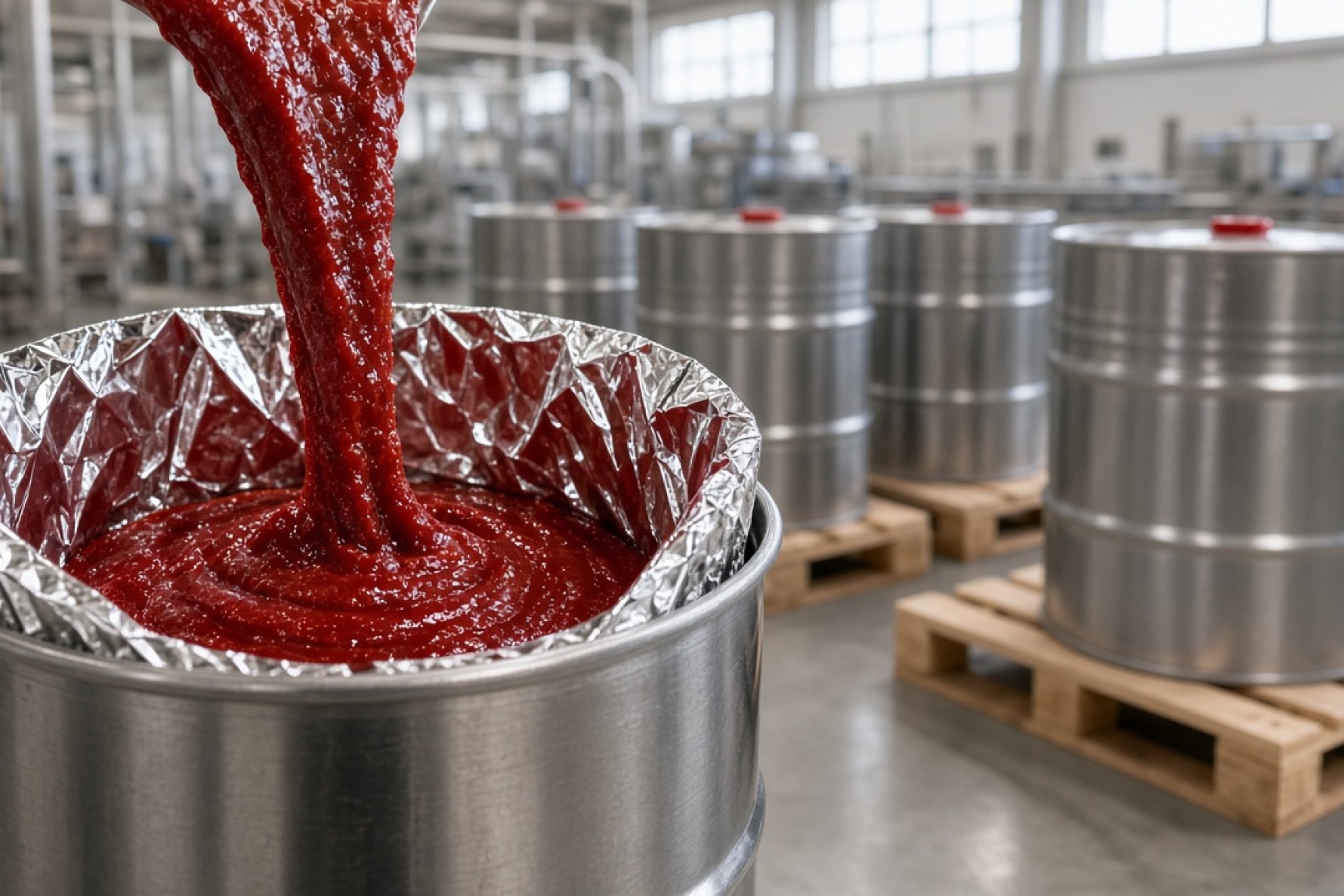
This advanced technology is the primary B2B channel for industrial tomato paste trade worldwide. Concentrated paste is sterilized in heat exchangers, immediately cooled, and injected under sterile conditions into multilayer impermeable aluminum–polymer bags.
- Bags are placed in food-grade lined metal drums of 220 L capacity.
- Net product weight per drum is 230–235 kg.
- Shelf life is 24–36 months under ambient warehouse conditions with no refrigeration requirement. Importing plants at destination can open these drums throughout the year and convert them into sauces and food products.
Metal can packaging
- Internal can lacquer: Because of paste acidity, the inner wall must be coated with two protective sanitary lacquer layers of epoxy-phenolic or BPA-free organosol type. Any lacquer defect allows acid to react with the steel sheet, causing hydrogen swelling and migration of tin and iron ions into the product.
- Sizes and ends: Cans are mainly produced in 400 g, 800 g, 1,600 g, and 4,000 g net weights. Easy-open ends with transparent plastic overcaps are the export standard for 400 g and 800 g sizes.
Glass jar packaging
Glass containers offer high transparency for retail appeal. However, heavy weight, transit fragility, and container load limits raise logistics costs. Long-term light exposure also causes surface lycopene oxidation and haze in the upper product layers.
| Packaging metric | 220 L aseptic metal drum | 800 g metal can | 720 g glass jar |
|---|---|---|---|
| End-use market | Reprocessing at plants (B2B) | Retail and household use (B2C) | Premium retail and stores |
| Net weight per unit | 230–235 kg | 800 g net | 700–720 g net |
| Shelf life without cold storage | 24–36 months in temperate warehouse | 24 months in dry, cool conditions | 12–18 months (light-sensitive) |
| Load in 20-ft container | 80 drums on 20 wooden pallets | 23,000–24,000 cans in cartons | 18,000–20,000 jars in shrink wrap |
| Total net shipment weight | 18.4–18.8 tons | 18.5–19.2 tons | 12.5–14.0 tons (breakage constraint) |
| Transit robustness | Excellent under severe shock | Good with thick cartons and shrink wrap | Breakage risk; cushioning required |
7. Customs classification and commercial clearance procedures (HS Code)
Export and clearance of tomato products in international trade fall under Chapter 20 of the import–export tariff schedule.
- Tariff code 2002.90.10: In Iranian customs and most buyer countries, specifically defined for “tomato paste.”
- Tariff code 2002.90.90: Assigned to other tomato derivatives such as dilute puree at low Brix or non-concentrated chopped tomato.
- Tariff code 2002.10.00: Covers canned whole peeled or diced tomatoes.
Exporters must state product name, commercial grade, and harmonized tariff code consistently on the commercial invoice, packing list, certificate of origin, and bill of lading. Any mismatch between the origin declaration and destination clearance documents will stop the goods at the border and trigger heavy demurrage costs.
Tomato paste export requires registration in the customs system, a consignment health certificate from the Food and Drug Administration, and a valid factory standards license. Exporters’ foreign-exchange repatriation obligations are also fulfilled through official systems in accordance with Central Bank regulations.
8. Demand-structure analysis in Iran’s main export markets
Demand patterns and entry regulations differ clearly across target markets; understanding them underpins success in regional trade.
Iraq market
Iraq is the leading destination for Iranian tomato paste exports and absorbs nearly 50% of the country’s export share. Iraqi consumers prefer 800 g metal cans at 28–30% Brix with high body consistency.
- Iraq’s Central Organization for Standardization and Quality Control (COSQC) applies strict oversight to food imports.
- Cans must carry bilingual labels with Arabic text, manufacturer name, country of origin, and GS1 international barcode. Production and expiry dates must be industrially printed on the can body; hand-applied stickers are treated as a violation.
- During peak tomato harvest in Basra and Zubair fields, Iraq’s Ministry of Agriculture applies temporary seasonal import bans that must be factored into contract timing.
Russia and Eurasian markets
Due to cold climate and agricultural constraints, the Russian Federation is a major regional importer of tomato paste. Demand focuses on aseptic drums at 36–38% Brix for ketchup production lines.
- Entry into the Eurasian customs territory requires an EAC declaration of conformity under TR CU 021/2011 (food safety) and TR CU 022/2011 (Russian-language labeling).
- Russian border laboratories are highly sensitive to HMC (Howard count below 40%) and absence of pesticide residues.
- Implementation of the Iran–Eurasian Economic Union free-trade agreement has created favorable tariff exemptions for this product.
Gulf Cooperation Council markets (UAE, Oman, Qatar)
These markets apply food standards based on Gulf Standardization Organization (GSO) regulations. Consumer packaging must meet the highest grade for internal lacquer, visual design, and absence of can denting. Dubai’s Jebel Ali port is a hub for re-export of 36–38 Brix aseptic paste to African destinations. Halal certification, port health authority approval, and pesticide control are clearance conditions.
Afghanistan and Pakistan markets
Afghanistan is the second destination by volume for Iranian tomato paste. In addition to consumer cans, 16 kg tin pails for restaurant use have a strong market. Pakistan also turns to bulk aseptic paste and export cans via Mirjaveh and Rimdan border crossings during monsoon seasons or temporary production shortfalls in Sindh and Punjab provinces.
| Destination country | Common import format | Preferred Brix | Key rules and documents |
|---|---|---|---|
| Iraq | 800 g and 400 g metal cans | 28–30% | COSQC, Arabic label, and GS1 barcode |
| Russia | 220 L aseptic drums and cans | 36–38% | EAC conformity, Howard test below 40% |
| UAE | Aseptic drums and easy-open cans | 36–38% and 28–30% | GSO standard, can lacquer test, and Halal certificate |
| Afghanistan | Cans, glass, and tin pails | 25–28% | Health inspection at Dogharoun and Milak borders |
| Pakistan | Bulk aseptic metal drums | 36–38% | Plant quarantine and health at eastern borders |
9. Logistics management, cold-chain considerations, and container stowage principles
Tomato paste is a dense product with approximate density of 1.15–1.25 g/cm³. Container loading calculations are therefore governed by maximum permitted road and ocean tonnage.
Ocean loading in 20-ft containers (FCL)
- Eighty 220 L drums are placed on 20 heat-treated or fumigated standard wooden pallets (4 strapped drums per pallet with metal or polyester banding).
- Container stowage is arranged in two longitudinal rows of pallets.
- Net paste weight is approximately 18.4–18.8 tons; gross weight including drums and pallets approaches 20.5 tons.
Cargo securing against inertial stress
Tomato paste inside aseptic bags behaves like a thick non-Newtonian fluid. During sudden container movements at sea or hard braking on road, the product mass generates high inertia. Without firm pallet securing, repeated shocks drive bags against metal drum edges, causing puncture and loss of sterility. Heavy-duty straps, floor bracing timber, and airbag dunnage between pallets are essential logistics measures.
Temperature management and dew-point risk
Aseptic paste is stable at moderate temperatures; however, if a shipment sits for extended periods in uninsulated containers above 40 °C during hot seasons, Maillard browning accelerates. This reduces redness index and flavor quality. Day–night temperature swings at Gulf coastal ports raise dew-point risk and container-wall condensation. Condensed water droplets can rust drum lids and damage carton packaging. Hanging silica-gel desiccant bags inside the container provide reliable protection against this climatic hazard.
Road haulage to neighboring countries
On land routes to Iraq, Turkey, Armenia, and Russia, transit flatbed and curtain-side trailers carry loads up to the permitted road limit (22–24 tons). In this mode, inspection of tautliner condition, full cargo-bay sealing, and selection of exit customs with minimal dwell time are critical.
10. Production cost structure, landed-cost analysis, and global competitiveness
Export tomato paste is typically quoted per metric ton under Incoterms (especially FOB southern ports or delivered at land borders). Landed product cost is the direct outcome of the following factors:
- Farm-gate raw tomato price: Raw tomatoes account for 65–75% of paste cost of goods. Any shift in rainfall, seed or fertilizer cost, or contract purchase rate moves paste price directly.
- Final Brix grade: As Brix rises, tomato consumption per ton increases; accordingly, one ton of 36–38 Brix paste is typically priced about 25–35% above 28–30 Brix paste.
- Energy and heating costs: Tomato concentration in evaporators requires large volumes of industrial steam from natural gas. Iranian plants’ access to competitively priced gas creates a meaningful cost advantage versus regional competitors.
- Containers and packaging materials: Prices of tinplate for cans, drums, aseptic aluminum bags, and corrugated cartons fluctuate with global metal and polymer markets.
| Competitor country | Competitive advantages | Limitations and challenges | Global price level | Primary target markets |
|---|---|---|---|---|
| Iran | Low-cost energy, multi-season climate, favorable land position | Exchange-rate volatility; need for continuous logistics-fleet development | Highly competitive at bulk scale | Iraq, Russia, Gulf region, Caucasus, Pakistan |
| China | Massive production scale, low-cost packaging | High ocean freight to the Middle East; tariff sensitivities | Lowest global level in large volumes | Africa, East Asia, Russia, Europe |
| Turkey | Full alignment with European rules; Mediterranean proximity | High energy carrier costs; summer drought stress | Mid to high | EU, Balkans, Middle East |
| Italy | Premium international branding; luxury packaging | High raw-material prices; elevated processing overhead | Highest global price level | North America, Germany, UK, Australia |
11. Operational importer checklist before contract finalization
Trade managers and bulk buyers must verify and record the following items before fund transfer and contract finalization:
- Specify the exact thermal process type (hot break or cold break) based on formulation and finished product
- Define the precise salt-free Brix range with stated laboratory tolerance
- State Bostwick viscosity at standard 12.5 Brix and 20 °C reference temperature
- Set a minimum HunterLab a/b color ratio in the contract to prevent delivery of dull paste
- Specify the maximum permitted Howard mold count (40% or lower per destination country)
- Assess packaging integrity, internal can lacquer resistance, and aseptic bag sterile seal
- Align printed container text with labeling rules, target-market language, and international barcode
- Require the supplier to issue a certificate of analysis (COA) from accredited, standards-cooperating laboratories
- Appoint an international third-party inspection company at origin to supervise loading and cargo-bay sealing
- Confirm destination-country quarantine and health standards to prevent clearance barriers
- Clarify Incoterms delivery terms, damage compensation mechanism, and exact production and shipment schedule
12. Standard RFQ format and technical specifications
Generic inquiries without technical specifications typically produce unrealistic quotes and ambiguous commitments. To receive documented, competitive pricing, the buyer should put the following parameters in writing:
- Thermal break process type: hot break or cold break
- Requested Brix range (e.g., 28–30% or 36–38%)
- Expected Bostwick viscosity at 12.5 Brix
- Minimum HunterLab color index (a/b)
- Maximum permitted Howard mold count (HMC)
- Package format and volume: 220 L aseptic metal drum, metal can with conventional or easy-open end, and exact weight
- Commercial marking: factory brand or private-label packaging for the buyer
- Total tonnage requested or number of containers required within a defined period
- Delivery term under Incoterms (FOB Shahid Rajaee Port or delivered at a land border terminal)
- Final destination country and entry terminal for assessment of documents and specific permits
In export order workflows, Iranco enables buyers to submit requests with complete technical specifications so that plants can be vetted and selected against those same indices.
Export supply path for Iranian tomato paste with Iranco
Sustainable supply of tomato paste in industrial tonnages is not limited to price inquiry. Continuous Brix conformity, Bostwick viscosity control, microbial load monitoring, and physical integrity of aseptic bags are key success factors in commercial transactions.
Iranco, as a specialized sourcing platform for Iranian food-industry products, connects international buyers and trade managers directly with reputable tomato processing plants. Information including product type (hot break or cold break), Brix grade, container type, and order volume is reviewed in the buyer’s purchase request, and industrial options aligned with destination-market rules are identified.
Buyers can arrange factory samples and review of accredited laboratory analysis sheets before finalizing a deal. If you need Iranian tomato paste for food plants, catering operations, or international distribution networks, specify the required technical parameters, pack weight, and delivery destination in an Iranco purchase request so that review and supply can begin.
Analytical summary
Iranian tomato paste trade, backed by annual processing capacity exceeding 2 million tons of agricultural product and modern industrial complexes, is a strategic base for meeting international demand. Mastery of variables such as hot break for sauce and ketchup body stability versus cold break for color freshness, Bostwick monitoring, and Howard mold count control below 40% defines the line between commercial success and quality failure of a shipment.
Industrial buyers and exporters relying on 220 L aseptic packaging and standard tinplate cans with resistant lacquer can improve logistics-chain economic yield. Contracts grounded in precise physicochemical specifications, destination-country health standards, and a validated sourcing platform secure safe, sustainable transactions in international markets.
Frequently asked questions
1. What is pure Brix, and how is deviation prevented?
Pure Brix is the weight percentage of natural tomato soluble solids without additives, measured by refractometer at 20 °C. If table salt is present, salt percentage is measured and deducted from the refractometer reading to obtain true tomato dry-matter concentration.
2. In industrial ketchup formulation, what advantage does hot-break paste have over cold break?
In hot break, pectin-degrading enzymes are inactivated above 85 °C and the fruit’s native pectin structure is preserved. This pectin gives the paste high body and, in ketchup production, prevents syneresis or phase separation during storage.
3. What does the Howard (HMC) test measure, and what is the export limit?
The Howard test counts the percentage of microscopic fields containing mold hyphae in a paste sample at 8.5 Brix and indicates the quality and health of tomatoes entering the plant. The maximum permitted level under Codex and Iranian national standards is 40%.
4. What is the shelf life of tomato paste in aseptic drums, and what temperature conditions are required?
Aseptic paste, owing to complete air removal, vacuum pasteurization, and filling into multilayer impermeable bags, has a shelf life of 24–36 months without cold storage. To prevent color darkening and Maillard reactions, storage in a covered environment below 25 °C is recommended.
5. How many aseptic drums fit in a 20-ft container?
A standard 20-ft container loads 80 aseptic 220 L drums on 20 wooden pallets (4 drums per pallet). Net paste weight is about 18.4–18.8 tons, and gross weight including drums is near 20.5 tons.
6. What documents does Russian customs require for tomato paste clearance?
Entry into Russia and the Eurasian region requires a certificate of conformity with Eurasian Customs Union standards (EAC mark), a technical analysis sheet for pesticides and heavy metals, a Howard test below 40%, and nutritional and product labeling in Russian Cyrillic.
7. How can tomato paste with defined specifications be sourced directly from reputable Iranian plants?
For direct import, the buyer should define Brix grade, process type (hot break or cold break), pack format, and tonnage. International buyers can submit these specifications through Iranco so that, after capacity review of reputable lines, sample shipment and formal order registration can proceed.
8. What information must be entered for a price inquiry request on Iranco?
The buyer should enter thermal break type, Brix, Bostwick viscosity, packaging format (can, glass, aseptic), order volume, Incoterms, and destination customs so that a real price can be calculated against the technical specifications.
Featured Products




Related Articles



