 Iranco Magazine Team
International trade guide: ISO 3632 physicochemical analysis, authenticity testing and logistics requirements
Export Guide · Super Negin Saffron · Wholesale Buying
Iranian Super Negin Export Saffron: Specs, Grading & Wholesale Buying Guide
A comprehensive international trade guide covering physicochemical analysis under ISO 3632, authenticity testing and logistics requirements
Super Negin saffron is the highest quality grade of Iran’s red gold, with a leading position in international food trade, pharmaceutical industries and luxury product markets. This technical guide analyses physicochemical indicators, morphological differences, laboratory authenticity methods, packaging requirements, air logistics and tariff structure, giving importers and trade managers the operational information needed to optimise wholesale procurement and reduce commercial risk.
International saffron trade rests on highly precise, millimetre-level quality distinctions. In this specialised market, even a minor deviation in colouring strength, moisture or stigma appearance can materially change the commercial value of a shipment. Iran, producing the large majority of the world’s saffron each year, is the primary supply hub for this precious spice. Within that landscape, Super Negin saffron represents the peak of processing standards, visual excellence and concentration of active pharmaceutical and food compounds.
Traditional, concentrated saffron cultivation in eastern Iran’s distinctive climate—especially Razavi Khorasan and South Khorasan provinces—provides a natural setting for stigmas with high concentrations of secondary metabolites. Wholesale purchase of this product nonetheless involves multiple technical and commercial challenges. Seasonal price volatility, significant differences in drying quality, risks of chemical and physical adulteration, and the need to comply with destination sanitary and quarantine rules make technical mastery essential for every buyer.
Successful entry into saffron trade requires deep familiarity with parameters in international reference standards such as ISO 3632 and alignment with national standards such as Iran Standard 259. Importers, processing plants and foreign packaging companies must be able to distinguish ironed Super Negin from traditional Super Negin and, before transferring funds, set purchase-contract terms on the basis of a valid laboratory certificate of analysis. This guide serves as a reference document analysing the wholesale purchase of Super Negin saffron from farm origin through delivery at the destination customs office.
1. Iran’s commercial position in the global saffron market and Super Negin production advantages
Iran holds the leading position in world saffron production and ships hundreds of tonnes of the product to international markets each year. The climate of the country’s semi-arid eastern regions—dry autumns, mild winters, hot summers and sandy-loam soils with good drainage—creates an ideal ecosystem for saffron corm growth. These geographic traits maximise accumulation of carotenoids and glycosidic compounds in the stigma. Main production centres are concentrated in Torbat-e Heydarieh, Qaenat, Gonabad, Taybad, Khalilabad and Neyshabur.
Flower harvest begins in late October and continues through the end of November or early December. Field flowering lasts only 15 to 20 days, and flowers must be picked daily before sunrise. Direct sunlight on open flowers accelerates evaporation of volatile aroma compounds and degrades natural pigments. Stigmas harvested in the earliest morning hours and processed the same day form the foundation of premium Super Negin grade.
Despite high export volumes, Iran’s foreign saffron trade has for years relied largely on bulk shipments. Destinations such as the United Arab Emirates and Spain import bulk saffron, then re-pack, brand and adapt it for end-consumer markets before re-exporting at high added value. Within this framework, global demand for receiving Super Negin grade directly from Iran is rising, as international companies prefer to cut out intermediaries and obtain product with maximum colouring efficiency and minimal plant waste.
2. Morphology and structure of Super Negin saffron versus other commercial types
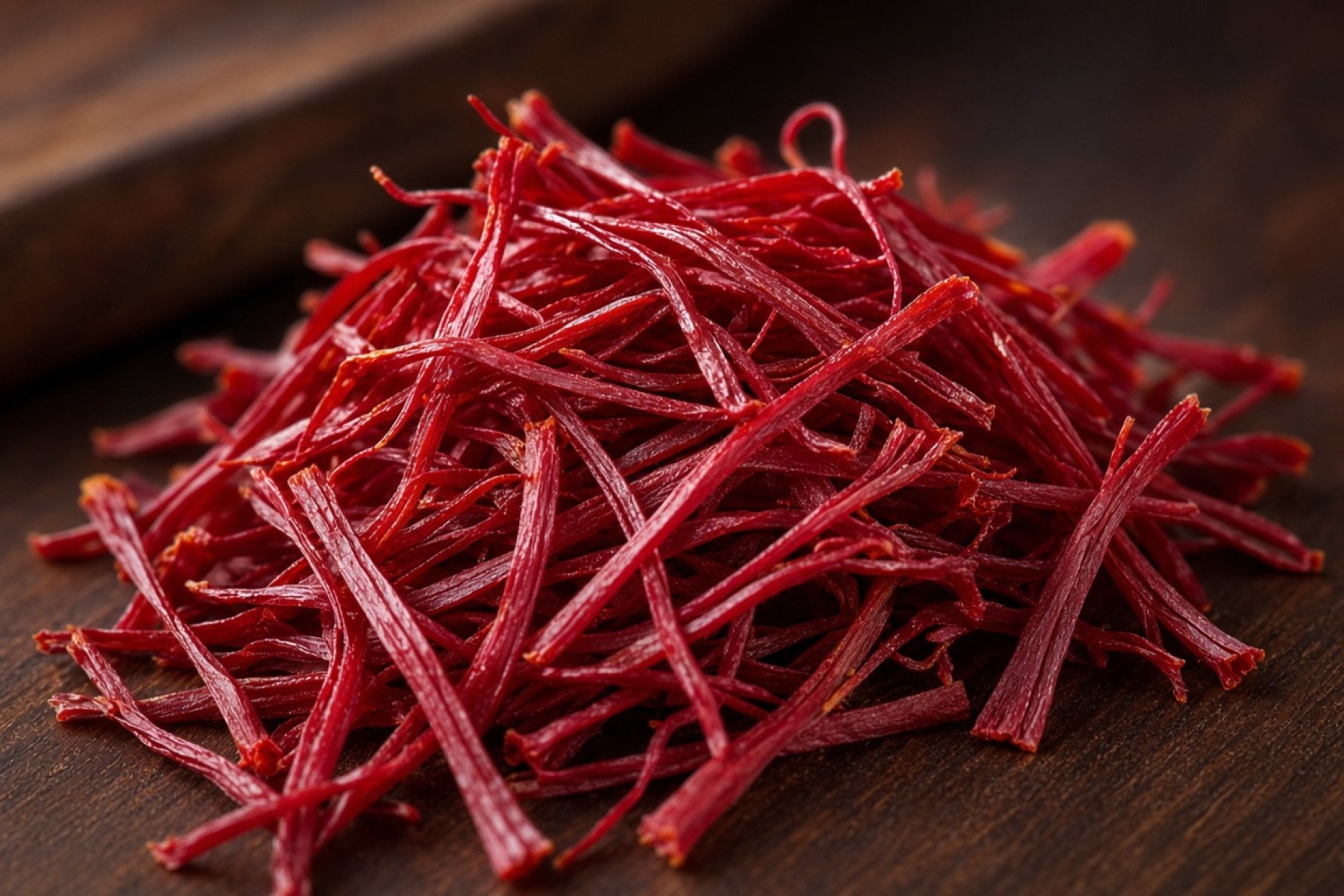
The saffron flower has three red stigmas that join at the tip to a yellow or cream-white stem known as the style. How these parts are separated and processed defines commercial saffron classifications. Among them, Super Negin grade presents the purest and most complete geometric form of the stigma.
In Super Negin grade, stigmas are separated exactly at the junction with the style so that no yellow or white appears at the thread ends and style content is zero. Stigmas are large, elongated, intact and trumpet-shaped when open. Average stigma length in this grade is typically 2 to 3 cm. Differences from other commercial types include:
- Standard Negin saffron: Similar redness to Super Negin and free of style, but threads are shorter and may show slight bending or breakage during drying.
- Sargol saffron: Fully red stigmas, but threads are broken during sieving and stigmas are short and fragmented.
- Poushal saffron: Red stigmas dried with 1 to 3 mm of yellow style attached, which reduces colouring strength on a weight basis.
- Bunch (Dasteh / Dokhtar-pich) saffron: Red stigma with the full white style length twisted into bundles and dried; lowest colouring strength.
| Comparison metric | Super Negin | Standard Negin | Premium Sargol | Export Poushal | Bunch (Dokhtar-pich) |
|---|---|---|---|---|---|
| Style content (white/yellow) | 0% (pure red) | Under 0.5% | Under 1% | 1–4% | 25–35% |
| Average stigma length | 2–3 cm | 1.5–2 cm | 1–1.5 cm | 2–3 cm (with style) | 3–4.5 cm |
| Physical condition & texture | Smooth, thick, no wrinkling | Medium thickness, slightly twisted | Short, fine, with breakage | Twisted with natural curvature | Compressed and tied with thread |
| Breakage & fines | Under 2% | 3–5% | 10–20% | 3–6% | Under 1% |
| Colouring strength (crocin) | 260–310 | 230–260 | 210–240 | 180–210 | 150–180 |
| Typical drying method | Mechanised hot-air flow | Mechanised or controlled traditional | Traditional or heated sieves | Traditional in shade and breeze | Traditional bunch drying in shade |
Mechanised drying technology and the rise of ironed Super Negin
Production of ironed Super Negin grade represents a major advance in saffron processing. Traditionally, stigmas were spread on cloths or sieves in the shade—a process lasting several days that left stigmas wrinkled, darkened and bent.
In modern mechanised methods, freshly cleaned stigmas are placed immediately in dryers with filtered hot-air circulation at 45–55°C. Stigmas are held between taut screens and dried under gentle air pressure or light physical pressing. This operation brings moisture below 8% in under an hour, prevents thermal degradation of crocin, and produces fully straight, broad, flat stigmas known as “ironed” or “pressed”.
3. Physicochemical indicators under ISO 3632 and Iran National Standard 259
In saffron export trade, visual claims alone have no official standing; the final reference for pricing and customs clearance is a laboratory certificate of analysis based on physicochemical tests. The international reference for saffron evaluation is ISO 3632 in two parts—technical specifications (ISO 3632-1) and test methods (ISO 3632-2)—aligned with Iran National Standard 259.
Chemical components are measured by UV-visible spectrophotometry on an aqueous saffron extract at three defined wavelengths. In the standard equation, absorbance at the relevant wavelength, sample mass in grams, and moisture and volatile matter percentage are used to calculate each index:
- 440 nm for crocin concentration (colouring strength)
- 330 nm for safranal concentration (aroma and volatile matter)
- 257 nm for picrocrocin concentration (characteristic bitter taste intensity)
Crocin and colouring strength
Crocin is a natural water-soluble carotenoid pigment. ISO requires a minimum absorbance of 200 for Category I (highest commercial class). In Iranian Super Negin saffron, owing to stigma purity and mechanised processing, this index typically registers in the 260–310 range. A higher value indicates greater economic efficiency for industrial users, since less product is needed to achieve the desired colour intensity.
Picrocrocin and bitter taste index
Picrocrocin is a bitter glucoside that defines saffron’s taste character. The ISO Category I minimum for this parameter is 70. In premium Super Negin grade, values typically fall in the 85–115 range. Gradual breakdown of this compound during storage contributes to formation of aromatic constituents.
Safranal and management of aroma and volatiles
Safranal accounts for most of the stigma’s volatile essential-oil compounds. ISO 3632 sets a range of 20 to 50 for this factor. Values above 50 can indicate aged stock from thermal conversion of picrocrocin or addition of synthetic essences. Fresh, standard Super Negin typically registers 28–42.
| Parameter | Unit | ISO 3632-1 Category I | National Standard 259 (Grade 1 premium) | Typical Super Negin range |
|---|---|---|---|---|
| Colouring strength (crocin) | Absorbance at 440 nm | Min. 200 | Min. 220 | 260–310 |
| Taste index (picrocrocin) | Absorbance at 257 nm | Min. 70 | Min. 85 | 85–115 |
| Aroma index (safranal) | Absorbance at 330 nm | Range 20–50 | Min. 20 (range 20–50) | 25–42 |
| Moisture & volatile matter | % by mass | Max. 10 (filaments up to 12) | Max. 10 | 5.0–7.5 |
| Total ash (dry basis) | % by mass | Max. 8.0 | Max. 8.0 | 4.5–6.5 |
| Acid-insoluble ash | % by mass | Max. 1.0 | Max. 1.0 | Under 0.4 |
| Cold-water soluble extract | % by mass | Max. 65.0 | Max. 65.0 | 52–58 |
| Floral waste (style, stamen, sepal) | % by mass | Max. 0.5 | Max. 0.5 | Under 0.1 |
| Foreign matter | % by mass | Max. 0.1 | Max. 0.1 | Zero (no foreign matter) |
4. Technical specs expected by wholesale buyers and reading the COA
In international trade, each shipment is accompanied by a quality identity document—the certificate of analysis (COA)—issued by laboratories accredited to ISO/IEC 17025. Buyers must verify all contract specifications against this certificate.
The following technical parameters form the core of COA evaluation:
- Excess moisture: Any figure above 8% raises mould risk in sea or air transit and charges the buyer for shipping extra water weight.
- Acid-insoluble ash: A direct indicator of dust, sand and field soil residues. Figures above 0.5% point to improper stigma harvesting.
- Artificial colourants: The test result in the lab table must be explicitly recorded as negative.
| Technical parameter | Super Negin standard range | Strategic importance for wholesale buyers |
|---|---|---|
| Colouring strength (crocin) | Min. 250 (recommended: 270+) | Determines dosage and cost efficiency in processing industries |
| Moisture & volatile matter | 5–8% | Storage stability and prevention of fungal spore growth |
| Total ash | Under 7% | Assures purity and no mineral salts added for weight |
| Acid-insoluble ash | Under 0.5% | Confirms physical cleanliness and filtration of sand and dust |
| Broken stigma & powder | Max. 2–3% | Acceptance in luxury packaging without loss of visual clarity |
| Intact three-branch stigma share | Min. 85% | Shipment authenticity; no blending with processed Sargol waste |
| Petroleum ether extract | Max. 3.5% | Confirms no oil, paraffin or glycerine added to the lot |
To register purchase specifications and receive a supply proposal, contact Iranco.
5. Authenticity identification and assessing commercial adulteration in wholesale buying
Saffron’s high commercial value creates a constant incentive for adulteration in the bulk supply chain. Mastery of adulteration detection methods is a protective necessity for wholesale buyers and quality-control managers.
Common fraudulent practices fall into three structural groups:
- Physical weight adulteration
- Chemical adulteration using industrial dyes
- Structural and botanical adulteration
Weight adulteration and addition of mineral salts or fat
Fraudsters spray mineral salt solutions, sugar, honey, glycerine or neutral fats onto stigmas to increase weight. In laboratory tests, salt addition raises total ash above 8%. Where oil or glycerine is used, the ether extract test shows an abnormal increase.
A basic workshop screening method is to press saffron threads between kraft paper or ash-free filter paper. Any remaining dull oily stain indicates physical manipulation to increase stigma weight.
Chemical adulteration and use of unauthorised synthetic dyes
Dyeing aged stigmas, white style waste or foreign fibres with synthetic colourants such as tartrazine, quinoline, Ponceau and Sunset Yellow is a serious risk. At commercial level, thin-layer chromatography (TLC) and high-performance liquid chromatography (HPLC) are the standard methods for detecting these compounds at very low concentrations.
In a cold-water colour-release test, authentic Super Negin stigma gradually releases a clear lemon-yellow colour, whereas synthetic dyes cause an immediate shift of the solution to orange or bright red within the first moments of contact with water.
Botanical adulteration and substitute stigmas
Dried safflower petals, dyed corn silk or white saffron roots dyed red are common botanical tricks.
Stereomicroscope examination of stigma morphology reveals structural identity. Super Negin stigma tips are trumpet-shaped with serrated edges, whereas corn-silk fibres have smooth margins and safflower tissue shows a distinctly different tubular structure.
6. Food safety requirements, contaminants and international sanitary rules
Exporting saffron to developed markets requires full compliance with food-safety rules. Products that fail tests for mycotoxins, pesticide residues or pathogens are seized or destroyed at destination ports and customs points.
Fungal toxins and mycotoxins (aflatoxin)
Contamination by toxin-producing fungi such as Aspergillus species can arise along the harvest-to-drying chain. EU regulations set the strictest limits for spices including saffron:
- Maximum aflatoxin B1: 5 µg/kg (ppb)
- Maximum total aflatoxins (B1+B2+G1+G2): 10 µg/kg
Shipments produced under industrial dryers without soil or open-air contact readily meet these limits.
Pesticide residues and MRLs
EU Regulation (EC) No 396/2005 sets maximum residue levels (MRLs) for plant products. Because saffron is a dried commodity, dehydration factors are applied in final assessment, but the default limit for unapproved substances is 0.01 mg/kg. Avoiding organochlorine and organophosphate pesticides in saffron fields is a precondition for entry into the European Economic Area.
Microbiology tests and pathogenic microorganisms
Saffron is often consumed raw or without prolonged cooking; therefore the following microbiology standards apply:
- Salmonella: negative / not detectable in 25 g of sample
- Escherichia coli: under 10 CFU/g
- Mould and yeast: max. 10³ CFU/g
- Total aerobic microbial count: max. 10⁵ CFU/g
| Safety & health indicator | EU maximum | US standard (FDA) | Reference test method |
|---|---|---|---|
| Aflatoxin B1 | 5 µg/kg | No separate specific limit | HPLC with fluorescence detection (HPLC-FLD) |
| Total aflatoxins | 10 µg/kg | 20 µg/kg | Immunoassay or liquid chromatography |
| Salmonella | Negative in 25 g sample | Negative in 375 g composite sample | Standard culture per ISO 6579 |
| Heavy metal — lead (Pb) | 1.0 mg/kg | 1.5 mg/kg | Atomic absorption spectrometry or ICP-MS |
| Heavy metal — cadmium (Cd) | 0.2 mg/kg | 0.3 mg/kg | Inductively coupled plasma mass spectrometry |
| Ethylene oxide (EtO) | 0.05 mg/kg (detection limit) | 7 mg/kg | Gas chromatography–mass spectrometry (GC-MS) |
7. Analysis of main export markets and major commercial destinations
Iran’s international saffron trade routes follow a clear structure in which some countries act as re-export hubs, others as specialised processors, and others as end-consumption markets.
International distribution channels include:
- United Arab Emirates: re-export and distribution hub for MENA and Asia
- Spain: European centre for quality control, industrial re-packing and distribution under EU labels
- China: direct consumption for traditional pharmacopoeia and ceremonial goods
- Germany and France: buyers of pharmaceutical raw materials, stable cosmetic formulations and fine foods
United Arab Emirates — re-export and regional trade centre
The UAE is Iran’s leading destination by saffron export weight. Traders based in Dubai import large volumes of ironed Super Negin in 0.5 kg and 1 kg metal tins, hold them in controlled warehouses, then supply Gulf retailers or more distant destinations. Emirati buyers place strong emphasis on visual aspects—stigma elongation and bright red colour.
Spain — European processing, standardisation and re-branding base
Despite a history of domestic production, Spain has for years sourced most of its commercial companies’ needs through bulk saffron imports from Iran. The country buys Iranian Super Negin under strict approvals, packs it in gram formats and supplies EU, North American and Latin American markets.
China — growing market for traditional medicine and premium products
China has strong potential for direct consumption of high-quality Iranian saffron. Known in China as fenghuang, saffron is prescribed mainly in traditional medicine to support blood circulation and heart tissue. Chinese importers apply strict oversight of crocin above 270 and tests for heavy metals such as lead and arsenic.
India and the EU — demand from ceremonial use to pharmaceuticals
India is a traditional saffron market, used heavily in religious rites, celebrations and luxury confectionery. By contrast, European countries such as Germany, Italy and France purchase Super Negin in bulk for companies extracting pharmaceutical carotenoids, neuro-psychiatric supplements, and Michelin-grade HoReCa restaurants.
| Destination market | Approx. demand share | Grade in demand | Typical packaging | Primary use channel | Key technical requirements |
|---|---|---|---|---|---|
| United Arab Emirates | Very high (trade hub) | Premium ironed Super Negin | Metal & khatam tins 0.5–1 kg | Re-export & regional hypermarkets | Stigma appearance, flatness, bright red colour |
| Spain | High (European trade base) | Super Negin & standard bulk Negin | Metal tins or aluminium barrier pouches 1–5 kg | Re-packing under global standards | Full ISO 3632 and EC compliance |
| China | Rapidly growing | Large Super Negin, high crocin | Hygienic bulk packs & gift boxes | Traditional pharma & supplements | Heavy metals, pesticides, crocin above 270 |
| Germany & Italy | High value-added | Organic Super Negin with COA | Sealed packs under inert gas | Modern pharma, extraction & fine foods | Aflatoxin under 5 ppb; no bacterial contamination |
| India | Medium to high | Negin & premium Sargol | Polycarbonate jars 50–500 g | Ayurvedic confectionery & ceremonial use | FSSAI entry hygiene standards & customs rules |
Importers can submit their required specs—grade, pack weight, order volume and destination country—via Iranco so that matching supply options can be reviewed.
8. Customs tariff codes, export packaging and entry requirements
In export–import regulations and the Harmonized System (HS Code), saffron is classified under Chapter 9, heading 0910. Tariff breakdown determines packaging rules, duty rates and border assessment conditions.
Classification codes break down as follows:
- 09102010: Neither crushed nor ground saffron in retail packs with net weight under 10 g.
- 09102020: Saffron powder in packs under 10 g.
- 09102030: Neither crushed nor ground saffron in packs of 10–30 g.
- 09102040: Saffron powder in packs of 10–30 g.
- 09102090: Other forms of neither crushed nor ground saffron, including bulk packs over 30 g, 0.5 kg and 1 kg metal tins, and industrial export packs.
Engineering bulk and retail export packaging
Crocin and safranal molecules are highly sensitive to visible light, ultraviolet radiation, oxygen and moisture exchange. Dried stigma is hygroscopic; free-air penetration raises moisture and lowers quality grade.
Optimal packaging methods include:
- Food-grade tinplate metal containers: The most common commercial vessels, known in the market as khatam tins. After filling, lids are sealed with polymer tape to block air exchange.
- Modified atmosphere packaging (MAP): Placing Super Negin stigmas in multi-layer laminated aluminium foil pouches, fully evacuating oxygen and injecting high-purity nitrogen. This approach preserves carotenoid compounds for more than 24 months.
- Clear polycarbonate jars for retail: These allow visual inspection of stigma form, but must be offered inside secondary opaque cartons to prevent photodegradation.
| Container & packaging type | Typical net weight | Functional advantages | Limitations & notes | Primary applications |
|---|---|---|---|---|
| Khatam-style metal tins | 500 and 1,000 g | Full light protection; good mechanical strength in freight | Requires polymer sealant to block moisture exchange | Wholesale trade with Gulf countries |
| Multi-layer aluminium foil pouches under inert gas | 1–5 kg | Full oxygen removal; maximum crocin retention; minimal dead weight in cargo | Vulnerable to point pressure without a thick master carton | Delivery to modern European pharma and food industries |
| Clear press-fit polycarbonate jars | 1–5 g | Visual appeal of stigma; moisture-resistant; light weight | Visible light transmission if not placed in opaque master carton | Retail and hypermarket distribution |
| Borosilicate glass with cork lid | 2–5 g | Chemically inert; no odour transfer; good airtightness | Breakage risk in transit; higher gross weight for air freight | Gift brands, ceremonial use and HoReCa restaurants |
9. International logistics, cold-chain management and air freight
Given saffron’s high value-to-weight ratio, all commercial Super Negin shipments move by air freight (cargo).
The air logistics chain includes the following stages:
- Packing in multi-layer five-ply master cartons with polyethylene foam cushioning to prevent stigma breakage during flight vibration.
- Holding in airport warehouses at a controlled 15–20°C and relative humidity under 50%. Sharp temperature swings create dew point and condensation inside packs.
- Issuing an air waybill (AWB) stating the exact scientific and commercial product name, production lot number and HS code 091020 to avoid holds at transit airports.
- Issuing valid cargo insurance under Institute Cargo Clauses (A)—the most comprehensive transit cover—for theft, water ingress and physical damage.
10. Wholesale pricing mechanics, cost structure and industrial applications
Saffron wholesale prices reflect convergence of product technical factors, the crop year’s climate conditions, and financial developments along the trading chain.
Pricing structure is analysed on the following components:
- Laboratory grade: Crocin above 280 attracts a premium to the base price.
- Hand-cleaning labour: Separating Super Negin stigma without style requires skilled labour and far more time than Poushal or bunch grades.
- Drying technology: Mechanised ironed dryers entail equipment investment, depreciation and energy costs that affect cost per kilogram.
- Incoterms: Price differs materially for delivery at the Iranian warehouse (EXW), free on board at origin airport (FOB Tehran or Mashhad), or carriage and insurance paid to destination airport (CIP/CIF).
Cost drivers for export Super Negin saffron pricing
- Farm-gate flower price
- Specialised stigma separation (hand-picking labour)
- Mechanised ironed drying cost
- Export tin and packaging cost
- Chemical and microbiology tests at a 17025 laboratory
- Customs charges, certificate of origin and export formalities
- Air freight and international insurance to destination
Value-adding industrial and pharmaceutical applications
Because of its high price, Super Negin saffron is a luxury raw material. This grade is used mainly in industries where high active-compound concentration and hygienic integrity matter most:
- Supplements and pharmaceuticals: Extraction of crocin and crocetin for antidepressants, sleep-regulation capsules and vision-support formulations.
- Premium cosmetics: Leveraging free-radical inhibition and skin-brightening properties in high-end anti-wrinkle creams.
- HoReCa and fine dining: Using smooth, uniform stigmas to garnish ceremonial dishes, premium rice and specialty desserts without leaving dark powdered particles.
For export orders, precise product specifications matter greatly. Via Iranco, you can register a purchase request with product details, packaging and destination so supplier review proceeds on that basis.
Importer checklist before placing an order
To assure shipment authenticity, destination regulatory compliance and investment-risk management, review the following checklist before signing a commercial contract and issuing a financial remittance:
- State the exact title “ironed/traditional Super Negin saffron” and minimum crocin grade in the commercial proforma invoice.
- Set allowed chemical parameter ranges: crocin above 260, moisture under 8%, total ash under 7%.
- Agree a specific crop year (current autumn harvest) to avoid delivery of aged stock.
- Obtain a sealed reference sample from the intended batch and match its lab results to contract conditions.
- Designate an accredited partner laboratory with ISO/IEC 17025 certification to issue the COA.
- Review the buyer country’s allowed pesticide list and sanitary requirements, and require the lab to test pesticides and mycotoxins.
- Confirm absolute Salmonella negative in 25 g and permitted total counts for other microorganisms.
- Specify primary packaging type (sealed khatam tin or inert-gas pouch) and exact weight per pack.
- Require the seller to place packs in five-ply master cartons with full foam cushioning.
- Define net-weight basis excluding packaging accessories, to two decimal places in grams.
- Define dispute resolution and the right to cancel or replace goods if destination customs analysis does not match.
- Clarify Incoterms and each party’s obligations for air freight and international insurance.
What information should be sent to receive an accurate price?
Calculating a realistic wholesale saffron quotation requires clarity on quality and logistics dimensions of the order. To receive a firm price, the buyer should provide:
- Exact product grade: specify standard Super Negin or ironed Super Negin.
- Quality and laboratory level: set minimum crocin index (e.g. 260, 280 or above 300).
- Total order volume: quantity in kilograms for volume-discount review.
- Required packaging: bulk (0.5 kg or 1 kg metal tins) or retail packaging under the buyer’s brand.
- Incoterms delivery basis: e.g. delivery at origin airport or destination airport.
- Final destination country and city: to calculate cargo costs and identify sanitary requirements.
- Special documents and tests: requests for heavy metals, aflatoxin or pesticide residue testing.
Price requests can also be registered with Iranco on the same information so suitable suppliers can be compared against purchase specifications.
Sourcing export Super Negin saffron from Iran with Iranco
In saffron export trade, differences in drying conditions, crocin grade, moisture and packaging standards are variables that determine final shipment value. Professional purchase requires direct links to core production regions, access to standard mechanised processing workshops and precise laboratory evaluation.
Iranco provides an operational structure for buyers, food-industry companies and international traders to register Super Negin export purchase requests on real technical parameters. Information including stigma grade, minimum biochemical indices, order volume, packaging model and delivery destination is entered, and the supply chain is evaluated against defined quality criteria.
To review available options and source Super Negin saffron directly from reputable Khorasan producers, register your technical specs, order volume and delivery terms in an Iranco purchase request so evaluation and enquiry can begin.
Submit a purchase request with IrancoConclusion
Export Super Negin saffron is the flagship among Iran’s commercial saffron grades, driven by outstanding physical traits—broad, elongated, deep-red stigmas free of any yellow style—and strong international demand. Mechanised drying, locking crocin colouring strength above 260 and holding moisture under 8%, has set a new industry standard. Profitable wholesale import of this red gold nevertheless requires vigilance against physicochemical adulteration, mastery of ISO 3632 COA interpretation, and packaging structures that preserve shelf life. Transparent contracts, laboratory parameters stated on the proforma invoice, and reputable supply channels place investment in this trade at the highest level of commercial security.
Frequently asked questions
What distinguishes ironed Super Negin saffron from other grades?
Ironed Super Negin consists exclusively of large red stigmas with no attached white style. These stigmas are dried mechanised under gentle air pressure or special screens, producing a fully smooth, unwrinkled structure with an open stigma width and colouring strength typically above 260.
How can Super Negin saffron be sourced directly from Iran?
The proper process includes defining laboratory parameters (crocin, moisture, microbial load), order volume, packaging type and receiving a reference sample before shipment delivery. International buyers can submit these specs via Iranco as a purchase request so available Iranian supply options are reviewed against their needs.
Is Super Negin saffron suitable for tea and herbal-drink factories?
No. Super Negin is the most expensive saffron grade, priced largely for stigma visual beauty. In tea-bag or herbal-drink lines where threads are hidden or milled, Poushal, bunch or fines grades offer far better economic justification.
How long does Super Negin saffron keep, and what storage conditions are required?
Stored in light- and air-impermeable containers at 15–20°C and humidity under 50%, product quality is maintained for up to two years. Exposure to light and moisture rapidly degrades crocin pigments and lowers quality.
What is the maximum moisture allowed for Super Negin under the standard?
ISO 3632 sets a moisture ceiling of max. 10–12%, but for premium mechanised Super Negin, optimal moisture is held at 5–8% to avoid excessive stigma brittleness while ensuring microbial stability.
Why does the crocin index matter so much in wholesale saffron pricing?
Crocin determines saffron’s natural colouring strength. A higher value means the buyer needs less spice to achieve target colour and concentration in food or pharmaceutical products; lots with crocin above 270 therefore always trade at a premium.
What causes saffron shipments to be rejected at international customs?
Salmonella contamination, aflatoxin above legal limits, pesticide residues outside MRL ranges, or detection of any synthetic dye such as tartrazine are among the factors that lead to seizure at customs entry points.
What HS tariff code is appropriate for declaring bulk Super Negin shipments?
Export shipments of neither crushed nor ground saffron in packs over 30 g (0.5 kg, 1 kg and larger bulk) are declared and cleared under international tariff code 09102090.
Featured Products




Related Articles



