 Iranco Magazine Team
Complete guide to technical specs, international sanitary requirements, cold-chain management and sourcing strategies for Iranian export seafood
Export Guide · Fisheries & Aquaculture
Iranian Fish and Seafood Exports: Target Markets, Standards, and the Cold Chain
A comprehensive guide to technical specifications, international sanitary requirements, cold-chain management, and commercial sourcing of Iranian export seafood — from vannamei shrimp and salmon trout to hairtail and farmed caviar.
Iranian fish and seafood exports, backed by extensive southern coastlines, dense aquaculture farms, and the Caspian Sea’s valuable stocks, have secured a strategic position in global markets. This specialised guide analyses the market structure of major destinations such as China, Russia, and the Persian Gulf, sets out laboratory limit values, reviews quarantine rules, and details full cold-chain engineering — giving importers, procurement managers, and exporters a practical tool for sustainable, low-risk trade.
Iran’s geoeconomic position and diverse climate create an exceptional base for farming and industrial harvest of aquatic species. Access to more than 2,700 km of coastline along the Persian Gulf, the Oman Sea, and the Caspian basin has made Iran one of the fisheries hubs of the Middle East and West Asia. Nominal annual production and catch capacity now exceeds 1.4 million tonnes, and the expansion of modern aquaculture has diversified the non-oil export basket with species such as vannamei shrimp, rainbow trout, and sturgeon.
International trade in marine animal proteins follows some of the most complex commercial patterns because of the biological sensitivity of muscle tissue and rapid spoilage. Sustained presence in high-consumption markets such as the Russian Federation, the People’s Republic of China, and GCC member states is not achievable on price advantage alone; it requires deep knowledge of destination sanitary authorities’ requirements, international plant registry codes, and strict protocols for rapid freezing and cold-chain integrity. The slightest temperature deviation during loading or transit can degrade organoleptic scores, accelerate volatile nitrogen-base breakdown, and ultimately lead to detention or rejection of the shipment.
1. Commercial position, production hubs, and the geoeconomic capacity of Iranian seafood
Over the past decade Iran’s fisheries industry has undergone a fundamental shift from local consumption toward an export-led model. According to Islamic Republic of Iran Customs data, exports of fisheries products and edible aquatic animals have reached 196 thousand tonnes valued at more than USD 372 million, recording 29% growth by weight and 17% by value. This expansion reflects processing infrastructure development, standardisation of packing halls, installation of advanced geomembrane-lined ponds, and operation of marine cages.
Geographic hubs of commercial production and catch
- Southern coasts (Bushehr, Hormozgan, Khuzestan, and Sistan and Baluchestan): the main centre for industrial marine catch and saltwater aquaculture. Bushehr and Hormozgan hold the largest shares in saltwater shrimp farming and harvest of species such as hairtail. Hormozgan’s extensive fishing fleet lands nearshore and distant-water catch at the ports of Jask, Bandar Abbas, and Lengeh.
- Freshwater and highland basins (Chaharmahal and Bakhtiari, Lorestan, Mazandaran, and Kohgiluyeh and Boyer-Ahmad): the rainbow-trout farming hub, fed by Zagros and Alborz headwaters. Stable cool water, favourable hydraulic slope, and high dissolved oxygen support dense flesh with minimal algal off-odour.
- Caspian coasts (Gilan, Mazandaran, and Golestan): the historic home of sturgeon and the cradle of caviar restocking farms, sturgeon meat, cyprinids, and farmed pike-perch in intensive and recirculating systems.
Seasonal catch and commercial harvest calendar
Harvest from southern farmed-shrimp ponds begins in late summer (September) and continues through December — coinciding with New Year and Chinese Spring Festival order windows. Industrial catch of Persian Gulf marine fish, including hairtail, is active from May through late summer and autumn. Cold-water trout is harvested year-round, although peak supply of heavy orange-flesh salmon trout loads falls in autumn and winter. This continuous cycle minimises interruption risk on long-term supply contracts.
2. Specialist assessment of export species: biological and commercial profiles
The biological diversity of the Persian Gulf and Iranian aquaculture farms enables fisheries exports to meet a wide spectrum of international protein demand.
Farmed vannamei shrimp (Litopenaeus vannamei)
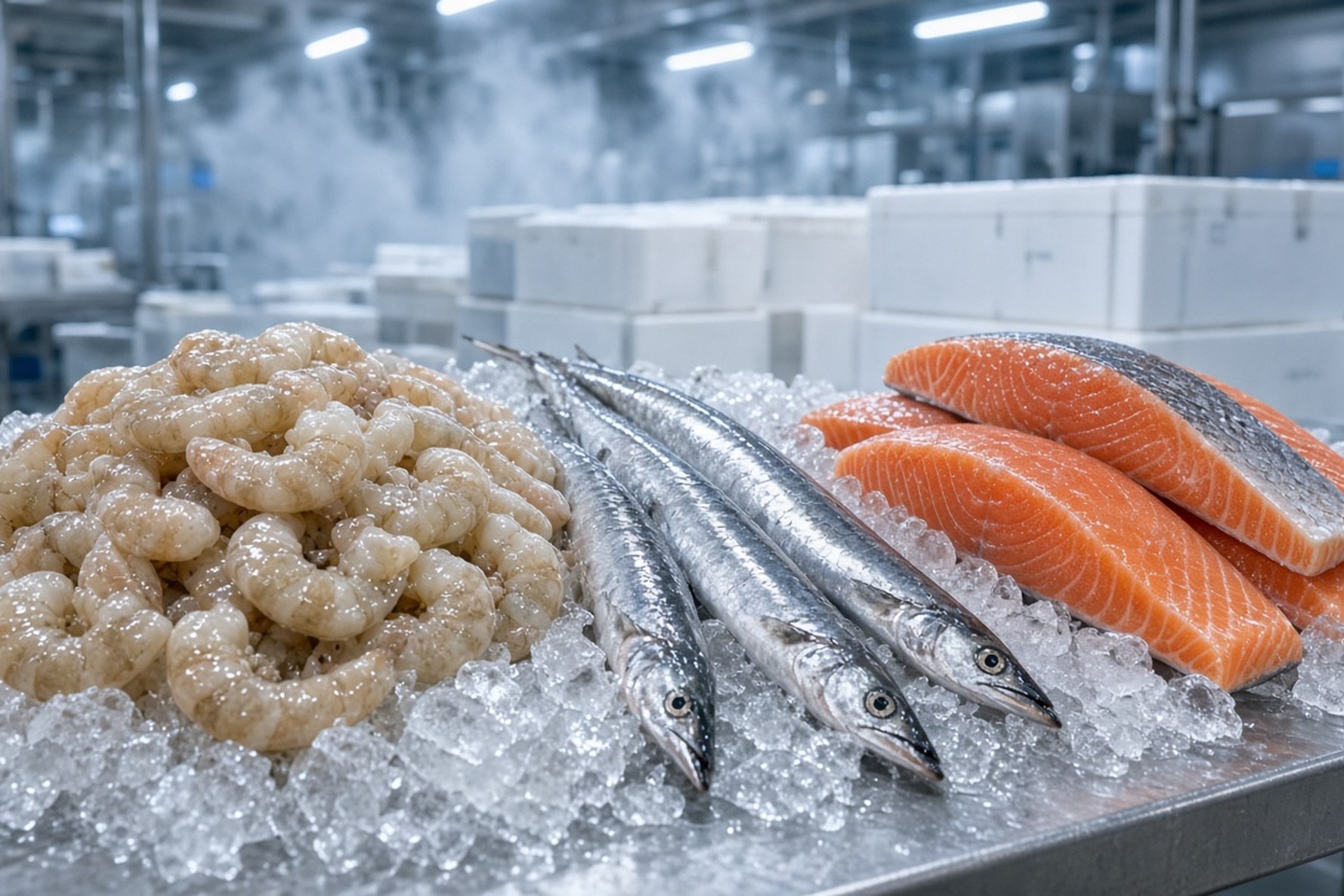
The dominant farmed shrimp in Iran is Western white shrimp, or vannamei. Fast growth, physiological tolerance of salinity swings, favourable feed conversion, and disease resilience have entrenched this species on southern coastal farms. Firm muscle, a clear shell free of darkening, easy deveining, and a naturally sweet cooked flavour distinguish Iranian shrimp in China, Russia, and Gulf markets. Processing is typically whole frozen head-on shell-on (HOSO) or headless shell-on (HLSO).
Rainbow trout and salmon trout (Oncorhynchus mykiss)
Iranian farmed trout is offered in two commercial forms: traditional white-flesh trout and salmon trout with deep orange–red flesh pigmentation. To produce salmon trout, growers use permitted carotenoid supplements such as astaxanthin in the finishing period so flesh colour reaches scores of 26 to 30 on the SalmoFan scale. Fish of 1.2 to 2.5 kg packed as frozen gutted carcasses are a premium substitute for ocean salmon in Russian and Eurasian markets.
Hairtail (Trichiurus lepturus)
A scaleless species with an elongated silver body and a wide habitat in deeper waters of the Persian Gulf and Oman Sea. Because it lacks scales it has little edible demand on the domestic market, yet high nutritional value and rich protein content have made it one of the most sought-after import fish in China and East Asia for household use and surimi plants. It is exported whole frozen in compressed blocks.
Sturgeon and sturgeon meat (Acipenseridae)
Following commercial catch bans in the Caspian basin, Iran has built the region’s largest farming infrastructure for sturgeon species including Beluga, sevruga, and Siberian and Russian sturgeon. Iranian farmed caviar ships with lead seals, CITES traceability IDs, and veterinary health certificates in glass and metallised containers to luxury markets in the UAE, Japan, and Europe. Pure, cartilaginous sturgeon meat as frozen fillets and steaks also enjoys steady demand in Russia.
| Species / product | Scientific name | Production or catch hub | Export processing forms | Key target markets |
|---|---|---|---|---|
| Vannamei shrimp | Litopenaeus vannamei | Bushehr, Hormozgan, Khuzestan, Golestan | HOSO, HLSO, peeled shrimp (PD/PUD) | China, Russia, UAE, Qatar |
| Trout and salmon trout | Oncorhynchus mykiss | Chaharmahal and Bakhtiari, Lorestan, Mazandaran | Gutted, semi-frozen and frozen IQF fillet | Russia, Armenia, UAE, Iraq |
| Hairtail | Trichiurus lepturus | Bushehr (Motaf), Hormozgan (Jask and Qeshm) | Whole frozen block and layered | China, Thailand, Malaysia |
| Cyprinids | Cyprinidae | Khuzestan, Gilan, Mazandaran | Whole fresh on ice, whole frozen gutted | Iraq, Republic of Azerbaijan |
| Sturgeon | Acipenseridae | Mazandaran, Gilan, Fars, Qom | Metallised caviar, frozen gutted carcass | UAE, Russia, Qatar, Europe |
| Small pelagics (anchovy and sardine) | Clupeidae / Engraulidae | Hormozgan (Charak, Parsian, Jask) | Sun- and industrially dried, frozen block | Sri Lanka, India, Indonesia |
3. Demand structure and buying behaviour in primary target markets
Trade structure and quality requirements differ sharply across destination markets for Iranian seafood. Successful entry into each market requires full awareness of consumption preferences, distribution channels, and government regulations in that geography.
Russian Federation and Eurasian Economic Union markets
First demand priority in this market is orange-flesh salmon trout in heavy weights (1.5 to 2.5 kg). Product must be fully gutted with precise cleaning of the kidney blood line (Kidney Line), and flesh must be free of muddy odour or geosmin taste. Medium shrimp sizes (30/40 and 40/50) enjoy strong demand in Moscow and St. Petersburg distribution networks. All shipments must comply with technical regulation TR EAEU 040/2016.
People’s Republic of China market
China is Iran’s largest seafood buyer by weight. Southern-caught hairtail is purchased by processing plants in Shandong, Zhejiang, and Guangdong for fillet and surimi. Chinese consumers emphasise the visual integrity of whole head-on shrimp (HOSO); head–thorax attachment and shell clarity signal catch and primary-freeze quality. All origin plants must hold official approval in China’s CIFER customs system.
United Arab Emirates and Persian Gulf markets
The UAE — especially Dubai and Jebel Ali — is a hub for ultra-premium product consumption and a re-export centre for fisheries to Africa and West Asia. Demand focuses on large shrimp (10/20 and 20/30), air-freight fresh trout fillet, Persian Gulf demersals such as silver pomfret and grouper, and caviar. Shipments must carry a Halal certificate and comply with GSO standards.
Republic of Iraq market
Iraq is the main buyer of Iranian warm-water farmed fish (common carp and silver carp) and fresh unfrozen trout. Fresh fish loads move in foam boxes packed with ice or in live-haul tankers through Shalamcheh, Chazabeh, Mehran, and Parvizkhan crossings into Basra, Baghdad, Najaf, and the Kurdistan Region.
| Country / market | Products in demand | Preferred form | Common packaging | Distribution channels |
|---|---|---|---|---|
| Russian Federation | Salmon trout, vannamei shrimp | Frozen gutted, IQF fillet | 5–10 kg carton; 500–1000 g vacuum | Retail chains (Magnit, X5), processing lines |
| People’s Republic of China | Hairtail, shrimp, squid | Frozen block, HOSO | 10–12 kg master carton with compressed block | Surimi plants, wholesale fish markets |
| United Arab Emirates | Large shrimp, trout fillet, caviar | Fresh on ice, MAP, caviar | Iced foam; 30–100 g tins | Luxury hospitality, re-export |
| Republic of Iraq | Cyprinids, fresh trout | Whole fresh on ice, live loads | 20–25 kg baskets; oxygenated tankers | Urban markets, traditional protein centres |
4. Technical standards, sorting, sizing, and quality specs buyers expect
In fisheries trade, precise technical naming and dimensional calibration of product are the foundation of contract drafting and prevention of commercial claims.
Commercial codes and shrimp processing forms
- HOSO (Head-On, Shell-On): whole shrimp with head, shell, and tail — the most popular form in East Asian markets.
- HLSO (Headless, Shell-On): headless shrimp retaining body shell and tail fan — the traditional form for canning and hotels.
- PD (Peeled and Deveined): peeled and deveined shrimp ready for direct use.
- PUD (Peeled and Undeveined): peeled without vein removal — suited to shrimp nuggets and burgers.
- PTO (Peeled, Tail-On): peeled with last segment and tail fan retained — widely used in battered food-service chains.
Shrimp and fish sizing standards
Whole shrimp (HOSO) sizing is calculated as pieces per kilogram (pcs/kg); for example, grade 30/40 means 30 to 40 pieces per kilogram. For headless shrimp (HLSO) the traditional standard is pieces per pound (16/20, 21/25, 26/30, 31/40). Size uniformity (Uniformity Ratio) is measured as the weight ratio of the ten largest pieces to the ten smallest and must not exceed 1.3.
- Trout: portion 300–500 g; restaurant 500–800 and 800–1200 g; heavy export salmon trout 1.2–1.8 kg and above 2 kg (SalmoFan colour 26+).
- Hairtail: light 100–300 g; commercial medium 300–700 g; premium heavy 700 g to above one kilogram.
| Technical parameter | Options and standard ranges | Importance to the buyer |
|---|---|---|
| Shrimp processing form | HOSO, HLSO, PD, PUD, PTO, Butterfly | Critical; sets base rate and recovery factor |
| Whole shrimp sizing | 10/20 … 70/80 pcs/kg | Very high; match to retail orders |
| Trout piece weight | 300–500g … 2kg+ | Very high; Russia and Gulf marketability |
| Trout fillet colour index | SalmoFan 20–32 | Critical in Eurasia; below 24 not accepted |
| Ice glaze percentage (Glazing) | 0%, 5%, 8%, 10%, 12%, and maximum 20% | Critical; basis for net weight after defrost |
| Freezing technology | IQF / Contact Plate Block | Determines flesh texture and ease of separation |
5. Sanitary requirements, permits, and origin/destination registry processes
Export of aquatic products as high-risk animal commodities requires strict sanitary approvals, production-line inspections, and formal registration with destination health authorities.
Iran Veterinary Organization and the supervisory IR code
All farms, industrial fishing vessels, primary processing centres, packing plants, and cold stores entering the export cycle must obtain an international sanitary supervisory code (IR Code) from the Iran Veterinary Organization. Issuance depends on implementation of HACCP and GMP. On the basis of laboratory sampling from each lot, the Veterinary Organization issues a Veterinary Health Certificate — the primary clearance document at international customs.
China Customs (GACC) rules and the CIFER system
Edible seafood exports to China are governed by Decrees 248 and 249 of the General Administration of Customs of China. Iranian processing and storage plants must be recommended by the Veterinary Organization and registered in CIFER after document audit. The official 18-digit registration number must appear on inner labels and master cartons; absence of this number leads to detention at Shanghai or Ningbo ports.
Russia and Eurasia standards and inspections (TR EAEU 040/2016)
Exports to Russia require official approval from the Federal Service for Veterinary and Phytosanitary Surveillance (Rosselkhoznadzor) and listing of the plant on the registry of companies authorised to import into the Eurasian Economic Union. Technical regulation TR EAEU 040/2016 sets strict limits for antibiotic residues, heavy metals, parasitic and bacterial contaminants, and the absence of unauthorised chemical dyes in trout flesh.
Persian Gulf rules and Gulf Standardization Organization (GSO)
GCC member states control seafood imports under GSO 1016:2015. In addition, a Halal certificate is mandatory. Under Islamic jurisprudence, fish exports for Muslim communities are limited exclusively to scaled species; scaleless fish such as hairtail cannot carry a Halal certificate and are shipped only to non-Muslim destinations.
6. Laboratory test protocols, spoilage control, and contaminant limit values
Shipment safety depends on issuance of a comprehensive laboratory analysis sheet (Certificate of Analysis — COA) for every production lot. Safety monitoring covers organoleptic, biochemical, and microbiological domains.
Sensory and organoleptic freshness indices
- Eye cornea: in sound fish, convex, clear, and bright; clouding signals unwanted defrost or pre-freeze ageing.
- Gills: cherry-red or clear coral colour without grey slime.
- Muscle firmness: elastic tissue that rebounds quickly under finger pressure.
- Shrimp shell and melanosis: free of local darkening at the head–thorax joint and dark lines on abdominal segments.
Biochemical indices of protein and fat spoilage
- Total volatile basic nitrogen (TVB-N): in frozen export seafood must not exceed 30 mg per 100 g. Values of 30–35 signal the onset of breakdown; above 35 indicates tissue spoilage.
- Histamine: maximum permitted 100 mg/kg (ppm) under TR EAEU 040/2016.
- Peroxide value (PV) and free fatty acids (FFA): indicate the onset of omega-3 lipid oxidation in fatty fish.
Drug, chemical, and heavy-metal residues
- Antibiotics and chemical dyes: malachite green, chloramphenicol, and nitrofuran metabolites under absolute Zero Tolerance.
- Heavy metals: maximum mercury 0.5 mg/kg in non-predatory species and 1.0 mg/kg in predatory fish and hairtail; lead maximum 0.3 and cadmium 0.05 to 0.1 mg/kg in muscle.
- Sulphur dioxide (SO₂) in shrimp: residual sodium metabisulphite used against melanosis maximum 100 to 150 mg/kg.
| Test group | Parameter | Maximum limit | Reference method | Significance |
|---|---|---|---|---|
| Biochemical | TVB-N | ≤ 30 mg / 100g | Kjeldahl distillation and titration | Absolute freshness accept/reject criterion |
| Biogenic | Histamine | ≤ 100 mg / kg | HPLC | Prevention of acute poisoning |
| Heavy metals | Hg / Pb / Cd | 0.5–1.0 / 0.3 / 0.05–0.1 mg/kg | CV-AAS / ICP-MS / GFAAS | Definite clearance ban if exceeded |
| Additives | SO₂ (shrimp) | 100–150 mg/kg | Monier-Williams | Control of anti-melanosis metabisulphite |
| Drug residues | Nitrofuran / malachite green | Zero Tolerance | LC-MS/MS | Invalidates health certificate |
| Microbiology | Salmonella / Listeria | Negative / 25g | ISO 6579 / ISO 11290 | Acute foodborne illness risk |
| Physical | Glazing % | Contract match (±2%) | Differential weighing in cold-water bath | Tissue protection against oxidation |
7. Cold-chain engineering: rapid freezing, temperature monitoring, and refrigerated packaging
Qualitative value, muscle texture, pigment, and digestible proteins in seafood remain stable only when the cold chain is held intact across transport and storage lines.
Thermodynamic freezing phenomena and ice crystals
Aquatic muscle contains more than 68 to 80% interstitial water. The critical chilling phase occurs between −0.5 and −5 °C, where more than 80% of free muscle water freezes. In slow cooling, coarse ice crystals rupture muscle fibres and upon thawing release a large volume of drip (Drip Loss). To control this loss, ultra-rapid freezing technologies are mandatory:
- Individually quick frozen (IQF): in air-blast tunnels at −35 to −40 °C, pieces reach full freeze within 10 to 25 minutes; uniform microscopic crystals and free piece separation are key advantages.
- Contact plate freezing (Contact Plate Freezing): the most common technique for export shrimp and hairtail blocks; −40 °C hydraulic plates produce geometric, impact-resistant packs for palletising.
Controlled ice glazing (Glazing)
Frozen fish and shrimp in long-term storage are exposed to surface moisture sublimation and freezer burn (Freezer Burn). Immediately after leaving the freezing line, product is immersed or sprayed in sterile filtered water at 0 to +1 °C so a protective ice layer coats the surface. The glaze percentage (typically 5% to 10%) must be declared on the label; glazes above 20% are treated as commercial fraud.
Export packaging materials engineering
- Primary packaging: five-layer copolymer nylon bags, thick polyethylene impermeable to water vapour and oxygen, or tear-resistant vacuum packs.
- Secondary packaging (master carton): multi-ply die-cut moisture-resistant cartons (Wax-Coated) with heavy fluting that retain vertical compression strength in cold stores above 90% relative humidity. For air-freight fresh cargo, EPS foam boxes with drip-absorbent pads are used.
8. Transit routes, transport modes, and fisheries logistics risk management
Successful transit of export seafood depends on selecting fleets equipped with active cooling systems and precise route scheduling.
Ocean reefer containers (Reefer Containers)
The primary method for exporting shrimp and fish to East Asian and Gulf ports is 40 ft high-cube reefer containers. Setpoint temperature is held at −22 to −25 °C so tissue core temperature remains below −18 °C. Reefer floors use aluminium T-Bar channels; pallet stowage must allow airflow beneath the pallets. Loading cartons above the wall red Load Line creates local hot spots. Installation of at least two electronic data loggers in the mid and rear sections of the container is mandatory.
Refrigerated road transit and air cargo
Road haulage to Moscow and St. Petersburg by refrigerated trailer via Astara or Bileh Savar crossings takes 5 to 8 days. On Iraq routes, short transit times (12 to 36 hours) allow trout and warm-water fish to move fresh with flake ice. Luxury caviar and fresh salmon-trout fillet ship by air cargo from Imam Khomeini Airport or Shiraz and Bandar Abbas airports to Doha, Dubai, and Muscat; hold temperature is kept below +4 °C.
| Logistics mode | Route and major destinations | Standard temperature | Approximate duration | Cold-risk measures |
|---|---|---|---|---|
| Ocean reefer container (FCL) | Qingdao, Shanghai, Jebel Ali | −22 … −25°C | 22–32 days | Generator monitoring, data logger, loading in cold dock |
| Refrigerated road trailer | Moscow, St. Petersburg, Yerevan | −18 … −22°C | 5–8 days | Fast Astara clearance, backup reefer diesel fuel |
| Caspian Ro-Ro vessels | Anzali and Amirabad to Astrakhan and Aktau | −18°C | 3–6 days | Secure ship power connection, Volga ice assessment |
| Light insulated vehicles | Basra, Najaf, Baghdad, Erbil | 0 … +2°C | 12–36 hours | Continuous flake ice, meltwater drainage |
| Express air cargo | Dubai, Doha, Kuwait, Muscat | 0 … +4°C | 4–12 hours | Leak-free gel packs, immediate airport clearance |
9. Customs tariff codes (HS Code) and foreign-trade classification
Correct alignment with the Harmonized System of commodity description and coding is a prerequisite for official proforma invoices, quarantine permits, and penalty-free clearance. Aquatic products are classified under Chapter 03 of the export–import tariff schedule:
- 0301: live fish (live carp, live trout, fry, and broodstock).
- 0302: fresh or chilled fish, excluding fillets under heading 0304.
- 0303: frozen fish — including 0303.14 frozen trout and 0303.89 other frozen marine fish (hairtail).
- 0304: fish fillets and other fish meat, fresh or frozen.
- 0306: crustaceans — 0306.17 frozen shrimp (vannamei) and 0306.35 live, fresh, or chilled shrimp.
- 1604: prepared and preserved fish and caviar — 1604.31 natural farmed sturgeon caviar.
10. Cost-structure analysis and competitiveness of Iranian seafood
Final export seafood pricing is a function of domestic production variables and global market volatility.
- Feed cost and conversion ratio (FCR): the largest farming cost component; FX swings and prices of fishmeal, soybean meal, and fish oil directly change unit cost.
- Sizing and farming yield: large shrimp 20/30 command up to 40% more than fine sizes 60/70; bringing salmon trout above 2 kg requires expensive pigmented feed.
- Processing yield loss: conversion to gutted causes 15–20% loss and skinless boneless fillet 45–55% loss.
- Glaze percentage and packaging: the final determinant is price paid per net drained weight after defrost (Net Drained Weight).
| Supplier country | Competitive advantages | Structural constraints | Quality level | Pricing strategy |
|---|---|---|---|---|
| Islamic Republic of Iran | Low energy and processing cost; dense natural flesh texture | Road-transit volatility; multiple intermediaries | High with minimal texture alteration | Competitive with sustainable buyer margin |
| Turkey | Extensive road fleet; regional tariff agreements | Higher fuel and processing costs; saturated farms | Standard, mechanised-line dependent | 5 to 15% more expensive on trout |
| Ecuador | Large continuous output; intensive mechanised farms | Long ocean distance to the Middle East | Uniform with precise sorting | Sets the global shrimp base-price benchmark |
| India | Huge export volume; seasoned trade networks | Occasional antibiotic-residue challenges | Variable by packing unit | Aggressive pricing backed by export incentives |
11. Practical importer checklist before placing a firm order
- Verify the plant supervisory code against official China CIFER lists or the Russian veterinary registry.
- State processing and cut form explicitly in the contract annex (HOSO, HLSO, gutted, fillet).
- Clarify the sizing basis and tolerance and record the permitted uniformity ratio (maximum 1.3).
- Lock the colour index for salmon trout (minimum score 26 on SalmoFan).
- Define glaze percentage and net weight excluding glaze (Net Weight Without Glaze).
- Set biochemical and microbial acceptance: TVB-N below 30 mg/100 g and absence of Salmonella and antibiotics.
- Design and fully align labels in the destination language (Latin scientific name, catch/freeze date, expiry, registry code).
- Shelf-life floor at delivery: at least 12 to 18 months of the official shelf-life period remaining.
- Temperature-logging protocol in logistics and delivery of the data-logger chart at destination.
- Independent third-party inspection (SGS / origin inspection) during loading.
12. Guide to drafting an official request for quotation (RFQ)
Providing complete, specialised information in a price enquiry shortens commercial negotiation time and makes realistic offers easier to obtain. The buyer should state the following parameters clearly:
- Exact aquatic species with Latin scientific name
- Processing and cut form (whole, gutted, fillet, HOSO, PD, and similar)
- Desired sizing and percentage share of each size in the container
- Flesh colour grade (when requesting salmon trout)
- Freezing method (IQF or block on plate freezer)
- Target glaze percentage and primary/secondary packaging type
- Total purchase volume by tonnage or number of 40 ft reefer containers (FCL)
- Delivery port or customs border and Incoterms rule (FOB, CFR, or CIF)
- Final destination country for alignment with sanitary supervisory codes
Lodging these specifications as formal requests on the Iranco commercial platform lets buyers connect directly to a network of suppliers with the required technical qualifications and sanitary documents.
13. Direct sourcing of export seafood from Iran via the Iranco trade network
In foreign trade of perishable marine products, the difference between a successful deal and heavy financial loss lies in processing lines’ adherence to technical commitments. Product grade, sorting accuracy, net-weight compliance, control of nitrogenous compounds, and observance of rapid-freezing standards are the parameters that decide a shipment’s fate at destination customs.
Iranco, as a specialised trade reference and the platform connecting global markets to Iran’s food-industry production base, has opened a path to reputable processing units with export sanitary standards. International buyers and trade managers can state exact technical specs, grade, processing form, net weight, and destination country in their Iranco purchase request so sourcing options are audited and assessed among producers holding international licences.
This structured platform enables monitoring of veterinary health-certificate compliance, coordination of real sample receipt, and oversight of contractual specifications — raising commercial investment security. To review Iranian export seafood supply capabilities, traders can register their purchase requirements at iranco.com.
14. Analytical summary
Iran’s fisheries and aquaculture industry, combining the natural potential of the Persian Gulf, historic Caspian stocks, and Zagros aquaculture farms, has reached an influential position in supplying the world’s marine protein basket. The shift from bulk sales to value-added processing, observance of standard packaging rules, and expansion of −18 °C cold-chain capacity form the foundations of this commercial presence.
Sustainable trader success in this sector depends on compliance with destination sanitary rules such as China Customs monitoring systems and Eurasian veterinary standards, continuous control of protein-spoilage indices such as TVB-N, and drafting of clear technical contracts based on numeric tolerances. Combining unit-cost advantage with quality standards has made Iranian export seafood a stable, profitable opportunity for international importing companies.
Frequently asked questions
1. How does Iranian salmon trout differ from ocean salmon?
Iranian salmon trout is farmed rainbow trout (Oncorhynchus mykiss) fed in the finishing months with pigmented feed such as astaxanthin so flesh colour reaches scores of 26 to 30 on the SalmoFan scale. Ocean salmon belongs to Atlantic salmon (Salmo salar) with a larger body size. Iranian salmon trout, through similar texture and colour at a more economical price, has secured a wide place in Russian and Asian markets.
2. What is the maximum permitted TVB-N for accepting frozen seafood?
Under Iran Veterinary Organization rules and international standards, the ceiling for total volatile basic nitrogen in frozen export seafood is 30 mg per 100 g of muscle tissue. Results between 30 and 35 mg signal the onset of muscle spoilage, and values above 35 lead to loading stoppage and cancellation of the export certificate.
3. Why is registration of Iranian fisheries plants in China’s CIFER system mandatory?
Under Decrees 248 and 249 of the General Administration of Customs of China (GACC), all food and aquatic product manufacturing, processing, and storage units must be formally registered in CIFER and obtain an 18-digit registry code. Without this official code on primary packaging and the master carton, clearance and exit from Chinese ports is impossible.
4. What is the difference between IQF and block freezing for shrimp?
In IQF processing, each shrimp piece is frozen individually in an air-blast tunnel within minutes; product pieces remain free and the consumer can take a partial pack. In block freezing, shrimp are frozen in metal moulds with water in contact plate freezers, yielding a compressed cubic piece (1 or 2 kg block) for industrial bulk use.
5. How can fisheries products be purchased directly from Iranian producers?
The purchase process requires specifying species, grade, size, packaging type, and destination country, plus verifying the plant’s sanitary standing with international authorities. International buyers can register their purchase specs on the Iranco platform so coordination can proceed to identify producers with IR and CIFER codes, obtain real samples, and issue the required certificates.
6. What limit applies to sodium metabisulphite in shrimp processing?
This substance is used to inhibit polyphenol oxidase activity and prevent black spots on shrimp shell and head (melanosis). Under standard rules, residual expressed as sulphur dioxide (SO₂) in edible shrimp meat must not exceed 100 to 150 mg/kg.
7. What is the standard temperature for transport and storage of seafood in the cold chain?
Tissue core temperature of all frozen seafood must be held at −18 °C or colder throughout warehousing and road and ocean transit. For that reason, reefer container thermostats are set to −22 to −25 °C to offset environmental heat exchange.
Featured Products


Related Articles



