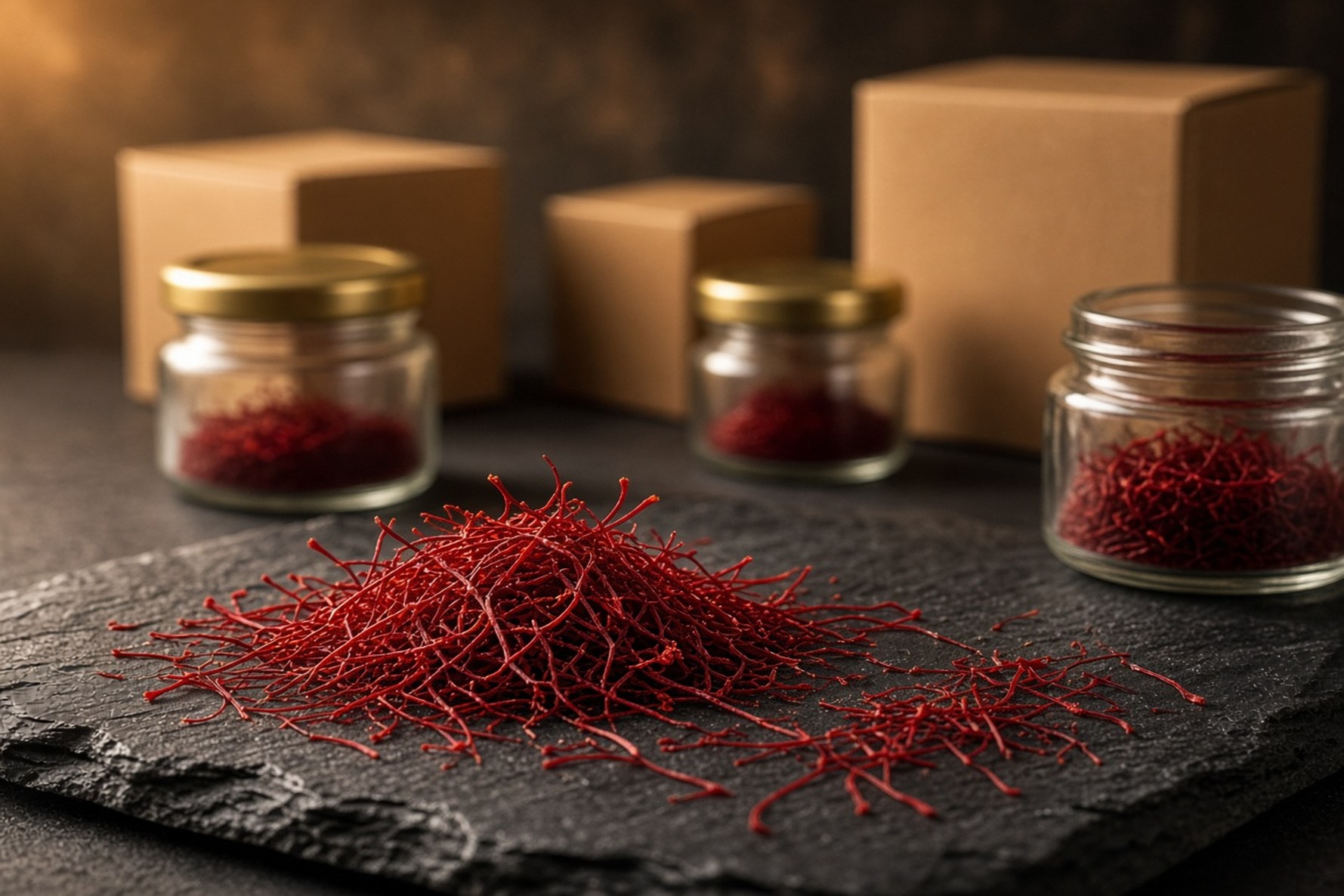
 Iranco Magazine Team
From bulk export to direct and brand-led sales: market strategy, quality, standards, packaging, authenticity and channel development for Iranian saffron
Export guide · Saffron · Market share
Growing Iran’s Saffron Exports: How to Capture More Global Market Value
From bulk export to direct and brand-led sales: market strategy, quality, ISO 3632, packaging, authenticity testing and channel development for Iranian saffron.
Analytical introduction
Iran’s saffron challenge is not volume — it is turning production dominance into durable global market power. FAO in 2025 puts Iran at about 85–90% of world output.
In FY 1403 the UAE, Spain and China were the top three destinations; exports were 214.3 tonnes worth USD 184.7 million. Spain imported over USD 50.7M from Iran in 2024 while exporting over USD 56.2M — showing downstream hub roles.
Growth should not be measured by tonnes alone. Track value per kg, Iranian-branded share, end markets, repeat orders, direct contracts and fully traceable batches.
1. Iran’s real place in the global saffron chain
Iran is the core global supplier: volume, trade grades and specialised clusters from harvest to export. Khorasan Razavi reports ~97,000 ha and ~261–280 t/year — about 62% of national output.
1403 exports: 214.3 t, USD 184.7M; simple customs average ~USD 862/kg — an aggregate, not a single grade price.
Several value links sit between farm and retail shelf. The rational goal is to keep more value-adding steps in Iran or under Iranian control before exit.
| Chain link | Traditional | Higher-value model |
|---|---|---|
| Production | Sale by appearance | Sort by measurable specifications |
| Quality control | Limited or ad-hoc testing | Test dossier per shipment |
| Packaging | Bulk focus | Industrial and retail packs for each market |
| Sales | Generic product trade | Contracts on technical specifications |
| Markets | Few intermediaries | Mix of importers, food industry and brand |
| Product identity | Generic “saffron” | Origin, batch, harvest and traceability |
| Pricing | Weight-driven | Quality, specs, services and channel |
2. Why high production share has not equalised value share
Three issues: export concentration, bulk sales and weak conversion of quality into measurable specs. UAE ~USD 50M, Spain ~USD 40M, China ~USD 30M — 65% of 1403 export value.
Bulk is natural for extract and spice plants; the problem is exporting identity-ready product without traceability — competition collapses to price per kg.
Professional buyers want supply solutions: batch stability for EU repackers, gift appearance for the Gulf, chemistry for extract makers.
- Colouring strength, taste, aroma, moisture, foreign matter, thread appearance, batch uniformity, origin, residues, authenticity, packaging, continuity of supply
3. Which markets matter most for growth?
Target market = market size + Iran’s position + room to capture more value. EU, Spain, China, Saudi Arabia, Kuwait, Qatar and India stand out in 2024 trade data.
Europe: close the gap between raw supply and final sale with defined batches, COAs and custom packs. China: defend supply share while growing brand and consumer packs.
Gulf: Qatar and Kuwait for premium and gifting. Saudi Arabia is a gap market needing import-route and partner analysis.
| Market | 2024 status | Iran position | Main opportunity |
|---|---|---|---|
| European Union | ~$77.1M imports; ~$69.6M from Iran | Critical supplier | Direct contracts, packing and brand |
| Spain | ~$56.3M imports; ~$50.7M from Iran | Very strong supply role | Spec-led sales with repackers |
| China | ~$16.4M imports; mostly from Iran | Very strong position | Consumer packs, channel control, brand |
| Saudi Arabia | ~$19.3M imports | Limited direct share in 2024 data | Import route analysis and local partner |
| Kuwait | ~$6M imports; ~$3.9M from Iran | Strong position | Consumer and premium packs |
| Qatar | ~$4.3M imports; ~$3.8M from Iran | Dominant supplier | Branded and gift products |
| India | ~$37.7M imports | Low direct share | Specialty segment and access barriers |
4. Designing Iran’s export product portfolio
Trade names like negin or super negin are not international specs alone. Contracts must define what each name means technically.
Best practice: dual naming — commercial label for sales and technical definition (ISO grade, colouring strength, picrocrocin, safranal, moisture, contaminants) for the contract.
| Trade type | Trait | Use | Contract note |
|---|---|---|---|
| Bunch (daste) | Stigma with style attached | Traditional markets | Define yellow portion |
| Pushal | Red with style | Wholesale and traditional | Style uniformity |
| Sargol | Separated red stigma | General use and food industry | Breakage and uniformity |
| Negin | Longer red threads | Premium retail | Appearance is not chemical grade |
| Super negin | Stricter visual selection | Premium retail and gifts | Must pair with lab specs |
| Powder | Ground product | Food industry and extracts | Authenticity control critical |
5. Quality standardisation — the main bargaining tool
ISO 3632-1:2025 (July 2025) replaces 2011; covers threads, cut threads and powder. ISO 3632-2:2010 remains the test methods standard. Extra grade added.
Shifting negotiation from “what saffron do you have?” to “supply product meeting these specs” professionalises the trade.
| Parameter | Extra | Grade I | Grade II | Grade III |
|---|---|---|---|---|
| Max moisture — threads | 12% | 12% | 12% | 12% |
| Max moisture — powder | 10% | 10% | 10% | 10% |
| Min taste strength (picrocrocin) | 80 | 70 | 55 | 40 |
| Safranal range | 30–50 | 20–50 | 20–50 | 20–50 |
| Min colouring strength at 440 nm | 230 | 200 | 170 | 120 |
| Parameter | To define | Importance |
|---|---|---|
| Product form | Threads, cut or powder | Control method and use |
| Trade type | Negin, sargol, pushal | Expected appearance |
| ISO grade | Extra, I, II or agreed | Technical comparison |
| Colouring strength | Minimum accepted | Food application |
| Picrocrocin | Minimum accepted | Taste index |
| Safranal | Acceptable range | Aroma profile |
| Moisture | Maximum accepted | Stability and weight |
| Foreign matter | Acceptance limit | Purity |
| Artificial colour | Not permitted | Authenticity |
| Pesticide residues | Per destination | Clearance |
| Batch | Traceable | Dispute handling |
| Packaging | Material and weight | Protection and market |
| Reference sample | Approved sample | Final shipment match |
6. Authenticity control — where Iranian brand can win
In a study of 104 retail samples from 16 countries, 45 showed adulteration. FAO–MUMS projects support authenticity and chain management in Iran.
A COA without proper final-batch sampling cannot settle disputes: batch ID, sampler, package coverage, retained sample and matching labels.
| Risk | Suggested control |
|---|---|
| Weak colour and taste | ISO 3632 tests |
| High moisture | Moisture and volatile matter |
| Added plant material | Microscopy; DNA when sensitive |
| Artificial colour | Non-permitted dye tests |
| Compound adulteration | HPLC and chromatography |
| Pesticide residues | Destination regulatory panel |
| Metals and contaminants | Contractual testing |
| Sample vs shipment mismatch | Official sampling from batch |
7. Tariff code HS 091020 and EU/China entry rules
HS 091020 is saffron in the harmonised system. EU: 09102010 whole/cut, 09102090 ground. EC 396/2005 for MRLs; EU 2023/915 contaminants (e.g. BaP 10 µg/kg for dried spices). EU 1169/2011 for prepacked labels.
China: foreign producer registration and labelling; GB 7718-2025 applies from 16 March 2027 — long-run packs should be designed now. Order: destination → rules → label → tests → production.
8. Packaging and brand
Packs must limit moisture, light, odour uptake and tampering. Industrial: food-grade materials, moisture/light barrier, seal, batch, net weight, strong outer cartons. Retail: answer what, why trust, origin, traceability — QR to batch and COA.
Iranian brand builds long-term asset; buyer private label speeds entry to existing networks. Air freight suits high-value orders; protect from moisture, heat and light throughout.
9. Export saffron pricing
Equal weight can mean unequal value. The 1403 ~USD 862/kg average is macro only.
A higher quoted price can mean lower true cost if specs, COA, consistency, packaging and delivery are stronger.
| Factor | Commercial effect |
|---|---|
| Trade type | Defines end market |
| ISO grade | Measurable quality |
| Colouring strength | Consumer and industrial use |
| Moisture | Quality and true weight |
| Authenticity testing | Control cost vs buyer risk |
| Pesticide residues | Critical in strict markets |
| Packaging | Cost and final value |
| Order volume | Unit processing cost |
| Private label | Separate design and print |
| Destination and Incoterm | Freight and liability |
| Payment terms | Transaction risk |
10. Practical strategy for more global share
Priority is Iran’s share of post-farm value, not headline production tonnes.
Step 1 — Change success metrics
- Average export value per kg, share sold under Iranian brand, direct sales share, repeat order rate
- Number of active markets, concentration on top three destinations, fully traceable shipments, dispute/rejection rate
Step 2 — Define the product portfolio
- Industrial line: competitive price, stable specs, bulk pack and rigorous testing
- Premium line: superior appearance, high lab grade and consumer packaging
- Private-label line: production to importer specs and visual identity
Step 3 — Digital dossier per batch
- Origin, harvest time, processing centre, ISO result, supplementary tests, weight, packing date, batch number, destination, retained witness sample
Step 4 — Direct sales to professional buyers
- Spice companies, specialist repackers, extract plants, confectionery, ice cream, beverages, premium distributors and saffron brands
Step 5 — Sample-led selling, not catalogue-only
- Representative sample, test report, technical specs, packaging options and price tied to those specs — submittable on Iranco
Importer checklist (16 items)
- Define form: threads, cut threads or powder.
- State exact trade type — “premium” alone is not enough.
- ISO grade and standard edition in contract.
- Minimum colouring strength as a number.
- Acceptable moisture limit.
- Destination test panel (residues and contaminants).
- Reference sample with ID.
- Final shipment sampling method.
- Batch number on all units.
- Inner pack: material and seal.
- Outer carton suited to transport mode.
- Approve destination label before print (EU, China).
- Quality tolerance and remedies in contract.
- Incoterms and risk transfer point.
- List shipping documents.
- Assess supplier continuity capacity.
What to send for an accurate quote
- Form and trade type, ISO grade, colour and moisture targets
- Required tests, volume and pack weight
- Industrial or consumer pack, private label, label language
- Country, city/airport, shipping mode and Incoterm
- Sample need, one-off or recurring purchase
Iran saffron export supply path
Two offers differ beyond price — COA, destination residues and appearance must be weighed together.
Iranco hosts purchase requests: saffron type, grade, volume, packaging, destination and lab needs for matched sourcing options.
Summary
Export growth is value management. ISO 3632:2025 is the shared technical language; authenticity and residues must follow each market.
Diversify while keeping strength in Europe, China, Qatar and Kuwait and targeting gaps such as Saudi Arabia. Success means how much final value, brand equity and buyer relationships stay with the Iranian chain.
Frequently asked questions
Is Iran still the world’s largest producer?
Yes — FAO cites ~85–90% of global output, concentrated in Khorasan. Production share alone does not equal retail value share worldwide.
Best type for export?
Market- and use-dependent — negin for premium retail, sargol for industry; always with ISO, colour, authenticity and target price.
Is super negin an ISO grade?
No — it is a trade name. ISO 3632-1:2025 uses Extra, I, II and III; contracts should pair trade name with technical specs.
Most important export tests?
ISO indices for colour, picrocrocin, safranal, moisture and purity; plus destination residues/contaminants and HPLC or DNA when sensitive.
Why does Spain matter?
Major importer and re-exporter — 2024 ~USD 50.7M imports from Iran and ~USD 56.2M exports; packing and distribution network.
What drives price?
Trade type, ISO, colour, moisture, testing, volume, pack, brand, destination, freight and Incoterm — compare only with matching specs.
Selling in China?
Producer registration and Chinese labelling; GB 7718-2025 from March 2027 — design long-lead packs accordingly.
Direct supply from Iran?
Define specs, review sample and COA, then contract — submit the same data via Iranco.
Bulk vs consumer pack?
Channel-dependent — factories need bulk; retail needs consumer packs; match pack to buyer position, do not abolish bulk.
Featured Products


Related Articles



