 Iranco Magazine Team
From golden and sultana to green and sun-dried — grades, QC, destination standards, packaging and logistics for professional buyers
Raisin export · Grades · Standards · Logistics
Iran Raisin Exports: Global Markets, Export Grades and Quality Standards
Moisture, size uniformity, colour, stems, sulfite, mycotoxins and packaging can sharply change shipment value — this guide is for importers and B2B buyers.
Raisins are a long-standing Iranian dried-fruit export, but sourcing is not only choosing golden, sultana or green types. Moisture, size uniformity, colour, stems, pesticide residues, sulfite, mycotoxins, processing and packaging can sharply change shipment value — for importers, procurement managers and food plants.
| Indicator | Value | Commercial note |
|---|---|---|
| Iran annual output | ~300,000 t | 1403 horticulture estimate |
| HS code | 080620 | Dried grapes |
| UNECE max moisture | 18% | Seedless baseline |
| EU imports from Iran 2024 | 13,855 t / ~$34.7M | Strict-market presence |
Introduction
Two lots labelled “export raisins” can differ in drying, colour, moisture, defects, SO₂, contamination and industrial fit. Malayer, Malekan, Takestan and parts of Khorasan are known clusters; Malayer’s Jowzan Valley grape system is on the FAO GIAHS list since 2018.
Turkey exported over 205,000 t in 2024 — scale alone does not define Iran’s edge. Matching type, processing, contaminants control and lot uniformity to the destination market does.
1. Iran's production and trade position
Annual output was reported at about 300,000 tonnes in 1403; Malayer, Malekan and Takestan are major hubs. Specs vary by origin.
Malekan is known for golden raisins and export processing; Malayer's Jowzan Valley heritage and Takestan for sultana/treated types. Green and long raisins target nuts and specialty retail.
Global competitors include Turkey, the USA, South Africa, Chile, China, India and Uzbekistan. Iran competes when type, processing, contaminant control and uniformity match the destination.
2. Raisin types vs grade
| Type | Colour | Processing | Use |
|---|---|---|---|
| Golden | Golden to amber | Controlled sulfiting | Retail, nuts, confectionery |
| Sultana / treated | Light to brown | Alkali pre-treatment | Bakery, cereals, industrial |
| Sun-dried | Brown to dark | Direct sun drying | Food industry, natural segment |
| Green / long | Green to yellow-green | Controlled drying | Nuts, premium packs |
Type covers drying, colour and processing; grade covers uniformity, defects and sorting. A/AA/AAA are not globally harmonised — UNECE DDP-11 uses Extra, Class I and Class II.
Golden: light appearance; residual SO₂ is critical. Sultana/treated: fast drying; bakery and volume. Sun-dried: dark colour is not automatically low quality. Green/long: shape and length drive value.
3. Technical specs before purchase
| Parameter | In contract | Importance |
|---|---|---|
| Raisin type | Golden, sultana, sun-dried, green | Application & market |
| Moisture | Numeric maximum | Shelf life & texture |
| Size | Berries per 100 g | Uniformity & price |
| Sulfite | Max SO₂ | Golden & labelling rules |
| Defects | Stems, breakage, sugaring | Contract grade |
| Testing | OTA, aflatoxin, MRLs | Strict destinations |
'Grade one' or 'AAA' is insufficient for international contracts. Define size as berries per 100 g — common in UNECE and Iranian trade.
For large orders, lock an approved sample and lab acceptance limits — appearance alone is not enough.
4. Evaluating export quality
Sound raisins keep the natural character of the type, have no off-odour and meet contract defect limits. Codex CXS 67-1981 and UNECE DDP-11 are key references.
Moisture: 18% max for seedless (UNECE) is a ceiling, not always the ideal texture. Defects (stems, sugaring, mould, clumping) need numeric limits.
5. Key laboratory tests
| Test | Why | When |
|---|---|---|
| Moisture | Shelf life & stickiness | Nearly all lots |
| SO₂ | Labelling & compliance | Golden / sulfited |
| Ochratoxin A | EU food safety | Especially Europe |
| Pesticide residues | Customs clearance | Retail & EU |
Certificates must link to the shipment batch. Codex cites 1500 mg/kg SO₂ for bleached raisins; the EU allows up to 2000 mg/kg total SO₂ for dried grapes.
Ochratoxin A: 8 μg/kg EU limit for dried grapes. Aflatoxin B1 max 2 μg/kg and total 4 μg/kg for consumer dried fruit. Pesticide MRLs need a named destination market.
6. Global markets and competition
| Market | Note | Iran position |
|---|---|---|
| European Union | Strict safety rules | Active presence; Turkey competition |
| Turkey | Exporter & importer | Key direct buyer of Iran |
| Germany / Netherlands | Industry & distribution | Quality upgrade potential |
| Kazakhstan | Regional volume | Established Iran destination |
The EU imported about 227,000 t of dried grapes in 2024; ~13,900 t from Iran. Turkey is both rival and buyer — ~11,400 t from Iran in 2024.
Germany and the Netherlands are major consumption and distribution hubs. Azerbaijan, Kazakhstan, Ukraine and Algeria are active destinations with different price structures.
7. Standards, tariff and entry rules
HS 080620 — check national subheadings for duty. UNECE: three quality classes, up to 19% moisture for berries with seeds, sizing by diameter or berry count.
EU: OTA, aflatoxin, sulfites E220–E228, allergen labelling above 10 mg/kg SO₂, pre-pack labelling and HACCP in the European chain.
8. Export packaging
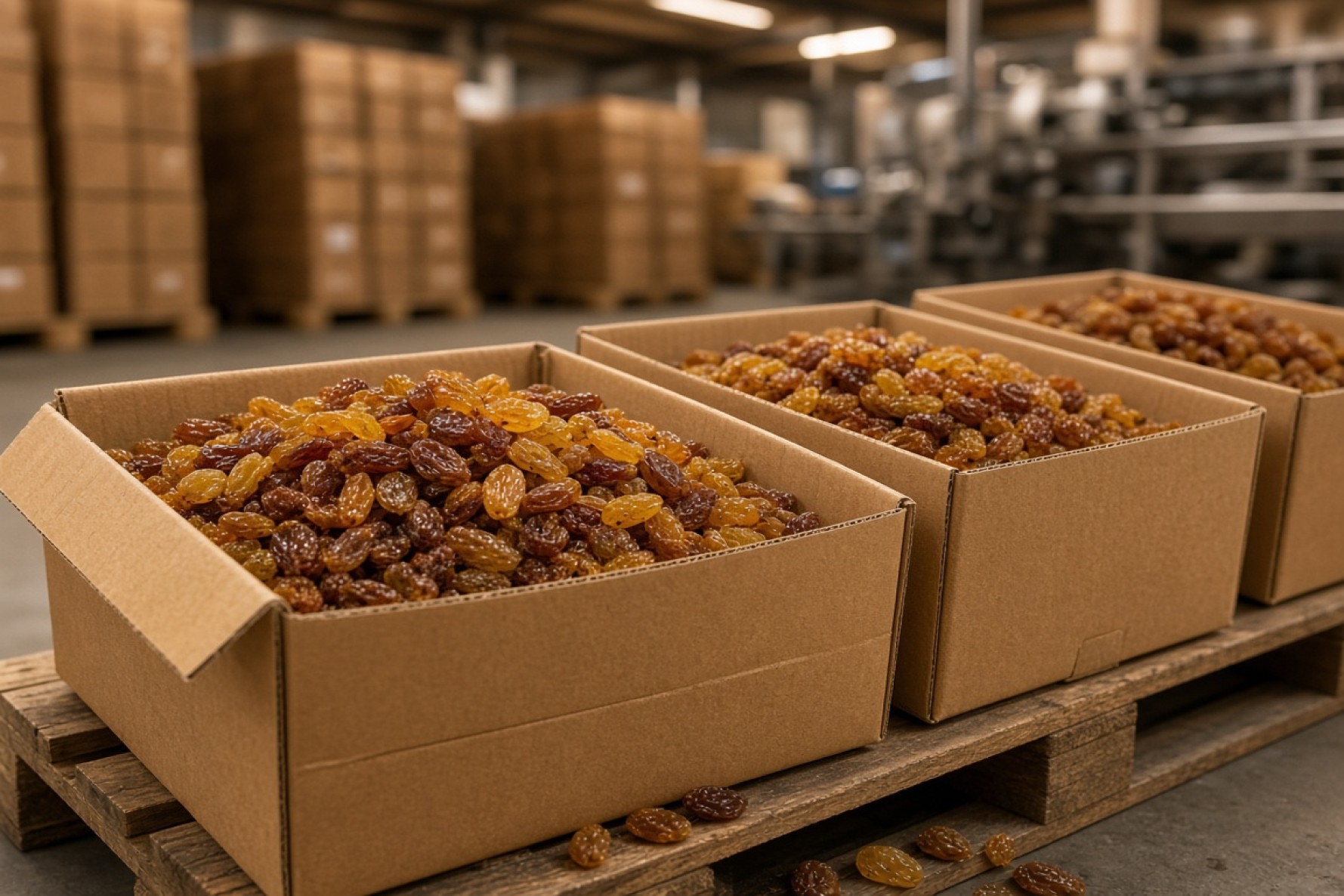
Packs must block moisture, odours and crushing. 5–10 kg cartons with food-contact liners, batch codes and storage conditions are typical.
Vacuum is not always best — choose by grade, destination and line use.
9. Transport and logistics
No mandatory cold chain, but raisins are sensitive to moisture, heat, odours and container condensation. Pre-load: dry odour-free container, no crushing, product moisture controlled.
10. Pricing and industrial use
Unit price without specs is meaningless: type, size, grade, sulfite, testing, pack, volume, destination and Incoterms all matter.
Bakeries need stable moisture and cleanliness more than premium colour; nut retail needs appearance and uniformity.
11. Importer checklist before ordering
- Define type, appearance and processing — not trade name alone.
- Seedless vs seeded explicitly.
- Numeric max moisture.
- Size; berries per 100 g when it matters.
- Sulfite cap for golden and regulated markets.
- Defect limits: stems, breakage, sugaring, foreign matter.
- Pre-order and contract reference samples.
- COA tied to production batch.
- Destination tests: MRL, OTA, aflatoxins.
- Net weight, packaging and label text before print.
- Delivery terms and risk transfer point.
- Final inspection sampling method.
- How many batches make up the order.
- Supplier capacity vs order volume.
- Lead time for sort, test and prep separate from transit.
- Pre-load container inspection.
- Written accept/reject criteria before loading.
On Iranco you can submit type, grade, pack, volume and destination so sourcing is reviewed against a clear spec.
FAQ
What types dominate Iranian export raisins?
Golden, sultana/treated, sun-dried, green and long — differing in drying, sulfite, size and use.
Is AAA a global standard?
No — use UNECE classes or numeric defect and moisture limits in contracts.
What moisture is appropriate?
UNECE 18% max for seedless; buyers often set a tighter band.
Why test sulfite on golden raisins?
Light colour links to sulfiting; the EU sets SO₂ limits and allergen declaration rules.
Key tests for EU export?
Moisture, MRLs, OTA, aflatoxin and SO₂ for sulfited product.
How to source from Iran?
Define specs, sample, then submit a structured request on Iranco.
Summary
Iranian raisin exports create real advantage when production diversity becomes standard commercial specifications. Deals should start with written technical specs — type, size, moisture, defects, sulfite, testing, packaging and delivery — so pricing and supply can be professional.
Featured Products




Related Articles



