 Iranco Dergisi Ekibi
Altın ve sultaninadan yeşil ve güneşte kurutulmuşa — sınıf, KK, varış standartları, ambalaj ve lojistik
Kuru üzüm ihracatı · Sınıf · Standart · Lojistik
İran Kuru Üzüm İhracatı: Küresel Pazarlar, Sınıflar ve Kalite Standartları
Nem, boyut, renk, sap, sülfit, mikotoksin ve ambalaj parti değerini değiştirir — ithalatçılar için rehber.
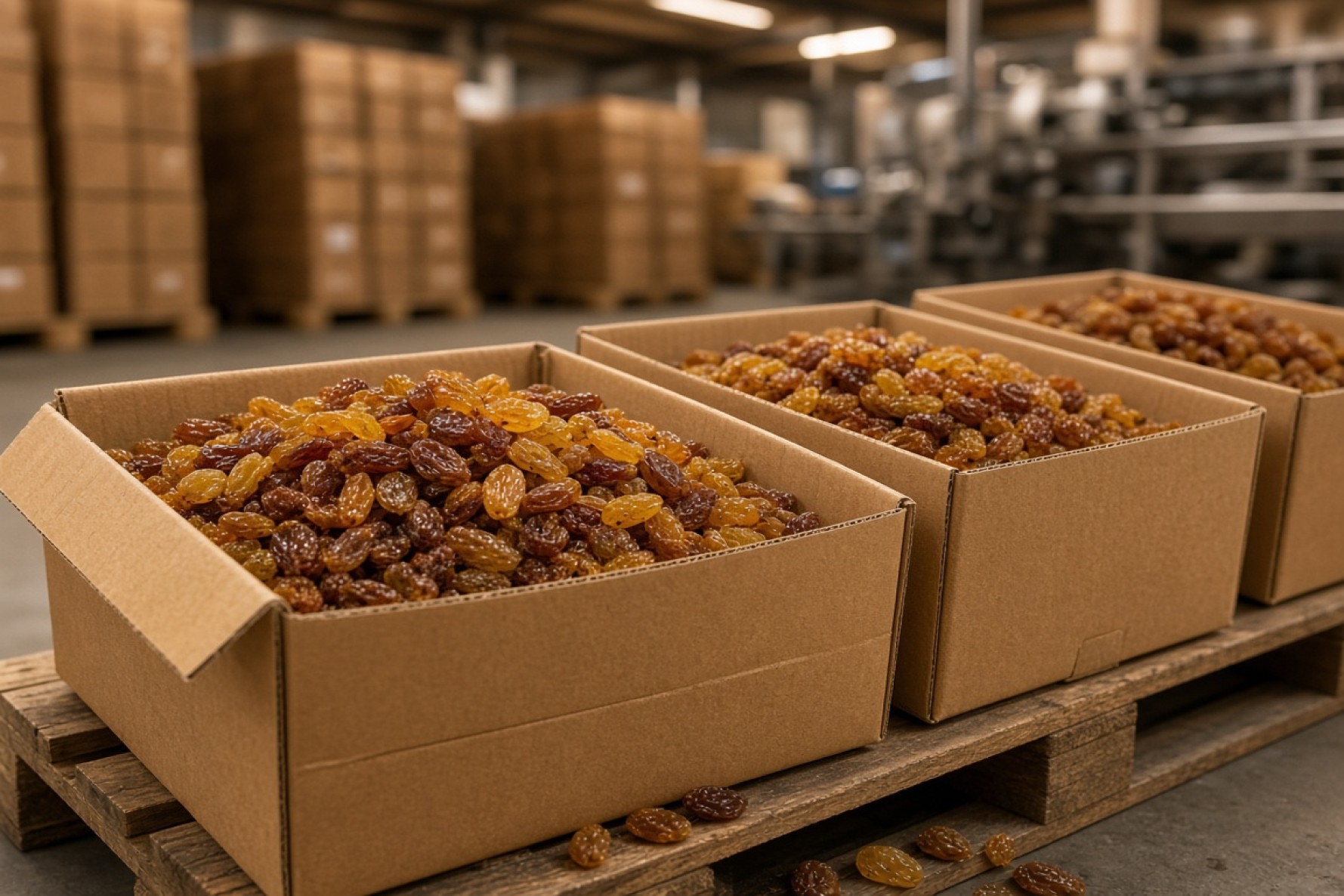
Raisins are a long-standing Iranian dried-fruit export, but sourcing is not only choosing golden, sultana or green types. Two 'export raisin' lots can differ in drying method, moisture, defects, SO₂, contamination and industrial use. Professional buying starts with a precise technical specification.
1. Iran's production and trade position
Annual output was reported at about 300,000 tonnes in 1403; Malayer, Malekan and Takestan are major hubs. Specs vary by origin.
Malekan is known for golden raisins and export processing; Malayer's Jowzan Valley heritage and Takestan for sultana/treated types. Green and long raisins target nuts and specialty retail.
Global competitors include Turkey, the USA, South Africa, Chile, China, India and Uzbekistan. Iran competes when type, processing, contaminant control and uniformity match the destination.
2. Raisin types vs grade
| Type | Colour | Processing | Use |
|---|---|---|---|
| Golden | Golden to amber | Controlled sulfiting | Retail, nuts, confectionery |
| Sultana / treated | Light to brown | Alkali pre-treatment | Bakery, cereals, industrial |
| Sun-dried | Brown to dark | Direct sun drying | Food industry, natural segment |
| Green / long | Green to yellow-green | Controlled drying | Nuts, premium packs |
Type covers drying, colour and processing; grade covers uniformity, defects and sorting. A/AA/AAA are not globally harmonised — UNECE DDP-11 uses Extra, Class I and Class II.
Golden: light appearance; residual SO₂ is critical. Sultana/treated: fast drying; bakery and volume. Sun-dried: dark colour is not automatically low quality. Green/long: shape and length drive value.
3. Technical specs before purchase
| Parameter | In contract | Importance |
|---|---|---|
| Raisin type | Golden, sultana, sun-dried, green | Application & market |
| Moisture | Numeric maximum | Shelf life & texture |
| Size | Berries per 100 g | Uniformity & price |
| Sulfite | Max SO₂ | Golden & labelling rules |
| Defects | Stems, breakage, sugaring | Contract grade |
| Testing | OTA, aflatoxin, MRLs | Strict destinations |
'Grade one' or 'AAA' is insufficient for international contracts. Define size as berries per 100 g — common in UNECE and Iranian trade.
For large orders, lock an approved sample and lab acceptance limits — appearance alone is not enough.
4. Evaluating export quality
Sound raisins keep the natural character of the type, have no off-odour and meet contract defect limits. Codex CXS 67-1981 and UNECE DDP-11 are key references.
Moisture: 18% max for seedless (UNECE) is a ceiling, not always the ideal texture. Defects (stems, sugaring, mould, clumping) need numeric limits.
5. Key laboratory tests
| Test | Why | When |
|---|---|---|
| Moisture | Shelf life & stickiness | Nearly all lots |
| SO₂ | Labelling & compliance | Golden / sulfited |
| Ochratoxin A | EU food safety | Especially Europe |
| Pesticide residues | Customs clearance | Retail & EU |
Certificates must link to the shipment batch. Codex cites 1500 mg/kg SO₂ for bleached raisins; the EU allows up to 2000 mg/kg total SO₂ for dried grapes.
Ochratoxin A: 8 μg/kg EU limit for dried grapes. Aflatoxin B1 max 2 μg/kg and total 4 μg/kg for consumer dried fruit. Pesticide MRLs need a named destination market.
6. Global markets and competition
| Market | Note | Iran position |
|---|---|---|
| European Union | Strict safety rules | Active presence; Turkey competition |
| Turkey | Exporter & importer | Key direct buyer of Iran |
| Germany / Netherlands | Industry & distribution | Quality upgrade potential |
| Kazakhstan | Regional volume | Established Iran destination |
The EU imported about 227,000 t of dried grapes in 2024; ~13,900 t from Iran. Turkey is both rival and buyer — ~11,400 t from Iran in 2024.
Germany and the Netherlands are major consumption and distribution hubs. Azerbaijan, Kazakhstan, Ukraine and Algeria are active destinations with different price structures.
7. Standards, tariff and entry rules
HS 080620 — check national subheadings for duty. UNECE: three quality classes, up to 19% moisture for berries with seeds, sizing by diameter or berry count.
EU: OTA, aflatoxin, sulfites E220–E228, allergen labelling above 10 mg/kg SO₂, pre-pack labelling and HACCP in the European chain.
8. Export packaging
Packs must block moisture, odours and crushing. 5–10 kg cartons with food-contact liners, batch codes and storage conditions are typical.
Vacuum is not always best — choose by grade, destination and line use.
9. Transport and logistics
No mandatory cold chain, but raisins are sensitive to moisture, heat, odours and container condensation. Pre-load: dry odour-free container, no crushing, product moisture controlled.
10. Pricing and industrial use
Unit price without specs is meaningless: type, size, grade, sulfite, testing, pack, volume, destination and Incoterms all matter.
Bakeries need stable moisture and cleanliness more than premium colour; nut retail needs appearance and uniformity.
Importer checklist (summary)
- Define raisin type and processing method.
- State seedless vs with seeds explicitly.
- Set a numeric maximum moisture.
- Define size as berries per 100 g.
- Set SO₂ limits for golden and sensitive markets.
- Numeric defect limits (stems, breakage, sugaring).
- Approved sample and batch-linked CoA.
- Destination OTA, aflatoxin and MRL testing.
- Confirm packaging and net weight before production.
- Written accept/reject criteria before loading.
FAQ
What types dominate Iranian export raisins?
Golden, sultana/treated, sun-dried, green and long — differing in drying, sulfite, size and use.
Is AAA a global standard?
No — use UNECE classes or numeric defect and moisture limits in contracts.
What moisture is appropriate?
UNECE 18% max for seedless; buyers often set a tighter band.
Why test sulfite on golden raisins?
Light colour links to sulfiting; the EU sets SO₂ limits and allergen declaration rules.
Key tests for EU export?
Moisture, MRLs, OTA, aflatoxin and SO₂ for sulfited product.
How to source from Iran?
Define specs, sample, then submit a structured request on Iranco.
Özet
İran kuru üzüm ihracatı, üretim çeşitliliği standart ticari spesifikasyonlara dönüştüğünde gerçek avantaj sağlar.
Öne Çıkan Ürünler




İlgili Yazılar



