 Iranco Magazine Team
Industrial capacity, semolina supply chain, strategic export destinations, quality standards and competitive balance with global trade leaders
Export Guide · Pasta · Global Markets
Iran Pasta & Macaroni Export: Target Markets and Iranian Producers’ Global Competition
Industrial capacity, semolina supply chain, strategic export destinations, quality standards and competitive balance with global trade leaders — from HS 190219 and ISIRI 213 to 40ft high-cube container loading.
This strategic report analyses Iran’s pasta industry production and trade capacity, the semolina supply chain, potential and active markets in the Middle East, Africa and Central Asia, and quality-control requirements under international standards. Trade managers, wholesale buyers and international importers gain a clear view of product technical specs, cost structure, container shipping variables and ways to optimise bulk purchase contracts.
Over the past two decades, Iran’s pasta and pasta-products industry has moved from traditional workshops with semi-industrial machinery to an advanced structure built on continuous vacuum extrusion. Ultra-high-temperature processing lines, advanced cleaning units and modern flour silos have brought national production scale to international-player level. Despite nominal capacity beyond 1.2 million tonnes per year, a substantial share of industrial lines faces spare capacity — the main incentive for factories to penetrate international markets. Geographic access to road transit corridors of eastern and western neighbours and southern ports linked to open seas creates a geo-economic position for low-cost shipment.
Iran’s fundamental pasta-export advantage rests on competitively priced energy, skilled technical labour and durum wheat farmland in fertile regions. Sustaining and growing export markets still requires precise consumer insight, currency-risk management and packaging standards fit for humid climates. Iranian producers compete with established players such as Turkey, Italy and Egypt. Technical and economic assessment shows that value-added focus, semolina granulation standardisation and cooking-quality stability are the keys to higher foreign-exchange earnings and shelf presence for Iranian brands abroad.
1. Infrastructure capacity and pasta production capability in Iran
Iran’s pasta production structure is built on heavy investment in automated grain-processing technology. Official food-industry figures indicate more than 36 large industrial units operate nationwide, including 13 complexes with fully automatic continuous lines. Installed nominal capacity exceeds 1.26 million tonnes per year, while operational annual output is recorded in the 750,000–900,000 tonne range. The gap points to at least 350,000 tonnes of unused potential that can be allocated immediately to long-term export contracts without new machinery investment.
Main production centres are concentrated in Alborz, Qazvin, Tehran, East Azerbaijan, Razavi Khorasan and Khuzestan. Leading companies have vertically integrated semolina milling into their value chain. Wheat enters storage silos, then cleaning and conditioning lines, and milled semolina moves straight to press and extrusion forming. Ultra-high-temperature (UHT) dryers sharply cut dehumidification time, optimise energy use and secure gluten network integrity plus full starch gelatinisation. Mechanical waste and breakage on the line fall below 2%.
Most active exporters hold international food-safety management certificates (ISO 22000), quality management (ISO 9001), Hazard Analysis and Critical Control Points (HACCP) and Halal marks. This technical base enables high-tonnage shipments with uniform quality across consecutive production batches.
2. Raw materials, durum wheat and the foundational role of semolina
The global pasta industry’s fundamental distinction is durum-wheat semolina versus soft wheat (noll or star) flour. Durum (Triticum durum) has a glassy kernel and high physical hardness with chemistry suited to resilient pasta. Soft-wheat flour alone cannot hold structure in boiling water and causes heavy leaching.
Modern mills extract semolina on specialised fluted rolls and multi-stage sieves. The durum-milling goal is coarse, homogeneous particles of 300–600 microns. Suitable specific surface lets water absorb evenly during mixing and prevents dense, unbalanced dough masses. Durum gluten — mainly gliadin and glutenin — forms a three-dimensional elastic network that traps starch granules during cooking and limits amylose loss into the water phase, keeping cooking water clear and strands non-sticky.
Regions such as Khuzestan, Ilam, Fars and the Moghan plain offer strong climates for high-protein durum. Natural carotenoid and xanthophyll pigments in Iranian durum endosperm give amber-yellow colour without added dyes. For highly price-sensitive markets, plants may use controlled blends of semolina with star flour plus commercial gluten and permitted enzymes to meet minimum physical indices at a lower buyer price.
3. Product diversity and industrial shapes for export pasta
International pasta demand splits by dietary habits and preparation methods into clear shape and size patterns. Iranian factories engineer dies and extrusion tooling for these preferences.
Spaghetti and long strands
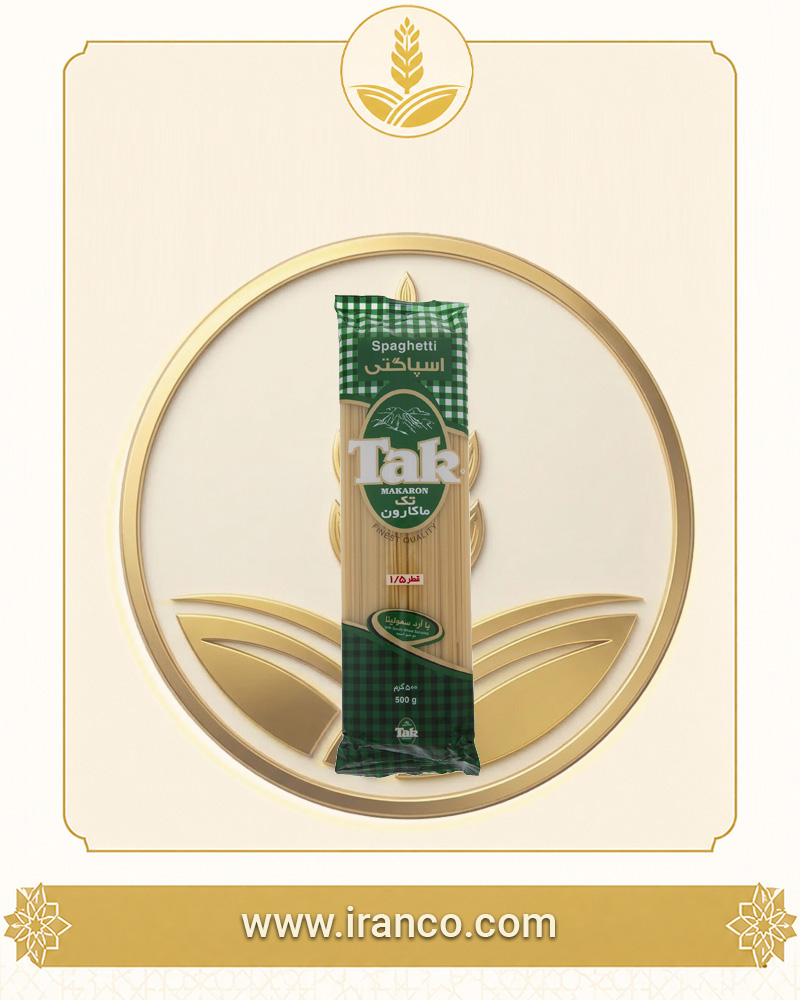
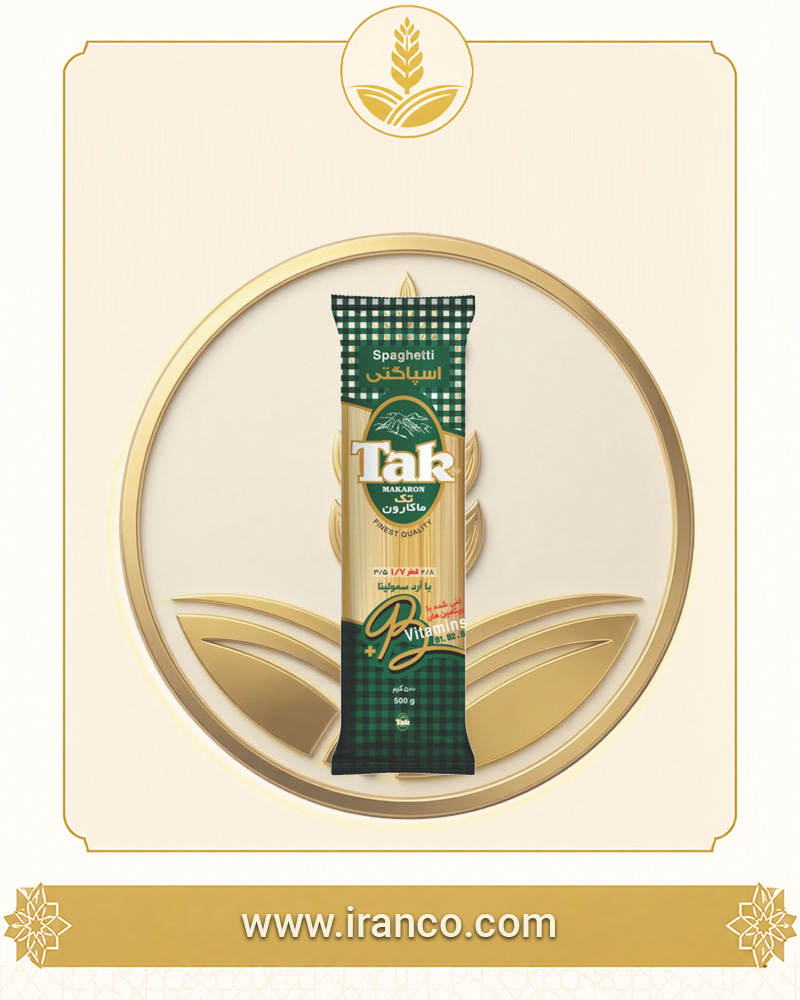
Spaghetti accounts for most of Iran’s export tonnage and is graded by strand diameter. Calibres 1.2 and 1.4 mm (“thin strands”) are highly popular in West and East Africa because cook time falls below 6–7 minutes and household fuel use is limited. Calibres 1.5 and 1.7 mm are classic standards in the Middle East, Central Asia and the domestic market, with higher physical resistance in long cooks.
Short shapes and specialty products
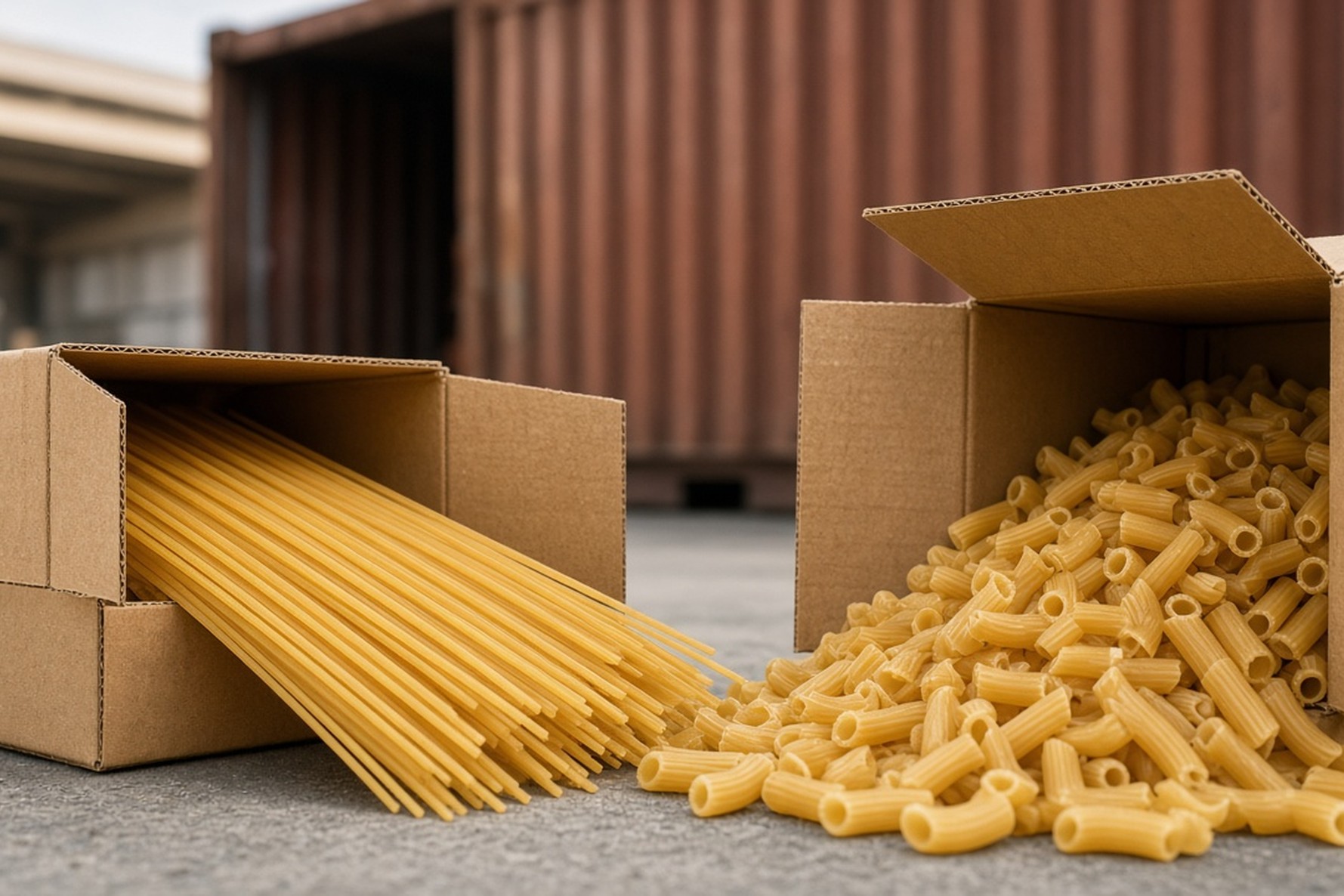
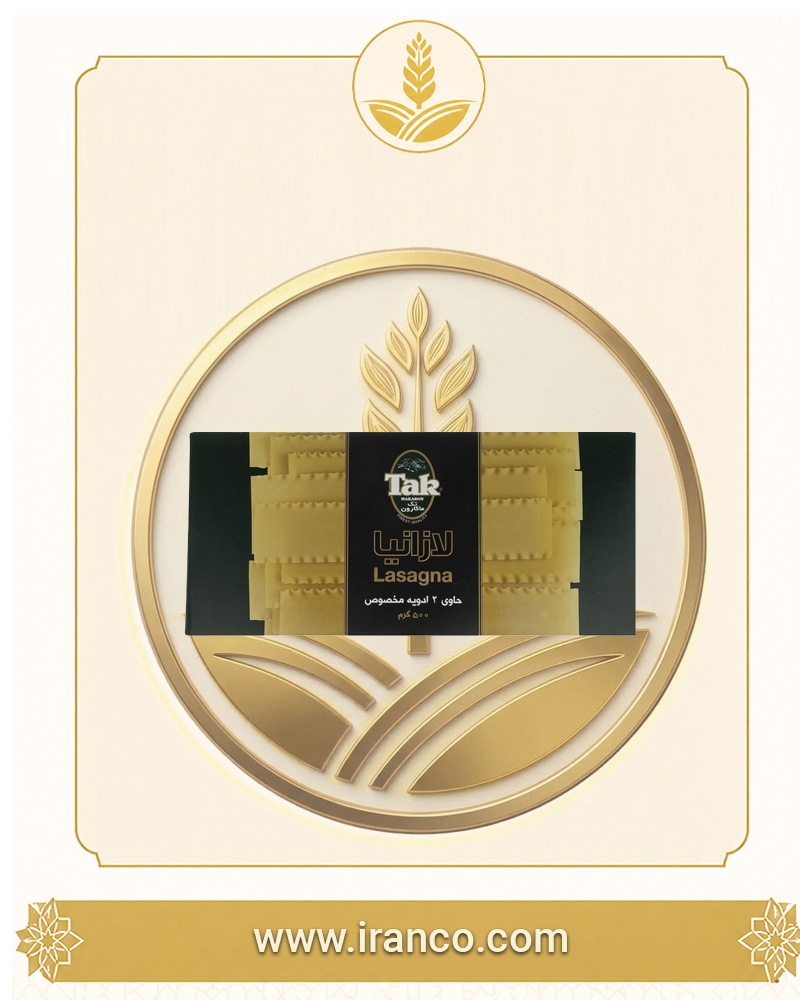
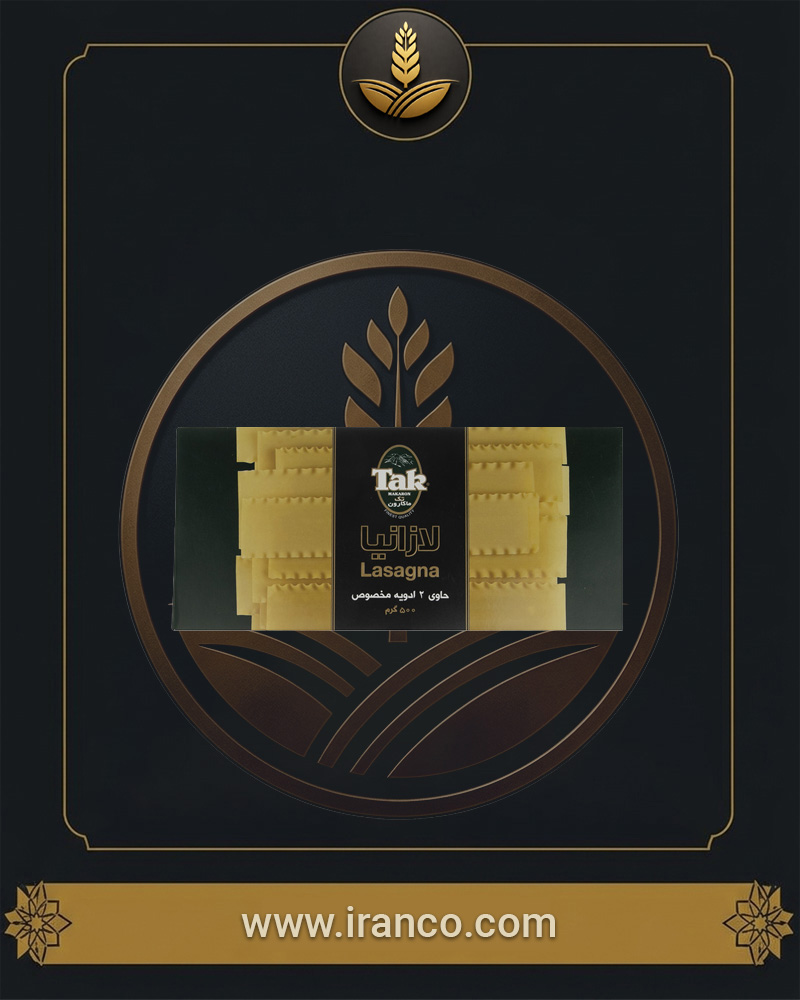
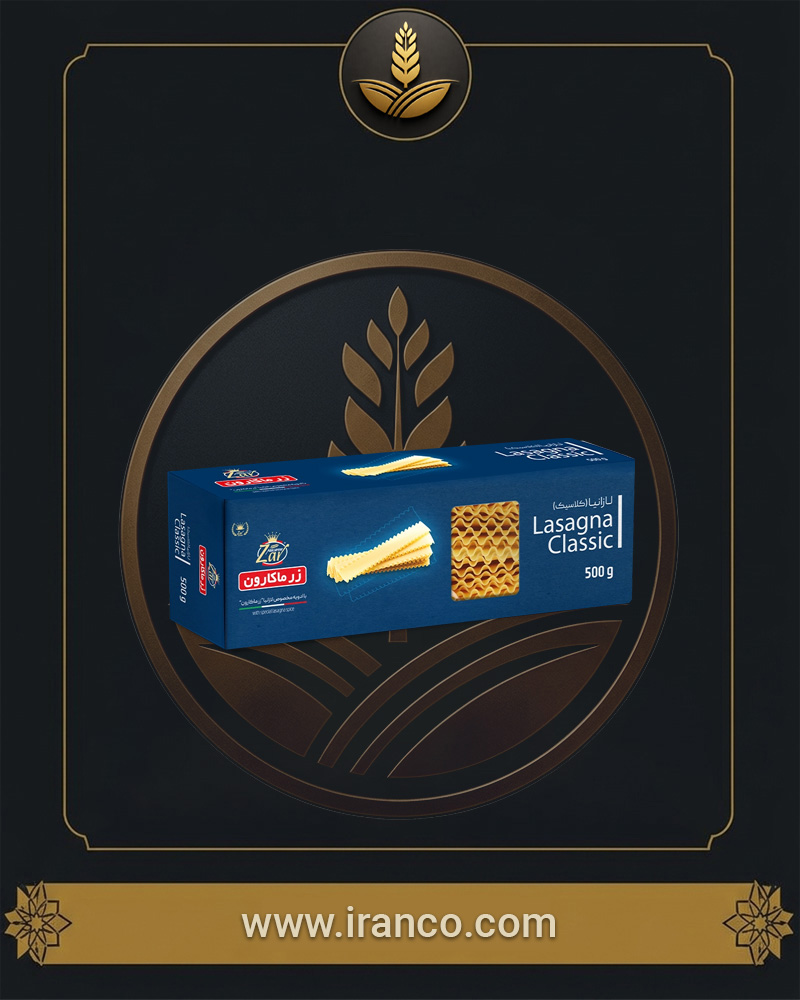
Short shapes include spiral, ridged tubular, plain tubular, screw, farfalle, shell and elbow designs. Teflon dies create a smooth, glossy, bright-yellow surface; bronze dies leave microscopic roughness that holds thick sauces better. Vermicelli and soup strands under 1 mm cover much of seasonal Ramadan demand. Sheet lasagna needing high-tensile pure semolina ships in five-layer carton boxes to prevent edge breakage.
| Form | Calibre / size | Texture & cook | Common packs | Main destinations |
|---|---|---|---|---|
| Thin spaghetti | 1.2–1.4 mm | Fast cook, soft elastic bite | 400 & 500 g | Somalia, Côte d’Ivoire, Benin, Ghana |
| Classic spaghetti | 1.5–1.7 mm | High al dente resistance | 500, 700 & 1000 g | Iraq, Afghanistan, Turkmenistan |
| Ridged short pasta | 30–40 mm length | Stable structure, regular ridges | 400, 500 & 900 g | Iraq, UAE, Oman, Georgia |
| Spiral short pasta | 25 mm curvature | Uniform wall, no thermal cracks | 400 & 500 g | Russia, Kazakhstan, Tajikistan |
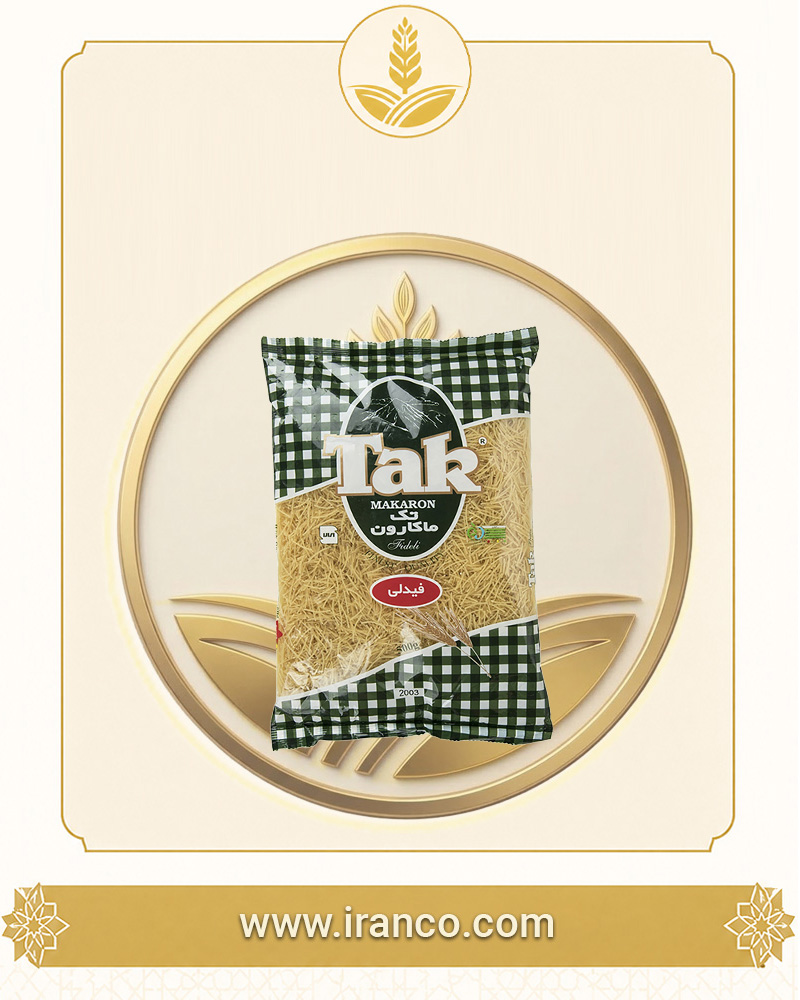
| Vermicelli & fideli | 0.7–0.9 mm | Cooks in ~3 min, clear soup | 250 & 400 g | Kuwait, Iraq, Bahrain, Qatar |
| Sheet lasagna | 0.9–1.1 mm thick | Flat or wavy, no folding | 300 & 500 g boxed | Armenia, Russia, UAE |
4. Quality standards, physicochemical indices and lab tests
In professional pasta trade, quality agreement must rest on quantitative lab tests and documented physicochemical indices. Iran’s legal reference is National Standard No. 213 (“Pasta — specifications and test methods”), aligned with Codex Alimentarius guidance.
Final moisture is a key commercial index: ISIRI 213 caps moisture at 12.0%. Keeping moisture below this limit restricts water activity and mould/spore growth on long sea voyages. Total protein on a semolina basis must not fall below 11.5% dry matter. Total ash (bran mineral content) is capped at 0.90%. For export grade-one pasta, cooking loss must not exceed 6.0% dry weight, and the product should absorb at least 2–2.5× its initial weight without collapsing.
| Control index | ISIRI 213 limit | Codex limit | Reference method | Commercial effect |
|---|---|---|---|---|
| Final moisture | Max 12.0% | Max 12.5% | Oven 105°C | Prevents mould spoilage |
| Protein (dry basis) | Min 11.5% | 10.5–11.5% | Kjeldahl (×5.7) | Texture strength |
| Total ash | Max 0.90% | 0.90–1.0% | Furnace 550–600°C | Yellow colour purity |
| Cooking loss | < 6.0% | < 7.0% | Evaporation / gravimetry | Clear cooking water |
| Titratable acidity | Max 0.05% | Max 0.05% | Titration | Process hygiene |
| Breakage index | Max 5.0% w/w | Max 5.0% | Screen separation | Visual uniformity |
| Black spots | Max 5 / dm² | Defect card | Visual grading | Freedom from foreign matter |
Visually, quality pasta must be free of fine transverse or longitudinal cracks. Stress cracks usually come from steep thermal gradients and non-standard moisture exit rates in the dryer. Cracked strands break within seconds of entering boiling water. Mechanical strength checks before export loading are part of quality control.
5. Geographic analysis of target markets: Middle East, Africa and Central Asia
Iran’s pasta export destinations cover a wide band of peripheral and extra-regional demand. Territorial proximity plus growing container liner links create different sales strategies per climate zone.
Iraq and Afghanistan
Iraq remains one of the steadiest absorption markets for Iranian food and pasta. Road access via Mehran, Parvizkhan, Shalamcheh and Bashmaq cuts transit below 48 hours and reduces capital idle time. Calibre 1.2 and 1.4 mm spaghetti and ridged short pasta in 400–500 g packs dominate. Afghanistan — via Dogharoun, Mahiroud and Milak — is a key destination for 1.5 mm spaghetti in 700 g and 1 kg packs, usually formulated in the economy grade.
Africa and Central Asia
Horn of Africa and West African countries have become dynamic outlets: Somalia (Mogadishu, Bossaso), Côte d’Ivoire (Abidjan), Benin (Cotonou) and Ghana buy thin 1.2 mm spaghetti in 500 g packs, typically as full 40ft containers from Bandar Abbas. Turkmenistan, Uzbekistan, Tajikistan and Armenia connect via Sarakhs rail or Astara / Incheh Borun road terminals, with rising demand for short shapes in metallised 900 g packs.
| Country / region | High-demand forms | Pack weight | Master carton | Sales channel | Competitors |
|---|---|---|---|---|---|
| Iraq | Spaghetti 1.2–1.4, ridged short | 400–500 g | 20 & 24 packs | Baghdad wholesalers | Southern Turkey |
| Afghanistan | Spaghetti 1.5, tubular short | 700–1000 g | 20-pack heavy | Kabul & Herat | Limited Pakistan |
| Somalia | Thin spaghetti 1.2 | 500 g | 20-count bulk | Trade consortia | Turkey & Oman |
| Côte d’Ivoire & West Africa | Spaghetti 1.2–1.3 | 500 g clear | 5-ply strong | National distributors | Turkey & Egypt |
| Central Asia | Screw, spiral, farfalle | 400 & 900 g | 12 & 20 luxury | Tashkent chains | Kazakhstan & Russia |
| Gulf | Lasagna, specialty, vermicelli | 300–500 g | Carton boxes | Hypermarkets & catering | Italy & Turkey |
Importers can send flour grade, pack weight, order volume and destination country via Iranco so matching supply options are reviewed.
6. Trade requirements, clearance documents and regional entry standards
Smooth clearance depends on structural match between shipping documents, bills of lading and health certificates and the importing country’s regulators. Any textual mismatch can cause long delays and heavy demurrage/storage losses.
For Iraq, shipments fall under pre-shipment inspection and conformity assessment (ICIGI) supervised by the Central Organization for Standardization and Quality Control of Iraq (COSQC). Competent international inspection firms sample at the plant or warehouse (moisture, heavy metals, pesticide residues, microbial load, labelling) and issue a Certificate of Conformity (CoC) required at Mehran or Umm Qasr.
GCC markets apply Gulf Standards Organization (GSO) rules; GSO 1016 sets cereal microbial limits — aerobic count, coliforms and Bacillus cereus within limits; any Salmonella in five random 25 g samples is a reject. Labelling must include destination language, net weight, brand, Gregorian production/expiry dates, batch number, storage conditions, nutrition facts, explicit “Made in Iran”, and Halal certification where required.
- 190219: Uncooked pasta, not stuffed, without egg — primary code for >95% of Iran’s dry spaghetti and short-pasta shipments
- 190211: Dry pasta containing egg
- 190220: Stuffed pasta (ravioli, tortellini)
- 190230: Other prepared pasta products such as instant noodles with dry seasoning
7. International competition matrix: Iran vs Turkey, Italy and Egypt
Sustainable Iranian presence balances price, quality and logistics against major global rivals. Middle East and Africa competition centres on Turkey and Egypt; Italy occupies the premium segment.
Turkey is the world’s second-largest pasta exporter after Italy, recently shipping about 1.3–1.5 million tonnes worth nearly USD 1 billion. Large plants in Gaziantep use temporary grain inward processing from Russia and direct access to Mersin and Iskenderun to move containers quickly across Africa. Rising wages and energy costs in Turkey, however, open competitive space for quality Iranian product. Italy manages nearly 27% of world pasta trade volume, with export prices typically USD 1.5–2.5 per kg for affluent and five-star channels. Egypt’s COMESA and AfCFTA duty exemptions favour East and Central Africa, while Iran may face 10–20% import duty in some African ports; Egypt’s weakness is soft-wheat import dependence and semolina quality volatility.
| Country | Key advantages | Constraints | Approx. FOB / t | Main reach |
|---|---|---|---|---|
| Iran | Low-cost energy, quality durum semolina, rail/road access | Banking limits & FX surrender rules | $500–650 | Iraq, Afghanistan, Africa, Central Asia |
| Turkey | Direct shipping lines, active marketing, bank facilities | Production inflation & fuel costs | $650–800 | Africa, Middle East, Latin America |
| Italy | Brand equity, bronze dies, high value share | Very high cost base | $1,500–2,500 | Europe, North America, premium |
| Egypt | COMESA / AfCFTA duty relief | Flour quality swings & grain imports | $620–750 | East, South & Central Africa |
8. Export packaging engineering and climate shelf life
Export pasta packaging must protect against moisture, direct light and handling damage, not only shelf marketing. Standard shelf life is usually 24 months from production and needs suitable polymer films. Horizontal form-fill-seal lines use clear or printed biaxially oriented polypropylene (BOPP). For humid African ports such as Cotonou or Mogadishu, dual-layer laminates with water-vapour transmission rate (WVTR) below 5 g/m²·24 h are essential. Film thickness of 35–50 microns resists puncture from sharp spaghetti ends.
Consumer packs go into five-ply heavy kraft corrugated master cartons that must survive 10–12 stacked rows in high temperature and saturated humidity. Iranian UHT dryers kill insect eggs and larvae in the dough core via thermal shock; consumer packs still need continuous airtight heat seals, and for specific destinations aluminium-phosphide fumigation of the container with an official disinfection certificate attached to the B/L.
9. Logistics analysis, transport modes and container load calculations
Pasta is relatively light and bulky, so container cube utilisation and freight per tonne directly set exporter margin. For Iraq, Afghanistan and Turkmenistan, curtain-side trailers of 22–24 t are most common; Central Asia rail uses covered wagons of 55–60 t. For Africa, East Asia and Europe, 40ft high-cube dry containers (~76 m³ internal) are the most economical. Export pasta is almost always floor-loaded without pallets: 2,000–2,200 master cartons (24–26.5 t net). Palletising wastes about 25–30% of useful volume and caps load at 18–20 t.
On Persian Gulf–Indian Ocean voyages crossing the equator, day/night temperature swings cause condensation under the metal roof — “container rain.” Mitigations include:
- Covering the top of the stow with scrap cartons or thick nylon rolls
- Hanging calcium-chloride desiccant bags to keep relative humidity below 60%
- Lining the container floor with particle board or carton rolls against metal-floor heat
| Mode | Fleet | Net capacity | Stowage | Risk control |
|---|---|---|---|---|
| Road (neighbours) | 24 t curtain trailer | 22–24 t | Manual interlocking rows | Customs seal & load straps |
| Sea floor-load HQ | 40ft dry container | 24.5–26.5 t | Fill to roof | Desiccants & roof insulation |
| Sea palletised | 40ft container | 18–21 t | 100×120 pallets | Modern hypermarkets only |
| Rail CIS | 4-axle covered wagon | 52–58 t | Even both sides | Door sealing vs rain |
10. Cost drivers and export price volatility
Final export pasta price reflects base materials, industrial processing and world grain markets. Wheat is over 90% of net pasta weight and up to 70% of cost. Exporters may buy wheat at approved industrial rates or use temporary durum imports from Central Asia and the Caspian basin. Competitive industrial gas and electricity keep energy’s share of cost well below European and Turkish peers; polymer films and cartons track crude and petrochemical prices. Large continuous runs without frequent die changes earn scale discounts. FOB Bandar Abbas or Bushehr is the most common term; suppliers able to quote destination CFR absorb liner freight volatility and often win more international RFQs.
11. Industrial use in processed foods and foodservice
- Canned and sterilised ready meals: Dense, gluten-reinforced pasta must survive autoclave at 121°C under steam without collapsing or depositing starch in the sauce.
- Catering and large restaurants: Hospitals, universities, hotels and institutions prefer 5–10 kg bulk packs. Stable cook in large kettles and non-stick hold in hot bain-marie are procurement priorities.
- Cold salads and QSR: Vegetable-powder coloured short shapes need high elasticity and texture retention with mayonnaise under refrigeration.
12. Importer checklist before placing an Iranian pasta order
- Define exact geometric form and calibre with dimensional tolerance
- Define base flour formula: pure durum semolina or allowed star-flour blend and minimum protein
- Lock physicochemical limits: moisture ≤12.0%, ash <0.90%, cooking loss <6%
- Approve film artwork and BOPP thickness (min 35–40 microns)
- Specify five-ply kraft master carton and packs per carton
- Obtain a retention sample and run a field cook test
- Agree weight tolerance (usually ±2%)
- Name the origin inspection company for quality/quantity/conformity certificates
- Check daily line capacity and delivery schedule
- Align draft certificates (origin, health, analysis, Halal) with destination customs
- Write container stowage and insulation instructions including desiccants
- Clarify Incoterms, settlement currency, demurrage free time and fund-transfer path
13. What information is needed for an accurate price?
- Product type and requested calibre
- Raw-material grade and minimum protein
- Consumer pack weight and film type
- Packs per master carton
- Total order volume (40ft HQ count or metric tonnes)
- Factory brand or buyer private label
- Delivery terms and destination port (FOB / CFR)
- Special documents and tests (CoC, consular health, fumigation)
On Iranco, price requests can be registered with the same structured data so comparable offers from verified Iranian suppliers are presented transparently.
14. Sourcing export pasta from Iran via Iranco
In pasta foreign trade, offer differences are not only about price. Semolina granulation uniformity, elastic cook behaviour, heat-seal strength, shape stability on long sea transit and precise customs-document coordination decide deal success.
Iranco is a specialised platform for access to Iran’s food manufacturing chain, connecting foreign buyers with verified producers. Importers can register technical specs — product form, strand calibre, protein %, film weight, carton type, tonnage and destination port — as an enquiry. The mechanism supports identifying capable plants, coordinating retention samples before loading, reviewing physicochemical tests and aligning standards with the target country.
If you need bulk container shipments of Iranian pasta for your target markets, register technical details and purchase volume on Iranco so production and supply feasibility can start against your specification.
15. Analytical conclusion
Iran’s pasta industry — continuous extrusion technology, hard durum farmland and energy-cost advantage — has become a regional hub for pasta products. Neighbouring Middle East markets and developing African economies offer exceptional opportunities to buy this strategic staple at economical prices. Competitive balance against Turkey still requires engineered contracts, guaranteed physicochemical indices, impermeable moisture packaging and professional container logistics. Buyers who base procurement on laboratory analytics and tight loading-point control secure durable margins and long-term supply security.
16. Frequently asked questions
1. What is the main technical difference between semolina and soft-wheat (noll) pasta?
Semolina from durum has coarser 300–600 micron particles, a strong gluten network, high protein and natural beta-carotene pigments. Soft-wheat noll flour has finer particles and weaker gluten; in long cooks it loses structure and makes cloudy, starchy cooking water.
2. Which spaghetti calibre suits African export markets best?
In West and East Africa — Somalia, Benin, Côte d’Ivoire and Ghana — thin spaghetti of 1.2–1.4 mm is most demanded. Short cook times (~5–7 minutes) save household cooking energy and match local preferences.
3. What is the maximum pasta load in a 40ft high-cube container?
With manual floor loading (no wooden pallets), 2,000–2,200 standard master cartons equal about 24–26.5 t net. Pallets create dead space and limit tonnage to 18–21 t.
4. Which documents are mandatory for legal clearance in Iraq?
Certificate of origin, stamped commercial invoice, international B/L, official health certificate and — most critically — a Certificate of Conformity (CoC) from inspection firms trusted by Iraq’s standards body (COSQC).
5. How can export pasta be sourced directly from Iran?
Define calibre, flour type, pack dimensions and loading destination; test a physical sample; then contract. International buyers can also submit these specs as a purchase request via Iranco so Iranian supply options are reviewed against their need.
6. What causes fine cracks on pasta strands?
Thermal shock and improper drying. When the moisture gradient between surface layers and the strand core exceeds limits, mechanical stress creates hairline cracks that shatter strands during cooking.
7. What is the standard shelf life of export dry pasta?
With moisture below 12.0%, dual-layer impermeable BOPP packs and dry ventilated storage, shelf life is 24 months (two years).
8. What information is required for an accurate Iranian pasta price?
Product type, calibre, flour type (semolina or soft), pack weight, container volume and delivery port. On Iranco, price requests are also registered on this basis so suitable suppliers can be compared.
Featured Products
Related Articles



