 Iranco Magazine Team
From tomato paste, canned goods and juice to biscuits, chocolate, pasta and dairy — technical product differences, export markets, quality control, packaging and professional ordering requirements
Iranian Packaged Food · Differences · Export Markets
Iranian Packaged Foods: Types, Technical Differences, and Key Export Markets
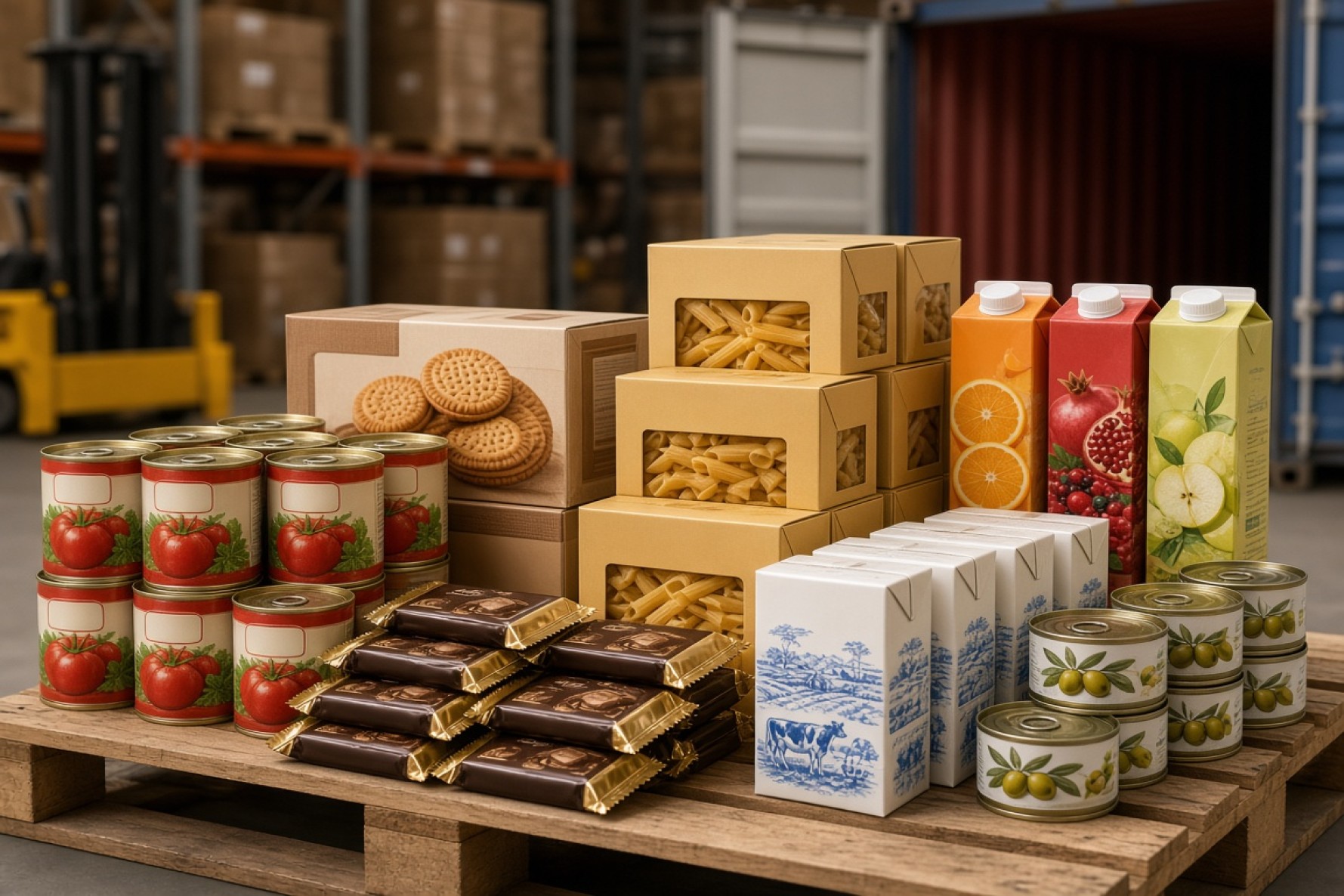
From tomato paste, canned goods and juice to biscuits, chocolate, pasta and dairy — Iranian packaged foods cover a wide range of dry, canned, dairy, beverage, confectionery and ready-meal products. For a foreign buyer, differences among these products are not only about taste or brand name; preservation technology, shelf life, packaging, shipping conditions, laboratory specifications and destination-market regulations directly affect supplier choice and final price.
Introduction: Iran's Packaged Food Sector Is Not a Single Market
Iran's packaged food sector cannot be treated as one market. A can of tomato paste, a biscuit pack, processed cheese, a juice pouch and a jar of pickles may all sit on the same retail shelf, but for the factory, bulk buyer and importer they are five completely different products.
In paste and canned goods, thermal processing, seam integrity and microbial stability are central. In biscuits and wafers, moisture, crispness, fat oxidation and pack barrier performance against water vapour are decisive. In chocolate, temperature control and prevention of fat bloom matter. In dairy, product type determines whether a cold chain is required or ambient transport is acceptable. In juice, formulation, juice percentage, thermal process and packaging type directly affect shelf life and target market.
Iran's export structure also shows how important regional markets are for this industry. In FY 1402, Iraq, Afghanistan, the UAE, Turkey, Turkmenistan, Pakistan, Russia, China, Azerbaijan and Uzbekistan were among the main destinations for Iranian food-industry exports. Iraq alone absorbed a very large share.
Published data for FY 1403 put total exports of Iranian food-industry products at more than 2 million tonnes. Even so, a professional exporter or importer should not evaluate Iran's food market with the phrase "Iranian product" alone. Buying should start with precise product definition: formulation, net weight, raw-material quality, laboratory specifications, pack type, label language, remaining shelf life at delivery, units per carton, pallet conditions and, finally, destination market.
1. What Product Groups Do Iranian Packaged Foods Include?
From a commercial perspective, Iranian packaged foods are best classified by production technology and storage method, because that determines how a product is tested, packed and shipped.
Sterilised and canned products
Tomato paste, canned beans, peas, some ready meals, compote, pickles and similar products fall in this group. The main advantage of many of these products is the ability to store them at ambient temperature until the end of the shelf life set by the manufacturer. For importers, can or container integrity, seam condition, net weight, drained weight where relevant, formulation, raw-material quality and microbial stability matter more than the appearance of the master carton.
Dry cereal-based products
Pasta, noodles, biscuits, wafers, crackers and part of the industrial bakery range belong here. These products usually do not need a cold chain, but moisture is their main enemy. A pack that performs well at the factory may lose quality on a humid sea route, in a hot warehouse or in a container with condensation.
Confectionery, chocolate and sugar products
Chocolate, toffee, hard candy, gaz, some industrial sweets and cocoa-based products are an important value-added segment. Unlike dry biscuits, chocolate is more sensitive to heat in transit. Season of shipment, container choice, warehouse conditions and border dwell time can therefore affect appearance and texture.
Beverages and juice
Juice, nectar, fruit drinks, non-alcoholic beverages and some syrups are produced in bottles, cans or multilayer packs. In this group, the word "juice" should not be used generically in a purchase request. The buyer must specify whether the product is juice, nectar or a fruit drink and what formulation is required.
Packaged dairy
This group is highly diverse: milk, cheese, yoghurt, doogh, cream, milk powder and other dairy products do not share the same conditions. Some require a cold chain, while others are designed for ambient storage through process and packaging. The phrase "export dairy" is therefore not enough for pricing enquiries.
Sauces, condiments, pickles and processed vegetables
Tomato sauce, various sauces, pickles, processed olives, pickled vegetables and processed greens fall here. Acidity, salt level, formula composition, pasteurisation or sterilisation method and pack compatibility are important in this group.
2. What Are the Main Differences Between Iranian Packaged Food Types?
The most important difference is the method used to create shelf life. A product may be stabilised through moisture reduction, thermal processing, acidification, permitted preservatives, impermeable packaging, chilling or a combination of these methods.
| Product group | Main stability factor | Common packaging | Main sensitivity |
|---|---|---|---|
| Paste and canned goods | Thermal process and sealed pack | Can, glass, pouch or industrial pack | Leakage, swelling, corrosion, contamination |
| Pasta | Low moisture | Flexible wrap and carton | Moisture, breakage, storage pests |
| Biscuits and wafers | Low moisture and protective pack | Multilayer wrap, tray, carton | Moisture uptake, crushing, oxidation |
| Chocolate | Formulation and storage control | Multilayer wrap, box | Heat, bloom, texture change |
| Juice | Thermal process and packaging | Bottle, can, multilayer pack | Fermentation, colour change, leakage |
| Chilled dairy | Refrigeration | Polymer containers and carton | Cold-chain failure |
| Shelf-stable dairy | Thermal process or drying | Multilayer pack, can, bag | Moisture ingress, pack damage |
| Pickles and cucumbers | Acidity, salt and thermal process | Glass, polymer containers | Leakage, cloudiness, texture change |
These differences have a practical consequence for importers: comparing two offers on price per tonne or per carton alone is not logical. A cheaper product may have weaker packaging, different raw materials, shorter remaining shelf life, lower net weight or more complex shipping requirements.
Consumer packs and industrial packs
Another source of difference is target market. Tomato paste may be sold in cans or jars for retail or in large industrial packs for food factories. In the latter case, the buyer may care more about concentration, colour, pumpability, aseptic process and batch uniformity than outer-pack design. The same logic applies to fruit purée, dairy powders and some food-industry raw materials.
3. Iran's Most Important Exported Packaged Foods
FY 1403 data show dairy products, tomato paste, various food pastes, juice and compote, and biscuits and wafers among the largest export items in Iran's food industry. More than 780,000 tonnes of milk and dairy products, more than 216,000 tonnes of tomato paste, more than 178,000 tonnes of various food pastes, more than 163,000 tonnes of juice and compote, and more than 144,000 tonnes of biscuits and wafers were exported.
Tomato paste
Paste is one of Iran's best-known export products. Iran produces both retail packs and industrial paste that can be used as raw material in sauce, ready-meal, soup and other products. In 2024 trade data, Iraq was one of the main buyers of Iranian products under prepared or preserved tomato headings. Italy, Turkey and Armenia also appear among markets that imported from Iran in this group.
Biscuits and wafers
This segment matters strongly for retail export because the product competes directly on brand, pack design, units per carton, unit weight and consumer price. 2024 data for sweet biscuits, waffles and wafers show Iraq, by a wide margin, as one of the main markets for Iranian products in this group. Azerbaijan, Yemen and some European markets also recorded imports from Iran.
Pasta and food pastes
Pasta's export advantage is mainly linked to large-scale industrial production, good shelf life and the ability to ship without a cold chain. Iraq is a clear market for Iranian pasta, but trade in this group is not regional only. 2024 data for egg-free pasta also show imports from Iran into Kenya and Tanzania.
Chocolate and confectionery
In this segment, brand, flavour, consumer weight, fat type, cocoa content, pack design and resistance to heat in the distribution chain matter greatly. In recorded 2024 trade, Iraq was the main market for Iranian cocoa products under heading 1806, followed by Azerbaijan, Oman, Bahrain, Armenia and several other markets. For sugar confectionery without cocoa, Iraq, Azerbaijan, Uzbekistan, Bahrain and Oman also appear in 2024 import data from Iran.
Juice and compote
This group is highly heterogeneous in technology and market. Consumer juice, concentrate, compote and fruit purée should not be confused in commercial buying. For retail product, unit weight or volume, formula, flavour, sweetener type, pack design and label language are highly important. For industrial raw material, physicochemical specifications and performance on the buyer's production line matter more.
4. What Technical Specifications Should Buyers Fix When Ordering?
A common mistake is to send a request using phrases such as "export paste", "Iranian biscuits" or "quality juice". These expressions cannot be priced accurately. A professional purchase request should convert the product into measurable specifications wherever possible.
| Product | Important request specs | Why it matters |
|---|---|---|
| Tomato paste | Concentration, salt, pack type, net weight, colour, industrial or retail use | Defines quality and application |
| Pasta | Shape, raw material, pack weight, cooking resistance, breakage % | Defines market and quality |
| Biscuits | Flavour, weight, fat/oil type, units per pack, wrap type, breakage % | Defines shelf life and price |
| Wafers | Layer count, cream type, flavour, weight, wrap structure | High moisture sensitivity |
| Chocolate | Product type, composition, filled or plain, weight, pack, shipping conditions | Price and stability control |
| Juice | Drink type, flavour, juice %, pack volume, pack type | Prevents formula ambiguity |
| Cheese | Product group, fat %, weight, pack shape, storage conditions | Large formula and logistics differences |
| Pickles and pickled vegetables | Product size, brine formula, net weight, drained weight, container | Defines deliverable quality |
| Canned goods | Formula, net weight, drained weight if relevant, can type, units per carton | Order uniformity control |
The commercial sample must represent real production. Buyers should review a sample before the main order, but sample approval alone is not enough. The contract must define how the commercial shipment should match the approved sample. Colour, aroma, weight, pack dimensions, formula, texture characteristics and key laboratory parameters should be recorded.
5. How Is Packaged Food Quality Evaluated?
Quality control should be done at three levels: product, packaging and shipment.
Paste and canned goods control
In tomato paste, soluble solids, colour, pH, salt and microbial characteristics are important parameters. In canned products, seam condition and container integrity must also be checked. Swollen, leaking or abnormally deformed cans are not acceptable for a commercial shipment even if the print looks good. In canned goods, confirmation of the thermal process and commercial sterility is fundamental.
Biscuit and wafer control
Biscuits and wafers should be checked for moisture, texture, baking uniformity, odour and flavour, fat condition and breakage percentage. Wafers are especially sensitive to moisture uptake. If the wrap does not provide an adequate barrier against water vapour, the product may lose desirable crispness before the end of its nominal shelf life.
Chocolate control
Surface appearance, uniformity, melt, flavour and fat stability matter. Surface bloom may result from poor process conditions or temperature swings in storage. For exports to hot markets, even sound factory product may be damaged in poor transit. Chocolate quality is therefore not only a production-lab issue; distribution-chain design is part of quality control.
Beverage and juice control
Brix, acidity, pH, composition, microbial characteristics, colour and flavour are common evaluation indices. Packaging must also be checked for leakage, deformation and closure integrity.
Dairy control
Required parameters depend on the product. Fat, protein, dry matter, microbial characteristics and, where relevant, veterinary drug residues or specific quality indices become important. For chilled product, recording and controlling transport temperature is part of shipment quality specifications and should not be separated from the contract.
| Defect | Sensitive products | Commercial message |
|---|---|---|
| Moisture uptake | Wafers, biscuits, powders | Loss of crispness or clumping |
| Leakage | Juice, pickles, canned goods | Spoilage and returns |
| Breakage | Biscuits, wafers, pasta | Retail value loss |
| Fat oxidation | Snacks, biscuits, nut products | Off odour and flavour |
| Can swelling | Canned goods | Serious rejection risk |
| Temperature swings | Chocolate and sensitive dairy | Texture and appearance change |
| Incorrect date printing | All products | Clearance or sales problem |
| Net weight mismatch | All products | Contractual and regulatory dispute |
6. Which Countries Import Iranian Packaged Foods Most?
Main markets depend on the product, but Iran's food-industry export data show neighbouring countries and regional markets playing a dominant role. In FY 1402 statistics, Iraq, Afghanistan, the UAE, Turkey, Turkmenistan, Pakistan, Russia, China, Azerbaijan and Uzbekistan were among the top ten destinations for Iran's food industry. Iraq's share of food-industry exports that year was reported at 41%.
Iraq
Iraq is the most important regional market for many Iranian packaged foods. Land distance, truck transport and relative consumer familiarity with Iranian products make entry easier for Iranian producers than distant markets; but intense competition and high price sensitivity make pack weight and price structure very important. From 2023, Iraq's general labelling requirements state that products must be labelled in Arabic or in Arabic and English.
Afghanistan
Afghanistan is a significant market for everyday consumer products, beverages, biscuits, confectionery, pasta, dairy and some canned goods. Consumer unit price and pack size matter strongly in this market.
UAE and GCC countries
The UAE is both a domestic consumption market and an important redistribution hub for food trade. For GCC markets, GSO regulations matter. GSO 9:2022 on prepackaged food labelling replaced the 2013 version. In the UAE, imported foods must also be registered in the relevant national food registration and validation system before market placement.
Russia and the Eurasian Economic Union
Entry into Russia requires more regulatory preparation than Iran's traditional markets. TR CU 022/2011 sets food labelling requirements. For Russia, mandatory information must be provided in Russian. General food-safety requirements must also be reviewed alongside product-specific regulations for that product group.
Azerbaijan and Central Asia
Iranian biscuits, wafers, confectionery, chocolate and some other foods are present in Azerbaijan and Central Asian countries. 2024 data show Azerbaijan as a notable buyer of Iranian biscuits and wafers, chocolate and sugar confectionery. Uzbekistan also has visible trade in Iranian sugar confectionery.
Europe
Europe is not equally accessible or suitable for all Iranian products. Prepackaged food labelling in the EU falls under Regulation (EU) 1169/2011. For foods of animal origin, correct labelling alone is not enough; the country and production unit must meet the relevant entry conditions and approvals for that product group.
| Market | Notable product groups | Key buyer note |
|---|---|---|
| Iraq | Dairy, paste, biscuits, chocolate, pasta, canned goods | Price, Arabic label, land transport |
| Afghanistan | Biscuits, beverages, pasta, dairy, confectionery | Consumer weight and unit price |
| UAE | Wide range of consumer products | Product registration and compliant labelling |
| Oman and Bahrain | Confectionery, chocolate and other foods | Packaging and GCC market fit |
| Russia | Foods capable of EAEU compliance | Russian label and technical conformity |
| Azerbaijan | Biscuits, wafers, chocolate and confectionery | Regional competition and packaging |
| Central Asia | Confectionery, dry products and some preparations | Distribution network and freight cost |
| East Africa | Some food pastes in particular | Price, sea freight and pack strength |
| Turkey and Italy | Part of tomato preparations | More industrial nature in some deals |
7. Regulations, Labelling and Export Documents
Exporting packaged food without designing the label for the destination market is one of the most expensive trading mistakes. Printing a generic pack and then trying to adapt it to several different markets may require corrective labels, clearance delays or even repacking.
Core label information
Depending on country and product, items such as food name, ingredients, allergens, net quantity, manufacturer, country of origin, production date, expiry or best-before date, storage conditions, nutrition information, instructions for use and importer details may apply. Order, language and format of this information must be checked for the destination country.
Food claims
Phrases such as "sugar-free", "high protein", "natural", "low fat" or health claims should not be printed on packs for marketing appeal alone. Claims must match product formulation and destination regulations.
Factory certificates
Standards such as ISO 22000 and HACCP can matter in assessing a food-safety management system and supplier capability, but a management certificate does not replace compliance with the legal product requirements of the destination country. Professional buyers should keep two matters separate: the factory system shows the producer has defined control and management processes; product conformity shows the specific goods to be imported meet the law and standards of the destination market.
8. Important Tariff Codes for Packaged Foods
The phrase "packaged food" has no single tariff code. Each product is classified in a different chapter and heading according to composition and processing method.
| Group | Sample HS code | Note |
|---|---|---|
| Milk and cream | 0401 and 0402 | Depends on concentration and product traits |
| Cheese | 0406 | Subheading varies by cheese type |
| Sugar confectionery | 1704 | Sugar products without cocoa |
| Chocolate | 1806 | Chocolate and cocoa-containing products |
| Pasta | 1902 | Various pasta types |
| Biscuits and bakery products | 1905 | Includes multiple subgroups |
| Processed tomatoes | 2002 | Includes part of paste products |
| Vinegar pickles | 2001 | Vegetables and fruit preserved in vinegar |
| Jam and cooked purée | 2007 | Jam, jelly, marmalade and some purées |
| Juice | 2009 | Fruit and vegetable juices |
| Sauces and condiments | 2103 | Sauces and condiment preparations |
| Non-alcoholic beverages | 2202 | Specific beverage subgroup |
These codes are shown at group level. Final six-, eight- or longer-digit classification must be based on actual composition, processing method and the destination country's tariff system. Two products both called "sauce" in the market may not share the same customs classification if composition or nature differs.
9. Export Packaging: Attractive Appearance Is Not Enough
Packaging must perform four tasks at once: preserve quality, survive transport, communicate legal information and support sellability.
Metal cans
Common for paste, canned goods and some thermally processed products. Can quality, suitable internal coating, seam integrity and corrosion resistance matter. In export, the master carton must be designed so cans do not deform under pallet pressure or route vibration.
Glass
Used for pickles, sauces, jam and some higher-value retail products. Visibility of product and good chemical resistance are advantages, but weight and fragility increase shipping cost. Proper dividers inside the carton are essential.
Flexible packs
Biscuits, wafers, snacks, pasta and many dry products are sold in polymer or multilayer wraps. Pack structure must match sensitivity to oxygen, moisture, light and fat. Thickness alone does not guarantee better performance; material and layer structure matter.
Multilayer beverage packs
Widely used for some shelf-stable beverages. Product, filling process and packaging should be designed as one integrated system.
Industrial packs
Paste, purée, concentrate and some raw materials may be supplied in larger containers for factory buyers. In these deals, the buyer must specify pack type, net weight and unloading conditions.
Master cartons
Export cartons should not simply be the domestic-market printed version. Units per carton, gross weight, compression strength, pallet-compatible dimensions, shipping information, batch code and legibility of specifications must all be reviewed.
10. Shipping and Logistics for Packaged Foods
Most of Iran's dry and canned products can reach nearby markets by truck and more distant markets by sea container. Chilled dairy and some chocolate or sensitive products may require tighter temperature control.
Land transport
Land transport matters strongly for Iraq, Afghanistan, Turkey, Azerbaijan, Armenia and part of Central Asia. Its advantage is relatively short transit time and the ability to send more varied loads. Border delays, seasonal conditions and ambient temperature must be considered in transport design.
Sea transport
For the Gulf, Africa and distant markets, sea freight is more economical. Product may remain in a container for a considerable period. Heat, humidity and internal container condensation can affect cartons and product. Weak cartons lose strength in humid conditions and pallet pressure can collapse lower rows.
Reefer containers
Not every packaged food needs a reefer container. Unnecessary use increases freight cost. Conversely, if the product must be kept in a controlled temperature range according to manufacturer specifications, saving money by removing the cold chain can put the entire shipment at risk. For chocolate, route conditions should be reviewed separately.
Loading
Before closing a container or truck, carton count, pallet condition, pack integrity, batch code, dates and visible condition should be recorded. Loading photos are especially useful in new orders for resolving possible transit-damage disputes.
11. How Is Iranian Packaged Food Pricing Determined?
For most of these products, stating one "Iran export price" has little precise commercial meaning. Even two apparently similar packs can have very different factory prices.
- Product formula and raw-material quality
- Net weight
- Packaging type and structure
- Units per carton
- Generic print or private label
- Order volume
- Number of different SKUs in one order
- Requested tests
- Palletised or unpalletised loading
- Destination market and dedicated label
- Domestic freight to border or port
- Delivery terms
- Cold-chain requirement
- Production timing and delivery schedule
In products such as chocolate, biscuits and beverages, private-label packaging design can carry a separate upfront cost. If order volume is low, that cost will have a larger effect per unit.
Buyers should state at minimum the exact product name, technical specifications, flavour or formula, weight per pack, packaging type, required quantity, factory brand or private label, label language, destination country, delivery city or port and transport mode. Buyers can include this information when submitting a purchase request on iranco.com so supply options are reviewed against actual order specifications.
12. 18-Point Importer Checklist Before Placing an Order
Before buying a main shipment of packaged food from Iran, the following should be reviewed:
- Define the exact product name and group.
- Record required formula or technical specifications.
- Confirm net weight per unit.
- Specify units per carton.
- Review a pre-production or production-line sample.
- Set measurable product acceptance criteria.
- Define required pre-loading tests.
- Align label language and content with destination regulations.
- Approve final print artwork before pack production.
- Set acceptable production date and minimum remaining shelf life at delivery.
- Review master-carton dimensions and gross weight.
- Specify palletisation or loading method.
- Verify real factory capacity for the order volume.
- Record production schedule and shipment readiness date.
- Set transport temperature conditions if the product is sensitive.
- Define delivery terms and point of responsibility transfer.
- Check destination-country documents before final production.
- Write contract rules for non-conforming or damaged packs.
This checklist matters even more for private-label orders, because correcting design errors after high-volume printing of wraps, cartons or labels is costly.
Supply Path for Packaged Foods from Iran
In international packaged-food buying, the gap between two offers is usually more than price. Formula, net weight, raw-material quality, pack structure, units per carton, production timing, remaining shelf life, shipping conditions and the factory's ability to prepare destination-market documents must all be reviewed together.
Supply should therefore start with clear purchase specifications. For example, "50 g chocolate biscuits with private label for the Iraq market" is far more precise than "export biscuits". The same principle applies to paste, pasta, chocolate, juice, canned goods and dairy.
Iranco (iranco.com) can be used to submit purchase requests for Iranian food-industry products. Importers can state product type, technical specifications, pack weight, order volume, destination market and packaging requirements so supply options can be reviewed against that need.
For supply review, it is best to include product information, approximate order volume, packaging type, destination and whether private label is required from the start of the request.
Conclusion
Iranian packaged foods are not a single commercial group. Products such as paste, canned goods, biscuits, wafers, pasta, chocolate, juice and dairy each have different production structure, quality risk, packaging and export market.
Export data show dairy, tomato paste, food pastes, juice and compote, and biscuits and wafers as major export groups in Iran's food industry. At market level, Iraq holds a very prominent position, but Iran also ships products such as chocolate, confectionery, biscuits, pasta and tomato preparations to markets across the Caucasus, Central Asia, the Gulf, Europe and even East Africa.
For importers, the key decision is not which factory "has export product". The right question is which supplier can deliver defined specifications, repeatable quality, route-appropriate packaging, destination-compliant labelling and a reliable production schedule.
The further a purchase request moves from descriptive language toward measurable parameters, the more reliable price comparison becomes. Net weight, formula, laboratory specifications, pack structure, units per carton, remaining shelf life and delivery conditions should be clear before final supplier selection.
Frequently Asked Questions (FAQ)
Which Iranian packaged foods have the highest export volumes?
Among major food-industry groups, dairy products, tomato paste, various food pastes, juice and compote, and biscuits and wafers have significant export volume. The exact export mix changes each year, so statistical period and product-group definition should be specified when analysing the market.
Which country is the main buyer of Iranian food products?
Iraq is one of the most important and, for many groups, the largest market for Iran's food industry. In FY 1402 statistics, it accounted for 41% of Iran's food-industry exports. However, the main market differs by product and the overall food-industry share should not be applied to every product group.
Are all Iranian packaged foods exported without a cold chain?
No. Pasta, many canned goods, paste, biscuits and dry products are usually designed for ambient storage, but a large share of dairy and other perishable foods require a cold chain. The conditions stated by the manufacturer for that specific product should be the basis for shipping.
What specifications should be fixed when buying Iranian tomato paste?
The buyer should specify industrial or retail use, required concentration, salt level, expected colour, pack weight, pack type, order volume and destination market. In industrial buying, physicochemical traits and aseptic or other industrial pack type become especially important.
What matters for exporting food products to the UAE?
The product must be ready in terms of labelling and registration for the UAE market. GSO 9:2022 is an important regional framework for prepackaged food labelling, and in the UAE food registration before market placement is part of the official control structure.
What labelling do Iranian foods need for Russia?
Products must meet Eurasian Economic Union technical regulations, including TR CU 022/2011 on labelling. For Russia, mandatory information must be in Russian. Manufacturer, importer, ingredients, date, shelf life and storage conditions are among the key label items.
Is ISO 22000 enough for food export?
No. ISO 22000 relates to food-safety management and can help assess a factory, but it does not replace product regulations and legal requirements in the importing country. The product must separately comply on composition, contaminants, labelling, packaging and other destination-market requirements.
How can packaged foods be sourced directly from Iran?
First define product type, technical specifications, weight per pack, required quantity, packaging type, destination country and delivery terms. Then review sample and product documents and, after approval, define the commercial order. International buyers can submit these specifications through Iranco as a purchase request.
What factors affect the price of Iranian packaged foods?
Formula, raw materials, net weight, quality, pack type, order volume, private-label printing, units per carton, tests, delivery terms and freight cost are main drivers. Two products with similar appearance are not necessarily comparable unless technical specifications and packaging are identical.
Related Articles



