 Iranco Magazine Team
Technical specs, international standards, industrial calibration, cold-chain management and dried-nut trade patterns
Export Guide · Tree Hazelnut · Wholesale Markets
Iran Hazelnut Export: Target Markets and Wholesale Buyer Requirements
Technical specs, UNECE DDP-04 mm calibration, aflatoxin control, MAP/vacuum packing, Gulf and EAEU markets and wholesale checklists — for tree hazelnut (not pistachio “Fandoghi”).
Introduction
Iranian hazelnuts are among the most valuable items in the country’s dried-nut export basket. With sorting, quality control and standard packaging they can take a stronger position in regional and international trade. Wholesale buyers look beyond price: kernel size, uniformity, freshness, breakage, soundness, aflatoxin, packaging, steady supply and shipment traceability are contract criteria.
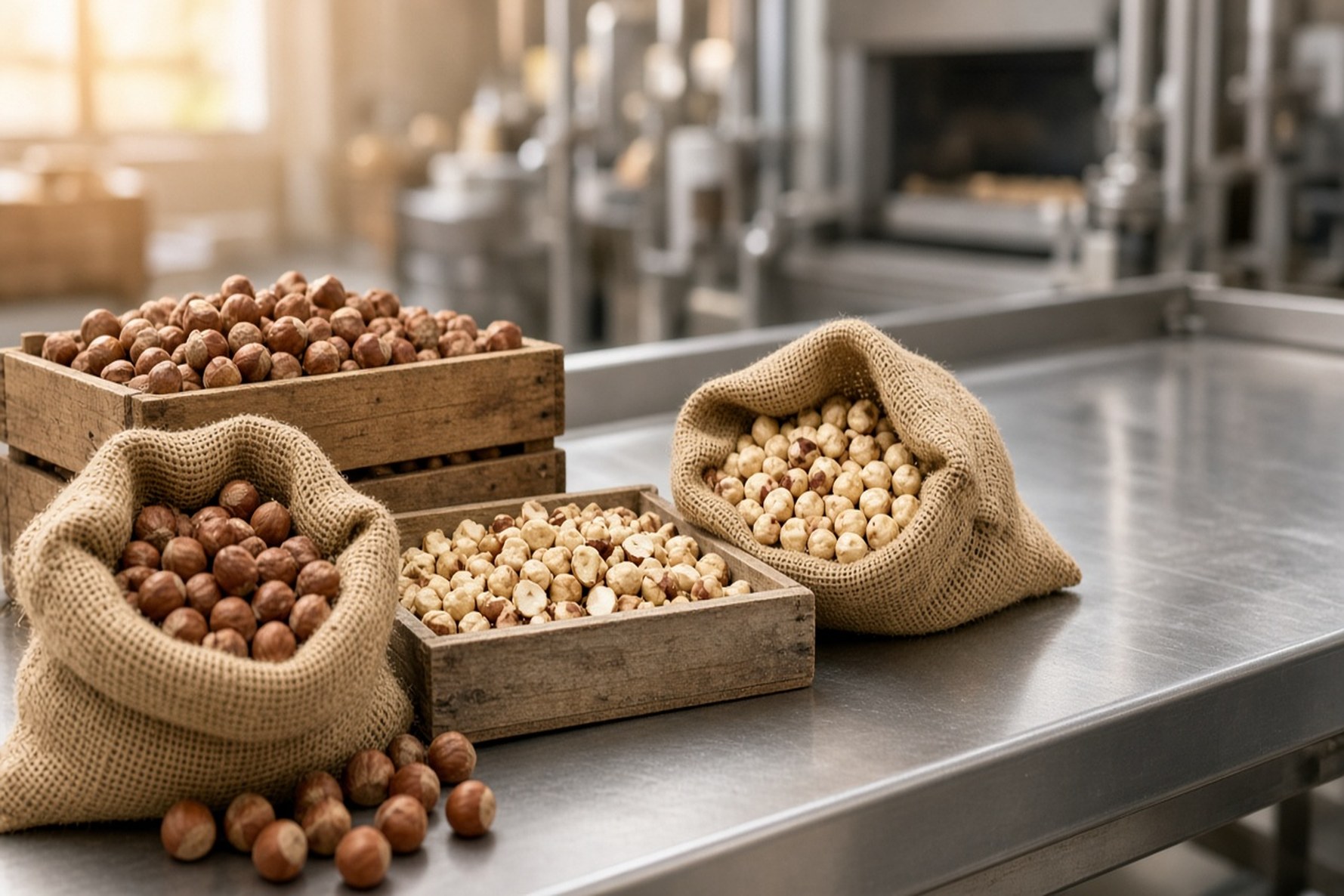
Most production is in northern Iran — especially Gilan (Ashkorat, Rahimabad, Rudsar and similar areas) and upland orchards. Supply in shell, raw kernels, roasted, chopped and industrial grades expands export options.
Successful export requires control from sourcing through drying, storage, sorting, shelling, testing, packing and transport. A non-uniform lot can cut price, trigger claims or end repeat business.
1. Iran hazelnuts in the world market
Turkey, Italy, the US, Georgia, Azerbaijan and Chile dominate global hazelnut trade. Iran should focus on real advantages: proximity to the Gulf, Iraq, Central Asia, Russia and some European routes; lower logistics cost regionally; and flexible product forms.
Industrial demand matters: chocolate, hazelnut spread, confectionery, biscuits, ice cream and bakery plants need kernels with stable specs and repeat supply — here consistency beats luxury appearance.
2. Export product forms
| Product form | Typical use | Key quality points |
|---|---|---|
| In shell | Dried nuts, mixed nuts, processors | Size, uniformity, shell soundness, empties, freshness, pests |
| Raw kernels | Chocolate, pastry, hazelnut cream | Size, breakage, colour, moisture, shrivelled/damaged kernels |
| Roasted kernels | Snacks and flavoured ingredients | Roast uniformity, aroma, taste, colour, skin removal |
| Chopped kernels | Ice cream, desserts, chocolate, bakery | Uniform chop size for the buyer’s line |
| Industrial grade | Grind, paste, powder | Internal soundness; retail look less critical |
3. Target markets
GCC (Persian Gulf)
Qatar, UAE, Oman, Kuwait and Bahrain demand quality dried nuts. Retail and hospitality care about appearance, uniform size, colour and professional packs; wholesalers and industry focus on price, quality stability and continuity of supply.
Qatar
A strong market for Iranian in-shell hazelnuts; food supply relies heavily on imports. Working with importers, nut wholesalers and retail suppliers — plus complete documents and regular delivery — supports long-term presence.
UAE
Consumption and regional redistribution hub; part of imports is repacked or consolidated for other destinations. Samples, precise specs, standard bulk packs and competitive pricing matter.
Iraq
Proximity, large food trade with Iran and economical transport; direct consumption and nut retail networks. Competitive price and fast delivery favour Iranian exporters.
Russia and Eurasia
Large market for nuts and confectionery inputs; strict quality, packaging, documents and hygiene. Kazakhstan, Armenia and neighbours support regional trade. Several lots with identical specs across a contract term are expected.
Europe
Italy, Germany, France and the Netherlands have high industrial use. Entry is specialist: aflatoxin, pesticide residues, traceability, uniformity and COA. Professional path: product to spec, tested sample, then gradual volume growth.
China and East Asia
Huge nut consumption; heavy competition from major origins. Needs defined channel and buyer, packaging or specialist importer — not price-only competition.
| Market | In shell | Raw / industrial kernel |
|---|---|---|
| GCC / Qatar | High | Medium–high |
| UAE (re-export) | High | High |
| Iraq | High | Medium |
| Russia / Eurasia | Medium | High |
| EU | Limited (strict QC) | High (industry) |
| China | Medium | Medium (needs differentiation) |
4. Who wholesale buyers are
| Buyer group | Product | Top criterion |
|---|---|---|
| Nut importers | In shell and kernels | Price, uniformity, supply stability |
| Wholesalers | In shell and kernels | Appearance, size, soundness |
| Chocolate factories | Kernels | Flavour, size, quality stability |
| Pastry / biscuits | Kernels and chopped | Price and processing spec |
| Repackers | Graded product | Appearance and uniformity |
| Retail chains | Consumer-ready | Label, pack, visual quality |
| Re-exporters | Bulk types | Price, packing, capacity |
5. Wholesale requirements and contract specs
“High-quality hazelnut” is not enough for a contract. Domestic terms like “grade one” or “premium” must become measurable indices — before contract or proforma.
| Parameter | Define in contract | Why it matters |
|---|---|---|
| Supply form | In shell / raw / roasted / chopped | Market fit |
| Size / sort | Calibre or mm band | Price and uniformity |
| Breakage | Max allowed % | Coated chocolate vs paste |
| Moisture | Numeric limit | Mould, shelf life |
| Aflatoxin | Per destination | EU clearance and strict markets |
| Foreign matter | Tolerance | Lot acceptance |
| Packaging | Material, net weight, pallet | Transport and traceability |
| Traceability | Batch / lot ID | Recall and industrial QC |
- Size uniformity; sort before packing
- Freshness; warehouse temperature, RH and holding time (natural fat)
- Sensory: no off-odour, rancidity, mould or oxidation
- Pesticide residues may be requested in professional markets
Approved sample is the quality reference — it must represent the actual shipment, not the best bag in the warehouse versus a weaker delivery.
6. Quality control and aflatoxin
Control starts after harvest with proper drying, dry storage and ventilation. Sorting out suspect kernels is part of the programme. Test the shipment at an accredited lab (ISO/IEC 17025 for strict destinations) before dispatch.
| Index | B1 | Total B1+B2+G1+G2 |
|---|---|---|
| Ready-to-eat food | 8 | 10 |
7. Samples, packaging and documents
Professional buyers do not place large orders from photos alone. With the sample: product type, origin region, harvest timing, size, sound kernels, breakage, packing, test results, available volume and lead time.
Packaging
In shell: moisture and impact protection. Kernels: multi-layer bags, limited oxygen exposure; pack weight matched to the buyer’s line. Retail: label, net weight, batch, origin, storage and destination language.
Typical documents
- Commercial invoice, packing list, certificate of origin, customs papers, bill of lading
- Health / phytosanitary certificates when required
- Lab COA, insurance, contract or PO
Tariff codes: 080221 hazelnuts in shell; 080222 kernels — verify national subheadings at destination.
8. Pricing and common exporter mistakes
Final price reflects quality, sorting, kernel yield (in shell), processing (dry, sort, shell, roast, chop, test), packaging, volume, freight and Incoterms.
- Bulk purchase without order spec
- Mixing grades to fill volume
- Shipping without adequate testing, weak packs, overstated capacity
- Quick quotes without breakage, tests and pack definition
9. Fourteen steps of Iran hazelnut export
- Select target market and identify buyers
- Obtain detailed product specification
- Source from reliable growers and centres
- Proper drying and storage
- Cleaning and sorting
- Required laboratory tests
- Prepare and send sample
- Buyer approves sample
- Negotiate price, volume and payment
- Choose packaging
- Commercial and health documents
- Customs clearance
- Ship the lot
- Follow up delivery and feedback
10. Warehousing, retail vs industrial, value added
Warehouse: low RH, ventilation, controlled temperature, away from strong odours, storage pests, pallets and off-floor storage. Retail buyers prioritise appearance, colour and low breakage; industry prioritises compositional stability, roastability, fat content, line size and cost.
Value added: professional sort, shelling, whole/broken split, roasting, blanching, chopping and industrial or consumer packs — each step only adds value when the buyer wants it.
11. Negotiation, proforma, trial order, transport and branding
Before talks: in shell or kernel? Raw or roasted? Size, allowed breakage, end use, initial and annual volume, packaging, destination, tests and delivery date.
Proforma: parties, exact goods description, net/gross weight, pack count, unit and total price, Incoterms, lead time, payment, offer validity, origin — plus agreed quality spec attached.
Trial order: checks match to sample, packing, documents, timing and responsiveness — bridge to recurring contracts. Pre-load control: weight, appearance, labels, batch, COA, sample match. Transport: road for neighbours, sea for volume, air for samples/high value; clean odour-free containers.
Export brand: stable quality, professional pack, transparent spec, regular delivery — trust beats spot price. Private-label packing (language, barcode, weight) deepens distributor relationships.
12. Traceability, harvest season and strategy
Each batch: source, intake/sort/pack dates, test results, shipment number, buyer, dispatch date. Planning before harvest avoids late buying and price spikes. Long-term contracts should fix spec, acceptable quality drift, delivery schedule, payment and dispute resolution upfront.
Sustainable strategy: trusted Gilan suppliers → inbound standard → market-based sort → buyer pipeline → regular samples → trial to recurring contract. Route each quality level to the right market to cut waste and raise total revenue.
Pre-loading checklist
- Market, buyer and end use defined
- Written spec and approved sample
- Full sort, moisture and sensory OK
- Tests done and COA ready
- Packing, labels, weight, batch and traceability
- Commercial documents and checked transport
Summary
Sustainable export means preparing product for the real destination need. The Gulf, Iraq and Eurasia offer regional opportunity; Europe is reachable with strong QC. The professional edge is delivering what was ordered — not the cheapest spot quote.
Sorted, tested, spec-defined hazelnuts can move from a local crop to a high-value food-industry ingredient.
Frequently asked questions
What are Iran’s main hazelnut target markets?
GCC (Qatar, UAE, Oman, Kuwait, Bahrain), Iraq and Eurasian markets are strong regional targets. Europe has high industrial capacity but stricter rules.
In shell or kernels?
Depends on channel: nut wholesalers often buy in shell; chocolate and bakery need kernels. Processed kernels add value but need tighter QC.
What do wholesale buyers check?
Size, uniformity, freshness, moisture, breakage, damage, aflatoxin, packaging, consistency between lots and traceability.
Is aflatoxin testing mandatory?
Yes — a key safety index for nuts; practically required before shipment to the EU and other strict markets.
Best export kernel packaging?
Moisture- and oxygen-resistant, matched to transit time and buyer spec; food-grade multi-layer for professional lots.
What drives export price?
Quality, size, uniformity, breakage, freshness, processing, packaging, volume and freight.
How to sell to industrial plants?
Technical spec, representative sample, COA, competitive price and steady supply — lot-to-lot stability beats marketing gloss.
Tree hazelnut vs pistachio “Fandoghi”?
This guide is Corylus hazelnut from northern Iran; “Fandoghi” is only a pistachio cultivar name — different HS codes, specs and markets.
Featured Products


Related Articles



