 Iranco Magazine Team
Real markets for Iranian fresh grapes, buyer quality specs, cold chain, export packing, standards and key transport points to destination
Export guide · Grapes · FFV-19 · Cold chain
Iran Grape Export: High-Demand Markets, Cold Chain and Export Packaging
Real markets for Iranian fresh grapes, buyer quality specs, cold chain, export packing, standards and transport to destination
Iran produced about 2.24 million tonnes of grapes in 2022 — over 3% of world output. Global fresh-grape trade reached roughly 5 million tonnes in 2024. Storage at -1 to 0 °C and 90–95% RH is central to export cold-chain design.
Introduction
Success or heavy losses are often decided after harvest: orchard heat, loading warm fruit without pre-cooling, or poor packs cause brown rachises, shatter, cracks, soft berries or grey mould. Takistan, Fars, Khorasan Razavi, Hamadan, Malayer and West Azerbaijan are key hubs. Professional buyers ask about cultivar, berry size, cluster weight, Brix, shatter, rachis condition, MRLs, pre-cooling and pack format — not price per kg alone.
1. Iran’s production regions
2022 data cite ~2.24 million tonnes and ~227,000 ha under vines. Export buying must follow load specifications, not province names alone.
2. Commercial cultivars
| Type | Trait | Market fit |
|---|---|---|
| White seedless | Easy eating, light colour | Retail & chains |
| Red seedless / Flame | Strong appearance | Modern retail |
| Yaghuti | Early, smaller berry | Nearby fast turnover |
| Askari / Shahrouyi | Regional recognition | Wholesale |
| Black grapes | Dark colour | Ethnic & niche retail |
3. Demand markets (2024)
| Market | Iran position | Note |
|---|---|---|
| Iraq | Major active market; high recorded share | Short haul / price & in-transit QC |
| Pakistan | Huge market, smaller Iran share | Road access / Afghanistan competition |
| Azerbaijan | Very strong in recorded imports | Proximity / limited market size |
| EU | Limited but high value potential | MRL, standards, supply chain |
4. Technical order specs
UNECE FFV-19 (2025) cites 16° Brix as a general ripeness benchmark, with defined sugar:acid ratios below that. Ripening must be completed before harvest. Contract fields must cover cultivar, seedless/seeded, Brix, berry size, cluster weight, shatter, rachis freshness, MRLs and delivery temperature.
5. QC, standards & documents
Measure quality before loading. FFV-19 sets a 75 g minimum cluster weight for relevant classes. MRL programmes start in the vineyard. Botrytis grey mould remains active near 0 °C. Fresh grapes: HS 080610 — do not mix with dried grapes on documents.
6. Cold chain after harvest
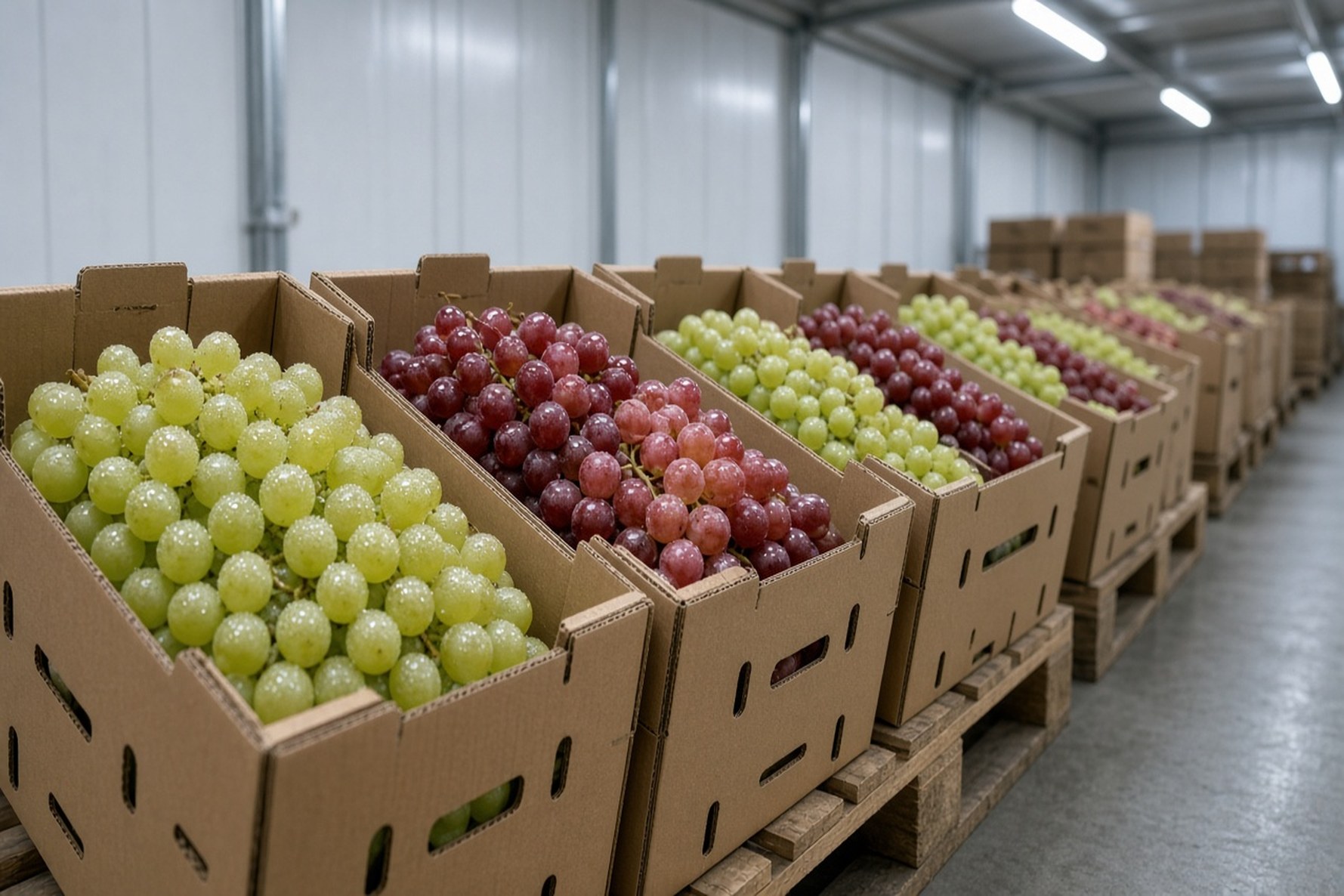
A refrigerated truck does not pre-cool warm fruit. Pre-cool to core temperature, load cold, log temperatures, avoid freezing injury (berry freezing point near -2.7 to -3 °C).
7. Export packaging
Ventilated multi-kg cartons for wholesale; 250 g and 500 g consumer packs in master cartons for chains. Avoid over-packing that blocks cold air or crushes clusters.
8–9. Transport, pricing & competition
Road haulage suits Iraq, Azerbaijan and Pakistan when pre-cooling and data loggers are used. Price follows cultivar, Brix, sorting, pack, tests, volume, season and delivery point — compare quotes only with identical specs.
10. Importer checklist & Iranco
Define cultivar, Brix, defects, pack weights, pre-cool plan, MRL testing, phytosanitary docs and rejection rules before loading. Iranco helps match Iranian suppliers when destination, volume, quality and pack format are clear from the first RFQ.
FAQ
Best grape for export?
Depends on destination — modern retail favours uniform seedless and consumer packs.
Transport temperature?
-1 to 0°C, 90–95% RH; pre-cool before loading.
Main destinations?
2024 trade data highlight Iraq, Pakistan and Azerbaijan; EU volumes also recorded.
HS code?
Fresh grapes: 080610.
Featured Products




Related Articles



