 Iranco Magazine Team
Registered destinations, Italy’s role, buyer quality criteria, cold chain, packaging and actual vs potential markets
Market Report · Fresh Mushroom · Export
Real Buyer Markets for Iranian Fresh Mushroom: What Does Foreign Trade Data Say?
Analysis of Iran's registered fresh mushroom destinations, Italy's unexpected position, buyer quality criteria, cold chain, packaging and the difference between actual and potential markets.
2024 data shows Italy registered roughly 200,000 kg of imports under code 070951 with Iranian origin — one of the most significant recorded destinations. In the same year, Bulgaria, Kuwait, Germany, France, Croatia, Bahrain and Spain also reported imports from Iran.
Fresh mushroom export analysis cannot rely on geographic distance alone. Trade data confirms regional markets, but the fuller picture shows several European countries with notable registered imports from Iran, with Italy as the standout example.
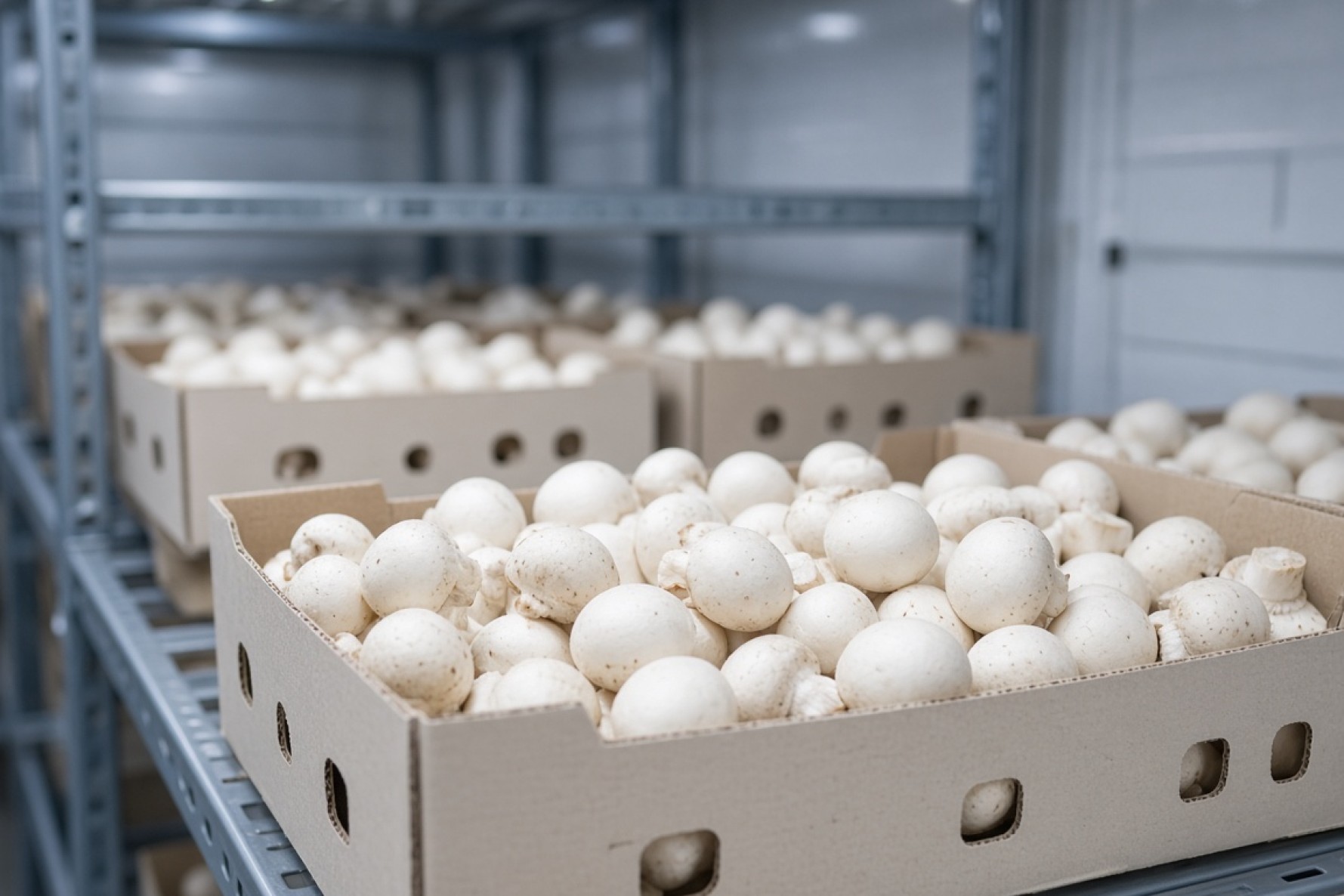
Fresh mushrooms are highly perishable: high respiration rate, sensitivity to temperature rise, rapid loss of whiteness, cap opening, softening and shelf-life reduction. For procurement managers, cap size, uniformity, colour, cap closure, surface dryness, firmness, loading temperature, packaging type and remaining shelf life must be defined before pricing.
1. What does foreign trade data actually say about Iran's mushroom market?
An "export market" is not a country that could theoretically buy mushrooms — it is a country that has registered inbound trade from Iran in its import statistics. For fresh or chilled Agaricus mushrooms, the primary six-digit code is HS 070951.
| Market | Volume from Iran | Registered value | Takeaway |
|---|---|---|---|
| Italy | 200,328 kg | ~$11.6 million | Significant actual European market |
| Bulgaria | 25,803 kg | ~$1.27 million | EU market with registered flow |
| Kuwait | 246,554 kg* | ~$0.71 million | Actual regional market |
| Germany | 3,366 kg | ~$0.39 million | Smaller but registered flow |
| France | 11,518 kg | ~$0.32 million | Registered European presence |
| Croatia | 7,160 kg | ~$0.24 million | Smaller actual market |
| Bahrain | 40,029 kg | ~$0.19 million | Regional destination suited to fast transit |
| Spain | 1,215 kg | ~$0.19 million | Limited flow |
*Reported values may be revised in statistical database updates.
Dividing trade value by weight is not a reliable method for "Iran mushroom price". Contract price must be derived from technical specifications, pack type, delivery route and commercial terms of that specific deal.
2. Why does Italy matter in the data?
In 2024 Italy registered roughly 30.7 million kg of global imports under code 070951 worth nearly $151 million. Iran appeared on Italy's list of registered suppliers; 2023 data shows ~156,000 kg from Iran worth nearly $12 million.
Non-EU sellers face at least three challenges: arrival quality must compete with European options; the cold chain must hold from harvest to delivery; product specs, labelling, food safety and entry documentation must meet EU requirements.
3. Actual vs potential markets
| Market type | Key indicator | Entry risk | Analysis priority |
|---|---|---|---|
| Established actual | Multi-year import flow | Relatively lower | Maintain quality, repeat orders |
| Small actual | Registered but limited imports | Medium | Assess buyer, growth potential |
| Near potential | Demand exists, short route | Medium | Market test and logistics |
| Distant potential | Large imports, weak Iran presence | High | Study cold chain and regulations |
| Theoretical | Attractive only by population/income | Very high | Insufficient for export decisions |
4. What does a professional fresh mushroom buyer actually purchase?
Real quality is built from appearance, physical and post-harvest indicators: cap diameter (mm range with tolerance), whiteness or colour, cap closure, surface dryness, texture firmness, loading temperature, pack type and remaining shelf life.
| Parameter | Order entry | Importance |
|---|---|---|
| Species | Agaricus bisporus | Product and tariff alignment |
| Cap diameter | Defined mm range | Uniformity and sales channel |
| Maturity stage | Closed, semi-open or agreed | Shelf life |
| Loading temperature | Specific number | Cold chain control |
| Pack type | Tray, tub, film or bulk | Ventilation and retail |
| Expected shelf life | Based on route and storage | Waste management |
5. Quality standards: from acceptable appearance to export lot
UNECE FFV-24 for cultivated mushrooms is a recognised technical reference. Value is created when acceptance criteria become measurable parameters.
- Browning, spots, excessive cap opening, visible gills when closed grade ordered
- Softness, bruising, stem or cap breakage
- Free water in pack, shrivelling, off-odour, severe size non-uniformity
6. Cold chain: the decisive factor in fresh mushroom trade
UC post-harvest guidance recommends ~0–1.5°C and 95–98% RH. Typical shelf life at ~1.5°C is 5–7 days; at 4.5°C it is much shorter. Product temperature must be measured directly — not inferred from air temperature alone.
7. Fresh mushroom packaging
| Method | Advantage | Risk | Best use |
|---|---|---|---|
| Perforated film tray | Simple, visible | Limited protection on long routes | Near markets |
| Ventilated lidded tub | Better mechanical protection | Higher cost | Retail |
| Designed MAP pack | Better quality retention | Sensitive to design and temperature | Planned routes |
| Ventilated bulk pack | Lower pack cost | Higher mechanical pressure | Food service |
8. EU market regulations
EU entry requires food safety, traceability, pesticide residues, contaminants, packaging and labelling in the procurement plan. General marketing rules apply under delegated regulation 2023/2429; contaminant limits under 2023/915.
9. Regional markets
Iraq, Kuwait, Bahrain and nearby countries offer significant logistics advantages. Shorter land or air routes can extend remaining shelf life, reduce temperature risk and lower packaging complexity requirements.
10. How to select a real target market
| Factor | Decision question |
|---|---|
| Trade history | Has inbound trade from Iran been registered? |
| Total import volume | How large is the market really? |
| Cold chain | Can product temperature be controlled throughout? |
| Grade | What size, colour and maturity is purchased? |
| Repeatability | Can the supplier repeat quality weekly? |
11. How to compare export mushroom prices
Price without technical specs has little analytical value. A higher quote with younger, pre-cooled, uniform product may deliver more sellable kg at destination. Customs statistics should not be used as "daily export mushroom price".
Importer pre-order checklist
- Specify species — Agaricus bisporus for button mushroom.
- Define colour, cap diameter range and maturity stage.
- Obtain pre-contract sample; write defect tolerances.
- Include loading temperature, container type and net pack weight in contract.
- Plan destination food safety tests before harvest.
- Define destination acceptance criteria and temperature logging method.
- Assess continuous supply capacity separately from sample shipment ability.
- Define delivery terms and carriage responsibility precisely.
12. From supplier selection to delivery
Good sample production is not the same as regular export execution. Evaluation stages: production (capacity, cold store, grading), sample test in actual pack, transit test and definition of remaining sellable shelf life at delivery.
13. Sourcing fresh mushroom from Iran to buyer specifications
Iranco enables buyers to submit purchase requests based on species, size, expected quality, pack weight, order volume and destination country so available Iranian supply options are reviewed against real buyer needs.
Summary
Iran's real fresh mushroom market cannot be guessed from a map. Trade data shows European countries alongside regional destinations have registered purchases from Iran. Sustainable export advantage lies in delivering uniform product with sufficient shelf life — not production alone.
FAQ
Does Italy really import fresh mushrooms from Iran?
Yes. Italy's foreign trade data for code 070951 shows imports with Iranian origin in multiple years. In 2024 roughly 200,000 kg from Iran was registered.
What is the tariff code for fresh button mushroom?
Fresh or chilled Agaricus mushrooms use six-digit HS code 070951.
What is the best storage temperature for fresh mushrooms?
For fresh button mushrooms, approximately 0–1.5°C with ~95–98% RH is recommended post-harvest.
Is MAP packaging essential for mushroom export?
Not on all routes. For near markets, ventilated packs with a strong cold chain are often simpler and more reliable.
What is Iran's export mushroom price?
Without species, size, grade, pack type, order volume, transport mode and delivery point, a comparable price cannot be stated.
Featured Products
Related Articles



